Past Questions
Aureons BIO 101 EXAM PQ&A - Studentsdash
View and download Aureons BIO 101 EXAM PQ&A - Studentsdash
Free

View and download Aureons BIO 101 EXAM PQ&A - Studentsdash
A solid foundation in biology is essential for success in your first year at EBSU. At Studentsdash, we provide accurate and up-to-date course outlines to help freshers organize their studies and excel academically. Below is the detailed BIO 101 (General Biology) course outline for 100L students: BIO 101: General Biology Concept of LifeActivities of Living ThingsThe CellSpermatophytes / CryptogramsMeade’s Work & Plant Breeding, Chromosomes & InheritanceAquatic Habitat (Ecology)ClassificationVariation (Interrelationship of Organisms)Habitat Why This Outline Matters: Following this course outline helps you focus on key topics and organize your study schedule effectively.Studentsdash ensures that any updates or changes to the course outline are reflected here immediately so you always have the most current information.A structured outline allows you to prepare thoroughly for lectures, laboratory sessions, assignments, and examinations. Need More Help? If you require course outlines for other subjects, Studentsdash can provide them promptly.For guidance, clarification on topics, or academic support, our team is always available to assist you. Stay Connected with Studentsdash: WhatsApp: 07075012541Telegram: t.me/studentsdashApp: studentsdash.com/app Studentsdash is dedicated to equipping EBSU students with the resources and guidance they need to succeed academically. Keep this post for reference and check back for updates or additional course outlines.
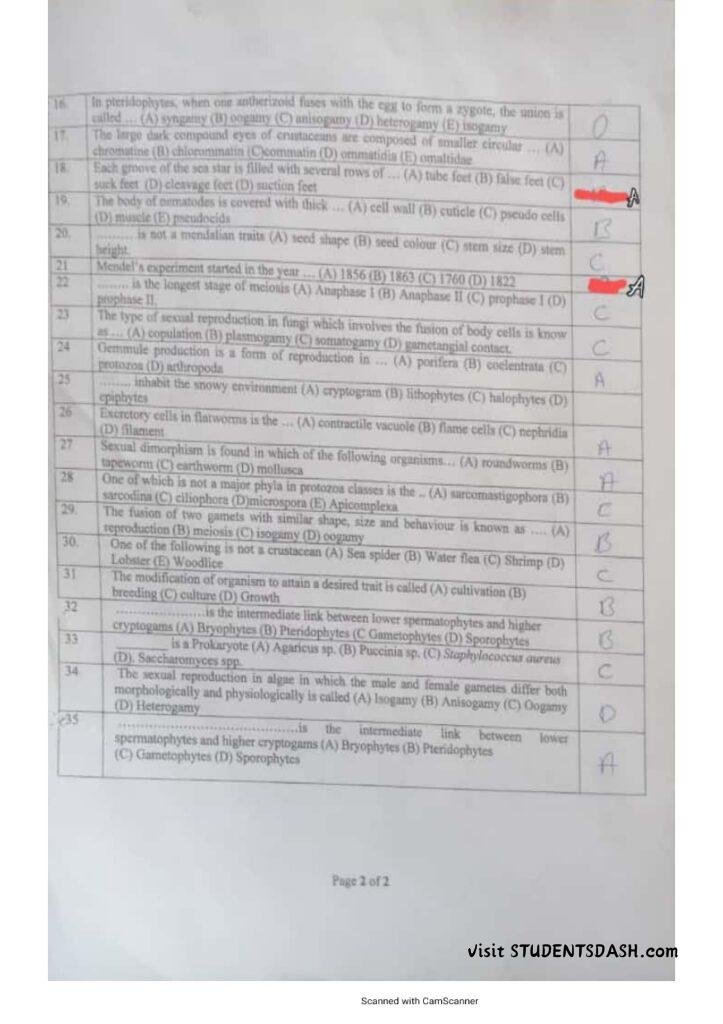
Title: BIO 101 PAST QUESTIONS AND ANSWERS URL: https://studentsdash.com/bio-101-past-questions-and-answers/ -------------------------------------------------- Hey, as you may know the Ebonyi State University(Ebsu) year one exam is CBT BASED which means it will be written with computer, and today we will be drop only 11 Past Questions here to practice more use our STUDENTSDASH Practice code to Practice more on STUDENTSDASH APP . BIO 101 PAST QUESTIONS 1.calyx and ____are the non essential part of flower Answer Agaricussp. Another name for spermatophytes is________ Answer Seed plants The site of gene location __ Answer: Locus __ is the unit of heredity Answer Gene Sweating helps in temperature regulation by Answer: cooling the body 6. _ is a group lower green plant with vascular bundles Answer: Pteridophytes Morphological variation is also known as variation __ Answer: continuous The major photosynthesis pigment found in all algae is _ Answer:chlorophyll a The female part of flower is_____ Answer: Gynoecium _ is the boiling point of adenine Answer: 591.4oC Which of the following is not a characteristic of living things Answer: crystallisation The organelles responsible for energy production Answer: Mitochondrial 13 the chemical formula for cytosine Answer: C4H5N30 Which of the following is unicellular green algae Answer :chlamydomonas Red algae store food mainly in the form of _ Answer:Floridean starch The ability of an organism to maintain constant internal environment is called __ Answer:Homeostasis The following are the methods of plant breeding except _ Answer : cutting method The mature sex cell that can take part in sexual reproduction is __ Answer: Gamete The following are asexual reproduction except Answer: conjugation The location of a chromosome in the cell____ Answer: Nucleus MORE 1: Water exist the body of Sponges through Ostium Chonanocytes Osculum Pinacoderm ANS – Osculum 2: Platyhelminthes possess the following except Triplobastic body Exoskeleton Digestive system Mouth ANS – Exoskeleton 3- Nematodes are parasites of both plants and animals Yes No ANS – YES 4- Types of viruses based on shapes are (1) Helical (2) Polyhadel (3) Enveloped (4) Complex (1,2,3,4) (1,2,3 only) (1,2,4) 1,3 and 4 only) ANS – 1,3 and 4 only) 5- Viruses can be controlled using the following except Vaccines Antibodies Interferons Prophages ANS – Prophages 6- The major types of body structure is sponges include the following except Oscunoid Asconoid Syconoid Leuconoid ANS –Oscunoid 7- Examples of Ciliophora are the following except Opalina Paramecium Balantidum Euglena ANS – Euglena 8- The division of plants that is made up of mostly primitive plants is Bryophytes Thallophytes Pteridophytes Spermatophytes Schizophytes ANS – Pteridophytess 9- Schyzophyte is a kind of bacteria that resembles every other plants in the plant kingdom by possessing Chitinous cell wall Membranous cell wall Cellulose cell wall Chloroplasts None of the above ANS – Cellulose cell wall 10- The mode of nutrition in which organisms absorb nutrients in a soluble form is called Autotrophic Mixotrophic Osmotrophic Holozoic Saprophytic ANS – Osmotrophic 11- Which of the division of plants are used as surgical dressing? Thallophytes Bryophytes Pteridophytes Spermatophytes Angiospgrm ANS – Bryophytes 12- Streptomycin is obtained from Streptomyces rimosus Streptomyces griseus Aureomycin Streptomyces aureofaciens ANS – Streptomyces griseus 13- Cryptogams reproduce by Spores Seeds Root Fruit ANS – Spores 14 ——-type of photosynthesis is found in photoautotrophic bacteria Anoxygenic photosynthesis Toxygenic photosynthesis Autotrophic photosynthesis Heterotrophic ANS – Anoxygenic photosynthesis 15- The function of plasmodesmata is? Protection of the plasma membrane selectively permeable Allow communication between cells Osmoreguintion Photosynthesis ANS – Allow communication between cells 16- In plants, co-ordination is achieved by? Nervous system and endocrine system Nervous system and plant hormones Endocrine system and phytohormones Plant hormone and Phytohormones ANS – Plant hormone and Phytohormones 17 – In plants, assimilation include processes such as Photosynthesis Nitrogen fixation Absorption of nutrients from the soil All of the above None of the above ANS – All of the above 18 __ organelle is associated with secretory activity of the cell Ribosome Mitochondria Endoplasmic Reticulum Golgi apparatus Plastids ANS – Golgi apparatus 19- Leucoplasts are predominant in———–? Brightly coloured flowers Brightly coloured leaves Storage organs Reproductive organs Petals ANS – Storage organs 20- The functions of microtubules and microfilaments are Absorption and circulation of nutrients Structural support, flexibility, and shape of the cell Protection and selective permeability Regulation of metabolic activities Storage and excretion of waste products 21- is the simplest, smallest, and most successful micro-organism Bacterium Virus Fungus Protozoa 22 ———–is a practical means of accelerating success in plant breeding and improving economically important crops Hybridization Induced mutation Tissues culture Artificial selection ANS – Tissues culture 23- Example of traits being influenced by no trace of environment is Sun tanned skin Behaviour Blood group Height ANS – Blood group 24- Species of the phyla below serve as food for other animals except Mollusca Arthropoda Echinodermata Platyhelminthes Cnideria 25- Molluscs have a muscular foot called Muscular tube Mantle Muscular mast Mass Mast foot 26- Echinoderms possess a Shiny face Spiky surface Smooth surface Spiny surface Shiny surface ANS – Spiny surface 27- The following are parasites of humans and animals except Taenia Trichuris Dugesio Fasciola Schistosoma 28- The photoautotrophic bacteria possess photosynthetic pigments in Nucleus Thylakoid Chlorophyll Lysosome ANS – Thylakoid 29- The fungi which produce their spores in a small cup-shaped sac belong to the phylum Glomeromycota Zygomycota Basidiomycota Ascomvcota ANS – Ascomvcota 30 ——– is the type of sexual reproduction which both gametes are motile but the male gamete is more active and smaller isogamy Anisogamy Oogamy Heterogamy ANS – Anisogamy 31- A group of algae found on stones and rocky surfaces are called Mesophytes Matophytes Xerophytes Lithophytes ANS – Xerophytes 32- The use of a single cell to produce a full organism in a cell culture is called Totipotanty Somatogamy Hybridization ANS – Somatogamy 33- Land snail belongs to which class Gastropoda Petecypoda Scaphopoda Polyplacophora ANS – Gastropoda 34- Tube feet is a characteristic feature of Nematode Echinoderms Arthropods mollusc ANS – Echinoderms 35- Binomial nomenclature as a system of assigning two names to an organism originated from which of these scientists Carolus Linnaeus Charles Darwin Jean Baptiste Lamarck Alfred Wallace ANS – Carolus Linnaeus VIEW MORE
Title: EBSU-BIO 101 Past Questions and Answers URL: https://studentsdash.com/ebsu-bio-101-past-questions-and-answers/ -------------------------------------------------- Which of the following is the basic unit of life? a) Tissue b) Organ c) Cell d) Organism Answer: c) Cell What is the primary function of ribosomes in a cell? a) Energy production b) Protein synthesis c) DNA replication d) Lipid storage Answer: b) Protein synthesis Which process do plants use to convert sunlight into chemical energy? a) Cellular respiration b) Photosynthesis c) Fermentation d) Glycolysis Answer: b) Photosynthesis What type of bond holds the two strands of DNA together? a) Ionic bonds b) Covalent bonds c) Hydrogen bonds d) Metallic bonds Answer: c) Hydrogen bonds In the context of genetics, what does the term “phenotype” refer to? a) The genetic makeup of an organism b) The physical appearance of an organism c) The number of chromosomes d) The evolutionary history of an organism Answer: b) The physical appearance of an organism Which of the following is NOT a characteristic of living organisms? a) Growth b) Metabolism c) Reproduction d) Inertia Answer: d) Inertia What is the function of the cell membrane? a) Energy production b) Protection against pathogens c) Regulation of entry and exit of substances d) Storage of genetic information Answer: c) Regulation of entry and exit of substances Which macromolecule is primarily responsible for storing and transmitting genetic information? a) Proteins b) Carbohydrates c) Lipids d) Nucleic acids Answer: d) Nucleic acids What is the role of enzymes in biological reactions? a) They increase the temperature of the reaction. b) They slow down the reaction rate. c) They lower the activation energy needed for the reaction. d) They change the products of the reaction. Answer: c) They lower the activation energy needed for the reaction. Which organelle is known as the powerhouse of the cell? a) Nucleus b) Golgi apparatus c) Mitochondria d) Endoplasmic reticulum Answer: c) Mitochondria What is the main component of the cell wall in plants? a) Protein b) Lipid c) Cellulose d) Nucleic acid Answer: c) Cellulose Which organelle is responsible for photosynthesis? a) Chloroplast b) Mitochondria c) Ribosome d) Nucleus Answer: a) Chloroplast Which of the following processes occurs in the mitochondria? a) Photosynthesis b) Glycolysis c) Krebs cycle d) Protein synthesis Answer: c) Krebs cycle The primary structure of proteins is determined by which of the following? a) Hydrogen bonds b) Peptide bonds c) Ionic bonds d) Disulfide bridges Answer: b) Peptide bonds What is the role of chlorophyll in plants? a) Absorbs water b) Absorbs light energy c) Stores carbohydrates d) Synthesizes proteins Answer: b) Absorbs light energy Which of the following is a type of RNA that carries amino acids to the ribosome? a) mRNA b) tRNA c) rRNA d) sRNA Answer: b) tRNA What is the term for a group of similar cells that perform a specific function? a) Organ b) Tissue c) Organ system d) Organism Answer: b) Tissue Which of the following is a function of the cytoskeleton? a) Energy production b) Structural support c) Protein synthesis d) DNA replication Answer: b) Structural support What is the primary function of the Golgi apparatus? a) DNA synthesis b) Modifying and packaging proteins c) Lipid synthesis d) Energy production Answer: b) Modifying and packaging proteins Which type of cell division produces gametes? a) Mitosis b) Binary fission c) Meiosis d) Budding Answer: c) Meiosis What structure in plant cells allows for turgor pressure? a) Cell membrane b) Cytoplasm c) Cell wall d) Chloroplast Answer: c) Cell wall Which of the following is a prokaryotic organism? a) Fungi b) Bacteria c) Plants d) Animals Answer: b) Bacteria What is the main purpose of cellular respiration? a) To produce glucose b) To convert energy stored in food into usable energy c) To synthesize proteins d) To remove waste products Answer: b) To convert energy stored in food into usable energy What is the liquid portion of the cell that contains organelles? a) Cytoplasm b) Nucleoplasm c) Plasma d) Protoplasm Answer: a) Cytoplasm Which of the following is a characteristic of enzymes? a) They are consumed in the reaction. b) They are specific to their substrates. c) They increase the activation energy. d) They function at all temperatures. Answer: b) They are specific to their substrates. What is the role of the nucleolus in a cell? a) DNA replication b) Ribosome production c) Protein synthesis d) Energy production Answer: b) Ribosome production Which type of macromolecule are enzymes classified as? a) Nucleic acids b) Carbohydrates c) Lipids d) Proteins Answer: d) Proteins What process describes the movement of water across a semi-permeable membrane? a) Active transport b) Osmosis c) Diffusion d) Filtration Answer: b) Osmosis Which part of the neuron receives signals? a) Axon b) Dendrites c) Soma d) Synapse Answer: b) Dendrites Which of the following organelles is involved in the synthesis of lipids? a) Ribosome b) Smooth endoplasmic reticulum c) Golgi apparatus d) Rough endoplasmic reticulum Answer: b) Smooth endoplasmic reticulum What is the function of the lysosome? a) Energy production b) Digestion of macromolecules c) Protein synthesis d) DNA replication Answer: b) Digestion of macromolecules Which of the following is a product of glycolysis? a) Oxygen b) Carbon dioxide c) Pyruvate d) Glucose Answer: c) Pyruvate In which part of the cell does transcription occur? a) Cytoplasm b) Nucleus c) Ribosome d) Mitochondria Answer: b) Nucleus What is the primary role of the rough endoplasmic reticulum? a) Lipid synthesis b) Protein synthesis c) Carbohydrate metabolism d) Energy production Answer: b) Protein synthesis Which organ system is primarily responsible for transporting nutrients and gases? a) Digestive system b) Respiratory system c) Circulatory system d) Nervous system Answer: c) Circulatory system What is the basic structural and functional unit of life? a) Tissue b) Cell c) Organ d) Organism Answer: b) Cell Which process is used by cells to expel waste materials? a) Endocytosis b) Exocytosis c) Osmosis d) Diffusion Answer: b) Exocytosis Which component of the cell is selectively permeable? a) Cytoplasm b) Cell wall c) Cell membrane d) Nucleus Answer: c) Cell membrane Which organelle is responsible for detoxifying harmful substances? a) Ribosome b) Smooth endoplasmic reticulum c) Golgi apparatus d) Mitochondria Answer: b) Smooth endoplasmic reticulum What is the primary energy carrier in cells? a) Glucose b) ATP c) ADP d) NADH Answer: b) ATP Which of the following is a function of the skeletal system? a) Producing hormones b) Protecting vital organs c) Transporting nutrients d) Regulating temperature Answer: b) Protecting vital organs What is the main purpose of the integumentary system? a) To support the body b) To protect against pathogens c) To facilitate movement d) To control body functions Answer: b) To protect against pathogens Which phase of the cell cycle involves DNA replication? a) G1 phase b) S phase c) G2 phase d) M phase Answer: b) S phase Which of the following structures is found in prokaryotic cells? a) Nucleus b) Mitochondria c) Ribosomes d) Endoplasmic reticulum Answer: c) Ribosomes Which component of the cell is responsible for energy production? a) Ribosomes b) Mitochondria c) Golgi apparatus d) Nucleus Answer: b) Mitochondria What type of macromolecule are enzymes? a) Nucleic acids b) Carbohydrates c) Proteins d) Lipids Answer: c) Proteins Which of the following is a characteristic of eukaryotic cells? a) Lack of nucleus b) Membrane-bound organelles c) Circular DNA d) Unicellular only Answer: b) Membrane-bound organelles What is the function of the pancreas in the digestive system? a) Producing bile b) Absorbing nutrients c) Producing digestive enzymes d) Storing glycogen Answer: c) Producing digestive enzymes Which type of transport does NOT require energy? a) Active transport b) Passive transport c) Endocytosis d) Exocytosis Answer: b) Passive transport What is the term for the variety of life in the world or in a particular habitat? a) Population b) Community c) Biodiversity d) Ecosystem Answer: c) Biodiversity