Studentsdash
New Search

Results for "Law"

75 found

Matched Resources

75 total results
Past Questions

MAC 302 Past Questions and Answers 2024

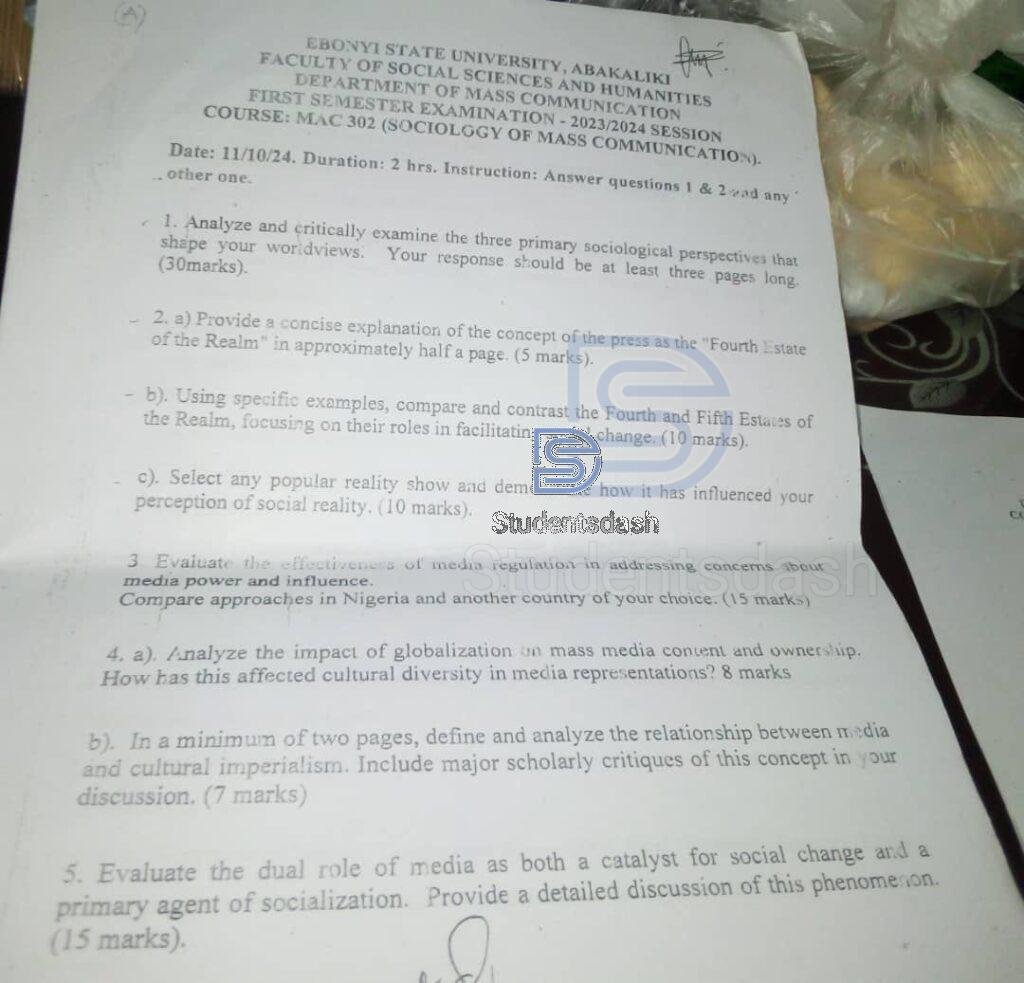
Title: MAC 302 Past Questions and Answers 2024 URL: https://studentsdash.com/mac-302-past-questions-and-answers-2024/ -------------------------------------------------- 1. Analyze and critically examine the three primary sociological perspectives that shape your worldviews. (30 marks). In sociology, there are three main perspectives that help us understand society and human behavior. These are Functionalism, Conflict Theory, and Symbolic Interactionism. Each one explains the society in a different way and they also shape the way I look at life. Functionalism Perspective: Functionalism sees society as a system made up of different parts that work together to keep society stable. Just like the human body has organs that perform different roles, society has institutions like family, school, government, religion, and economy that perform special roles. For example, the family raises children, schools teach knowledge, religion gives morals, and government enforces laws. This perspective makes me appreciate order and unity. It makes me believe that everyone has a role to play in society, no matter how small. However, its weakness is that it sometimes ignores inequality and poverty. It can claim that everything has a function, even suffering, which is not always fair. Conflict Perspective: Conflict theory, from Karl Marx, sees society as a place of struggle. People and groups fight for power, money, and resources. For example, in Nigeria, politicians enjoy wealth while ordinary people suffer poverty. This shows inequality. The media, schools, and even religion can sometimes support the powerful. This perspective shapes my worldview by making me question fairness in society. It shows me that social change comes when people fight injustice. For example, the #EndSARS protest showed young people fighting against police brutality. The weakness of this theory is that it sometimes makes it look like everything is conflict, ignoring peaceful cooperation. Symbolic Interactionism Perspective: Symbolic interactionism looks at daily life and small interactions between people. It explains how we give meaning to words, symbols, and gestures. For example, a handshake can mean respect, agreement, or friendship. Clothes, language, and emojis on WhatsApp also carry meaning. This shapes my worldview by making me value communication. It helps me see how people can misunderstand each other when they interpret symbols differently. The weakness is that it focuses too much on small interactions and sometimes ignores bigger issues like politics and economy. Conclusion: When I put all three perspectives together, I understand society better. Functionalism teaches me about order, conflict theory teaches me about injustice and change, while symbolic interactionism teaches me about communication and meaning. They shape how I view the world and guide how I interact with people every day. 2. a) Provide a concise explanation of the concept of the press as the “Fourth Estate of the Realm” in approximately half a page. (5 marks). The press is called the “Fourth Estate of the Realm” because it plays a powerful role in society, just like the three main arms of government — the executive, legislature, and judiciary. The press acts as a watchdog over those in power. It informs the public, exposes corruption, and holds leaders accountable. For example, newspapers, television, and online media report government actions, criticize wrong policies, and give citizens a voice. The press shapes opinions and can bring about social change. That is why it is called the Fourth Estate — it balances power and protects democracy. 2. b) Using specific examples, compare and contrast the Fourth and Fifth Estates of the Realm, focusing on their roles in facilitating social change. (10 marks). The Fourth Estate refers to the traditional press such as newspapers, radio, and television, while the Fifth Estate refers to digital media, especially social media platforms like Twitter (X), Facebook, blogs, and YouTube. Both estates promote social change, but they do so in different ways. The Fourth Estate uses professional journalism. For example, The Guardian Newspaper or Channels TV can expose corruption or poor governance. The Fifth Estate uses ordinary citizens who share news, campaigns, and opinions online. For example, during the #EndSARS protest, Twitter and Facebook played a big role in mobilizing youths and spreading information. The Fourth Estate is more structured, regulated, and trusted for accuracy, while the Fifth Estate is more flexible, fast, and interactive. However, the Fifth Estate can also spread misinformation quickly. Together, both estates influence society and contribute to social change. 2. c) Select any popular reality show and demonstrate how it has influenced your perception of social reality. (10 marks). A popular reality show I can use is Big Brother Naija (BBNaija). This show brings different people from various backgrounds to live together in one house, competing for money and fame. The show has influenced my perception of social reality in many ways. It shows me how people from different tribes and lifestyles can live together. It also reflects real issues like love, friendship, betrayal, and competition, which happen in everyday life. However, it has also influenced me to see how society celebrates fame and money. Some people believe BBNaija promotes immorality, while others see it as entertainment and an opportunity for success. For me, it shows both the positive and negative sides of modern Nigerian society. 3. Evaluate the effectiveness of media regulation in addressing concerns about media power and influence. Compare approaches in Nigeria and another country of your choice. (15 marks). Media regulation means the laws, policies, and guidelines that control how the media operates. It ensures that the media does not abuse its power and influence. In Nigeria, media regulation is done by bodies like the National Broadcasting Commission (NBC) and Nigerian Press Council. These agencies monitor content on TV, radio, and newspapers. For example, NBC sometimes fines TV stations for showing offensive content or hate speech. However, in practice, media regulation in Nigeria is sometimes weak and influenced by politics. Some government leaders use regulation to silence critics instead of protecting the public. In contrast, in a country like the United States, media regulation is done by the Federal Communications Commission (FCC). The FCC regulates radio, TV, and internet services. Unlike Nigeria, where politics interferes a lot, the US system gives more freedom to the press, although there are still rules about obscenity, copyright, and fake news. When I compare both, I see that Nigeria struggles with press freedom because regulation is often misused, while countries like the US focus more on protecting both the public and freedom of expression. This shows that regulation is effective only when it is fair and not used for oppression. 4. a) Analyze the impact of globalization on mass media content and ownership. How has this affected cultural diversity in media representations? (8 marks). Globalization has made the world more connected through technology, internet, and international trade. In mass media, globalization has changed both content and ownership. Big international companies like CNN, BBC, and Netflix now dominate the media space, meaning that Western culture spreads widely. Nigerian youths now consume American music, movies, and fashion more than local culture. This has reduced cultural diversity because many local traditions and languages are not represented enough. For example, Nollywood films sometimes copy Hollywood styles instead of promoting Nigerian culture. At the same time, globalization also gives Nigeria a chance to show its culture to the world, like how Afrobeats music became popular globally. So globalization has both positive and negative impacts — it promotes exchange of ideas but also risks erasing smaller cultures. 4. b) In a minimum of two pages, define and analyze the relationship between media and cultural imperialism. Include major scholarly critiques of this concept in your discussion. (7 marks). Cultural imperialism means the domination of one culture over another, often through media. It happens when powerful countries like the US use their movies, music, fashion, and news to influence weaker countries. The media plays a big role in this because TV, films, and the internet spread Western culture everywhere. For example, Nigerian children grow up watching Disney and Hollywood movies instead of local folktales. American celebrities influence fashion and lifestyle more than African leaders or stars. Scholars like Herbert Schiller argue that cultural imperialism makes developing countries lose their identity. It creates dependency because people consume foreign content more than their own. However, critics say cultural imperialism is not total. People in weaker countries also adapt and reshape foreign culture to fit their local needs. For example, Nigerians took hip-hop and turned it into Afro-hip-hop with local flavor. Nollywood films also mix Western styles with African traditions. In conclusion, media and cultural imperialism are connected because media spreads culture widely. But cultural imperialism is not absolute, as local cultures also fight back and survive. 5. Evaluate the dual role of media as both a catalyst for social change and a primary agent of socialization. Provide a detailed discussion of this phenomenon. (15 marks). The media plays two important roles in society. It can bring social change and also act as an agent of socialization. As a catalyst for social change, media exposes problems, mobilizes people, and spreads new ideas. For example, during the #EndSARS protest, social media helped Nigerians unite and fight against police brutality. Internationally, the Arab Spring protests were driven by social media. This shows how media can push governments and societies to change. As a primary agent of socialization, media teaches values, norms, and behaviors. Children learn how to dress, talk, and behave from TV, cartoons, music, and the internet. Media introduces people to global culture, fashion, technology, and even moral lessons through films and adverts. The dual role shows that media is very powerful. It can shape how people see themselves and also change the entire society. While it can be positive, it can also spread harmful values like violence, drug use, or immorality. Therefore, society must use media wisely. Conclusion: Media is both a teacher and a change agent. It helps us socialize into culture and also gives us the power to demand a better future.

Image Post
Past Questions

MAC 321 Past Questions and Answers 2019_2020

Title: MAC 321 Past Questions and Answers 2019/2020 URL: https://studentsdash.com/mac-321-past-questions-and-answers-2019-2020/ -------------------------------------------------- Question 1: “The quality of a good photograph is dependent on some major variables. How can the angle of view, magnification, and perspective be used to achieve the desired purpose?” Answer: The quality of a photograph is determined by several factors, including the angle of view, magnification, and perspective . These elements influence how an image is perceived and interpreted. 1. Angle of View: The angle of view refers to the position from which a photograph is taken. It plays a crucial role in storytelling and composition. There are different angles a photographer can use: High Angle: Taken from above the subject, making it appear smaller, weaker, or vulnerable. Low Angle: Taken from below, making the subject appear dominant, powerful, or larger than life. Eye Level: Captures the subject at normal eye height, providing a natural and balanced view. Bird’s Eye View: A shot from directly above, giving a unique and often dramatic perspective. Worm’s Eye View: Taken from ground level, making the subject look towering and grand. 2. Magnification: Magnification refers to how much the subject is enlarged in the frame. It is influenced by the camera lens and the distance between the camera and the subject. It affects the details captured in an image: Close-up Shots: Show fine details, making the subject more intimate and engaging. Medium Shots: Balance subject and background, often used in storytelling. Long Shots: Capture a wider scene, placing the subject in a broader context. Photographers use zoom lenses or move closer to the subject to achieve the desired magnification level. 3. Perspective: Perspective refers to the spatial relationship between objects in an image and how depth is portrayed. It affects how the viewer perceives size and distance. Linear Perspective: Parallel lines converge towards a vanishing point, creating depth. Forced Perspective: Manipulating objects in the frame to appear larger or smaller than they actually are. Aerial Perspective: Uses lighting, haze, and contrast to create a sense of depth. By carefully adjusting angle of view, magnification, and perspective , a photographer can enhance the visual impact, convey emotions, and guide the viewer’s attention to specific elements in a photograph. Question 2: “The purpose of composition is to heighten the effect of the picture. Discuss.” Answer: Composition in photography refers to the arrangement of elements within a frame to create a visually appealing and meaningful image. The primary goal of composition is to enhance the impact of a picture by guiding the viewer’s eye and emphasizing the subject or message of the photograph . A well-composed image improves storytelling, evokes emotions, and maintains balance and harmony. Ways Composition Heightens the Effect of a Picture Rule of Thirds: The rule of thirds divides the image into a 3×3 grid. Placing the subject at one of the intersection points rather than the center makes the composition more dynamic and engaging. This technique helps to direct the viewer’s attention naturally. Leading Lines: Leading lines are natural or artificial lines within an image that guide the viewer’s eyes toward the subject. Examples include roads, railways, rivers, or architectural elements that create depth and movement. Framing: Using elements like windows, doorways, tree branches, or other objects to enclose the subject can help draw focus and add context to the image. Framing isolates the subject and adds depth to the picture. Balance and Symmetry: A well-balanced image creates harmony, whether symmetrical (mirror-like) or asymmetrical (creative placement of elements). Asymmetrical balance can make an image more interesting by positioning the subject off-center. Depth and Perspective: Adding foreground, midground, and background elements enhances the three-dimensional feel of a photograph. Perspective techniques, such as converging lines or a shallow depth of field, can create emphasis and draw the viewer into the image. Contrast and Color Composition: Contrast in light and shadow makes images more striking. Complementary colors (e.g., blue and orange, red and green) can enhance the visual appeal of the photo. Simplicity and Minimalism: A clutter-free image with a single, strong subject is often more powerful than a chaotic composition. Negative space (empty areas around the subject) can help highlight the main focus. Conclusion Composition is a crucial element in photography that helps to heighten the effect of a picture by improving its structure, storytelling, and emotional impact . By using composition techniques effectively, photographers can create images that are not only visually appealing but also communicate a clear and compelling message. Question 3: “With the aid of a good diagram, explain the concept of the tripartite nature of news judgment.” Answer: The tripartite nature of news judgment refers to the three essential factors that determine whether a news story is worth publishing or broadcasting. These three elements are: Audience Interest: News should be relevant to the target audience. A story that interests one group may not appeal to another. Factors such as location, demographics, and culture influence what people consider newsworthy. Timeliness: A story must be fresh or recent to be considered news. The more current an event, the more impact it has. Stories that are delayed lose their value. Significance (Impact and Consequence): The importance of the story and how it affects people determine its newsworthiness. A story with a broader impact (such as political changes, natural disasters, or economic issues) is more newsworthy than one with limited reach. Diagram Representation A simple diagram for the tripartite nature of news judgment: +--------------------+ | Newsworthiness | +--------------------+ / | \ / | \ / | \ +------------+ +------------+ +------------+ | Audience | | Timeliness | | Significance | | Interest | | | | & Impact | +------------+ +------------+ +------------+ Conclusion The tripartite nature of news judgment helps journalists and editors decide what makes a story newsworthy. By considering audience interest, timeliness, and significance , media organizations ensure they deliver relevant and impactful news. Question 4a: “What is a photo essay? Examine the digital demands of a photo essay.” Answer: A photo essay is a series of photographs arranged in a way that tells a story or conveys a specific message. Unlike a single image, a photo essay provides a more detailed narrative by combining multiple pictures with captions or brief text descriptions . Types of Photo Essays: Thematic Photo Essay: Focuses on a single theme or issue, such as poverty, climate change, or street life. Narrative Photo Essay: Tells a story in a sequential order, such as a wedding or a day in the life of a worker. Digital Demands of a Photo Essay: With advancements in digital media, modern photo essays require: High-resolution images to maintain quality across different platforms. Proper sequencing to create a logical and engaging visual story. Captions and brief texts to provide context and enhance meaning. Digital platforms and social media integration to reach a wider audience. Editing and post-processing software like Adobe Lightroom or Photoshop for enhancement. Question 4b: “Explain four (4) qualities of a good picture story.” Answer: A good picture story must be well-structured and visually compelling. Key qualities include: Strong Narrative Flow: The images should tell a coherent story from start to finish. There should be a logical sequence that engages the viewer. Emotional Impact: The images should evoke emotions such as joy, sadness, or curiosity. A good picture story connects with the audience on a personal level. Clear Subject and Focus: Each photo should have a clear subject that stands out. Avoid clutter or unnecessary distractions. Technical Excellence: Proper lighting, sharpness, and composition enhance storytelling. Poorly captured or low-quality images reduce the effectiveness of the story. Question 5a: “Trace the historical development of photojournalism in Nigeria.” Answer: Photojournalism in Nigeria has evolved over the decades, influenced by technological advancements and historical events. Colonial Era (1900s – 1960s): Early photojournalism in Nigeria was influenced by British colonial rule. Newspapers such as The West African Pilot used photographs to document events. Post-Independence (1960s – 1980s): The Nigerian Civil War (1967-1970) increased the demand for photojournalists. Photographers documented war scenes, political movements, and cultural shifts. Military Rule and Media Censorship (1980s – 1999): Journalists faced restrictions under military regimes. Photojournalists risked arrest for publishing politically sensitive images. Democratic Era (1999 – Present): The rise of private media and digital photography expanded photojournalism. Social media and online platforms have made photojournalism more accessible. Question 5b: “What type of pictures can be used by a photojournalist to make up stories?” Answer: A photojournalist can use various types of pictures to build a story, including: News Photos: Images capturing breaking news events like protests, accidents, or natural disasters. Feature Photos: Pictures that tell human-interest stories, such as a day in the life of a market woman. Portraits: Individual or group portraits of key figures in the story, such as political leaders or victims of a crisis. Action Shots: Dynamic images capturing movement, like a football match or a rescue operation. Environmental Photos: Images that provide context to a story, such as photos of flood-affected areas. Candid Shots: Unstaged photos that capture real, spontaneous moments. Conclusion Photojournalism plays a key role in storytelling by using different types of images to capture reality, evoke emotions, and provide insight into events . PAPER 2 THERE Question 1: “One of the commonsensical definitions of investigative and interpretative reporting is ‘that it is a report that reveals the news behind the news.’ Give and explain at least two definitions of this concept. Who is an investigative reporter? What are the features/qualities expected of him or her?” Answer: Definitions of Investigative and Interpretative Reporting Investigative Reporting as In-Depth Journalism: Investigative reporting is a form of journalism that involves in-depth research and fact-finding to uncover hidden truths, corruption, or issues of public interest. It goes beyond surface-level reporting and requires detailed analysis. Interpretative Reporting as Contextual Journalism: Interpretative reporting not only presents facts but also provides explanations, background analysis, and expert opinions to help the audience understand complex issues. Who is an Investigative Reporter? An investigative reporter is a journalist who conducts extensive research to uncover facts that are not readily available to the public. This journalist digs deeper into issues of corruption, crime, governance, and human rights to bring hidden information to light. Qualities of an Investigative Reporter Curiosity and Persistence: Investigative reporters must be highly curious and persistent in seeking the truth. Strong Analytical Skills: They must analyze data, documents, and witness accounts to piece together facts. Courage and Objectivity: Investigative journalism often involves risks. A good reporter must be fearless yet remain neutral and fact-based. Ethical Standards: They must maintain high ethical standards by verifying facts before publication. Excellent Research and Writing Skills: Effective investigative reporting requires thorough research and the ability to communicate findings clearly. Question 2: “Recent investigations revealed that professional Investigative and Interpretative journalists are no more celebrated. Some scholars attribute this finding to myriad of untold hazards in the act while others hold that quackery and fear are the cause. Review these points and take a stand on what could be described as the major internal and external challenges of contemporary investigative reporting.” Answer: Investigative journalism has declined due to both internal and external challenges . Internal Challenges Quackery in Journalism: Many self-proclaimed “journalists” lack professional training, leading to false or poorly researched reports. Lack of Funding: Investigative journalism requires extensive resources, but many media houses lack the funds to support deep investigations. Fear and Censorship: Journalists fear for their safety due to threats from powerful individuals or organizations. Declining Public Interest: In the digital era, audiences often prefer quick news rather than in-depth reports. External Challenges Government and Political Pressure: Many governments restrict press freedom, making it difficult for journalists to expose corruption. Legal Risks and Defamation Lawsuits: Investigative journalists risk lawsuits from individuals or corporations exposed in their reports. Technological Challenges: Digital surveillance and hacking make it harder for journalists to protect confidential sources. My Stand While fear and quackery play a role in the decline of investigative journalism, the bigger issue is external pressure from political and corporate interests . Journalists need more protection, financial support, and public backing to thrive. Question 3: “Outline and extensively explain the critical steps that should be followed in developing and writing a good investigative and interpretative report. What should be in an investigative reporting?” Answer: Steps in Writing an Investigative and Interpretative Report Identifying the Topic: Choose a story of public interest that requires deep investigation. Gathering Information: Use multiple sources, including documents, interviews, and expert opinions. Verifying Facts: Cross-check all data to ensure accuracy before reporting. Structuring the Report: Organize the report into an introduction, background, evidence, and conclusion. Writing Clearly and Objectively: Use simple language and avoid personal bias. What Should Be in an Investigative Report? A strong lead that captures attention. A clear narrative with evidence-based facts . Quotations from credible sources . Photographs or documents as supporting evidence . A conclusion that calls for action or further investigation . Question 4: “The beauty of an investigative report lies in its in-depth nature of interpretation. Discuss the importance of interpretative reporting in print journalism and how it contributes to the development of a society.” Answer: Importance of Interpretative Reporting in Print Journalism Provides Deeper Understanding: Helps readers understand complex issues by giving context and expert analysis. Encourages Critical Thinking: Challenges people to think beyond surface-level information. Holds Leaders Accountable: Exposes corruption and mismanagement. Informs Public Policy: Investigative reports influence government decisions and reforms. How It Contributes to Society Promotes transparency and good governance . Encourages civic engagement and activism . Protects human rights by exposing injustices. Conclusion Interpretative reporting is essential for an informed and democratic society as it provides in-depth analysis and holds the powerful accountable . Question 5: “An investigative report is of no social use until it is adequately, accurately, and appropriately interpreted for public consumption. Discuss.” Answer: Investigative journalism is only useful if the public understands it. Why Accurate Interpretation Matters Avoids Misinformation: If a report is unclear, people may misinterpret the findings. Increases Impact: A well-explained report encourages action from policymakers and citizens. Enhances Credibility: Clear and factual reports build trust in the media. Simplifies Complex Issues: Some investigations involve technical details (e.g., financial fraud). Proper interpretation helps make them understandable. Conclusion An investigative report must be clear, factual, and easy to interpret to create social impact. If it is not properly explained, it loses its value to society .

Image Post
Past Questions

MAC 322 Past Questions and Answers

Title: MAC 322 Past Questions and Answers URL: https://studentsdash.com/mac-322-past-questions-and-answers/ -------------------------------------------------- ANSWERS Q1 Draft Speech for Israeli Prime Minister, Benjamin Netanyahu Topic Statement: General Purpose: To persuade. Specific Purpose: To convince the United States Congress to give Israel stronger support in the Middle East conflict. Thesis: Only through deliberate and consistent U.S. backing can peace and security be sustained in the region. Introduction: Mr. Speaker, distinguished members of Congress, I bring to you the voice of Israel, a nation that has known war, sacrifice, and resilience. The bond between our two nations is built on democracy, freedom, and justice. Today, I come not only to speak for my people but to remind us of the shared destiny that ties us together. Body: The Reality of the Threat Israel faces daily existential dangers from terrorism and hostility in Gaza, Lebanon, and beyond. These threats are not only against Israel but against democracy and civilization. If terrorism grows stronger in Israel, it weakens freedom everywhere. The Necessity of U.S. Support Israel remains America’s strongest ally in the Middle East. With American military, diplomatic, and economic support, we can confront extremism effectively. A secure Israel means a more stable Middle East, which ultimately benefits the entire world. The Path to Lasting Peace Peace cannot be built on weakness. True peace requires deterrence, strength, and partnership. Israel does not seek endless wars; we seek peace. But peace cannot be pursued in isolation — it must be strengthened by allies who share the same dream. Conclusion: Honorable members, history will not only remember the battles we fought, but the peace we made together. Let Israel and the United States stand side by side, so that freedom can triumph over fear and the generations to come will inherit a safer and brighter world. Thank you. Q2 Draft Speech for Palestinian Leader, Mahmoud Abbas at the United Nations General Assembly Topic Statement: General Purpose: To inform and persuade. Specific Purpose: To draw global attention to the situation in Gaza and Lebanon. Thesis: The Palestinian people deserve peace, justice, and dignity, and the global community must act deliberately to end the cycle of suffering. Introduction: Mr. President, distinguished delegates, I stand before you with a heavy heart yet a hopeful spirit. My people in Gaza and Lebanon have lived for decades under the weight of war, displacement, and hopelessness. Today, I speak not just for Palestine but for humanity, for justice, and for the peace the United Nations was created to uphold. Body: Defining the Subject of the Lesson on Ground The situation in Gaza and Lebanon is defined by humanitarian crises, displacement of families, loss of innocent lives, and persistent political instability. This is not merely a regional concern; it is a matter of global conscience. Outlining the Problem and the Justification for Its Discussion Palestinians live under conditions that deny them freedom, basic rights, and hope. The escalation of violence and military attacks continues to rob children of their future. This problem demands urgent global attention because justice delayed is justice denied. Objectives, Purpose, Significance, and Expectations Objective: To end violence and ensure the recognition of Palestinian statehood. Purpose: To appeal for peace, justice, and international intervention. Significance: A stable Palestine means a stable Middle East. Expectations: I call for international solidarity, humanitarian aid, and renewed peace talks under the supervision of the United Nations. Strategies, Tactics, and Audience Focus Strategies: Use of emotional appeals, evidence of human suffering, and appeals to international law. Tactics: Quoting UN resolutions, highlighting humanitarian data, and making moral appeals. Audience Focus: To appeal to the conscience of world leaders and the empathy of ordinary citizens watching across the globe. Main Points, Supporting Ideas, and Sub-points Main Point 1: The humanitarian crisis in Gaza and Lebanon (support: statistics of casualties, images of displacement, testimonies). Main Point 2: The need for justice and recognition of Palestinian statehood (support: UN resolutions, global precedents). Main Point 3: The urgent call for peace and global solidarity (support: appeal to shared humanity and moral obligation). Conclusion: Distinguished delegates, the voice of Palestine is the voice of every oppressed people yearning for freedom. Let the United Nations rise to its true calling — to defend justice, to protect the weak, and to give hope where despair has reigned too long. Peace for Palestine is peace for the world. Thank you. Perfect. Here’s Q3, written in assignment style, clear and ready for submission. Q3 (a) “The Danger of a Single Story” Speech Area: Informative and persuasive. Speech Type: Awareness-raising speech. Speech Title: The Danger of a Single Story. General Purpose: To inform the audience about the harm of stereotypes. Specific Purpose: To persuade the audience to embrace diverse perspectives and avoid limiting others to single narratives. Thesis Statement: When people are defined by a single story, their identity is reduced, their dignity undermined, and stereotypes are reinforced. Outline: Introduction (Strategy – story/illustration): Begin with an anecdote about how stereotypes distort truth and perception. Main Point 1: A single story creates stereotypes that are incomplete and misleading. Supporting idea: Stories about Africa often focus on poverty, ignoring innovation and culture. Main Point 2: Single stories rob people of dignity. Supporting idea: They reduce people to one dimension, ignoring their complexity. Main Point 3: Multiple stories create balance and truth. Supporting idea: Hearing diverse stories helps us understand humanity better. Concluding Technique: Call to action – encourage the audience to seek multiple perspectives before making judgments. Transitions: Move logically from definition of a single story → its effects → solution through diversity of stories. (b) “What a Friend We Have in Friendship” Speech Area: Inspirational/ceremonial. Speech Type: Motivational speech. Speech Title: What a Friend We Have in Friendship. General Purpose: To inspire appreciation of friendship. Specific Purpose: To emphasize the importance, loyalty, and value of true friendship in life. Thesis Statement: True friendship provides comfort, trust, and strength in both joy and adversity. Outline: Introduction (Strategy – quotation/attention grabber): Begin with a short quote or proverb on friendship. Main Point 1: Friendship is a source of support. Supporting idea: Friends share burdens and celebrate victories. Main Point 2: Friendship is based on trust and loyalty. Supporting idea: Trust makes relationships strong even in trials. Main Point 3: Friendship shapes character and adds meaning to life. Supporting idea: Friends influence our values and guide us toward growth. Concluding Technique: End with a call to appreciate, nurture, and protect true friendships. Transitions: From the definition of friendship → benefits → influence on personal growth. Q4 (a) Critical Analysis of “The Danger of a Single Story” i. Mindset of the Speaker and Overall Style of the Speech The speaker, Chimamanda Ngozi Adichie, approaches the speech with a mindset of advocacy for diversity, representation, and truth. She believes strongly that narratives shape perception, and when only one story is told, it limits understanding. Her overall style is conversational, simple, and personal. She uses anecdotes from her life and her encounters with stereotypes to connect emotionally with her audience. ii. Contextual, Structural, and Rhetorical Significance Contextual: The speech addresses global issues of cultural misunderstanding, prejudice, and stereotyping. Structural: It follows a logical sequence: defining the “single story,” illustrating its effects, and offering solutions through multiple stories. Rhetorical: The speech relies heavily on storytelling, repetition of key phrases, and the balance of logos (reason) with pathos (emotion). iii. Rhetorical Devices and Emotional Appeal Devices: Anecdotes, contrast, repetition, humor, and vivid imagery. Emotional Appeal: She evokes empathy by narrating her own experiences of being stereotyped and by highlighting the consequences of narrow narratives. This humanizes the issue and makes it relatable to a global audience. (b) Recall of a Speech Exercise in Class In one of our class exercises, I delivered a short speech on the topic “The Power of Education.” Introduction: I began with a quotation: “Education is the most powerful weapon which you can use to change the world” (Nelson Mandela). This quotation served as my attention-grabber and set the tone for my argument. Body: I explained how education liberates the mind from ignorance. I gave examples of how education drives social and economic development. I emphasized how education promotes peace and global understanding. At each stage, I used simple examples, such as how literacy changes the life of a rural child, to strengthen my point. Conclusion: I ended with a call to action, urging my audience to value education not only as a personal achievement but as a tool for societal transformation. Justification of Strategies: I chose a quotation as my introduction because it gave authority to my speech. I used logical points supported by examples to maintain credibility (logos) and concluded with a call to action to make my audience reflect personally (pathos). Q5 (a) Critical Analysis of a Classical Speech One of the classical speeches I studied in this course was Martin Luther King Jr.’s “I Have a Dream.” i. Mindset of the Speaker and Overall Style of the Speech Dr. King spoke with the mindset of hope, justice, and equality. His speech reflected deep faith in the possibility of racial harmony in America. His style was highly rhetorical, emotional, and poetic. He employed rhythm, repetition, and vivid imagery to capture the hearts of his listeners. ii. Contextual, Structural, and Rhetorical Significance Contextual: The speech was delivered during the Civil Rights Movement, addressing the oppression of Black people in America. Structural: The speech moved from describing the problem of racial injustice to presenting a vision of a hopeful future. Rhetorical: The use of anaphora (“I have a dream”) gave the speech power and rhythm. The metaphorical language painted a vivid picture of freedom and equality. iii. Rhetorical Devices and Emotional Appeal Devices: Repetition, metaphor, parallelism, contrast, and biblical allusions. Emotional Appeal: Dr. King appealed to both the pain of injustice and the hope of redemption. His speech inspired empathy, faith, and courage in his audience. (b) Features, Uses, and Misuses of Modes of Speech Delivery There are four main modes of speech delivery: manuscript, memorized, impromptu, and extemporaneous. Manuscript Delivery Features: Reading word-for-word from a written text. Uses: Suitable for formal occasions such as state addresses or legal presentations. Misuses: Over-reliance on the script may lead to poor eye contact and monotony. Memorized Delivery Features: Speech is fully committed to memory. Uses: Effective for short, formal speeches such as toasts or stage performances. Misuses: Forgetting lines may break flow and reduce confidence. Impromptu Delivery Features: Delivered with little or no preparation. Uses: Useful in interviews, debates, or unexpected situations. Misuses: May lead to disorganized thoughts or shallow arguments if not managed well. Extemporaneous Delivery Features: Speech is well-prepared but delivered in a natural, conversational style with the aid of brief notes. Uses: Common in academic presentations, lectures, and professional talks. Misuses: Over-preparation may still make the speech rigid; under-preparation can lead to rambling. Conclusion: Each delivery mode has its strengths, but the most effective depends on the context, audience, and purpose of the speech. A skilled speaker chooses wisely and avoids misuses that can weaken communication.

Image Post
Past Questions

MAC 332 Past Questions and Answers

Title: MAC 332 Past Questions and Answers URL: https://studentsdash.com/mac-332-past-questions-and-answers-2/ -------------------------------------------------- QUESTIONS AND ANSWERS 1a. As a student writer, write a publishable story on EBSU WATCH Magazine on the topic; “2023 Election Petitions and judicial rulings: Implication on the sustenance of democracy in Nigeria.” Answer: The 2023 election petitions and judicial rulings in Nigeria raised important debates about democracy. Many political parties challenged results in different states, claiming irregularities. The courts played a major role in deciding who truly won. These rulings gave citizens hope that democracy can be protected by law, but they also created tensions because some people believed the judgments favored certain parties. For democracy to be sustained, the judiciary must remain independent and fair. The outcome of these cases shows that democracy in Nigeria depends on strong institutions, respect for the rule of law, and citizens’ trust in the system. 1b. State two major disparities between magazine and newspaper article. Answer: A newspaper article is usually brief and focused on immediate news, while a magazine article is longer and more detailed. Newspapers are published daily or weekly, while magazines are often published weekly, monthly, or quarterly with more in-depth analysis. 1c. List and explain five characteristics of a magazine. Answer: Periodicity – Magazines are published at regular intervals, like weekly or monthly. Specialization – They often focus on specific topics such as fashion, sports, or politics. Attractive design – They use glossy paper, colorful images, and good layouts. Long shelf life – People keep magazines for a long time compared to newspapers. Feature-oriented – They contain detailed stories, features, and interviews rather than breaking news. 1d. Explain the concept of fortnight and its relevance to magazine publishing business. Answer: A fortnight means a period of two weeks. In magazine publishing, fortnightly editions give enough time to gather materials, design, and produce quality content. It balances timely reporting and detailed analysis, making it useful for business sustainability. 1e. Illustrate the brief history of development of magazine in Nigeria. Answer: Magazine publishing in Nigeria started in the colonial era. Early magazines like The Eagle and Nigeria Magazine appeared in the 1930s and 1940s. After independence, magazines such as Drum and Newswatch became popular, addressing politics, culture, and entertainment. Today, magazines like The News, Tell, and lifestyle publications continue the tradition, showing growth from colonial control to independent and diverse publishing. 2a. With the aid of a diagram, draw and label an organizational chart of a magazine industry. Answer: Diagram (text format): Publisher Editor-in-Chief Managing Editor Section Editors (Features, Sports, Business, etc.) Reporters/Writers Photographers Art Director Graphic Designers Advertising Manager Circulation/Marketing Manager 2b. Who is an editor? Answer: An editor is a professional who plans, reviews, corrects, and manages content in a magazine to ensure quality, accuracy, and clarity before publication. 2c. Articulate five qualities of a good editor. Answer: Good communication skills. Strong command of language. Ability to pay attention to detail. Fair judgment and decision-making. Creativity and vision. 2d. State three career positions in any magazine industry. Answer: Feature Writer. Photojournalist. Circulation/Marketing Officer. 3a. With verifiable examples, list and explain five classifications of magazine. Answer: News Magazines – e.g., Newswatch, focused on politics and current affairs. Lifestyle Magazines – e.g., Ovation, covering celebrities and events. Sports Magazines – e.g., Complete Sports, focusing on football and athletics. Fashion Magazines – e.g., ThisDay Style, covering trends and clothing. Educational Magazines – e.g., Students’ Digest, focusing on academics and youth. 3b. Articulate four factors that militated against early publishing of magazine especially in the third world countries. Answer: Low literacy levels. High cost of printing and production. Poor distribution and infrastructure. Government censorship and restrictions. 3c. Critically examine how democracy and press freedom aided the publishing of magazine. Answer: Democracy creates an environment where different opinions are allowed. Press freedom gives publishers the right to report without fear. Together, they encourage investigative journalism, the growth of independent magazines, and public access to balanced information. 4a. Define editorial policy of a typical magazine organisation. Answer: Editorial policy is the guiding principle or set of rules that determines the type of content, tone, and style a magazine publishes to maintain consistency and reputation. 4b. Explain five factors that influence editorial policy of a magazine organisation. Answer: Ownership interest. Target audience. Cultural values. Government regulations. Ethical standards. 4c. What is magazine formula? Answer: Magazine formula is the fixed structure or style a magazine follows, including layout, recurring sections, and type of content. 4d. Chronologically list and explain five factors that determine magazine formula. Answer: Target audience – defines the focus and tone. Frequency of publication – daily, weekly, or monthly. Type of content – news, fashion, sports, etc. Design/layout style – pictures, columns, and graphics. Editorial policy – guiding rules for publishing. 5a. As a young graduate that is desirous and passionate about establishing a magazine outfit, elaborate five steps involved in the establishment of a magazine outfit. Answer: Conduct market research. Develop a business plan. Secure funding. Recruit staff (editors, writers, designers). Register and launch the magazine. 5b. List and explain five principles of editing. Answer: Accuracy – ensure facts are correct. Clarity – make writing simple to understand. Brevity – remove unnecessary words. Balance – present fair opinions. Consistency – follow style rules throughout. 5c. Explain five reasons why editing is indispensable to magazine publishing. Answer: It removes errors and mistakes. It improves clarity and readability. It maintains the magazine’s standard. It ensures facts are accurate. It makes the publication professional and trustworthy.

Image Post
Past Questions

MAC 361 Past Questions and Answers

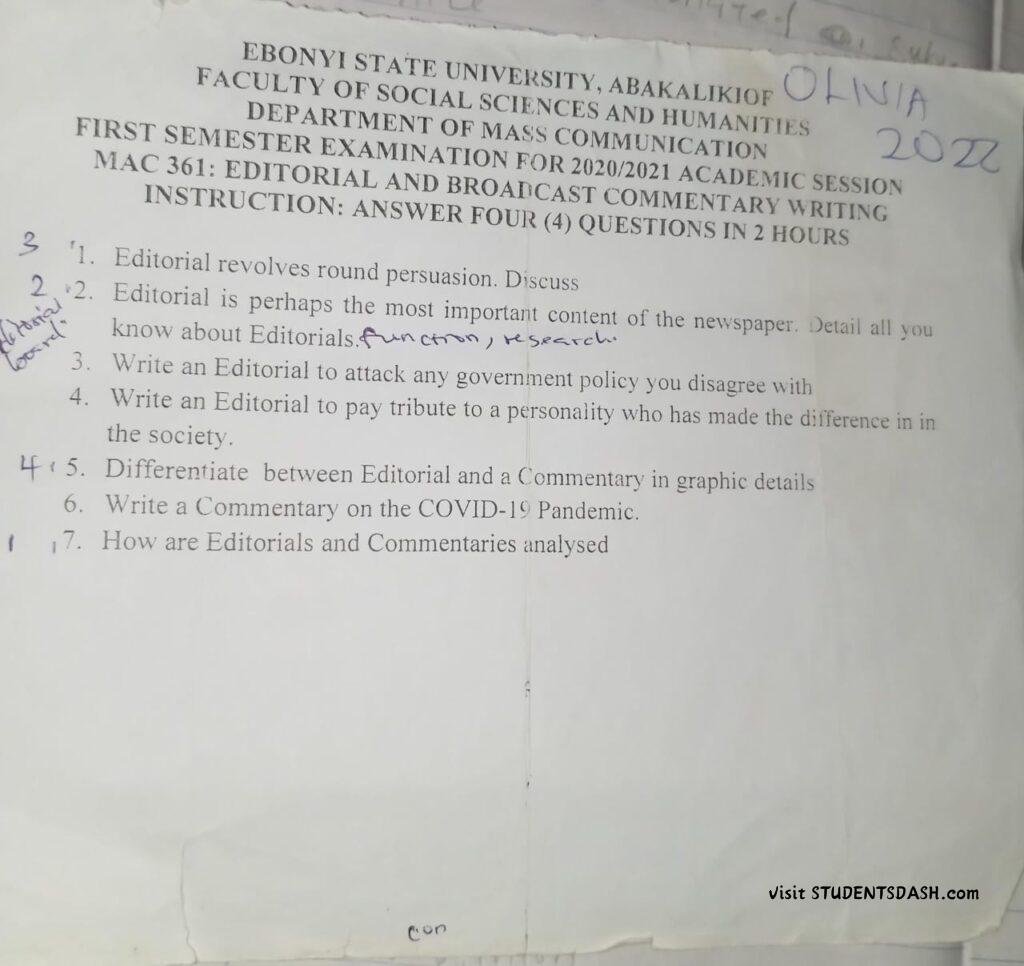
Title: MAC 361 Past Questions and Answers URL: https://studentsdash.com/mac-361-past-question-and-answers/ -------------------------------------------------- Answer 1. Editorial revolves around persuasion. Discuss. An editorial is a type of newspaper article that presents an argument or opinion on important issues. It is written by the editorial board of a newspaper or media house and is meant to guide public thinking on certain matters. One of the most important characteristics of an editorial is persuasion —it tries to convince the readers to see things from a particular perspective. Why Editorials are Persuasive Editorials use different techniques to make their arguments strong and convincing. Some of these techniques include: 1. Logical Reasoning: Editorials provide well-researched facts and logical arguments to support their opinions. 2. Emotional Appeal: They use emotional language to connect with readers’ feelings and make them take an issue seriously. 3. Authoritative Tone: Editorials are written in a confident and convincing manner, making the reader trust the argument being presented. 4. Call to Action: Many editorials end with a strong conclusion that encourages people to act in a certain way, such as supporting a policy or protesting against it. Examples of Persuasive Editorials • An editorial urging the government to increase the minimum wage by presenting facts about the cost of living. • A newspaper editorial criticizing corruption in politics and calling for more transparency. • An editorial supporting a law that bans smoking in public places, explaining the health risks involved. Editorials are persuasive because they help shape public opinion, influence government decisions, and sometimes even bring about social change. 2. Editorial is perhaps the most important content of the newspaper. Detail all you know about Editorials. Editorials are considered the heart of a newspaper because they reflect the opinions of the newspaper’s editors on important national and international issues. Unlike news articles, which are meant to be neutral, editorials take a clear stance and try to influence public thinking. Features of an Editorial 1. Opinion-Based but Factual: Even though an editorial expresses an opinion, it is based on facts, statistics, and expert analysis. 2. Influential: Editorials shape public opinion, influence government decisions, and sometimes even lead to policy changes. 3. Well-Structured: Editorials usually follow a structure that includes an introduction, body, and conclusion. The introduction presents the issue, the body provides arguments, and the conclusion gives recommendations. 4. Written in Formal but Simple Language: Editorials use a serious but understandable tone so that a wide range of people can read and understand them. Functions of an Editorial 1. Educates the Public: Editorials explain complicated issues in simple terms, helping people understand current events better. 2. Criticizes or Commends Policies: If a government policy is good, an editorial praises it. If it is bad, the editorial criticizes it and suggests improvements. 3. Advocates for Change: Many social movements start because of strong editorial pieces that draw attention to important issues. 4. Represents the Newspaper’s Voice: The editorial reflects the newspaper’s official stance on an issue, making it different from opinion articles written by individual columnists. Without editorials, newspapers would only be reporting facts without guiding the public on how to interpret or respond to them. That is why they are one of the most important parts of a newspaper. 3. Write an Editorial to Attack Any Government Policy You Disagree With. Title: The Fuel Subsidy Removal: A Burden on the Poor The recent removal of fuel subsidy by the Nigerian government has caused great suffering for millions of citizens. While the government argues that the removal will save money and boost the economy, the reality is that the policy is making life unbearable for ordinary Nigerians. Before the subsidy was removed, fuel was affordable, and transportation costs were reasonable. However, after the policy was implemented, the price of fuel more than tripled, leading to a sharp increase in the cost of transportation, food, and basic goods. This has placed a heavy financial burden on poor and middle-class Nigerians, who are already struggling to survive. The government promised that the money saved from the subsidy removal would be used to improve infrastructure, healthcare, and education. But months have passed, and Nigerians have not seen any real benefits. Instead, what we see are politicians living in luxury while the common man suffers. If the government truly cares about the people, it should introduce measures to reduce the suffering caused by this policy. This includes providing alternative fuel sources, increasing the minimum wage, and putting in place programs to support small businesses. Until these steps are taken, the fuel subsidy removal will remain an anti-people policy that should be reconsidered. 4. Write an Editorial to Pay Tribute to a Personality Who Has Made a Difference in Society. Title: Ngozi Okonjo-Iweala: A Symbol of Excellence and Integrity Dr. Ngozi Okonjo-Iweala has proven to the world that Nigerians are capable of great leadership. As the first African and first woman to become the Director-General of the World Trade Organization (WTO), she has shown exceptional intelligence, dedication, and integrity. Throughout her career, Okonjo-Iweala has worked tirelessly to improve economic policies, fight corruption, and promote good governance. As Nigeria’s Minister of Finance, she helped to reduce the country’s debt and introduced policies that boosted economic growth. Despite facing many challenges, she remained committed to transparency and accountability. Her success on the international stage has inspired millions of young Nigerians, especially women, to believe in their abilities and strive for excellence. She has proven that hard work, honesty, and intelligence can take anyone to the highest levels of leadership. Nigeria and the world celebrate Dr. Ngozi Okonjo-Iweala for her remarkable achievements. She is truly a role model for the present and future generations. 5. Differentiate Between Editorial and Commentary in Graphic Details. Feature Editorial Commentary Definition A newspaper article expressing the opinion of the editorial board. A personal opinion piece by a columnist or broadcaster. Author Written by the editorial board. Written by an individual journalist or contributor. Purpose To persuade, educate, or criticize a policy or issue. To analyze and interpret events from a personal viewpoint. Tone Formal and objective. Can be informal and personal. Audience General public, policymakers, and stakeholders. Primarily for readers who follow the columnist. Examples “Why the Government Must Improve Healthcare” “My Thoughts on the Election Results” 6. Write a Commentary on the COVID-19 Pandemic. Title: The Lessons from COVID-19 The COVID-19 pandemic was one of the most challenging periods in recent history. It affected every aspect of life, from health and economy to education and social interactions. As the world recovers, it is important to reflect on the lessons learned. One major lesson is the importance of a strong healthcare system. Many countries, including Nigeria, struggled because their hospitals were not well-equipped. This shows that governments must invest more in health facilities and medical research. Another lesson is the role of technology in education and business. During the lockdown, online learning and remote work became necessary. This means that schools and businesses should continue to embrace digital tools for efficiency. Finally, the pandemic reminded us of the value of unity and kindness. People supported one another, and governments worked together to find solutions. As we move forward, these lessons should not be forgotten. 7. How Are Editorials and Commentaries Analyzed? To analyze an editorial or commentary, we look at the following: 1. Purpose: What is the writer trying to achieve? (Persuade, inform, or criticize?) 2. Arguments: Are the points well-researched and supported by facts? 3. Language and Tone: Is it formal, emotional, or logical? 4. Impact: Does it influence public opinion or lead to change? Editorials and commentaries are powerful tools in journalism. By analyzing them, readers can better understand the message and its effect on society.

Image Post
Past Questions

MAC 361 and MAC 321 Past Questions and Answers

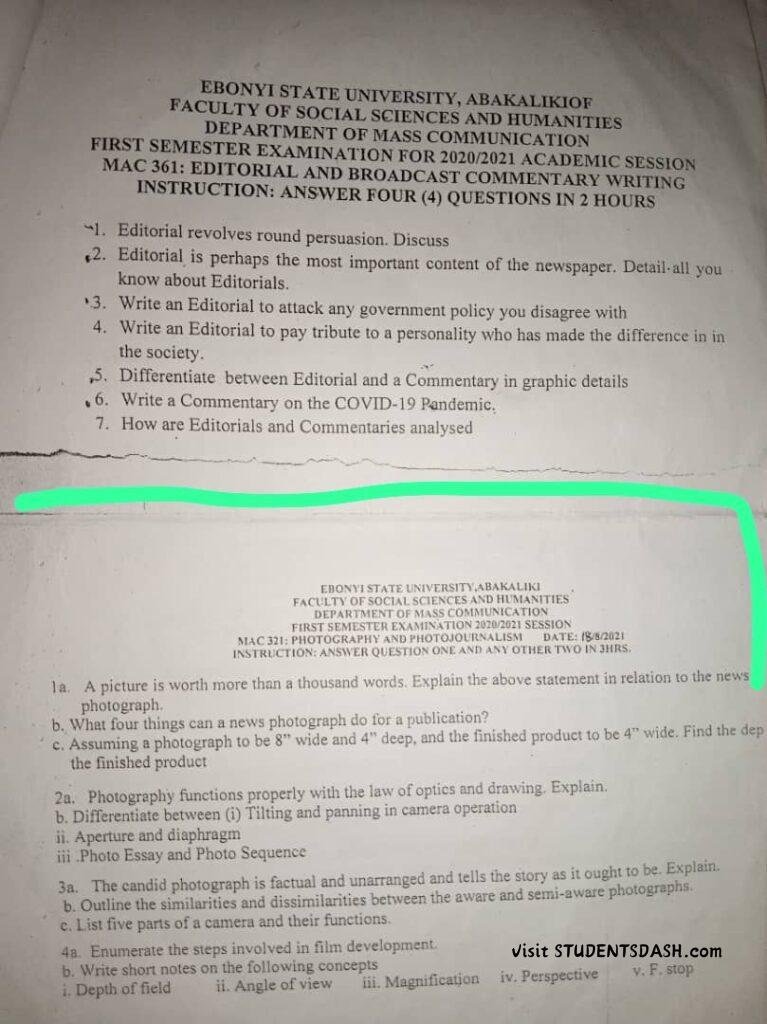
Title: MAC 361 and MAC 321 Past Questions and Answers URL: https://studentsdash.com/mac-361-and-mac-321-past-questions-and-answers/ -------------------------------------------------- MAC 361: Editorial and Broadcast Commentary Writing. 1. Editorial revolves around persuasion. Discuss. An editorial is an article written by an editor or a group of editors in a newspaper, magazine, or broadcast that expresses opinions on current issues. Editorials are meant to persuade the audience by presenting logical arguments, facts, and emotional appeals to influence public opinion. Persuasion in editorial writing is achieved through: Logical Reasoning – The writer presents well-researched facts and figures to convince the reader. Emotional Appeal – Some editorials use emotions to connect with the audience, making them feel strongly about the issue. Authority and Credibility – When an editorial is written by a credible media house or journalist, readers are more likely to be influenced. Call to Action – Editorials often encourage people to take action, such as voting, protesting, or changing a certain behavior. For example, an editorial on climate change may persuade people to adopt environmentally friendly habits by presenting scientific evidence and emotional stories of disaster victims. 2. Editorial is perhaps the most important content of the newspaper. Detail all you know about Editorials. An editorial is a newspaper article that presents an opinion on an issue. It is often written by senior journalists or editors and reflects the newspaper’s official stance on a topic. Characteristics of an Editorial: Opinionated: Unlike news reports, which are neutral, editorials express opinions. Persuasive: They aim to influence readers’ thoughts on important issues. Well-researched: They are backed by facts, examples, and logical arguments. Call to Action: Some editorials suggest solutions or urge readers to take action. Types of Editorials: Interpretative Editorials – Explain and analyze complex issues for the readers. Critical Editorials – Criticize policies, government actions, or social issues. Tribute Editorials – Honor great individuals, such as famous leaders or heroes. Persuasive Editorials – Aim to change public opinion on a subject. For example, a newspaper editorial might support free education by highlighting its benefits and urging the government to implement it. 3. Write an Editorial to attack any government policy you disagree with. Title: The Government’s Failure in Tackling Unemployment The rate of unemployment in Nigeria is alarmingly high. Despite government promises to create jobs, thousands of graduates roam the streets without employment. This failure has increased crime, poverty, and hopelessness among Nigerian youth. One major reason for this is poor economic policies. Instead of investing in industries, agriculture, and skill development, the government spends too much on political salaries and foreign travels. Many job creation programs, such as N-Power, have failed due to corruption and poor implementation. We urge the government to focus on real economic reforms. It should provide low-interest loans for small businesses, invest in technology, and improve the ease of doing business. If urgent action is not taken, unemployment will continue to destroy the future of this country. 4. Write an Editorial to pay tribute to a personality who has made a difference in society. Title: The Legacy of Prof. Dora Akunyili Nigeria has produced many great leaders, but few have had the impact of Prof. Dora Akunyili . As the Director-General of NAFDAC, she fearlessly fought against fake drugs that were killing thousands of Nigerians. Despite threats to her life, Akunyili did not give up. She introduced strict policies, arrested corrupt manufacturers, and restored confidence in Nigeria’s drug industry. Her leadership saved countless lives and made Nigeria a safer place. Her honesty, courage, and dedication should inspire our current leaders. Nigeria needs more people like Prof. Dora Akunyili —leaders who put service above self-interest. 5. Differentiate between Editorial and a Commentary in graphic details. Feature Editorial Commentary Definition An article expressing the newspaper’s official opinion on a major issue. A personal opinion piece that reflects the writer’s views on an issue. Tone Formal and persuasive. Can be conversational, reflective, or humorous. Author Written by editors. Written by columnists, experts, or guest writers. Purpose To influence public opinion and advocate for change. To provide personal insights or analysis of an issue. Examples Editorial on why corruption must end in Nigeria. A commentary on why football brings Nigerians together. 6. Write a Commentary on the COVID-19 Pandemic. Title: Lessons from the COVID-19 Pandemic The COVID-19 pandemic changed the world in ways we never imagined. It shut down businesses, schools, and even religious gatherings. Millions of lives were lost, and global economies suffered great losses. However, the pandemic also taught us many lessons. It showed the importance of healthcare investment . Many African countries struggled because they had poor hospitals and lacked medical supplies. It also taught us the value of technology —as schools and offices moved online. Above all, COVID-19 reminded us that life is fragile , and we must always be prepared for emergencies. Governments must invest in health infrastructure, and individuals must practice good hygiene to prevent future outbreaks. 7. How are Editorials and Commentaries analyzed? Analyzing editorials and commentaries involves: Identifying the Main Idea – What issue is being discussed? Checking the Argument – Is it based on facts, logic, or emotion? Examining the Tone – Is it formal, critical, persuasive, or humorous? Evaluating the Evidence – Does the writer use statistics, examples, or expert opinions? Looking at the Conclusion – Does the article offer solutions or just criticize? For example, if an editorial supports fuel subsidy removal, we analyze whether the arguments are strong, fair, and based on real facts. Let’s now answer MAC 321: Photography and Photojournalism 1a. A picture is worth more than a thousand words. Explain this statement in relation to the news photograph. The saying “A picture is worth a thousand words” means that a single image can convey complex messages, emotions, and stories better than a long written description. In news photography , this is especially true because photographs capture real-life moments and emotions that words alone might struggle to describe. For example, during the COVID-19 pandemic , a single photo of exhausted doctors in PPE or patients struggling to breathe told the world about the crisis more effectively than a long article. Similarly, during protests or war, a powerful photo of a crying child, a burning building, or people running for safety can immediately show the seriousness of the situation. News photographs are powerful because they: Provide instant understanding – Readers can immediately see what is happening. Create emotional impact – People feel more connected to an issue when they see real images. Enhance credibility – Photos provide proof that the event actually happened. This is why every newspaper and online media platform invests in photojournalism —to tell stories in a way that words alone cannot. 1b. What four things can a news photograph do for a publication? A news photograph serves multiple purposes in a publication. Here are four key roles it plays: Attracts Attention – A striking image on the front page can make people stop and pick up the newspaper or click on an online article. Tells a Story – A single photo can summarize an entire event, helping readers understand the news quickly. Adds Credibility – Readers trust a news story more when they see real images from the scene. Evokes Emotions – A photo can make people feel sad, happy, angry, or inspired, depending on the subject. For example, a photo of a collapsed building in an earthquake-hit area immediately shows the extent of the damage and suffering, making the news more impactful. 1c. Assuming a photograph is 8” wide and 4” deep, and the finished product is to be 4” wide, find the depth of the finished product. To calculate the depth of the finished product, we use the proportionality formula : Original WidthNew Width=Original DepthNew Depth\frac{\text{Original Width}}{\text{New Width}} = \frac{\text{Original Depth}}{\text{New Depth}} Given: Original width = 8 inches Original depth = 4 inches New width = 4 inches Now, let x be the new depth: 84=4x\frac{8}{4} = \frac{4}{x} Cross-multiplying: 8x=168x = 16 x=168=2 inchesx = \frac{16}{8} = 2 \text{ inches} So, the new depth of the finished product is 2 inches . 2a. Photography functions properly with the law of optics and drawing. Explain. Photography is based on the laws of optics , which deal with how light travels and interacts with surfaces. A camera works by using a lens to focus light onto a sensor (or film in older cameras), just like the human eye focuses light onto the retina. The laws of optics help photographers control: Focus – Making an object appear sharp or blurred. Exposure – Controlling how much light enters the camera. Depth of Field – Deciding what part of the image stays in focus while the background is blurred. Similarly, photography also follows drawing principles like composition, perspective, and balance to create visually appealing images. A well-taken photograph considers framing, symmetry, and subject positioning , just like an artist does in a painting. 2b. Differentiate between: i) Tilting and Panning in Camera Operation Feature Tilting Panning Definition Moving the camera up or down while keeping it in the same position. Moving the camera side to side (left or right) while keeping it in the same position. Purpose Used to capture vertical movements, such as tall buildings or falling objects. Used to follow moving subjects, like a running athlete or a moving car. Example Filming a plane taking off from the ground. Following a football player running across the field. ii) Aperture and Diaphragm Feature Aperture Diaphragm Definition The opening in the camera lens that controls how much light enters. The part inside the lens that opens or closes to adjust the aperture size. Function Affects exposure and depth of field. Physically controls the size of the aperture. Example A small aperture (f/16) makes everything sharp, while a large aperture (f/2.8) blurs the background. The diaphragm’s blades adjust to make the aperture smaller or larger. iii) Photo Essay and Photo Sequence Feature Photo Essay Photo Sequence Definition A collection of photos that tell a complete story. A series of photos showing step-by-step actions. Structure Each photo contributes to a broader theme. Photos must be arranged in a logical order. Example A set of pictures showing the impact of climate change on farmers. A sequence showing how a footballer scores a goal. 3a. The candid photograph is factual and unarranged and tells the story as it ought to be. Explain. A candid photograph is a natural and unposed picture taken without the subject being aware. It is considered factual because it captures real-life moments as they happen, without editing or staging. For example, a journalist covering a protest may take a candid photo of a policeman spraying tear gas at protesters. The photo tells the truth of the situation as it happened, unlike staged photographs, which may be manipulated to change the story. Candid photography is important in photojournalism because: It preserves truth in news reporting. It shows genuine emotions and actions. It prevents manipulation , making the image more credible. 3b. Outline the similarities and dissimilarities between aware and semi-aware photographs. Similarities: Both capture real-life events. Both involve human subjects. Both can be used in news reporting. Dissimilarities: Feature Aware Photograph Semi-Aware Photograph Definition A photo where the subject knows they are being photographed. A photo where the subject may not fully know they are being captured. Example A celebrity posing for a picture at an event. A person smiling naturally at a camera without realizing the photographer is about to take the shot. 4a. Enumerate the steps involved in film development. Loading the Film – Place the film into a development tank in a dark room. Developing – Soak the film in a chemical solution to reveal the images. Stopping – Use another chemical to halt the developing process. Fixing – Apply a fixer to make the image permanent. Washing – Clean the film with water to remove excess chemicals. Drying – Hang the film to dry before printing the photographs. 4b. Write short notes on the following concepts: Depth of Field – The area in focus in a photograph. Angle of View – The range of a scene captured by a camera. Magnification – The process of making an image appear larger. Perspective – The way objects appear based on distance. F-Stop – A camera setting that controls the aperture size.

Image Post
Past Questions

Nigerian universities’ UTME cut-off marks

Title: Nigerian universities’ UTME cut-off marks URL: https://studentsdash.com/nigerian-universities-utme-cut-off-marks/ -------------------------------------------------- Lagos State University and Lagos State University of Science and Technology fixed 195, while Lagos State University of Education adopted 185. JAMB explained that the approved figures represent the minimum thresholds for admission consideration, adding that institutions are permitted to set higher requirements for competitive courses such as Medicine, Law, Pharmacy and Engineering. UNIVERSITY CUT OFF MARK Full List OF University Cut Off Mark Pan-Atlantic University — 220 Air Force Institute of Technology — 200 Covenant University — 200 Federal University of Medicine and Medical Sciences — 200 Obafemi Awolowo University — 200 University of Benin — 200 University of Ibadan — 200 University of Lagos — 200 University of Nigeria — 200 Lagos State University of Science and Technology — 195 Lagos State University — 195 Lagos State University of Education — 185 Afe Babalola University — 180 Ahmadu Bello University — 180 Federal University of Health Sciences — 180 Nigeria Police Academy — 180 Nigerian University of Technology and Management — 180 Shanahan University — 180 University of Abuja — 180 University of Ilorin — 180 University of Jos — 170 Augustine University — 170 Babcock University — 170 Federal University of Applied Sciences — 170 Federal University — 170 Ladoke Akintola University of Technology — 170 Nasarawa State University — 170 BITS University — 170 Ibrahim Badamasi Babangida University — 160 Abubakar Tafawa Balewa University — 160 Admiralty University of Nigeria — 160 African Aviation and Aerospace University — 160 Ajayi Crowther University — 160 Al-Hikmah University — 160 Bamidele Olumilua University — 160 Bayero University Kano — 160 Bells University of Technology — 160 Caleb University — 160 Chrisland University — 160 Dominion University — 160 Emmanuel Alayande University of Education — 160 Federal University of Agriculture — 160 Federal University of Education — 160 Federal University of Health Sciences — 160 Federal University of Technology and Environmental Sciences — 160 Federal University of Technology — 160 First Technical University — 160 Imo State University — 160 Isaac Balami University of Aeronautics and Management — 160 Karl Kumm University — 160 Kwara State University — 160 Landmark University — 160 Lead City University — 160 Modibbo Adama University — 160 Nnamdi Azikiwe University — 160 Olabisi Onabanjo University — 160 Osun State University — 160 Plateau State University — 160 Redeemer’s University — 160 Summit University — 160 Tai Solarin University of Education — 160 Taraba State College of Nursing and Midwifery — 160 University of Ilesa — 160 AbdulRasaq Abubakar Toyin University — 150 Adamawa State University — 150 Adeleke University — 150 African School of Economics — 150

Image Post
Past Questions

PHY 108 (PHY 192) Pat Questions and Answers

Title: PHY 108 (PHY 192) Pat Questions and Answers URL: https://studentsdash.com/phy-108-phy-192-pat-questions-and-answers/ -------------------------------------------------- When a light ray goes from air into glass, which happens to the angle with the normal? A. It becomes smaller. B. It becomes larger. C. It stays the same. D. It becomes zero. Answer: A Which measurement is essential when using a glass slab to find lateral displacement? A. refractive index only B. slab thickness and shift between emergent and incident rays C. mass of the slab D. focal length of the slab Answer: B For a concave mirror, an object placed at the focal point produces an image that is: A. real and at 2f B. virtual and magnified C. formed at infinity (no real image on screen) D. same size as the object Answer: C The lens formula (1/f = 1/u + 1/v) assumes: A. small-angle (paraxial) approximation and thin lens B. that the lens is thick only C. only for mirrors, not lenses D. no refraction occurs Answer: A In the displacement method for focal length, you keep object and screen fixed and move the lens. One advantage is: A. you need only one measurement total B. you can get two lens positions that give sharp image and use a direct formula for f C. it eliminates the need for a lens D. it requires laser light only Answer: B Minimum deviation through a prism is useful because: A. it gives maximum dispersion B. the refractive index can be calculated from apex angle and Dmin C. it depends on the prism’s mass D. it depends only on incident intensity Answer: B Which of the following is a sign of a well-balanced Wheatstone bridge? A. maximum current through galvanometer B. zero deflection of galvanometer C. a flicker in galvanometer reading D. rapid oscillation of the needle Answer: B A potentiometer measures EMF by: A. drawing a steady current through the test cell B. balancing against a known potential gradient so no current flows in the test cell at balance C. heating the cell to a fixed temperature D. comparing resistances only Answer: B Two identical resistors in parallel will have total resistance equal to: A. twice one resistor B. half one resistor C. same as one resistor D. zero Answer: B When using a galvanometer in a Wheatstone bridge, the sensitivity improves if the galvanometer has: A. very high resistance and high coil sensitivity B. zero resistance C. no coil D. very large mass Answer: A If you measure several (u, v) pairs for a convex lens and plot 1/u vs 1/v, the intercept gives: A. 1/f B. focal length f directly C. object height D. image brightness Answer: A In an experiment comparing EMFs of two cells with a potentiometer, the longer balancing length corresponds to: A. the smaller EMF B. the larger EMF C. the cell with bigger diameter D. the cell with lower temperature Answer: B Which practical step reduces random error when timing an optics alignment? A. take several readings and average B. use one reading only C. ignore instrument readings D. record measurements without units Answer: A Snell’s law at a plane surface is (n_1\sin\theta_1 = n_2\sin\theta_2). If (\theta_1) increases, (\theta_2) will: A. decrease B. increase (until total internal reflection if possible) C. remain constant D. become negative Answer: B In a concave mirror practical, the magnification m is +2. This indicates the image is: A. virtual and upright, twice the object height B. real and inverted, twice the object height C. virtual and inverted D. same size as object Answer: A When measuring the internal resistance of a dry cell by plotting terminal voltage V against current I, the internal resistance equals: A. the y-intercept B. the negative of the slope C. the x-intercept D. the slope itself (positive) Answer: B A student gets two different focal-length values for the same lens using different object distances. The most likely cause is: A. measurement uncertainties and alignment errors B. the lens physically changing f during the experiment C. gravity altering optical power randomly D. the light frequency changing spontaneously Answer: A Dispersion causes different colours to refract differently because: A. refractive index depends on wavelength B. speed of light in vacuum changes with colour C. colours are produced inside the glass D. prism adds energy to red light only Answer: A In a series circuit, if one resistor doubles in resistance, the total current (for fixed supply voltage) will: A. increase B. decrease C. remain unchanged D. become infinite Answer: B To reduce parallax when reading a scale in a lab, you should: A. position your eye perpendicular to the scale mark B. read from a steep angle for clarity C. move the scale while reading D. close one eye and tilt the scale randomly Answer: A If the galvanometer in a Wheatstone bridge is very sensitive, balancing the bridge requires: A. larger changes in ratio values B. very small adjustments to reach zero deflection C. removing the galvanometer D. reversing the whole circuit Answer: B For a thin lens, when object distance u equals image distance v, the object position is: A. at 2f (twice focal length) B. at f (focal point) C. at infinity D. on the lens surface Answer: A Which arrangement is best to measure resistor R with least systematic error using ammeter and voltmeter? A. voltmeter with high resistance across R, ammeter with low resistance in series with R B. voltmeter in series and ammeter in parallel C. remove both instruments and estimate R visually D. connect voltmeter across power supply only Answer: A In practice, a tungsten filament’s resistance increases when current flows because: A. filament temperature rises, increasing resistivity B. filament gets polarized and reduces resistance C. resistance is independent of temperature D. the filament length decreases with current Answer: A When measuring the refractive index of a prism using minimum deviation, you must accurately measure: A. apex angle and minimum deviation angle B. prism mass and thickness C. ambient humidity and prism color D. prism temperature only Answer: A A student uses white light for lens focal experiments and gets fuzzy images. The likely reason is: A. chromatic aberration — different colours focus at slightly different points B. white light has no photons C. lenses do not work with white light D. the lens dissolved in white light Answer: A The balanced condition of Wheatstone bridge for unknown Rx is (R_x = (R_2/R_1)\times R_3). If R1 and R2 are interchanged, correct action is to: A. recalculate Rx using the new ratio B. ignore interchange — nothing changes C. remove Rx from circuit entirely D. short the bridge wires Answer: A In a potentiometer, the potential gradient along the wire is defined as: A. voltage drop per unit length of the wire B. current per unit length C. resistance per unit length only D. mass per unit length Answer: A If you connect two identical cells in parallel, the total EMF and internal resistance approximately become: A. EMF = E, r = r/2 B. EMF = 2E, r = 2r C. EMF = E/2, r = r/2 D. EMF = 0, r = infinite Answer: A When locating a real image from a convex lens onto a screen, the sharpest image indicates: A. the true image plane where v is correctly measured B. a random spot independent of lens position C. the lens has no focal length D. the object is at the lens center Answer: A In an optics lab, why use a monochromatic source like sodium lamp for lens/prism measurements? A. to avoid chromatic spread and get sharp minima or images B. because sodium lamps are cheaper than white lamps always C. because monochromatic light increases lens focal length D. to heat the lens for better performance Answer: A For two resistors R1 and R2 in series, the voltage across R2 equals: A. (V_{total}\times(R_2/(R_1+R_2))) B. (V_{total}\times(R_1+R_2)) C. (V_{total}) only if R1 = 0 D. half of R1 always Answer: A Which error reduces accuracy when using a potentiometer to find EMF? A. poor contact at jockey or non-uniform wire B. reading values in correct units C. using a calibrated standard cell D. balancing to zero deflection properly Answer: A In a graph of V (y) vs I (x) for a cell with internal resistance, the y-intercept equals: A. the EMF of the cell B. internal resistance r C. negative of r D. zero always Answer: A Which observation indicates total internal reflection at an interface? A. no refracted ray emerges and light is completely reflected back into the denser medium B. light refracts out into the rarer medium strongly C. light is absorbed at the boundary D. light passes through unaffected Answer: A To find focal length by the autocollimation method, you need: A. a plane mirror and an object — lens adjusted until image coincides with object (sharp), then distance = f B. only a prism and no lens C. a voltmeter and ammeter only D. two identical lenses in contact only Answer: A In the tungsten filament experiment, plotting V/I vs I shows a rising trend because: A. resistance increases with current (temperature) so V/I increases B. resistance decreases with temperature so V/I falls C. V/I is constant under all conditions D. current is independent of voltage Answer: A When calibrating a potentiometer, you must ensure the driver cell is: A. stable and has higher EMF than the test cells B. equal to zero volts C. variable randomly during measurement D. disconnected after every reading Answer: A If the object for a concave mirror is between the focus and the mirror, the image formed is: A. virtual, upright and magnified B. real and inverted on the screen C. same size and inverted D. not formed at all Answer: A A practical way to improve Wheatstone bridge accuracy is to: A. use decade resistors or precise standard resistors close in value to the unknown B. use wildly different resistor orders of magnitude C. remove the galvanometer entirely D. use only variable capacitors instead Answer: A What happens to the lateral shift through a glass slab if the slab thickness doubles (incident angle fixed)? A. lateral shift roughly doubles (proportional to thickness) B. lateral shift halves C. lateral shift remains zero D. lateral shift becomes negative Answer: A In an electricity lab, why place the voltmeter in parallel with the component under test? A. it measures the potential difference across that component directly without interrupting current path B. it measures current only in that configuration C. it reduces the circuit resistance to zero D. it converts voltage to frequency Answer: A While finding prism minimum deviation, turning the prism slowly and monitoring the emergent ray’s movement helps because: A. the minimum deviation is where emergent ray changes direction sign (slowest movement) — easy to identify B. it increases prism temperature to improve results C. it causes chromatic inversion D. it creates resonance in the prism Answer: A In a series circuit, the same current flows through each resistor because: A. there is only one path for charge flow B. each resistor has identical voltage across it always C. current splits equally by law D. resistors force current to change at each junction Answer: A Which of these is true for the image formed by a convex lens when the object is at 3f? A. the image is real, inverted and between f and 2f (smaller than object) B. image is virtual and erect C. image is at infinity always D. image equals object size and at 3f on other side Answer: A When using a potentiometer wire that is dusty and dirty, you may get: A. unstable contact and incorrect balance lengths B. more accurate readings C. increased wire conductivity uniformly improving gradient D. automatic calibration of the potentiometer Answer: A A student wants to test Ohm’s law for a resistor and sees the V–I plot curves upward (non-linear). The correct interpretation is: A. resistor is non-ohmic (resistance changes with V or temperature) B. Ohm’s law is false universally C. the resistor is superconducting D. the voltmeter is measuring frequency instead Answer: A If the galvanometer coil is damped heavily during Wheatstone balancing, the needle will: A. return to rest quickly with little oscillation (good for fast balancing) B. oscillate forever C. never move D. melt the coil Answer: A During lens experiments, why note the temperature or room conditions? A. because lens material refractive index and instrument readings can shift slightly with temperature (affects precision) B. because lenses change focal length drastically day by day C. because room color alters refractive index significantly D. because temperature determines lens polarity Answer: A Best immediate safety practice before rearranging connections in a circuit is to: A. switch off the power supply and discharge capacitors if present B. touch live wires to ensure current is present C. keep power on for convenience D. use metal tools across live nodes to test continuity Answer: A In the displacement method to find a lens’s focal length, which pair of measurements is needed? A. lens thickness and room temperature B. two lens positions that form a sharp image on a fixed screen and the separation between them C. the colour of the light and the lens material D. object mass and image brightness Answer: B Which best describes chromatic aberration in a lens? A. it makes the lens heavier B. it is corrected by lowering temperature C. different wavelengths focus at slightly different distances from the lens D. it causes total internal reflection Answer: C Why use a sodium lamp for a prism experiment? A. sodium lamps are red only B. white light is too bright C. the prism works only with sodium D. monochromatic light gives sharp minimum deviation and avoids colour spread Answer: D If object distance (u=30) cm and image distance (v=15) cm, what is the focal length (f) using (1/f=1/u+1/v)? A. 5 cm B. 20 cm C. 45 cm D. 10 cm Answer: A In a concave mirror experiment, an image that is real, inverted and smaller than the object suggests the object is: A. between mirror surface and focal point B. beyond centre of curvature (beyond 2f) C. at the focal point D. at the centre of curvature Answer: B Which procedure reduces systematic error when using a potentiometer? A. use the shortest possible wire length only B. balance with current flowing through the test cell C. ensure good, clean contact with the jockey and use a stable driver cell D. use a fluctuating driver voltage Answer: C For a balanced Wheatstone bridge with (R_1/R_2 = R_3/R_x), the correct expression for (R_x) is: A. (R_1 + R_2 – R_3) B. ((R_3 R_2)/R_1) C. ((R_1 R_3)/R_2) D. (R_3 – R_1) Answer: B When plotting terminal voltage (V) vs current (I) for a loaded cell, the y-intercept equals: A. internal resistance B. short-circuit current C. zero D. EMF of the cell Answer: D For a lens with object distance (u=40) cm and image distance (v=80) cm, the image is: A. inverted and twice the size of the object B. upright and half the size C. inverted and half the size D. virtual and same size Answer: A Adding another resistor in parallel to an existing parallel network will: A. keep resistance same if all resistors identical B. increase total resistance C. make the circuit open D. decrease total resistance Answer: D To avoid parallax when reading a metre rule during optics alignment you should: A. read from an angle for speed B. move the rule while reading C. close both eyes and estimate D. align your eye perpendicular to the scale mark while keeping the rule steady Answer: D The prism refractive index (n) is given by which formula (with apex angle (A) and minimum deviation (D_{min}))? A. (n = \sin\big(\tfrac{A}{2}\big)/\sin\big(\tfrac{A+D_{min}}{2}\big)) B. (n = \tan(A+D_{min})) C. (n = \sin\big(\tfrac{A+D_{min}}{2}\big)/\sin\big(\tfrac{A}{2}\big)) D. (n = A/D_{min}) Answer: C If a fixed object and screen are separated by distance (L) and the lens has two sharp positions separated by (d), the focal length is: A. (f = \dfrac{d^2}{L}) B. (f = \dfrac{L-d}{2}) C. (f = L + d) D. (f = \dfrac{L^2}{4d}) Answer: D Total internal reflection is used in the lab primarily to: A. change mass of the medium B. produce chromatic dispersion only C. create EMF in wires D. measure the refractive index of liquids by finding the critical angle Answer: D To minimize measurement error when using an ammeter and voltmeter, choose: A. voltmeter in series and ammeter in parallel B. remove both instruments and estimate R visually C. use an ammeter with low resistance and a voltmeter with high resistance D. connect voltmeter across power supply only Answer: C Why does a tungsten filament’s resistance increase when current flows? A. its length doubles only B. electrons disappear C. its resistivity increases with temperature D. applied voltage ceases to exist Answer: C If someone reports a focal length with no uncertainty, the examiner will likely: A. accept it as perfect data B. award full marks always C. ask for uncertainty or mark down for incomplete reporting D. ignore units only Answer: C Which method can directly give the refractive index of a liquid like groundnut oil using lens techniques? A. guessing from smell B. using a thermometer only C. weighing the oil only D. measuring focal length change when a lens is immersed and applying proper corrections Answer: D Why are multiple trials recommended in a well-run practical? A. to create more pages for the report B. to estimate random error and improve confidence in the mean value C. to increase the value of the instrument D. to confuse students Answer: B Jitter at the potentiometer null point most likely indicates: A. perfect experimental setup B. unstable driver supply or poor contact at the jockey C. the null point always moves with time by law D. humidity alone makes potentiometers impossible Answer: B The (approximate) lens-maker’s formula for a thin lens in air is: A. (f = R_1 + R_2) B. (n = f(R_1-R_2)) C. (\dfrac{1}{f} = (n-1)\left(\dfrac{1}{R_1} – \dfrac{1}{R_2}\right)) D. (R_1R_2 = n) Answer: C In a Wheatstone bridge, using standard resistors close in value to the unknown helps because: A. it warms up the circuit B. it neutralizes galvanometer sensitivity C. it increases balancing accuracy and lowers percentage error D. it always reduces the unknown value Answer: C A converging lens produces a virtual erect image when the object is placed: A. at infinity B. beyond 2f C. exactly at 2f D. between lens and focal point (inside f) Answer: D If you smell burning plastic from a circuit, the best immediate action is to: A. continue experimenting for data completeness B. switch off the power supply and inform the instructor C. use wet hands to touch components D. plug in more devices to test overload Answer: B When plotting (1/v) vs (1/u) for a lens, the intercept helps determine: A. focal length from intercept (1/f) and check linear behaviour B. mass of the lens C. colour of the image D. EMF of a cell Answer: A Compared to a single cell case (neglecting internal resistance), connecting two identical cells in series will make the circuit current: A. unchanged B. halved always C. zero D. doubled approximately Answer: D A clear null in a potentiometer balance indicates: A. the driver cell has zero voltage always B. the circuit is shorted deliberately C. the balance point where no current flows through the test cell (ideal null) D. the potentiometer is broken Answer: C For prism refractive-index measurements, the most critical reading is: A. the prism’s weight B. the colour of the table in lab C. the time of day only D. the angle of minimum deviation measured precisely Answer: D In a series circuit, the voltage drop across each resistor depends on: A. resistor colour only B. nothing — it is always equal for every resistor C. the flavour of wires used D. its resistance relative to total resistance and the supply voltage Answer: D Why is the null method (potentiometer) preferred for precise EMF measurement? A. it uses a magnet to measure voltage only B. it is faster to guess values C. it always gives zero EMF D. it avoids drawing current from the test cell at balance, eliminating loading errors Answer: D Doubling the thickness of a glass slab (same incident angle) will: A. make the lateral shift negative B. halve the lateral shift C. keep lateral shift zero D. roughly double the lateral shift (proportional to thickness) Answer: D If the galvanometer needle deflects slightly even at balance, you should: A. accept and record the deflection as balance B. check and improve contacts, zero-set the galvanometer, or use a more sensitive null method C. heat the galvanometer to reduce sensitivity D. remove the bridge wires entirely Answer: B For a concave mirror, if object distance (u = f), the image formed is: A. at 2f and real B. virtual and small C. formed at infinity (rays emerge parallel) D. disappears always Answer: C A non-ohmic device is identified by: A. infinite resistance only B. perfect straight-line V–I graph at all conditions C. zero current always D. a nonlinear V–I graph (resistance changes with V or temperature) Answer: D Best practice when reporting lab results is to: A. include numerical value ± uncertainty and units, describe method and main error sources B. give only the final number with no context C. use inconsistent units in same report for variety D. produce results without stating instruments used Answer: A To check the lens axis is straight on an optics bench, you should: A. guess by eye without tools B. use a voltmeter across the lens C. rotate the whole bench randomly D. use an optical bench with collimated source and ensure object, lens, and screen centres line up on the same axis Answer: D If minimum deviation for red light is smaller than for violet in a prism, it means: A. violet is not affected by glass B. red light is heavier than violet light C. colours don’t matter in dispersion D. red light has lower refractive index in the prism material than violet (normal dispersion) Answer: D To estimate the internal resistance of a cell without shorting it, you should: A. short the cell directly and measure heating B. insert the cell into a microwave C. measure terminal voltage at several known loads, plot V vs I and extract r from slope D. measure the cell’s mass exactly Answer: C In a V–I test, a straight-line plot slope of 5 Ω represents: A. the power at any voltage B. the current squared C. the conductance only D. the resistance of the resistor (5 Ω) Answer: D To reduce random error when balancing a Wheatstone bridge you should: A. change resistors mid-balance randomly B. use only one coarse knob always C. take several balance readings and average the corresponding ratio values D. fail to make any adjustment and record the first reading Answer: C When a convex lens is placed in a liquid with refractive index close to the lens material, the focal length will: A. become undefined by law B. invert sign randomly C. decrease to zero always D. increase (lens power drops) Answer: D Why use a plane mirror in the autocollimation method? A. to heat the lens for calibration B. to measure current precisely C. to change the focal length magically D. to reflect emergent rays back through the lens so a sharp coincident image occurs at the object when lens is at focal distance Answer: D If the driver cell voltage falls during a potentiometer run, the measured null lengths will: A. increase randomly only B. be unaffected always C. become imaginary numbers D. shorten proportionally, introducing systematic error unless corrected Answer: D Wide slits producing fuzzy diffraction patterns are fixed by: A. using a different colour of bench B. removing the slit entirely C. making the slit wider for more fuzziness D. narrowing the slit or using a more collimated source to produce clearer fringes Answer: D Galvanometer internal damping helps by: A. changing resistance of bridge automatically B. producing larger oscillations for style C. preventing any movement at all always D. reducing oscillation so the pointer settles faster for easier null detection Answer: D A large relative error in (v) when (v \gg u) during focal-length calculations will: A. reduce the lens focal length physically B. cancel out exactly C. have no effect at all D. significantly affect calculated (f) (propagated error larger) Answer: D “Zero deflection” in a potentiometer or bridge practically means: A. the circuit is shorted completely B. the instrument is dead and unusable C. the unknown becomes zero always D. no current flows through the detector — ideal balance condition Answer: D Why is a sodium lamp preferred for prism minimum deviation? A. it is the cheapest light source in lab supplier list B. it emits all colours equally so averaging is easier C. it lowers the prism temperature for accurate mass reading D. its nearly single wavelength avoids multiple minima and gives a sharp, repeatable minimum deviation reading Answer: D Before connecting the circuit to measure current through a filament, which is important? A. use wet hands to make better contact B. over-tighten wires to break them intentionally C. always short the power supply momentarily to test fuses D. ensure connections are secure, instruments rated for expected current, and power initially set low Answer: D Which lab habit improves every experiment? A. skipping notes and relying on memory B. coloring the apparatus for flair only C. doing experiments at midnight only D. careful notes (values, uncertainties, conditions), neat diagrams, and a short conclusion stating major error sources and suggestions for improvement Answer: D

Image Post
Past Questions

Phy 102 Past Questions and Answers

Title: Phy 102 Past Questions and Answers URL: https://studentsdash.com/phy-102-past-questions-and-answers/ -------------------------------------------------- CLICK HERE TO VIEW MORE A transverse wave on a string has displacement described by (y(x,t)=A\sin(kx-\omega t)). Which physical quantity does (k) represent? A. Angular frequency B. Wave number (spatial angular frequency) C. Phase velocity D. Group velocity Answer: B Two sinusoidal waves of identical amplitude and frequency travel in opposite directions along a string. The resulting standing wave has nodes at positions where A. The time derivative of displacement is maximum B. The amplitude is zero for all times C. The phase advances linearly with time D. Energy is locally maximal Answer: B In a medium where wave speed depends on frequency, a short pulse will spread because different frequency components travel with different A. Phase velocities only B. Group velocities C. Amplitudes always equal D. Polarization states only Answer: B For sound waves in air, intensity level in decibels is defined using (20\log_{10}) of pressure ratio or (10\log_{10}) of power ratio. The reason for the factor of 20 (not 10) when using pressure is that acoustic power is proportional to A. Pressure (directly) B. Pressure squared C. Pressure cubed D. Inverse of pressure Answer: B A piano string and a flute pipe both produce the same fundamental frequency. Which statement is correct about their harmonic series? A. Both must have only odd harmonics B. A string fixed at both ends produces harmonics at integer multiples; an open pipe produces integer harmonics too, but closed pipes can produce only odd harmonics C. Both always produce only even harmonics D. Flute pipes never support harmonics Answer: B Doppler shift for sound is influenced by both source and observer motion. If the source approaches a stationary observer, the observed frequency A. Decreases B. Increases C. Stays same D. Becomes undefined Answer: B In an organ pipe open at both ends, the fundamental frequency is (f=\frac{v}{2L}). If one end is closed, the fundamental becomes approximately A. (v/L) B. (v/2L) (unchanged) C. (v/4L) D. (2v/L) Answer: C The intensity of a spherical sound wave decreases as (1/r^2) because acoustic energy spreads over an area proportional to A. r B. (r^2) (surface area of sphere) C. (r^3) D. log r Answer: B In optics, a real image formed by a converging lens can be captured on a screen when the object is placed A. Inside the focal length B. At infinity only C. Beyond the focal length (outside focal point) D. Exactly at the focal point Answer: C The thin-lens equation (\frac{1}{f}=\frac{1}{u}+\frac{1}{v}) assumes which approximation? A. Large-angle rays (no paraxial approximation) B. Paraxial approximation (small angles relative to axis) C. No refraction at surfaces D. Lenses are infinitely thick Answer: B A telescope that forms an image using only lenses (objective + eyepiece) is called a A. Newtonian reflector B. Refracting telescope (Keplerian or Galilean designs) C. Cassegrain only D. Radio interferometer Answer: B When monochromatic light passes through two narrow slits separated by distance (d), the condition for constructive interference on a screen at angle (\theta) is A. (d\sin\theta = m\lambda) B. (d\cos\theta = m\lambda) C. (d\tan\theta = m\lambda) D. (d = m\lambda) only Answer: A Diffraction from a single slit of width (a) produces minima at angles satisfying A. (a\sin\theta = m\lambda) where (m) is nonzero integer B. (a\sin\theta = \lambda/2) only C. (a\cos\theta = m\lambda) D. No minima occur for single slit Answer: A Resolving power of an optical instrument is fundamentally limited by A. Chromatic aberration only B. Diffraction (finite aperture) — Rayleigh criterion C. The shape of the object only D. Number of lenses used only Answer: B Brewster’s angle corresponds to incidence where reflected light is perfectly polarized because the reflected and refracted rays are A. Parallel B. Perpendicular (90°) to each other C. Coincident D. Both at 45° exclusively Answer: B In a double-slit experiment, increasing the slit separation (d) while keeping wavelength constant will A. Increase fringe spacing on the screen B. Decrease fringe spacing (more closely spaced fringes) C. Not affect fringe spacing D. Remove interference entirely Answer: B Constructive interference of two light waves of equal amplitude but phase difference (\pi) results in A. Maximum intensity (constructive) B. Destructive interference (zero intensity) C. Half the maximum intensity only D. Intensity dependent on polarization only Answer: B The principle of superposition of waves fails when waves A. Have different frequencies only B. Interact nonlinearly at large amplitudes or in nonlinear media C. Are of different polarizations only D. Always holds — never fails in physics Answer: B Coulomb’s law in vacuum states that force between two point charges is proportional to (1/r^2). The constant of proportionality involves (\varepsilon_0), which physically represents A. Magnetic permeability of free space B. Electric permittivity of free space (ability of vacuum to permit electric field) C. Thermal conductivity of vacuum D. Refractive index of vacuum Answer: B Gauss’s law states that net electric flux through a closed surface equals charge enclosed over (\varepsilon_0). For a point charge at the center of a spherical Gaussian surface, the field magnitude falls as A. (1/r) B. (1/r^2) C. Constant with r D. (r^2) Answer: B Electric potential is defined as the negative line integral of electric field. If the field is conservative, potential difference between two points is path A. Dependent B. Independent (only endpoints matter) C. Complex and undefined D. Dependent on time only Answer: B A parallel-plate capacitor with area (A) and separation (d) is filled with dielectric of permittivity (\varepsilon). Its capacitance is A. (C=\frac{\varepsilon_0 A}{d}) regardless of dielectric B. (C=\frac{\varepsilon A}{d}) (dielectric increases capacitance) C. (C=\varepsilon A d) D. Independent of dielectric constant Answer: B In steady current, the current density (\mathbf{J}) and charge density (\rho) satisfy continuity equation (\nabla\cdot\mathbf{J} + \partial\rho/\partial t =0). For steady current (\partial\rho/\partial t =0), so (\nabla\cdot\mathbf{J}=) A. Nonzero constant B. Zero (current is divergence-free) C. Infinity D. Undefined Answer: B The drift velocity of electrons in a conductor is usually small because A. Electrons are massless B. The net motion is average of many random collisions and electric field produces tiny net drift superposed on thermal speeds C. Electrons are stationary permanently D. There are no collisions in metals Answer: B In Ohm’s law (V=IR), resistance (R) for a uniform conductor depends on resistivity (\rho) as (R=\rho L/A). Increasing temperature of a metallic conductor typically A. Decreases resistivity (more free electrons) B. Increases resistivity (more phonon scattering) C. Leaves resistivity unchanged always D. Makes conductor superconducting at room temperature Answer: B Kirchhoff’s loop rule is a consequence of which fundamental principle? A. Conservation of mass B. Conservation of energy (sum of EMFs and potential drops in closed loop is zero) C. Speed of light invariance D. Conservation of charge only Answer: B In an RC circuit charged through a resistor, the voltage across the capacitor reaches (63.2%) of the final value after one time constant (\tau), where (\tau) equals A. (R/C) B. (RC) C. (1/RC) D. (R+C) Answer: B In a series RLC circuit driven at angular frequency (\omega), resonance occurs when the inductive reactance equals the capacitive reactance, i.e., (\omega L = 1/\omega C). At resonance, the circuit’s impedance is A. Maximum (purely inductive) B. Minimum and purely resistive (equal to R) C. Infinite always D. Purely capacitive only Answer: B The root-mean-square (rms) value of a sinusoidal current (I(t)=I_0\sin\omega t) is A. (I_0) B. (I_0/\sqrt{2}) C. (I_0/2) D. 0 Answer: B Reactance of an inductor increases with frequency as (X_L=\omega L). Therefore, at very high frequency an inductor behaves approximately as A. Short circuit (zero impedance) B. Open circuit (large impedance) C. Pure resistor only D. Negative impedance device Answer: B For an AC circuit, power factor defined as (\cos\phi) equals real power divided by apparent power. A lagging power factor indicates the load is predominantly A. Capacitive B. Inductive (current lags voltage) C. Resistive only D. Superconductive Answer: B A transformer operating under ideal conditions conserves which quantity between primary and secondary? A. Voltage only B. Power (neglecting losses) — (V_p I_p = V_s I_s) C. Current only D. Resistance only Answer: B Maxwell’s correction to Ampère’s law introduced the displacement current term (\varepsilon_0\partial\mathbf{E}/\partial t) to make the law consistent with A. Conservation of energy only B. Conservation of charge and Gauss’s law (continuity equation) — making (\nabla\cdot \mathbf{J}+\partial\rho/\partial t=0) compatible C. Quantum mechanics only D. Thermodynamics exclusively Answer: B Faraday’s law of induction relates induced emf in a loop to time rate of change of magnetic flux. Lenz’s law adds that the induced emf opposes the change, which enforces A. Conservation of momentum B. Conservation of energy (direction of induced current opposes flux change) C. Conservation of charge only D. Newton’s third law exclusively Answer: B Electromagnetic waves in vacuum propagate at speed (c) where (c=1/\sqrt{\mu_0\varepsilon_0}). If (\varepsilon_0) were hypothetically doubled while (\mu_0) unchanged, the speed would A. Increase by (\sqrt{2}) B. Decrease by (1/\sqrt{2}) C. Remain unchanged D. Become imaginary Answer: B The Poynting vector (\mathbf{S}=\mathbf{E}\times\mathbf{H}) represents electromagnetic energy A. Density only B. Flux (power per unit area) and direction of energy flow C. Charge distribution only D. Magnetic field strength only Answer: B Rutherford’s gold foil experiment revealed the atomic nucleus because most alpha particles passed through foil while some were deflected at large angles, implying the atom is mostly A. Solid uniformly dense matter B. Empty space with concentrated positive charge at small nucleus C. A diffuse continuous positive medium D. A lattice of protons immobile in space Answer: B The Bohr model successfully explains hydrogen spectral lines by quantizing angular momentum. The quantized angular momentum condition is (mvr=n\hbar). The energy levels scale with (n) as A. (E_n \propto n) B. (E_n \propto 1/n^2) (energy becomes less negative as n increases) C. (E_n \propto n^2) D. Independent of n Answer: B De Broglie wavelength for a particle of momentum (p) is given by (\lambda = h/p). Electrons accelerated through higher potentials therefore have A. Longer wavelengths (since p decreases) B. Shorter wavelengths (momentum increases) C. Wavelength independent of acceleration D. Negative wavelength Answer: B X-rays are produced in an X-ray tube by two main processes: bremsstrahlung and characteristic X-rays. Characteristic X-rays result from A. Nuclear transitions only B. Electronic transitions when an inner-shell electron is ejected and an outer electron fills the vacancy, emitting photon with element-specific energy C. Thermal radiation of filament only D. Neutron capture exclusively Answer: B Radioactive decay law describes number of nuclei (N(t)=N_0 e^{-\lambda t}). The mean lifetime (\tau) relates to (\lambda) as A. (\tau = \lambda) B. (\tau = 1/\lambda) C. (\tau = \ln 2/\lambda) D. (\tau = \lambda^2) Answer: B In beta minus ((\beta^-)) decay a neutron transforms into a proton while emitting A. A positron and neutrino B. An electron and an antineutrino C. Only a gamma photon D. An alpha particle Answer: B The binding energy per nucleon is a measure of nuclear stability. The peak of binding energy per nucleon occurs near which region of atomic mass? A. Very light nuclei (A ≈ 4) only B. Medium nuclei around iron (A ≈ 56) — most stable C. Very heavy nuclei only (A > 200) D. Binding energy per nucleon is constant for all A Answer: B For a particle in an infinite potential well of width (L), the energy levels scale with quantum number (n) as A. (E_n \propto n) B. (E_n \propto n^2) C. (E_n \propto 1/n) D. Independent of n Answer: B The Rayleigh criterion for resolving two point light sources with a circular aperture uses angular separation (\theta \approx 1.22 \lambda/D). The factor 1.22 is associated with the first zero of the A. Sinc function (one-dimensional slit) B. Bessel function (Airy disk from circular aperture) C. Cosine function only D. Gaussian beam width only Answer: B For small oscillations of a stretched string of linear density (\mu) under tension (T), wave speed is (v=\sqrt{T/\mu}). Doubling tension will change speed by factor A. 4 B. 2 C. (\sqrt{2}) D. 1/2 Answer: C A standing wave on a string has a node at (x=0) and an antinode at (x=\lambda/4). The string length corresponds to which fraction of wavelength if it supports the fundamental? A. (L=\lambda/2) B. (L=\lambda) C. (L=\lambda/4) D. (L=3\lambda/4) Answer: A The phenomenon of beats arises when two waves of slightly different frequencies superpose. The beat frequency equals A. Sum of the two frequencies B. Difference between the two frequencies (|f1−f2|) C. Product of the frequencies D. Twice the average frequency always Answer: B The Mach number (M) is ratio of object speed to local speed of sound. Supersonic flows have (M>1). Shock waves in supersonic regime are associated with A. Smooth, reversible compression only B. Sudden irreversible changes in pressure, temperature, and density across shock front C. Decrease in entropy always D. Purely isentropic flow everywhere Answer: B For plane-polarized light passing through a quarter-wave plate oriented at 45° to its polarization, the emerging light becomes A. Unpolarized B. Circularly polarized (if retardation exactly (\lambda/4)) C. Linearly polarized at 90° only D. Absorbed completely Answer: B In Young’s double-slit with slits separated by 0.5 mm and screen distance large, using light of (\lambda=500) nm, the fringe spacing ( \Delta y = \frac{\lambda D}{d}). Increasing (\lambda) will A. Decrease fringe spacing B. Increase fringe spacing proportionally C. Not affect fringe spacing D. Make fringes disappear altogether Answer: B A Fabry–Pérot interferometer produces sharp transmission peaks when the cavity length is such that multiple reflections produce constructive interference. Increasing mirror reflectivity does what to the finesse? A. Decreases finesse B. Increases finesse (sharper, narrower peaks) C. Eliminates interference D. Changes central wavelength only Answer: B The concept of group velocity (v_g) and phase velocity (v_p) is important in dispersive media. Which statement is true? A. Group velocity equals phase velocity always B. Group velocity describes propagation of energy/information and can differ from phase velocity in dispersive media C. Phase velocity carries energy always faster than group velocity D. Neither velocity has physical meaning Answer: B In electrostatics, the potential inside a uniformly charged spherical shell is A. Varies linearly with r B. Constant (same as potential at surface) — field inside is zero C. Inversely proportional to r D. Oscillatory with r Answer: B Electric field lines begin and end on charges. The divergence of (\mathbf{E}) equals charge density divided by (\varepsilon_0). Therefore (\nabla\cdot\mathbf{E}=0) in regions where A. Free charge density (\rho) is zero (charge-free regions) B. There are point charges only C. Electric field is maximal only D. Magnetic field is zero only Answer: A A point charge +Q is at the center of a hollow conducting spherical shell carrying net charge −Q. The field outside the conductor is equivalent to that of A. Zero net charge (fields cancel completely) B. A dipole only C. A point charge at center with net charge 0 (net enclosed charge zero), so field outside is zero D. The total net charge on conductor plus point charge; here zero so no field outside Answer: D In a dielectric material placed in an external electric field, polarization reduces the effective field inside. The dielectric constant (\kappa) relates permitivity by (\varepsilon=\kappa\varepsilon_0). Increasing (\kappa) typically A. Reduces capacitance of capacitor with dielectric B. Increases capacitance (by factor (\kappa)) C. Has no effect on capacitance D. Reverses sign of stored charge Answer: B The Hall effect in a conductor yields a transverse voltage when current flows in magnetic field. The sign of Hall voltage can indicate whether dominant charge carriers are A. Photons or electrons B. Electrons (negative) or holes (positive) depending on sign of voltage C. Always positive only D. Only neutrons moving inside conductor Answer: B For current density (\mathbf{J}=\sigma\mathbf{E}), (\sigma) is conductivity. In highly doped semiconductors, conductivity increases mainly because carrier concentration A. Decreases B. Increases (more carriers available) C. Remains zero always D. Converts to photons only Answer: B The superposition of two harmonic oscillations of equal amplitude but slightly different frequencies leads to amplitude modulation with envelope frequency equal to half the difference of frequencies. True or false? A. True (envelope frequency equals (f1−f2)/2) B. False — envelope (beat) frequency equals |f1−f2| (not half) C. True only for light waves D. False — no envelope forms in superposition Answer: B In electromagnetic waves, polarization refers to orientation of which vector? A. Magnetic field only B. Electric field vector direction in transverse plane (for plane waves) C. Poynting vector only D. Wave number vector only Answer: B A plane electromagnetic wave in vacuum has (\mathbf{E}), (\mathbf{B}), and (\mathbf{k}) mutually perpendicular. If (\mathbf{E}) oscillates in x-direction and (\mathbf{k}) along +z, (\mathbf{B}) will oscillate in A. y-direction (perpendicular to both) B. x-direction too C. z-direction only D. Random directions always Answer: A The skin depth (\delta) of electromagnetic waves in a good conductor decreases with frequency as (\delta\propto 1/\sqrt{\omega}). Thus higher frequency waves penetrate A. Deeper into conductor B. Less deeply (smaller skin depth) C. Equally as low frequency waves D. Indefinitely — no attenuation Answer: B Gauss’s law for magnetism (\nabla\cdot\mathbf{B}=0) implies there are no magnetic monopoles; field lines of (\mathbf{B}) are A. Divergent from monopoles B. Closed loops (no beginning or end) C. Ending at electric charges only D. Nonexistent in vacuum Answer: B The magnetic moment of a current loop is given by (\mu=IA) (area vector). For a loop in uniform magnetic field, torque (\tau=\mu B\sin\theta). This torque tends to A. Increase potential energy always B. Align the magnetic moment with the field (minimize potential energy) C. Destroy the current in loop D. Produce linear acceleration only Answer: B Ampère’s law in integral form (\oint \mathbf{B}\cdot d\mathbf{l}=\mu_0 I_{enc}) must be modified by Maxwell for time-varying electric fields to include displacement current, otherwise it contradicts A. Newton’s laws only B. Charge conservation (continuity equation) for capacitors in circuits C. Hooke’s law only D. Thermodynamic cycles Answer: B The Biot–Savart law gives magnetic field due to steady current elements. For a long straight wire carrying current I, magnetic field at distance r is (B=\frac{\mu_0 I}{2\pi r}). Doubling I doubles B; doubling r A. Doubles B B. Halves B C. Reduces B by factor of 4 (since 1/r^2) D. Has no effect Answer: B A uniform magnetic field does no work on a charged particle because the magnetic force is perpendicular to velocity. Therefore magnetic field can change direction of velocity but not its kinetic energy. True or false? A. True B. False — magnetic field always changes speed too C. True only for stationary charges D. False — magnetic force is parallel to velocity Answer: A In Lenz’s law, the induced current produces magnetic flux opposing the change in original flux. This is analogous to which mechanical principle? A. Newton’s first law (inertia) — system resists change B. Hooke’s law only C. Energy creation principle D. Huygens’ principle Answer: A In a cyclotron, particles are accelerated across a gap by an alternating potential and bend in a magnetic field. The cyclotron frequency ( \omega = qB/m) is independent of particle speed for nonrelativistic particles, so as speed increases their radius A. Decreases B. Increases (r = mv/qB) C. Remains constant always D. Oscillates randomly Answer: B Photoelectric effect demonstrates that light can eject electrons when above threshold frequency. The kinetic energy of emitted electrons depends on incident photon energy minus work function: (K_{max}=h\nu – \phi). Increasing intensity at fixed (\nu) below threshold will A. Eject electrons with higher kinetic energy B. Not eject electrons at all (no photoemission below threshold regardless of intensity) C. Change threshold frequency only D. Create photons of higher energy spontaneously Answer: B Compton scattering of X-rays by electrons results in shift in wavelength depending on scattering angle (\theta): (\Delta\lambda = \frac{h}{m_e c}(1-\cos\theta)). The shift is maximum for (\theta=) A. 0° B. 90° C. 180° (backscatter) D. 45° only Answer: C For a standing sound wave in a tube closed at one end and open at the other, nodes occur at closed end for displacement and antinodes at open end. The harmonic series includes only A. All integer harmonics B. Odd harmonics (1st, 3rd, 5th…) C. Even harmonics only D. No harmonics at all Answer: B The resolving power of a diffraction grating with N slits and spacing d for wavelength λ is proportional to A. N (number of slits) times order m: (R=mN) — more slits increases resolving power B. d only C. λ only D. Independent of N and m Answer: A Snell’s law (n_1\sin\theta_1 = n_2\sin\theta_2) follows from Fermat’s principle of least time. Total internal reflection occurs when light travels from medium with higher n to lower n and angle of incidence exceeds A. Zero degrees B. Critical angle (\theta_c = \sin^{-1}(n_2/n_1)) C. 90° always D. Brewster’s angle only Answer: B In interference experiments using polychromatic light, fringe visibility typically decreases because different wavelengths have different fringe spacing, causing A. Enhanced fringe contrast always B. Washout of fringes except near central orders where overlap occurs C. No effect on interference pattern D. Only affects diffraction, not interference Answer: B The electric potential due to an infinite line of charge (linear charge density (\lambda)) diverges at infinity; potentials are defined up to additive constant. Electric field around line charge behaves as A. (1/r^2) in 3D B. (1/r) (field magnitude ∝ 1/r for infinite line) C. Constant independent of r D. Zero outside the line Answer: B A Wheatstone bridge balanced condition allows measurement of unknown resistance when ratio of two arms equals ratio of other two arms. The bridge is most sensitive when the resistances are A. Extremely different by orders of magnitude B. Nearly equal (close to balance) to detect small changes accurately C. All zero always D. Infinite only Answer: B In the AC analysis of circuits, complex impedance of capacitor is (Z_C=1/(j\omega C)) and of inductor is (Z_L=j\omega L). At very low frequency (ω→0), capacitor behaves approximately as A. Short circuit (zero impedance) B. Open circuit (infinite impedance) C. Pure resistor equal to 1/C D. Negative impedance element Answer: B The resonance curve of an RLC circuit shows quality factor (Q=\omega_0 L/R) (series). A high Q means A. Broad resonance (large bandwidth) B. Sharp, narrow resonance (small damping) and higher energy storage relative to losses C. No resonance possible D. Circuit burns out always Answer: B Maxwell’s equations predict transverse electromagnetic waves in vacuum where E and B fields satisfy wave equation with speed c. Which equation specifically describes how a time-varying magnetic field produces an electric field? A. Gauss’s law for electricity B. Faraday’s law of induction ((\nabla\times\mathbf{E} = -\partial\mathbf{B}/\partial t)) C. Ampère–Maxwell law only D. Gauss’s law for magnetism Answer: B In a photoelectric experiment, stopping potential (V_s) measures maximum kinetic energy of emitted electrons via (eV_s = K_{max}). If incident frequency is increased, the stopping potential A. Decreases linearly with frequency B. Increases linearly with frequency (slope = h/e) C. Remains independent of frequency D. Becomes negative always Answer: B Beta-plus ((\beta^+)) decay (positron emission) requires nucleus to have excess A. Neutrons relative to protons B. Protons relative to neutrons (proton converted to neutron + positron + neutrino) C. Equal numbers only D. No relation to proton/neutron excess Answer: B The Rutherford scattering formula predicts differential cross-section for alpha scattering off nucleus. Large-angle scattering is sensitive to which property of nucleus? A. Overall atomic mass only B. Nuclear charge (Z) and its concentrated positive charge (Coulomb scattering) C. Electron cloud only D. Magnetic dipole moment only Answer: B In the quantum mechanical hydrogen atom, the radial probability density for n=2, l=0 (2s) shows a node. Nodes in wavefunctions correspond to radii where probability density is A. Maximum B. Zero (zero probability of finding electron at node) C. Infinite always D. Undefined only for l>0 Answer: B The photoelectric effect cannot be explained by classical wave theory because classical theory would predict that increasing intensity at a frequency below threshold would eventually eject electrons. Experimentally this does not occur because photons have discrete energy (h\nu). Which observation supports photon model? A. Kinetic energy of emitted electrons depends on intensity only B. Kinetic energy of photoelectrons depends on frequency, not intensity C. Emission occurs only after long time delay predicted classically D. Photoelectric effect shows continuous energy distribution contradictory to photons Answer: B In a diffraction grating, angular separation of close spectral lines increases with increasing grating order (m). However higher orders may overlap; to avoid overlap for wavelength range you must satisfy A. mλmax < d (grating spacing condition for given order) for orders not to exceed sinθ=1 B. m always greater than N only C. Overlap never occurs for any m D. Orders are independent of d and λ Answer: A Ray optics (geometrical) fails when aperture or obstacle sizes are comparable to wavelength; in such cases wave optics (diffraction) must be used. An example is the formation of A. Perfect images with infinite resolution B. Diffraction-limited spot sizes and Airy disk patterns C. Sound waves in vacuum only D. Classical Newton rings nonexistent Answer: B The electric field inside a conductor in electrostatic equilibrium is zero. As a corollary, any excess charge resides A. Uniformly distributed throughout the volume of conductor B. On the surface of the conductor only C. Concentrated at center of conductor always D. In the interior pockets only Answer: B A semicircular loop of wire in a uniform magnetic field experiences a net torque but no net force if field is uniform and loop is symmetric. The net torque tends to align magnetic moment with field; this is used in devices like A. Galvanometer or galvanometer-based instruments (moving-coil meter) B. Thermocouples only C. Capacitors only D. Piezoelectric sensors always Answer: A Inverse-square laws apply to point sources in three dimensions. For waves confined to two dimensions (e.g., surface waves on pond), amplitude falls off approximately as A. (1/r^2) B. (1/\sqrt{r}) or (1/r) depending on energy distribution (intensity ∝ 1/r for 2D) C. Constant with r D. Exponential growth with r Answer: B For a series RLC circuit, the phase angle between supply voltage and current at frequency below resonance is A. Positive (current leads voltage) for capacitive dominance B. Negative (current lags voltage) for inductive dominance C. Zero always below resonance D. Undefined for sinusoidal steady state Answer: A The amplitude of oscillation in a driven damped harmonic oscillator at resonance is inversely proportional to damping. Reducing damping increases amplitude but also narrows bandwidth; this is analogous to which electrical parameter? A. Increasing resistance in RLC (reduces Q) B. Decreasing resistance (increases Q and amplitude at resonance) C. Changing inductance alone does not affect Q D. Increasing capacitance always reduces Q only Answer: B Kirchhoff’s current law (KCL) at a network node is a manifestation of which conservation law? A. Conservation of energy only B. Conservation of electric charge (sum of currents into node = 0) C. Conservation of momentum D. Conservation of entropy only Answer: B The Hall coefficient (R_H) for a simple metal with single carrier type is (R_H = -1/(nq)). A measured positive Hall coefficient indicates dominant carriers are A. Electrons (negative) B. Holes (positive charge carriers) C. Neutrons only D. Photons always Answer: B In alternating current circuits, complex power (S=VI^*) has real part (P) (average power) and imaginary part (Q) (reactive power). Reactive power represents energy that A. Is dissipated as heat only B. Oscillates between source and reactive elements (stored and returned each cycle) C. Is converted to mass per E=mc^2 D. Is always zero for ideal inductors and capacitors Answer: B When a charged particle moves in combined electric and magnetic fields, the Lorentz force is (\mathbf{F}=q(\mathbf{E}+\mathbf{v}\times\mathbf{B})). For a particle with velocity parallel to B and no E, motion will be A. Helical always B. Straight line (no magnetic force if v parallel to B) C. Circular in plane perpendicular to B D. Random walk always Answer: B The skin effect causes alternating current to crowd near the surface of a conductor at high frequencies, increasing effective resistance. This occurs because induced eddy currents in conductor oppose penetration of changing fields per A. Lenz’s law and Maxwell–Faraday induction effects B. Newton’s law only C. Fermat’s principle always D. Unrelated quantum tunneling Answer: A In the context of wave optics, Huygens’ principle states that every point on a wavefront acts as a source of secondary wavelets. This principle helps explain A. Conservation of charge only B. Reflection and refraction as emergent from secondary wavelet interference C. Chemical bonding patterns D. Nuclear stability schemes only Answer: B In Rutherford scattering, the scattering angle distribution is more forward-peaked as incident kinetic energy increases because higher-energy projectiles are less strongly deflected by Coulomb repulsion; this qualitatively means scattering becomes A. More isotropic at high energy B. Strongly forward-peaked (small-angle scattering dominant) C. Independent of incident energy D. Always 180° for all energies Answer: B Standing longitudinal waves in air columns produce pressure nodes at displacement antinodes. For a tube open at both ends, the pressure nodes occur at ends and the lowest mode has wavelength (\lambda = 2L). If L is halved, fundamental frequency A. Halves B. Doubles (frequency ∝ 1/L) C. Quadruples D. Is unchanged Answer: B The acoustic impedance (Z=\rho c) of a medium determines reflection at an interface between two media. Maximum reflection occurs when impedance mismatch is A. Zero (identical impedances) B. Large (big difference in (\rho c)) C. Negative always D. Complex only for solids Answer: B The phenomenon of acoustic resonance in wind instruments is strongly affected by end corrections because the effective length differs from physical length due to antinodes lying slightly outside open ends. End correction is roughly proportional to A. Pipe diameter (scale with radius) B. Square of length only C. Inverse of frequency always D. Negligible for all practical instruments Answer: A In the context of geometrical optics, spherical aberration arises because rays far from the axis are focused differently than paraxial rays. A common way to reduce spherical aberration is to use A. Single thin lenses only always B. Aspheric lenses or stop down aperture (use smaller aperture) C. Increase lens thickness indefinitely D. Use ultraviolet light only Answer: B In interference, optical path difference ( \Delta = n_1 d_1 – n_2 d_2) matters. A thin-film of refractive index n on substrate shows constructive or destructive interference depending on film thickness and phase changes on reflection; a π phase shift occurs when light reflects from medium with A. Lower refractive index to higher refractive index (phase change of π on reflection) B. Higher to lower n (π shift) C. No reflection ever produces phase shift D. Gas to vacuum always Answer: A Diffraction-limited resolution of microscopes can be improved by using immersion oil (n increases). According to Abbe’s diffraction limit, resolution (d=\frac{\lambda}{2n\sin\alpha}). Increasing n or numerical aperture NA improves resolution because denominator A. Decreases B. Increases (improves resolving power) C. Stays same always D. Flips sign making resolution negative Answer: B In electrostatics, image charge method is useful for solving potential near conducting planes by replacing induced surface charges with fictitious image charges placed in mirror positions. For a point charge q at distance d above infinite grounded conducting plane, the image charge is A. +q at +d B. −q at mirror position (−d) producing zero potential at plane C. Zero charge required always D. +2q at +d only Answer: B In dielectrics, hysteresis is observed in ferroelectric materials (not in linear dielectrics). Hysteresis loops show remanent polarization. This property is analogous to magnetic hysteresis and is exploited in A. Capacitors with stable linear behavior only B. Nonvolatile memory devices (ferroelectric RAM) and sensors C. Optical lenses only D. Pure resistors only Answer: B The mobility (\mu) of charge carriers relates drift velocity (v_d) to electric field: (v_d=\mu E). For a semiconductor, increasing temperature typically A. Decreases carrier mobility due to increased phonon scattering, but may increase carrier concentration via intrinsic excitation — net conductivity behavior depends on doping and T B. Always increases mobility and conductivity monotonically C. Makes mobility infinite at room temperature D. Has no effect on mobility or conductivity Answer: A In circuits, an ideal inductor resists change in current; the energy stored is (U=\frac{1}{2}LI^2). Rapid change in current can produce large induced emf according to (V=L\frac{dI}{dt}). To limit spikes when switching inductive loads, a common practice is to place A. A capacitor in series only B. A flyback diode (for DC circuits) or snubber RC network (for AC) to clamp voltage spikes C. A short to ground across supply always D. Remove the inductor permanently Answer: B The dispersion relation for electromagnetic waves in plasma yields cutoff below plasma frequency (\omega_p). Radio waves below (\omega_p) are reflected by ionospheric plasma while above (\omega_p) they propagate. Plasma frequency depends on electron density (n_e) as (\omega_p \propto \sqrt{n_e}). Increasing (n_e) thus A. Lowers plasma frequency B. Raises plasma frequency, reflecting higher-frequency waves C. Has no effect on propagation D. Converts plasma into solid metal instantly Answer: B The Lorentz force law plus Maxwell’s equations lead to concept of electromagnetic momentum density. The momentum carried by EM fields can be transferred to matter, e.g., in radiation pressure. Radiation pressure on an absorbing surface with intensity I is approximately A. I/c (pressure = intensity/c for perfect absorber) B. I^2 always C. Zero regardless of intensity D. Infinite for visible light only Answer: A Rutherford’s atomic model failed to explain atomic stability because accelerating electrons orbiting nucleus should radiate energy and spiral inward. The quantum solution required quantization of allowed states; Bohr’s postulate that electron angular momentum is quantized prevents classical radiation in stationary states. Which experimental fact supported Bohr besides spectral lines? A. Existence of blackbody radiation peak only B. Quantized energy differences matched observed hydrogen emission wavelengths (Rydberg formula) C. Photoelectric threshold independence of frequency only D. Compton shift behavior only Answer: B The fine structure of hydrogen spectral lines arises from relativistic corrections and spin–orbit coupling. Spin–orbit coupling depends on coupling between electron’s spin magnetic moment and A. External gravitational field only B. Effective magnetic field due to electron’s motion in central Coulomb field (orbital motion) C. Nuclear weak interactions only D. Thermal fluctuations exclusively Answer: B Pair production of electron-positron requires photon energy exceeding (2m_e c^2) and occurs near nucleus to conserve momentum. Minimum photon energy required is approximately A. (m_e c^2) B. (2 m_e c^2 ) (~1.022 MeV) C. 10 eV only D. Always infinite Answer: B In Compton scattering, scattered photon loses energy to recoil electron; conservation of energy and momentum yields wavelength shift formula. This effect demonstrates particle-like properties of photons because photons impart momentum (p=h/\lambda). Which observation supports particle nature? A. Continuous diffraction patterns only B. Discrete wavelength shift dependent on scattering angle (Compton shift) C. Interference fringes only D. No interaction with electrons observed Answer: B The intensity of radiation falling on a surface from a point isotropic source varies as (1/r^2). Therefore luminous flux through spherical surface of radius r is constant and equals source power. If two identical incoherent sources are placed close together, intensity at far point adds as A. Square root of individual intensities only B. Sum of intensities (incoherent addition) — no phase coherence C. Complex vector sum always D. Cancel each other always Answer: B A Michelson interferometer can be used to measure small length changes by monitoring fringe shifts. One fringe shift corresponds to mirror displacement of A. (\lambda) only B. (\lambda/2) (because change in path difference is twice mirror movement) C. (\lambda/4) only D. No displacement detectable Answer: B The quality factor Q for mechanical or electrical resonators is defined as (Q=\omega_0/\Delta\omega) where (\Delta\omega) is bandwidth. High Q resonators have long energy storage times and low damping; energy decay time (\tau) relates to Q approximately as A. (\tau = Q/\omega_0) B. (\tau = \omega_0/Q) C. (\tau=Q^2/\omega_0) D. No relation exists Answer: A In a DC circuit with capacitor initially uncharged, switching to connect a DC battery through resistor leads to exponential charge curve. The initial current immediately after closing switch is (I_0 = V/R). Over time current decays to A. V/R always nonzero B. Zero as capacitor becomes fully charged (steady state no DC current through ideal capacitor) C. Infinity eventually D. Random oscillations only Answer: B The polarization of light transmitted through an ideal linear polarizer oriented at angle θ relative to incident polarization is reduced in intensity by Malus’s law: (I = I_0\cos^2\theta). Passing unpolarized light through polarizer yields transmitted intensity of A. (I_0) (unchanged) B. (I_0/2) (half the incident intensity) C. (I_0/4) only D. Zero always Answer: B A plano-convex lens has one flat surface and one convex surface. For imaging, placing plane side toward image or object can reduce certain aberrations depending on symmetry; lensmaker equation relates focal length f to radii and refractive index (n). For thin lens approximation, focal length is determined primarily by A. Radii of curvature and refractive index differences (1/f=(n-1)(1/R_1 – 1/R_2)) for thin lens in air B. Mass of lens only C. Color of light only D. Temperature only Answer: A In a conducting loop moving into a region of uniform magnetic field, the induced emf equals rate of change of magnetic flux. If loop area inside field changes linearly with time, induced emf is A. Constant (proportional to dϕ/dt) B. Zero because field uniform C. Oscillatory only D. Nonphysical negative always Answer: A In superconductors, below critical temperature (T_c), resistance drops to zero and magnetic flux can be expelled (Meissner effect). Type II superconductors allow partial flux penetration in vortices between lower and upper critical fields, enabling practical high-field applications. Which of following increases critical current density? A. Removing all impurities always B. Introducing pinning centers (defects) that anchor flux vortices and prevent motion C. Heating above (T_c) D. Reducing carrier density to zero Answer: B The de Broglie hypothesis implies wave–particle duality. Electrons in electron diffraction experiments produce patterns with angular spacing dependent on wavelength. Using higher accelerating voltage reduces electron wavelength and therefore diffraction angles become A. Larger (wider) B. Smaller (narrower) — inversely related to momentum C. Unchanged D. Infinite Answer: B The minimum resolvable distance in electron microscopy is much smaller than optical microscopy because electrons have much shorter de Broglie wavelengths at typical accelerating energies. However practical resolution is limited by lens aberrations and A. Vacuum level only B. Chromatic and spherical aberrations of electromagnetic lenses and sample damage limitations C. Number of detectors only D. Ambient sound levels exclusively Answer: B In the photoelectric effect, the stopping potential is independent of intensity but depends linearly on frequency. The slope of stopping potential vs frequency gives Planck’s constant (h) divided by elementary charge e. Experimentally this was key in determining A. Speed of light only B. Numerical value of (h) (Planck’s constant) via photoelectric experiments C. Boltzmann constant only D. Avogadro’s number only Answer: B Radioactive half-life is the time for half the nuclei to decay. For two isotopes with same initial number of nuclei, the one with shorter half-life will have higher initial activity (decays per second) given same starting quantity because activity (A=\lambda N). If isotope A has half-life 1 day and isotope B 2 days, then (\lambda_A/\lambda_B) equals A. 1/2 B. 2 (since λ∝1/T_{1/2}) C. 4 D. 0.5 Answer: B In alpha decay, alpha particles are emitted with discrete energies characteristic of parent-daughter nuclear levels. Alpha particles, being helium nuclei, have relatively short ranges in matter due to high charge and mass and lose energy mainly by A. Nuclear reactions only B. Coulomb interactions with electrons (ionization and excitation), resulting in short penetration depth C. Gamma emission only D. Magnetic interactions exclusively Answer: B In a Michelson interferometer used with white light, the central white fringe occurs when path difference is near zero; moving one mirror by λ/2 shifts fringes by one fringe. For broadband source, interference fringes are visible only when path difference is within coherence length determined by spectral bandwidth. Narrower bandwidth gives A. Shorter coherence length and less visible fringes B. Longer coherence length and more extended observable fringes C. No change in coherence length D. Interference for all path differences always Answer: B The ponderomotive force acts on charged particles in oscillating electromagnetic fields and tends to push particles toward regions of lower intensity for high-frequency fields. It is proportional to gradient of intensity and inversely to square of oscillation frequency, so increasing frequency generally A. Increases ponderomotive force B. Decreases ponderomotive force (since ∝ 1/ω^2) C. Has no effect on ponderomotive force D. Reverses its direction always Answer: B In conductors at microwave frequencies, transmission lines are often used to guide waves; characteristic impedance depends on geometry and medium. To avoid reflections, load impedance must A. Be ill-matched deliberately for better power transfer B. Match characteristic impedance (Z_L = Z_0) for maximum power transfer and no standing waves C. Be zero always D. Be infinite always Answer: B In relativistic kinematics relevant to high-energy electron beams, as particle speed approaches c, further increases in kinetic energy produce diminishing increases in speed but large increases in relativistic momentum and energy (γ factor). Thus de Broglie wavelength for relativistic electrons must be computed using A. Classical momentum p=mv always B. Relativistic momentum p=γmv (leading to smaller wavelength at same accelerating potential than nonrelativistic approximation) C. p independent of v always D. Planck’s constant variable with speed Answer: B Brewster’s angle (\theta_B) satisfies (\tan\theta_B = n_2/n_1). At this angle reflected light from an uncoated glass surface is perfectly polarized perpendicular to plane of incidence. For glass n≈1.5 in air, (\theta_B) is approximately A. 0° B. ~56° (tan^-1 1.5 ≈ 56°) C. 90° D. 30° exactly Answer: B In standing wave ratios (SWR) on transmission lines, a mismatch between load and characteristic impedance produces standing waves; the voltage standing wave ratio (VSWR=\frac{1+|\Gamma|}{1-|\Gamma|}) where (\Gamma) is reflection coefficient. Perfect match yields VSWR of A. Infinity B. 1 (no standing waves) C. 0 only D. 2 always Answer: B The classical Rayleigh–Jeans law predicted ultraviolet catastrophe for blackbody radiation at short wavelengths; Planck resolved this by quantizing energy of oscillators (E=nh\nu). At high frequencies, quantum theory predicts spectral radiance falls off exponentially rather than diverge. Planck’s resolution introduced constant h with units A. Energy × time (J·s), fundamental quantum of action B. Force × distance only C. Pure number without units D. Frequency only Answer: A In a diffraction experiment using electrons (matter waves), observed pattern spacing depends on de Broglie wavelength λ=h/p. Doubling accelerating potential roughly increases kinetic energy and reduces λ; as λ decreases diffraction angles scale roughly as A. Increase proportionally to λ B. Decrease proportionally to λ (smaller angles for smaller λ) C. Independent of λ always D. Become infinite Answer: B The intrinsic carrier concentration (n_i) in a semiconductor increases with temperature approximately as (n_i \propto T^{3/2} e^{-E_g/2kT}). Thus for a given band gap (E_g), as T increases, intrinsic carriers increase rapidly due to A. Decrease in Boltzmann constant only B. Thermal generation across band gap (exponential dependence) dominating behavior C. Freezing out of carriers always D. Independence from temperature Answer: B In amorphous materials, lack of long-range order broadens spectral lines and reduces sharp diffraction peaks compared to crystalline materials; their electronic density of states near band edges may show localized states causing A. Metallic conduction always B. Tail states and variable-range hopping conduction at low temperatures C. Perfect semiconductor band behavior always D. Infinite mobility of carriers Answer: B The gyromagnetic ratio relates magnetic moment to angular momentum for charged particles. For electrons, electron spin gives rise to magnetic moment dominant in many magnetic resonance techniques; electron spin resonance detects transitions in magnetic field and is analogous to nuclear magnetic resonance but with much higher resonance frequencies because electron gyromagnetic ratio is A. Much smaller than nuclear gyromagnetic ratios B. Much larger than nuclear gyromagnetic ratios (so electron transitions at higher frequencies for same B-field) C. Equal to zero always D. Negative only making resonance impossible Answer: B The formation of beats in sound is useful in tuning musical instruments: when two tones are slightly detuned, beats occur at difference frequency. If two strings vibrate at 440 Hz and 442 Hz, beat frequency is A. 442 Hz B. 2 Hz (|440−442|) C. 882 Hz (sum) D. 440 Hz only Answer: B The optical aberration known as coma causes off-axis point sources to appear comet-shaped and grows with increasing aperture and off-axis angle. Coma can be minimized using symmetrical optical elements or by using A. Larger apertures only B. Apochromatic lens groups and stop down aperture to limit extreme rays C. Defocusing intentionally always D. Only by changing wavelength of light Answer: B In electrostatics, a dipole in uniform electric field experiences torque (\tau = pE\sin\theta) but no net force. A nonuniform field can exert net force on dipole tending to pull it toward region of higher field if aligned properly. This principle is used in A. Mass spectrometers only B. Dielectrophoresis (manipulation of neutral but polarizable particles in nonuniform fields) C. Ohmmeters exclusively D. Thermal conduction devices only Answer: B For a given RMS voltage, a purely inductive circuit stores energy alternately in magnetic field and returns it to circuit; average power over cycle is zero (no dissipation). Adding a small resistance causes real power dissipation proportional to (I_{rms}^2 R). Thus dissipation occurs because resistive element converts alternating stored energy into A. Potential energy only B. Heat via Joule heating (ohmic losses) C. Magnetic flux permanently D. Chemical energy exclusively Answer: B The Wien displacement law states that blackbody spectral radiance maximum wavelength (\lambda_{max}) scales inversely with temperature (T): (\lambda_{max}T=b). This implies hotter objects emit peak radiation at A. Longer wavelengths B. Shorter wavelengths (shift toward blue/UV) C. Same wavelength regardless of T D. Random wavelengths only Answer: B The quantum mechanical uncertainty principle (\Delta x \Delta p \ge \hbar/2) implies confinement of a particle in smaller region increases uncertainty in momentum and thus minimum kinetic energy (zero-point energy). For a particle in box of width L, ground-state energy scales roughly as A. (1/L) B. (1/L^2) (inversely with square of width) C. L^2 only D. Independent of L Answer: B In an RC differentiator circuit (R>>1/ωC), output approximates derivative of input for high-frequency components; conversely, integrator circuits use R<<1/ωC conditions. These circuits are useful in signal processing for shaping pulses and extracting edges. Which is true about practical differentiators? A. They amplify high-frequency noise unless stabilized by additional filtering B. They always suppress high-frequency components only C. Differentiators are ideal and noiseless in practice D. They convert DC to AC always Answer: A The classical electron radius (r_e = \frac{e^2}{4\pi\varepsilon_0 m_e c^2}) (~2.8 fm) is a length scale combining classical electrostatics and electron mass. It is not a true radius of electron but emerges in scattering cross-section estimates such as Thomson scattering for low-energy photons; Thomson cross-section (\sigma_T) scales as A. (r_e^2) (classical cross-section proportional to square of classical electron radius) B. r_e only linearly C. Independent of r_e D. Infinity always Answer: A In X-ray crystallography, constructive interference from lattice planes occurs when Bragg’s law (2d\sin\theta = n\lambda) is satisfied. Changing incident wavelength λ will change Bragg angle θ for given plane spacing d; shorter λ yields A. Larger θ for given n and d B. Smaller θ (because (\sin\theta = n\lambda/2d)) C. No change in θ D. Impossible to satisfy Bragg’s condition Answer: B Thermal noise (Johnson–Nyquist noise) in resistors has mean-square voltage (\langle V^2\rangle = 4k_BTR\Delta f). Thus thermal noise power increases with bandwidth; doubling bandwidth (\Delta f) at same temperature and resistance will A. Halve the noise power B. Double the noise power (linearly proportional) C. Leave noise power unchanged D. Reduce noise to zero Answer: B The Fresnel equations give reflection and transmission coefficients for light at an interface for s- and p-polarizations. At Brewster’s angle the reflection coefficient for p-polarized light goes to zero because reflected and refracted rays are at 90°, so reflected p-component A. Is maximized always B. Vanishes (no p-polarized reflection) C. Equals transmitted amplitude exactly D. Becomes purely imaginary only Answer: B In the context of alternating current, complex representation allows phasor addition. If two sinusoidal voltages of same frequency are (V_1=V_0\angle 0^\circ) and (V_2=V_0\angle 120^\circ), the phasor sum magnitude is less than sum of magnitudes due to phase difference; vector addition yields resultant magnitude equal to A. 2V_0 always B. (V_0\sqrt{3}) (for 120° separation of equal vectors) C. Zero always D. Infinite Answer: B The process of stimulated emission, essential to laser action, requires a population inversion where more atoms are in excited state than ground state. Achieving population inversion typically requires pumping mechanism and metastable excited states; in three-level lasers population inversion is harder than in four-level systems because A. Lower lasing threshold always B. Ground state involvement makes it difficult to obtain inversion without extremely strong pumping C. No metastable states required D. Stimulated emission does not occur in three-level lasers Answer: B In classical scattering of charged particles by Coulomb potential, impact parameter b relates to scattering angle θ; small impact parameters produce large-angle scattering. For Rutherford scattering, differential cross-section falls off rapidly with increasing θ for high-energy projectiles making small-angle scattering more probable. Observed deviation from Rutherford at very small angles often arises from A. Detector inefficiency only B. Screening by atomic electrons and multiple scattering effects in target thickness C. Nuclear fission only D. Quantum entanglement only Answer: B The resonance fluorescence spectrum of atoms under strong driving can show Mollow triplet structure due to quantum interference between scattered fields. Observing such quantum optical signatures requires highly coherent driving fields and isolated atomic systems; such phenomena demonstrate light–matter interactions beyond semiclassical approximations and highlight role of A. Classical wave interference only B. Quantum nature of both light and atomic transitions (quantized field effects) C. Thermal averaging only D. No physical significance in experiments Answer: B The Debye length in plasmas and electrolytes characterizes screening of electric fields; it scales inversely with square root of charge carrier density. Shorter Debye length means stronger screening and thus potentials from point charges are screened over shorter distances. Increasing temperature generally A. Decreases Debye length always B. Increases Debye length slightly (since thermal motion increases) depending on density and temperature balance C. Eliminates screening entirely D. Makes Debye length infinite always Answer: B In Rutherford’s scattering, if the target nucleus has finite size (not pointlike), high-energy α particles with impact parameters comparable to nuclear radius can probe nuclear structure. Elastic scattering at large angles that deviates from pure Coulomb expectations gives information on nuclear A. Chemical binding only B. Charge distribution and nuclear radius (form factors) C. Electron shell only D. Ambient temperature only Answer: B Cyclotron radiation refers to electromagnetic radiation emitted by charged particles spiraling in magnetic fields. For relativistic particles, emitted radiation is beamed forward and spectrum shifts; this is important in astrophysical jets and synchrotron sources. The critical frequency of synchrotron emission scales with particle energy and magnetic field strength as roughly A. Independent of energy and field B. Increases with higher particle energy and stronger magnetic field C. Decreases with energy always D. Depends only on gravitational field Answer: B In single-photon interference experiments, interference fringes can be produced even when photons are sent one at a time provided path information remains indistinguishable. Which principle is demonstrated by such experiments? A. Classical superposition of waves only B. Quantum superposition and wavefunction interference (single-particle interference) C. Particles cannot interfere individually D. Deterministic hidden variables always determine outcomes Answer: B The nuclear shell model predicts magic numbers of protons or neutrons for extra stability (e.g., 2, 8, 20, 28, 50, 82, 126). Nuclei with magic numbers exhibit higher binding energy per nucleon and lower reactivity. Observed anomalies from simple shell model led to inclusion of spin–orbit coupling which explains magic numbers by A. Reducing overall level splitting only B. Producing large energy gaps between certain shell levels through spin–orbit interactions, stabilizing particular nucleon counts C. Eliminating concept of nuclear energy levels entirely D. Making nucleons classical particles with no quantum states Answer: B

Image Post
Past Questions

Tax laws_ We’ve no business with your transfer narrations, FG tells Nigerians

Title: Tax laws: We’ve no business with your transfer narrations, FG tells Nigerians URL: https://studentsdash.com/tax-laws-no-business-with-your-transfer-narrations/ -------------------------------------------------- Tax laws: We’ve no business with your transfer narrations, FG tells Nigerians The Federal Government has assured Nigerians that the newly introduced tax reforms will not involve monitoring bank transfer narrations or debiting personal bank accounts . This clarification was made by Taiwo Oyedele , Chairman of the Presidential Committee on Fiscal Policy and Tax Reforms, during an end-of-year interview on Channels Television . His statement comes after widespread fear and misinformation online suggesting that the government plans to tax Nigerians directly through their bank transfers. “No One Is Monitoring Your Bank Transfers” – Oyedele Speaking during the programme, Oyedele made it clear that there is no system anywhere in the world where tax authorities monitor every individual’s bank transactions. “There is no tax man in the world that has the capacity to go after everyone,” he said. He explained that ordinary Nigerians should not worry about how they describe their bank transfers, no matter the amount involved. “Any amount of money you transfer, whether it’s $1 billion or ₦1,000, it doesn’t matter how you describe it. Nobody will debit your bank account.” How the New Tax System Will Work According to Oyedele, the reformed tax system is based on self-declaration , not forced deductions. At the end of the year: You declare your income yourself You pay tax only on what qualifies as income If you are exempted , you simply declare and pay nothing “You know the amount that is your income. You know the one that is not your income. So you tell the government, this is my income, and here is the tax.” This means Nigerians are not taxed blindly and no money will be taken from their accounts without consent. Why Some People Are Opposing the Tax Reforms Oyedele also addressed the misinformation being spread online , especially by some content creators. He noted that many of those opposing the reforms are actually high earners who do not want to pay tax. “There are content creators who admitted they make up to $10,000 a month. They don’t want to pay tax. So they spread fear that the government will debit your ₦5,000.” He warned Nigerians to be careful of false narratives designed to stir public anger. Good News for Small Business Owners One of the biggest benefits of the new tax reform, according to Oyedele, is for small businesses and sole proprietors . He explained that: Small business owners currently face too many levies and taxes Many operate informally without business names The reform aims to simplify taxes and reduce pressure on small earners “If you run a small business, this is one of the biggest benefits of the tax reform.” Final Thoughts The Federal Government insists that the tax reforms are meant to: Protect low-income earners Simplify tax reporting Reduce multiple taxes on small businesses Make the tax system more fair and progressive Nigerians have been advised to ignore misleading information and seek facts from reliable sources. Stay Informed With Studentsdash Studentsdash will continue to break down government policies, education news, and important updates in simple English for students and young Nigerians. Bookmark Studentsdash and stay updated.

Image Post
Past Questions

Tutorial on Legal Method ( PUL 101 ) Exam Preparation Tips

Title: Tutorial on Legal Method ( PUL 101 ) Exam Preparation Tips URL: https://studentsdash.com/tutorial-on-legal-method/ -------------------------------------------------- Introduction to Nigerian Legal Method A few days ago, on Friday the 18th at 8 am, we kicked off our Tutorial on Legal Method (PUL 101) in the 100L lecture hall, Faculty of Law. The session was hosted by Orji Uduma, Chief Justice of LAWSA (and former Chief Judge of LAWSA, EBSU), and powered by Studentsdash. What We Covered Exam Prep Tips Practical strategies on how to break down fact patterns, spot issues, and structure your answers for law exams. Legal Method Basics How to read cases, extract rules, and apply them in essays and problem questions. Why Studentsdash Tutorials Matter Free, Quality Content All our tutorials, class notes, and past questions are completely free. Real Classroom Experience We bring seasoned lecturers and former student leaders together to share insider tips. Interactive Learning Chat with peers, ask questions on the fly, and get instant feedback. Download the App! Don’t miss out on future tutorials and exclusive resources. 👉 Download Studentsdash on your phone today to: Join live and on-demand tutorials Access real class notes and past questions Take unlimited practice quizzes Missed the Tutorial? No worries! You can download the full PDF of this “Introduction to Nigerian Legal Method” session here 👇 INTRODUCTION TO NIGERIA LEGAL METHOD (1)_073733 Download Download the PDF Stay tuned for more Studentsdash tutorials and remember: with the right method, you can ace any law exam!

Image Post
Practice Quizzes (1) View all quizzes
Relevant Articles (3) Visit blog
Link copied to clipboard!