Studentsdash
✨ Academic Library

Past Questions Study Materials

Explore syllabus notes, verified past questions, and solved examinations in Past Questions.

📄 1,089 materials found

Showing 985–996 of 1,089 results

Sort:
Past Questions

Can You Receive NELFUND Upkeep Payment If You Didn’t Apply for the Student Loan_

Title: Can You Receive NELFUND Upkeep Payment If You Didn’t Apply for the Student Loan? URL: https://studentsdash.com/can-you-receive-nelfund-upkeep-payment-if-you-didnt-apply-for-the-student-loan/ -------------------------------------------------- Many students are confused about the difference between the NELFUND Student Loan and the NELFUND Upkeep Allowance . Some believe they can receive the monthly upkeep payment without applying for the student loan, while others assume the two are completely separate. So, can you receive NELFUND upkeep if you didn’t apply for the student loan? Here’s what you should know. What Is the NELFUND Upkeep Allowance? The upkeep allowance is financial support provided to eligible students under the NELFUND scheme to help with day-to-day educational expenses such as transportation, feeding, books, and other necessities. Unlike institutional fees, which are paid directly to your school, the upkeep allowance is paid into the bank account you provided during your application. Is the Upkeep Allowance Separate From the Student Loan? No. The upkeep allowance is part of the NELFUND support package available to eligible applicants. It is not a completely separate program that students can apply for independently. If you did not submit a NELFUND application, you should not expect to receive the upkeep allowance. I Only Want the Upkeep Payment. Can I Apply for That Alone? Many students ask this question because they don’t need assistance with tuition but would like help with living expenses. At the moment, students should follow the application process provided by NELFUND. The upkeep allowance is not generally treated as a standalone application separate from the main NELFUND scheme. Always rely on official updates from NELFUND regarding any future changes to the application process. What If I Applied but Haven’t Received My Upkeep? If you’ve already submitted your application but your upkeep payment hasn’t arrived, don’t panic. Payment timelines can vary depending on verification, processing, and payment batches. You may find these articles helpful: Why Is My NELFUND Upkeep Payment Taking Longer Than Other Students? Why Is My NELFUND Upkeep Payment Taking Longer Than Other Students? Does Your Bank Affect How Fast You Receive NELFUND Payment? Does Your Bank Affect How Fast You Receive NELFUND Payment? How Do I Know If My Application Is Still Being Processed? The easiest way is to monitor your NELFUND dashboard regularly. If your status still shows Pending , Under Review , or Verified , your application may still be moving through the normal processing stages. If your dashboard hasn’t changed recently, read: Why Hasn’t My NELFUND Dashboard Updated? https://studentsdash.com/why-hasnt-my-nelfund-dashboard-updated Frequently Asked Questions Can I receive upkeep without registering for NELFUND? Generally, no. Students are expected to complete the NELFUND application process before becoming eligible for benefits under the scheme. Is the upkeep allowance a separate application? No. The upkeep allowance forms part of the support available through NELFUND. Can I apply only for upkeep and skip the student loan? Students should follow the official application process provided by NELFUND. There is currently no separate application dedicated only to the upkeep allowance. Why haven’t I received my upkeep after applying? Processing timelines differ from one student to another. Verification, payment batches, and institutional processes can all affect when payments are received. Final Thoughts If you didn’t apply for the NELFUND scheme, you generally should not expect to receive the upkeep allowance. If you’ve already applied, continue monitoring your dashboard, ensure your information is accurate, and remain patient while your application progresses. Always rely on verified information and official updates instead of rumors circulating online. Stay Updated with Studentsdash Download the Studentsdash app today: www.studentsdash.com.ng/app Studentsdash also provides verified updates on JAMB, Post-UTME, admissions, scholarships, campus news, and educational opportunities across Nigeria. Download Studentsdash now: www.studentsdash.com.ng/app Thousands of Nigerian students trust Studentsdash for fast and reliable education updates. Stay informed with Studentsdash: www.studentsdash.com.ng/app Join our Telegram community: https://t.me/studentsdash Need help? Contact Studentsdash: 07075012541 Download the Studentsdash app: www.studentsdash.com.ng/app Never miss another NELFUND update: www.studentsdash.com.ng/app Stay one step ahead: www.studentsdash.com.ng/app Get verified student news every day: www.studentsdash.com.ng/app

Image Post
Past Questions

GST 102 Past Questions And Answers

Title: GST 102 Past Questions And Answers URL: https://studentsdash.com/gst-102-past-questions-and-answers-2/ -------------------------------------------------- Hey, as you may know the Ebonyi State University(Ebsu) year one exam is CBT BASED which means it will be written with computer, and today we will be drop only 11 Past Questions here to practice more use our STUDENTSDASH Practice code to Practice more on STUDENTSDASH APP . GST 102 QUESTIONS AND ANSWERS 1: Attempts to get a concise and universally accepted definition of philosophy leads to except Confusion Frustration Solidarity Absurdity ANS – Solidarity 2: Philosophy covers one of the following scope Science Technology Art Astrology ANS – Science Advertisement 3: The following pair is the scope covered by philosophy Astrology & technology Technology & Art Science & Humanity Humanity & art ANS – Science & Humanity 4: Philosophy is derived from the word Latin Greek Roman Spanish ANS- Greek 5: The meanings of the words that used to derived philosophy include To love and knowledge Knowledge to love Knowledge & wisdom To love and wisdom Advertisement ANS – To love and wisdom 6: Who viewed philosophers as a man whose passion is to seek the truth or a man whose heart is fixed on reality Plato Socrates Uduma John Hospers ANS – Plato 7: Who described definition of philosophy as numerous confusion and pitfalls to which every reader will fall action of he is not cleared about some of the basic principles and the problems of summations Socrates John Hospers Plato Uduma ANS – John Hospers 8: The department of knowledge which deals with ultimate reality or with the most general cause & principle of this was defined in which text? Oxford dictionary Philosophy Global handbook Plato’s ledger Uduma’s research ANS – Oxford dictionary 9: The only science which is the science itself and of other science as well was defined by Plato Socrates Uduma Hospers ANS – Plato 10: The advection of knowledge is a describe of philosophy in Phaedo Euthvdemus Plato’s ledger Oxford dictionary ANS – Euthvdemus 1. Attempts to get a concise and universally accepted definition of philosophy leads to _________ except A. Confusion B. Frustration C. Solidarity D. Absurdity Answer: C 2. Philosophy covers one of the following scope A. Science B. Technology C. Art D. Astrology Answer: A 3. The following pair is the scope covered by philosophy A. Astrology & technology B. Technology & Art C. Science & Humanity D. Humanity & art Answer: C 4. Philosophy is derived from the ______word A. Latin B. Greek C. Roman D. Spanish Answer: B 5. The meanings of the words that used to derived philosophy include A. To love and knowledge B. Knowledge to love C. Knowledge & wisdom D. To love and wisdom Answer: D 6. Who viewed philosophers as a man whose passion is to seek the truth or a man whose heart is fixed on reality A. Plato B. Socrates C. Uduma D. John Hospers Answer: A 7. Who described definition of philosophy as numerous confusion and pitfalls to which every reader will fall action of he is not cleared about some of the basic principles and the problems of summations A. Socrates B. John Hospers C. Plato D. Uduma Answer: B 8. The department of knowledge which deals with ultimate reality or with the most general cause & principle of this was defined in which text ______? A. Oxford dictionary B. Philosophy Global handbook C. Plato’s ledger D. Uduma’s research Answer: A 9. The only science which is the science itself and of other science as well was defined by __________ A. Plato B. Socrates C. Uduma D. Hospers Answer: A 10. The advection of knowledge is a describe of philosophy in ____ A. Phaedo B. Euthydemus C. Plato’s ledger D. Oxford dictionary Answer: B The Noblest & greatest of Art is a description of philosophy in __ A. Phaedo B. Euthydemus C. Plato’s ledger D. Oxford dictionary Answer: A Philosophy asks _ number of question A. 1 B. 2 C. 3 D. 4 Answer: D One of the following is not a question asked by philosophy A. What can I know? B. What can I hope for? C. What is man’s desire? D. What is man? Answer: C Attempts to answer philosophy question leads to A. Philosophizing B. Soloquising C. Confusion D. Absurdity Answer: A One of the following is a question asked by philosophy A. What hope has man? B. What ought I to do? C. What ought not to do? D. What is can’t man know ? Answer: B Which philosophy found and the question philosophy asks A. Immanuel Kant B. Eze Nwokereke C. Plato D. Socrates Answer: A Philosophy is fundamentally a reflection into the affairs of life was described by __ A. Plato B. Joseph Omoregbe C. Eze Nwokereke D. Immanuel Kant Answer: C Philosophy is a rational search for the answers to the questions that arise in the mind when we reflect on human experience A. Plato B. Socrates C. Eze Nwokereke D. Joseph Omoregbe Answer: D Who defined philosophy as rational search for answers to basic questions about the ultimate meaning of reality A. Jim Una B. Socrates C. Joseph Omoregbe D. Immanuel Kant Answer: C philosophy is the giant discipline, it is the supreme human activity without which no discipline can acdiverisature & maturity A. Eze Nwokereke B. Jim una C. Socrates D. Immanuel Kant Answer: B Philosophy is a battle against the bewitchment of our intelligence by means of language were in the words of _ ? A. Luding Wittgenstein B. William James C. John Dewey D. Eugene N. Okoro Answer: A _ Described philosophy in the full sense as the only man thinking, thinking about generalities rather than particulars. A. N. Okoro Eugene B. John Dewey C. Ludong Wittgenstein D. Williams James Answer: D The work of philosophers is to think or reason was proposed by _ A. John Dewey B. Williams James C. Socrates D. Plato Answer: B _________Described philosophy as thinking which has become conscious of itself A. Plato B. John Dewey C. Williams James D. Eugene Okoro Answer: B To think is to _ and to exert is to A. Think, Exist B. Live, love C. Exit, think D. Man, survive Answer: C Thinking or reasoning philosophy leads to __ A. Exist B. Philosophizing C. Absurdity D. Humanity Answer: B Socrates believed that through dialogue or discussion we can find truth assort __ A. Humanity B. Man’s existence C. Knowledge D. Everything Answer: D Everybody is intelligent and requires __________to help deliver the knowledge within one A. Wisdom B. Somebody C. Experience D. Nature Answer: B Aristotle defined philosophy as knowledge of __ A. Man B. Existence C. Truth D. Science Answer: C Glen Defined philosophy as science of all things naturally knowable to man’s unaided power in so far as these things are studies in their __ A. Shallowest, cause and reason B. Deepest ; Reason and cause C. Detailed, cause and reason D. Systematic, reason and cause Answer: B Philosophy is a path to systematic discovery of what it means to be and what it means to know A. Glen B. Aristotle C. Paul Tillich D. Paul Glen Tillich Answer: C John Dewey conceived philosophy as a __ A. Social method B. Scientific method C. Natural method D. Mathematical method Answer: A Which text gives us the meaning of philosophy as the theory of a subject matter taken as a whole or organized unity and requiring a certain harmony of theory and practice A. Oxford dictionary B. Plato’s ledger C. Beldam’s dictionary D. Philosophy global handbook Answer: C The following are ways to express philosophy except A. Pedestrian, ordinary or loose sense B. Esoteric or mystic sense C. Academic, professional or technical sense D. Ordinary, mystic, academic sense Answer: D __ refers to a persons way of making speeches, especially dull & uninspired ones A. Mystic, Academic sense B. Ordinary, mystic sense C. Ordinary pedestrian sense D. Esoteric, mystic sense Answer: C One of the following is of correct pair of philosophy expression A. Pedestrian, ordinary sense B. Esoteric, mystic sense C. Ordinary, mystic sense D. Mystic, academic sense Answer: C __ Refers to that which is meant for those who are initiated for a small circle of disciples of something abstruse A. Mystic sense B. Scientific sense C. Ordinary sense D. Academic sense Answer: A Philosophy in _ sense is to connote some kind of hidden things which can only be attained by person with more than ordinary knowledge A. Scientific B. Esoteric C. Pedestrian D. Professional sense Answer: B _ Refers to the sense you understand other academic disciplines A. Academic B. Esoteric C. Mystic D. Ordinary Answer: A _____________Refers to philosophy of critical examination of our views, belief, aspiration and man’s place in it. A. Academic B. Ordinary C. Mystic D. Esoteric Answer: A Professional sense of using philosophy refers to study of fundamental principles of ultimate reality assort men & __ A. Existence B. Universe C. Nature D. Wisdom Answer: B __ Refers to qualities or ingredient which make the activities & study of philosophy possible A. Coherence of philosophy B. Rationality of philosophy C. Characteristic of philosophy D. Consistory of philosophy Answer: C Nation of philosophy includes the following except _ A. Comprehensiveness B. Criticism C. Presuppositionlessness D. Non-rationality Answer: D The scope of philosophy is __ A. Parallels B. Deep C. Indefinite D. Insightful Answer: C Scope of philosophy refers to _ A. Area B. Perspertic C. Criticism D. Human activities Answer: C Philosophy is a living disciple because A. Human activity involves philosophy B. Human life involves philosophy C. No aspect of human life that does not concern philosophy D. Not all aspect of human activity involves philosophy Answer: C Philosophy is related in any field of study as long as such field is focused on __ A. Honesty B. Humanity C. Knowledge D. Wisdom Answer: C Ability of philosophy to relate at any field of study is due to A. Comprehensive nature B. Criticism nature C. Concise nature D. Companionship nature Answer: A __ Entah philosophy exposing every subject, inquiry or knowledge to entailed analysis A. Comprehensiveness B. Criticism C. Rationality D. Coherence Answer: B _ Entails philosophy interested in knowing the while reality by studying it in it’s totality A. Comprehensiveness B. Criticism C. Coherence D. Presuppositionlessness Answer: A VIEW MORE

Image Post
Past Questions

GST 102 Past Questions and Answers 2025

Title: GST 102 Past Questions and Answers 2025 URL: https://studentsdash.com/gst-102-past-questions-and-answers-2025/ -------------------------------------------------- GST 102 (Carryover) Past Questions and Answers – GST102 Reincarnation and Witchcraft is a topic which usually appears under which of the following Philosophy A. Nigerian Philosophy B. European Philosophy C. American Philosophy D. African Philosophy Correct Answer: D. African Philosophy Explanation: Reincarnation and witchcraft are topics commonly associated with African belief systems and cultural practices, making them fitting subjects of African Philosophy. The Rule of correct thinking is A. Philosophy B. Logic C. Epistemology D. Empiricism Correct Answer: B. Logic Explanation: Logic provides the principles and methods for correct reasoning and deduction. The Law of Contradiction stated that A. Two statements can both be true B. No statement can both be true and false C. All statements made are false D. No answer Correct Answer: B. No statement can both be true and false Explanation: This law holds that a proposition cannot be both true and false at the same time without contradiction. The Definitions of Philosophy can be exhausted A. True B. False Correct Answer: B. False Explanation: Philosophy is a dynamic field with evolving ideas; its definitions cannot be fully exhausted. Speculative philosophers uses logic to make their systems A. Intelligible and persuasive B. Strong and beautiful C. No answer D. Peace and unity Correct Answer: A. Intelligible and persuasive Explanation: Speculative philosophers aim for clarity (intelligibility) and convincing argumentation (persuasiveness). The critical philosophers uses logic to A. Subject viewpoints to critical decisions B. Subject viewpoints C. Subject debates on an issue D. To make the nation stable Correct Answer: A. Subject viewpoints to critical decisions Explanation: They apply logic to scrutinize perspectives in order to arrive at well-reasoned decisions. The Western Philosophy is divided into the following periods A. Ancient, Medieval, Modern B. Ancient, Modern, Classical C. Modern, Ancient, Classical D. Modern, Ancient, Medieval Correct Answer: A. Ancient, Medieval, Modern Explanation: Western Philosophy is conventionally categorized into Ancient, Medieval, and Modern eras. The two main divisions of Metaphysics are A. Idealism and Materialism B. Physical and Standard C. Ontology and Cosmology D. Psychology and Theology Correct Answer: A. Idealism and Materialism Explanation: Metaphysics splits primarily into Idealism (reality is mental) and Materialism (reality is physical). The Rationalism School is of the view that A. Knowledge involves thinking and reasoning B. Knowledge involves praying to God C. Knowledge involves the use of senses D. Knowledge is light Correct Answer: A. Knowledge involves thinking and reasoning Explanation: Rationalists emphasize a priori reasoning as the source of valid knowledge. The best way to define philosophy is A. To look at the various ways in which philosophers have presented philosophy B. To look at the origin of philosophers C. To call on professional philosophers D. Not to define philosophy Correct Answer: A. To look at the various ways in which philosophers have presented philosophy Explanation: Examining diverse philosophical presentations captures its multifaceted nature. The Law of Identity stated that A. If any statement is true, then it is true B. If any statement is false then it is true C. If any statement is true then it is false D. No statement can both be true Correct Answer: A. If any statement is true, then it is true Explanation: The Law of Identity asserts that each thing is identical to itself. The Western Philosophy is basically divided into how many parts A. 3 B. 5 C. 2 D. 1 Correct Answer: A. 3 Explanation: Ancient, Medieval, and Modern constitute the three main parts. In recorded History Thales believed that the Unity of things comes from A. Water B. Air C. Apeiron D. Fire Correct Answer: A. Water Explanation: Thales held that water is the primary substance unifying all things. Existentialism postulated that A. Existence precedes Essence B. Man existed and then dies C. God created man to worship him D. Essence comes before Existence Correct Answer: A. Existence precedes Essence Explanation: Existentialist thought holds that individuals define their essence through existence. Sultan: All men are mortal Deji: Ife is a man Oyin: Ife is mortal Who made the major premiss? A. Sultan B. Deji C. Oyin D. Ife Correct Answer: A. Sultan Explanation: “All men are mortal” is the major premise, stated by Sultan. Ignoratio Elenchi means A. Irrelevant Conclusion B. Complex Question C. Fallacy of Accident D. Love of Fallacy Correct Answer: A. Irrelevant Conclusion Explanation: It refers to arguing a point that misses the issue’s actual conclusion. The following are types of Fallacy of Ambiguity EXCEPT A. Fallacy of Equivocation B. Fallacy of Amphiboly C. Fallacy of Composition D. Argumentum ad Baculum Correct Answer: D. Argumentum ad Baculum Explanation: Argumentum ad Baculum is a relevance fallacy, not ambiguity. Fallacy can be categorized basically into A. Fallacy of Ambiguity, Fallacy of Relevance B. Fallacy of Ambiguity and Fallacy of Equivocation C. Fallacy of Relevance and Ignoratio Elenchi D. Fallacy of Ambiguity only Correct Answer: A. Fallacy of Ambiguity, Fallacy of Relevance Explanation: These are the two broad categories of fallacious argument. In Symbolic Logic, OR/EITHER is represented by A. V B. . C. / D. No answer Correct Answer: A. V Explanation: The disjunction “or” is denoted by the symbol ∨ (V). The way a philosopher perceives philosophy is often coloured by A. All answers are correct B. His peculiar experience C. His orientation D. His circumstances and environment Correct Answer: A. All answers are correct Explanation: Experience, orientation, and environment all shape philosophical outlooks. Philosophy is coined from two GREEK words, which are A. Philien Sophia B. Philien Sophie C. Philosophia D. Filosofi Correct Answer: A. Philien Sophia Explanation: Philo- (love) + -sophia (wisdom) form “philosophy.” Who founded the SOCRATIC DIALOGUE A. Plato B. Hegel C. Thales D. Anaximander Correct Answer: A. Plato Explanation: Plato developed and recorded Socratic dialogue in his writings. One of the reply against the Modernist argument on African Philosophy is A. African Philosophy is the Cultural part of the Western Philosophy B. African too should stay alone C. African needs to be independent of Philosophy D. No answer Correct Answer: A. African Philosophy is the Cultural part of the Western Philosophy Explanation: This counters the view that African Philosophy is entirely separate or inferior. The term Metaphysics was coined by A. Andronicus B. Heraclitus C. Thales D. Aristotle Correct Answer: A. Andronicus Explanation: Andronicus of Rhodes first labeled Aristotle’s post-Physics works “Metaphysics.” Honcho: “Marvellous has not been to London before. She does not know London exists, therefore London does not exist.” What type of Fallacy is this? A. Argumentum ad Ignorantiam B. Argumentum ad Hominem C. Argumentum ad Populum D. Ignoratio Elenchi Correct Answer: A. Argumentum ad Ignorantiam Explanation: Concluding nonexistence from ignorance exemplifies appeal to ignorance. If the truth is demonstrable or practicable then, the truth is A. Pragmatic B. Disclosure C. Correspondence D. Coherence Correct Answer: A. Pragmatic Explanation: Pragmatic theory ties truth to practical demonstrability. Peter Bodunrin holds the view that A. Philosophy is basically Western Philosophy B. African Philosophy is a good philosophy C. African should not be a philosopher D. African Philosophy should not be trusted Correct Answer: A. Philosophy is basically Western Philosophy Explanation: Bodunrin argues that philosophy’s core methods stem from Western traditions. The scope of Logic is said to include all the following except A. French B. Dialectics C. Sophistry D. Mathematics Correct Answer: A. French Explanation: “French” is not a subfield of logic, whereas the others pertain to reasoning forms. The Empiricism postulated that A. Knowledge involves the use of the senses B. Knowledge is acquired by studying C. Knowledge is light D. No one can know anything for certain Correct Answer: A. Knowledge involves the use of the senses Explanation: Empiricism asserts that sensory experience grounds all knowledge. During the Medieval Period, which Philosophy was Introduced A. The Christianity Philosophy B. The Muslim Philosophy C. The Traditional Philosophy D. No answer Correct Answer: A. The Christianity Philosophy Explanation: Christian theology shaped Medieval philosophical inquiry. The definition “Philosophy as a reflection on human experience” is broadly based because of the followings except A. Wealth B. Circumstances C. Age D. Environment Correct Answer: A. Wealth Explanation: Wealth is not typically cited as a broadening factor for human experience in this definition. One of the following is associated with “Deductive Reasoning” A. Validity B. True C. Probability D. Sound Correct Answer: A. Validity Explanation: Deductive arguments are evaluated primarily for validity (and then soundness). The “Apeiron” means A. The boundless B. The unboundless C. The beyonce D. Material World Correct Answer: A. The boundless Explanation: Apeiron denotes the infinite, limitless “boundless.” Which of the following movements was popularly known as Vienna Circle A. Logical Positivism B. Logical Atomism C. Language Philosophy D. Pragmatism Correct Answer: A. Logical Positivism Explanation: The Vienna Circle championed Logical Positivism in the early 20th century. Which of the following philosophers is in the Medieval Period A. No answer B. Thales C. Anaximander D. Hegel Correct Answer: A. No answer Explanation: None of the listed figures belong to the Medieval era. Philosophy as the Construction of “Epistemologies” is related to one of the Following Definitions of Philosophy A. The search for the Truth B. The search for the best form of life C. The rational study of Nature D. The Love of Wisdom Correct Answer: A. The search for the Truth Explanation: Constructing epistemologies is fundamentally about seeking truth. Which of the following relates a general (universal) truth to a specific (particular) truth A. Deductive Arguments B. Inductive Arguments C. Deductive Relation D. Inductive Relation Correct Answer: A. Deductive Arguments Explanation: Deduction applies universal premises to reach particular conclusions. Quyum: “That lightning caused this thunder.” What type of Fallacy is this? A. Fallacy of Equivocation B. False Cause C. Ignoratio Elenchi D. Argumentum ad Populum Correct Answer: B. False Cause Explanation: Mistaking correlation (lightning & thunder) for causation is the False Cause fallacy. If it is bringing what is obscure into limelight then the truth is A. Disclosure B. Pragmatic C. Correspondence D. Coherence Correct Answer: A. Disclosure Explanation: Disclosure refers to revealing or making clear what was hidden. In this new millennium what should consist of African Philosophy is A. Intersubjective consensus B. Politics C. Education D. Witchcraft Correct Answer: A. Intersubjective consensus Explanation: Emphasizing shared, communal understanding advances contemporary African Philosophy. The Quantification Theory was discovered by ________ Correct Answer: Frege Explanation: Gottlob Frege is credited with founding modern quantification theory. The Universal Quantification is represented by A. (x) B. (f) C. (u) D. (U) Correct Answer: A. (x) Explanation: Universal quantification uses the variable binding notation (x). Which of the following is not a movement in the 20th Century A. Epistemology B. Logical Positivism C. Philosophy of Analysis D. Existentialism Correct Answer: A. Epistemology Explanation: Epistemology is a branch of philosophy, not a distinct 20th century movement. ___________ was said to relate to experience but not derived from experience A. Synthetic A priori Knowledge B. A priori Knowledge C. Positivism D. Synthetic Knowledge Correct Answer: A. Synthetic A priori Knowledge Explanation: Kant’s “synthetic a priori” denotes truths about experience not learned from it. The Socratic dialogue was developed into a philosophy of the Absolute by A. Hegel B. Plato C. Peter Bodunrin D. Pauline Hountondji Correct Answer: A. Hegel Explanation: Hegel expanded Socratic method into his Absolute Idealism. One of the following is the African Logical Neo-Positivism argument against African Philosophy A. The term African in Philosophy debased Philosophy B. African Philosophy is full of Corruption C. African should not participate in defining Philosophy D. None of the above Correct Answer: A. The term African in Philosophy debased Philosophy Explanation: Neo-Positivists argue that labeling it “African” undermines its universality. One of the following is not a member of the Modernist School A. Campbell Momoh B. Kwasi Wiredu C. Gene Blocker D. Peter Bodunrin Correct Answer: A. Campbell Momoh Explanation: The others are recognized Modernist African philosophers. The exact and legitimate definition of Philosophy is A. The Love of Wisdom B. The Concern for Human Existence C. No answer D. The Reflection on Human Existence Correct Answer: A. The Love of Wisdom Explanation: Etymologically, philosophy literally means the love ( philo- ) of wisdom ( -sophia ). The idealist dictum; “Esse est percipi,” meaning “to be is to be perceived,” was made by A. Berkeley B. Kant C. Hegel D. Descartes Correct Answer: A. Berkeley Explanation: Bishop George Berkeley originated this foundational Idealist principle.

Image Post
Past Questions

GST 104 Past Questions and Answers

Title: GST 104 Past Questions and Answers URL: https://studentsdash.com/gst-104-past-questions-and-answers-2/ -------------------------------------------------- GST 104 History and Philosophy of Science _ is the systematic study of the structure and behaviour of the physical and natural world through observations and experiment. A. Science B. Art C. Literature D. Economics Answer: A Every physical entity in the terrestrial and extra-terrestrial environment is a component of the nature. A. True B. False Answer: A The following are physical entities of the mother-nature EXCEPT A. Galaxies B. Stars C. Moons D. None of the above Answer: D The methodical manner to our mental skills to satisfy human curiosity is what we call? A. Graphical method B. Structural method C. Scientific method D. Linear method Answer: C Science originates from the Latin word A. Scientia B. Scint C. Dominus D. None of the above Answer: A Science consist of what or things, we can think, believe or hope and things we know A. True B. False Answer: A Science is self-correcting and self-generating human activity A. True B. False Answer: A _________is a mental process which serves as the tool of a scientist with which new discovery are made A. Scientific method B. Graphical method C. Structural method D. Linear method Answer: A Scientific method consists traditionally of A. Observation B. Problem identification C. Hypothesis formulation D. Drawing of conclusion E. All of the above Answer: E Scientists are not in general agreement as to exactly what constitute scientific procedure in reality A. True B. False Answer: A Scientist use inductive and deductive logic in the development and testing of hypothesis A. True B. False Answer: A _ proceeds from the specific and arrives at a generalization A. Deductive logic B. Inductive logic C. Specific logic D. All of the above Answer: B _ proceeds from the general to specific A. Inductive logic B. Deductive logic C. Specific logic D. All of the above Answer: B _ involves arriving at a probable conclusion base on several samplings. A. Inductive logic B. Deductive logic C. Specific logic D. None of the above Answer: A Science progress by interplay of inductive and deductive reasoning A. True B. False Answer: A Inductive generalization never attains absolute certainty. They only attain higher degree of probability. A. True //b/ False Answer: A The following are broad division of science A. Biological science B. Applied science C. Computer science D. All of the above Answer: D _ is the study of living organisms and life. A. Biological science B. Applied science C. Physical science D. None of the above Answer: A _ deals with the theory, experimentation and engineering that form the basis for the design and use of computers. A. Biological science B. Applied science C. Computer science D. None of the above Answer: C __ involves the study of algorithms, that process, store, and communicate digital information. A. Biological science B. Applied science C. Computer science D. None of the above Answer: C __ is the application of existing scientific knowledge to practical application A. Biological science B. Computer science C. Social science D. Applied science Answer: D Applied science deals with application fo scientific knowledge to practical problem solving. A. True B. False Answer: A __ is the branch of science that studies non-living system. A. Primary science B. Physical science C. Health education D. All of the above Answer: B Physical science deals with mater and energy. A. True B. False Answer: A Physical science it concerned with study of inanimate natural objects. A. True B. False Answer: A Biological science is subdivided into the following EXCEPT A. Botany B. Zoology C. Biochemistry D. Computer science Answer: C Physical science is subdivided into A. Physics B. Chemistry C. Geology D. All of the above Answer: D Applied science is subdivided into A. Medicine B. Agriculture C. Engineering D. All of the above Answer: D __ is the science of animals A. Botany B. Zoology C. Microbiology D. Computer science Answer: B Plant anatomy is known as A. Zootomy B. Phytotomy C. Botany D. Zoology Answer: B Botany is the science of plants A. True B. False Answer: A The advancement in science and technology lead to wealth creation, ease of life and so on. A. True B. False Answer: A Advances is science and technology have help in improving human life. A. True B. False Answer: A __ is applying scientific knowledge in practical ways. A. Technology B. Art C. Law D. Literature Answer: A _ is the science of land cultivation and breeding/rearing of animals to provide food, fiber, medicinal plant and other products to enhance and sustain life. A. engineering B. Geology C. Agriculture D. Physics Answer: C __ is the act of conveying meaning from one entity or group to another through the use of mutually understood sign, signs, symbols. A. Communication. B. Agriculture C. Machine D. Technology Answer: A Radar is used to locate objects beyond the range of vision. A. True B. False Answer: A The following are the non-verbal means of conveying messages. A. Music B. Dance C. Drawings D. All of the above Answer: D __ means for communication A. Electronic communication B. Telecommunication C. Frequency D. Modulation Answer: B The following are major telecommunication transmission media or devices. A. Fax B. Telephone C. Television D. All of the above Answer: D _ is sometimes called tele-copying A. Fax B. Internet C. Telephone D. E-mail Answer: A _ provides private two-way voice and data communication between two persons separated by a distance. A. Fax B. Telephone C. Internet D. Agriculture Answer: B Each telephone set has both a transmitter (mouth piece) and a receiver A. True B. False Answer: A Science and technology has provided us with good and bad effects. A. True B. False Answer: A ____________is the science and practice of establishing the diagnosis, prognosis, treatment and prevention of disease A. Medicine B. Machines C. Communication D. Agriculture Answer: A The use of anti-retroviral drugs in the suppression of HIV strands is also a good development in the area of medicine. A. True //b/ False Answer: A Who built the first pendulum clock A. Robert Boyle B. Robert Hooke C. Christian Huygens D. Galileo Answer: C Who discovered electricity A. Robert Boyle B. Robert Hooke C. Isaac Newton D. Micheal Faraday Answer: D Who discovered and first made U of telescope A. Robert Boyle B. Robert Hooke C. Galileo D. William Harvey Answer: C Who observed the effects of the mould penicillium on a bacteria culture A. Galileo B. Albert Einstein C. Alexandre fleming D. Robert Boyle Answer: C __ is a natural condition A. Effects B. Environment C. Chemical D. Water Answer: B _ is a change which is a result of an action. A. Effect B. Chemical C. Pollution D. Land Answer: A __ is a substance produced by chemistry A. Water B. Air C. Chemical D. Food Answer: C _ is a natural science A. Animals B. Plants C. Human D. Chemistry Answer: D The introduction of contaminants into the natural environment is called _ A. Hygiene B. Pollution C. Cleanness D. Neatness Answer: B _ gets introduced into the environment to cause pollution. A. Chemical B. Water C. Pollutants D. Fire. Answer: C Chemical pollutants are classified into? A. Two B. Four C. One D. Tree Answer: A Metal pollutants includes all except A. Chromium B. Lead C. Mercury D. Paracetamol Answer: D ________is one of the heavy metals found in urban street dust. A. Lead B. Chromium C. Zinc D. Hydrogen Answer: B ________Inhalation causes dermatitis and induces lung cancer. A. Lead B. Mercury C. Chromium D. Arsenic Answer: C Chromic acid and its salts have a corrosive action on the __ and mucous membranes. A. Mouth B. Eye C. Nose D. Skin Answer: D __ is used often used as herbicides and insecticides A. Arsenic B. Mercury C. Lead D. Cadmium Answer: A _ is a causative agent of cancer of the larynx, lung, skin and esophagus A. Lead B. Arsenic C. Cadmium D. Chromium Answer: B Cases of loss of teeth and early infertility are traceable to __ A. Lead poisoning B. Food poisoning C. Poisoned drinks D. Arsenic in drinking water Answer: A Lead components are used as stabilizer in plastic pipes. A. True B. False C. None of the above D. All of the above Answer: A _ is one of the raw materials used in the production of batteries A. Cadmium B. Antimonies lead C. Mercury black D. None of the above Answer: B the toxicity of cadmium may depend on the presence of other elements such as zinc and __ A. Magnesium B. Sodium C. Selenium D. Silver Answer: C _ is implicated in causing cortices disease and hypertension. A. Lead B. Mercury C. Magnesium D. Cadmium Answer: D __________is a general protoplasmic poison A. Mercury B. Lead C. Sodium D. Selenium Answer: A What is the full meaning of ADI A. Address – Incomplete signal B. Attitude display indicator C. Anti-detonent infection D. Acceptable daily intake Answer: D __ causes Hogskin’s disease A. Tin B. Iron C. Wilson’s poisoning D. Lead poisoning Answer: C _________industry converts animals skin into leather A. Automobile industry B. Film industry C. Food industry D. Tanning industry Answer: D Tannery can contributed to the problem of health hazard A. False B. True C. All of the above D. None of the above Answer: B Tannery can cause the following except A. High concentration of salts B. Oxygen depletion in water C. Bacteriological pollution D. Good health Answer: D Method of tannery effluents disposal is through? A. Burning B. Recycling C. Water (rivers and streams) D. Incineration Answer: C Most common metals associated with tanneries includes all except. A. Zin B. Tin C. Magnesium D. Potassium Answer: B The following are the major air pollutants except A. Oxides of sulphur B. Formaldehyde C. Carbonmonoxide D. Oxygen. Answer: D Another name for formaldehyde is _ A. Methanal B. Metanol C. Alcohol D. None of the above Answer: A Carbon monoxide is the same as? A. Carbon iv oxide B. Carbon ii oxide C. Carbon and oxide D. All of the above Answer: B Inhalation of CO can damage the liver and _ A. Spleen B. Kidney C. Nerve tissue D. Heart Answer: C _ is the increase in the temperature of the earths atmosphere caused by the buildup of green house gases? A. Tsanami B. Global warming C. Erosion D. Bush burning Answer: B Sources of green house gases are all except A. Burning of forests B. Cattle rearing C. Cooking of food D. Burning of fossil fuels Answer: C __ provides a protective layer which prevents the penetration of the sun. A. Ozone layer B. God C. Clouds D. Sky Answer: A Agricultural activities contribute to lad pollution. A. False B. True C. All of the above D. None of the above Answer: B Water is found by the combination of hydrogen and __ A. Nitrogen B. Sodium C. Oxygen D. Potassium Answer: C Environmental hazard of water are all except A. Pollution B. Flooding C. Erosion D. Cooking Answer: D Benefits of water includes all except A. Domestic use B. Erosion C. Agricultural use D. Medium of transport Answer: B _ is the change in the quality of water A. Water pollution B. Water storage C. Water purification D. Water wastage Answer: A Causes of chemical water pollution are all except A. Domestic activities B. Agricultural activities C. Water purification D. Industrial activities Answer: C industry is the crown jewel of the industrial sector in Nigeria A. Oil B. Brewery C. Tanning D. Bakery Answer: A . Examples of changes that occurs in the environment of man include __ A. Climate B. Culture C. Biodiversity D. All of the above Answer: D Environmental changes that occur around man include _ except A. Human health B. Culture C. Water D. Economy Answer: C Environmental changes that occur around man include A. Biodiversity B. Economy C. All of the above D. None of the above Answer: C Man lives in a world with rapid environmental changes A. True B. False C. All of the above D. None of the above Answer: A The team environment was derived from a French word known as __ A. Viron B. Environia C. Veronica D. Environmental Answer: B The environmental controls life and its activities A. True B. False C. All of the above D. None of the above Answer: A About environmental of man A. Affects man’s activities B. Everything that surrounds man C. All the surrounding conditions and element D. All of the above Answer: D According to Gisbert (2010), the types of environment include __ A. Natural environment B. Social environment C. Psychological environment D. All of the above Answer: D Example of biotic natural environment include:- A. Light B. Store C. Grass D. Wind Answer: C About biotic natural environment except A. Grass B. Lion C. Stone D. Man Answer: C Types of environment according to Gisbert (2010) except A. Natural environment B. Artificial environment C. Social environment D. Break environment Answer: D Natural environment include biotic and abiotic element. A. True B. False C. All of the above D. None of the above Answer: A About example f man-made environment A. Machinery B. Infrastructure C. All of the above D. None of the above Answer: C Natural environment summarizes the whole apparatus of our civilization A. True B. False C. All of the above D. None of the above Answer: B Components of social environment include the following except A. Regulation B. Authorities C. Tradition D. Infrastructure Answer: D Organization, government, power relationship and labour market are component of ______environment A. Social B. Man-made C. Natural D. All of the above Answer: A Non- living component of man’s environment include the following except A. Atmosphere B. Solar system C. Soil D. Fungi Answer: D The layer on which the lithosphere rests on the earth’s live is called _ A. Anthropology B. Lithman C. Asthenosphere D. Lithospherication Answer: C the part of the earth occupied by water is called _ A. River B. Ocean C. All of the above D. Hydrosphere Answer: D The first and lowest layer of earth’s atmosphere is __ A. Troposphere B. Lowersphere C. All of the above D. None of the above Answer: A Troposphere contains about three-quarters of the mass of the entire atmosphere. A. True B. False C. All of the above D. None of the above Answer: A __ protects plants, animals and human beings by blocking the most harmful ways of the sun. A. Hydrosphere B. Vapour C. Ozone D. Argon Answer: C The strastosphere is very wet, air in this layer contain plenty water A. True B. False C. All of the above D. None of the above Answer: B Water can take the form of the following except A. Ice B. Litmus C. Vapour D. Liquid Answer: B The lithosphere is the _ part of the earth crust? A. Ice B. Liquid C. Solid D. Gas Answer: C

Image Post
Past Questions

GST 105 (Carryover – Old Code) Past Questions and Answers

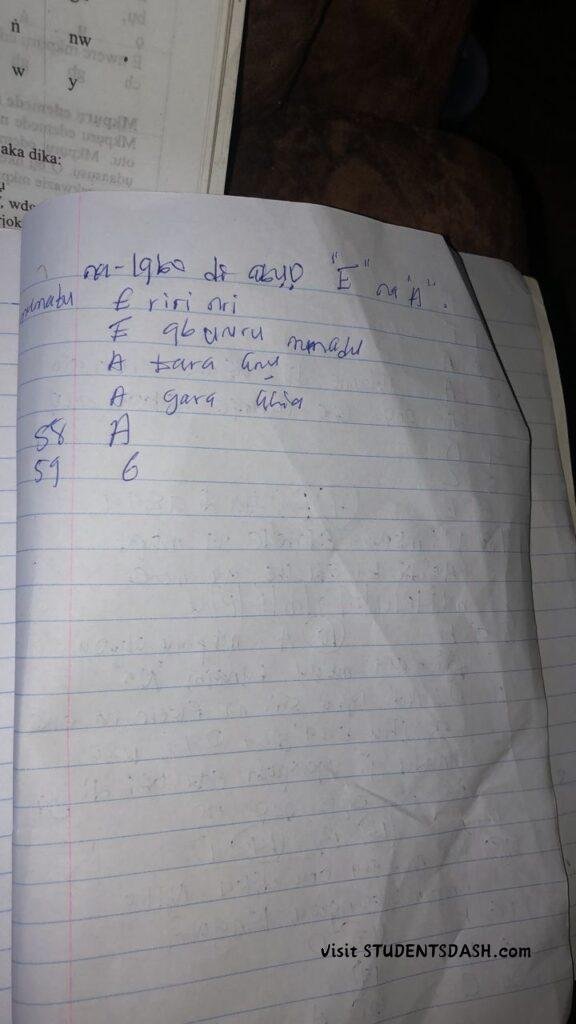
Title: GST 105 (Carryover – Old Code) Past Questions and Answers URL: https://studentsdash.com/gst-105-carryover-old-code-past-questions-and-answers/ -------------------------------------------------- Ihe na-ebuwe ụzọ na mmekọrịta mmadụ na ibe ya bụ? A. asịrị B. esemokwu C. ekele D. omenaala Answer: C Ndị Igbo sịrị “ekwee ekele” A. obi ụtọ adị B. udo adị C. enwee nghọta D. ihu asaa Answer: D Ibọọlachi bụ ekele A. ehihe B. abalị C. ụtụtụ D. agbamume Answer: C Naawo bụ ekele A. ehihe B. abalị C. ụtụtụ D. agbamume Answer: C Kachifoo bụ ekele A. ehihe B. abalị C. ụtụtụ D. agbamume Answer: B Obodo na-ekele jọọkwa n’ala Igbo bụ ndị A. Ọhọzara B. Nkanụ C. Abịrịba D. Afikpo Answer: D Ụzọ ọzọ ndị Igbo si ezipụta ekele bụ site na A. ịchị ọchị B. ibi ọma C. ikwe isi D. mkparịta ụka Answer: B Kedu nke na-abụghị ụzọ ndị Igbo si ezipụta ekele A. nnupu isi B. ibi ọma C. ikwe n’aka D. ekele ọnụ Answer: A N’ala Igbo ikwe n’aka bụ A. ekele B. ọgụ C. mgba D. ịkwa emu Answer: A Daalụ bụ ekele A. ehihe B. abalị C. ụtụtụ D. agbamume Answer: D Ekele onye rụrụ oru ọma bụ A. Imeela B. abalị ọma C. ụtụtụ ọma D. Ndo Answer: A Ekele onye ọrịa bụ A. Imeela B. abalị ọma C. ụtụtụ ọma D. Ndo Answer: D Kedu nke na-abụghị ekele onye na-arụ ọrụ A. Ị dị ike ọrụ B. Jisie ike C. Daalụ ọlụ D. Ndo Answer: D Mkpụrụ edemede Igbo bụ ……………….. e ji ede asụsụ Igbo. A. ụdaolu B. ọtọgrafị C. vọwelụ D. asụsụ Answer: B Mkpụrụ edemede Igbo dị ……………………………………………. A. 61 B. 32 C. 36 D. 45 Answer: C Ụdaume Igbo dị …………………………………………………………………. A. 10 B. 12 C. 13 D. 8 Answer: D Mgbochiume Igbo dị …………………………………………………………… A. 41 B. 32 C. 15 D. 28 Answer: D Ndị a bụ ezi ọmụmaatụ mgbochiume – m, k, g, h – ………………………… A. Eziokwu B. Asị C. o weghi m anya D. o nwere ike Answer: A Ndị a abụghị ezi ọmụmaatụ mgbochiume – o, u, i – ………………………….. A. Eziokwu B. Asị C. amaghị m D. otu bụ asịsa ya Answer: A Ụda mfe dị ……………………………………. A. 4 B. 6 C. 8 D. 2 Answer: A Ụda arọ dị …………………………………….. A. 3 B. 5 C. 4 D. 8 Mkpụrụ edemede Igbo nwere ntụpọ dị ………………………….. A. 4 B. 5 C. 6 D. 8 Answer: A Mkpụrụ edemede gbara mkpị dị …………………… n’Igbo A. 7 B. 9 C. 5 D. 3 Answer: B Ọ bụ na mkpụrụ ụdaasụsụ ka esi emepụta mkpụrụokwu ………… A. Eziokwu B. Asị C. amaghị m D. otu bụ asịsa ya Answer: A Ana-esi na mkpụrụ ụdaasụsụ emepụta isingwaa …………………….. A. oweghị m anya B. onwereike C. Eziokwu D. amaghị m Answer: C Ndịa abụghị ọmumaatụ isingwaa – fe, gwa, ri – …………………………… A. amaghị m B. Asị C. Eziokwu D. otu bụ asịsa ya Answer: D Enweghiike ijikọta mkpụrụ ụdaasụsụ were mebe mkpụrụokwu ……… A. Eziokwu B. Asị C. amaghị m D. otu bụ asịsa ya Answer: B /ŋ/ bụ akara (symbol) otu mgbochiume nwere ntụpọ ……………………….. A. Asi B. o nwereike C. Eziokwu D. amaghị m Answer: C /kp/ bụ akara mgbochiume mkpị ……………………………… A. amaghị m B. Asi C. Eziokwu D. otu bụ asịsa ya Answer: C Nanị otu n’ime mkpụrụ edemede ndị a bụ mgbochiume – m, k, o, p ……………… A. Eziokwu B. Asị C. amaghị m D. otu bụ asịsa ya Answer: B Mkpụrụ edemede akara ihe n’okpuru ya bụ ………………………….. A. mgbochiume B. ụdaolu C. ụdaume D. ntụpọ Answer: D “Akwụkwọ” nwere mkpụrụedemede …………………………………………. A. 6 B. 5 C. 7 D. 9 Answer: B “Mkputamkpu” nwere mkpụrụ edemede ……………………………. A. 9 B. 7 C. 8 D. 10 Answer: C Nkeji asụsụ Igbo dị olee? A. Asaa B. Ise C. Asatọ D. Iri Answer: D Kedu ihe na-abụghị Aha n’ebe a? A. Aha mmadụ B. Aha ihe C. Ọtọgrafị D. Aha ebe Answer: C ‘Ọnwụ’ bụ otu n’ime aha ndị a. A. Ahaaka B. Ahaizugbe C. Ahauche D. Ahaigwe Answer: C E nwere nnọchiaha ……….. A. Ise B. Asaa C. Atọ D. Iri Answer: B Kedu mkpụrụedemede e ji emebe nnọchiaha? A. Mgbochiume B. Ụdamkpị C. Ụdange D. Ụdaume na myiri ụdaume Answer: D Mkpọaha nwere ngalaba A. Anọ B. Ise C. Asatọ D. Iri Answer: A Nnọchiaha bụ okwu na-anọchi ….. A. Oche B. Aha mmadụ C. Akwụkwọ D. Ngwaa Answer: B Otu n’ime ndị a abụghị njụajụjụ A. Anaa B. Ebee C. Ọ dị mma D. Onye Answer: C Nkọwaaha bụ okwu na-akọwa maka A. Ngwaa B. Aha C. Nnọchiaha D. Nrụaka Answer: B Mkpọolu bụ …… A. M B. Anyị C. Unu D. Ha. Answer: A Ụbara onye atọ bụ ……… A. Anyị B. m C. Unu D. Ha Answer: A Nrụaka bụ okwu na-egosi……… A. Ihe a na-ekwu maka ya. B. ihe mmadụ na-eme. C. Ebe mmadụ na-aga. D. Ọrụ mmadụ na-arụ. Answer: A Ngwaa na-eme ka ahịrịokwu nwee……. A. Nghọta zuru oke. B. okwu dị ogologo. C. Ahịrịokwu maa mma. D. Ahịrịokwu nwee isi. Answer: A Mgbakwunye na-eso………. A. Nnọchiaha B. Nkọwaaha C. Mkpọaha D. Ngwaa. Answer: D Isingwaa mfe bụ ndị nwere…… A. otu nkejiokwu. B. nkejiokwu abụọ C. Nkejiokwu atọ D. Nkejiokwu anọ. Answer: A Nnyemakangwaa na-enyere ………..aka iji kwudosie ike n’ahịrịokwu. A. Omekangwaa. B. Isingwaa C. Isingwaa mfe D. Ngwaa. Answer: A Mmejupụta ngwaa bụ mkpụrụokwu na-esota ngwaa n’……. A. Azụ B. Ihu C. Etiti D. Ime. Answer: A Otu n’ime ndị a abụghị ụzọ e si amụba mkpụrụokwu A. Ngannihu. B. Nsonaazụ C. Ọnụọgụgụ. D. Nnọneetiti. Answer: C Omekangwaa bụ mkpụrụokwu …… A. na-akwudosi ike n’ahịrịokwu. B. anaghị akwudosi ike n’ahịrịokwu. C. Zuru oke D. nwere nghọta. Answer: A A na-eji akara ………..egosi nnyemakangwaa. A. Akara ọcha B. Akara uhie. C. Akara oji D. Akara ogologo. Answer: B Aha ndị a na- agụta ọnụ gụnyere ma ewepu ….. A. Ahaaka. B. Aha omee. C. . Ahaizugbe. D. Ahauche. Answer: D Ọyọkọ ube bụ ….. A. Ahaigwe. B. Ahaaka. C. Ahauche D. Aha izugbe. Answer: A Kedu nnọchiaha ahịrịokwu a na-akọwa ‘E riri nri’. A. Nnọchionye. B. Nnọchimpesin. C. Nnọchionwe. D. Nnọchinkọwa. Answer: B Aha ọnwa bụ ………. A. Ahaaka. B. Ahaizugbe. C. Ahaigwe. D. Ahaomee Answer: A Okwu ndị a bụ nkọwaaha ma ewepu……. A. Nwanyị ọma. B. Ewu oji. C. Ọjọọ mmadụ. D. Nkịta ọcha. Answer: A Otu n’ime ndị a abụghị njirimara nkọwa. A. Nkọwa na-eso mkpọaha. B. Nkọwa enweghi ike ikwu naanị ya. C. Nkọwa anaghị eso mkpụrụokwu ‘dị’. D. Nkọwa anaghị akọwa mkpọaha. Answer: B Mkpụrụokwu a bụ otu n’ime nrụaka. A. Ga. B. Jee. C. Ahụ. D. Ka. Answer: C Nrụaka bụ otu n’ime ngalaba…… A. Nnọchiaha. B. Aha. C. Nkọwaaha. D. Ngwaa. Answer: C Ngalaba ngwaa dị…… A. Asaa. B. Ise. C. Isii. D. Anọ. Answer: B E si na……enweta okwu ọhụrụ. A. Aha. B. Ngwaa. C. Nnọchiaha. D. Nkọwaaha. Answer: B Ngwaa ọbụla ga-enweriri ……… A. Isingwaa. B. Akangwaa. C. Ụkwụngwaa. D. Ahangwaa. Answer: A ‘Na’ na-arụ ọrụ dịka…… A. Tensi ndịugbu a. B. Tensi Ndịniihu. C. Ndịnaazụ. D. Njụ. Answer: D ‘Ga’ na-arụ ọrụ dịka……. A. Tensi Ndịnaazụ. B. Ndịugbua. C. Njụ. D. Ndịniihu. Answer: B Ọtụtụ okwu Igbo na-amụba site na ……… A. Aha. B. Ngwaa. C. Nbọchiaha. D. Nkọwaaha. Answer: B Omekangwaa bụ mkpụrụokwu na-esote…… A. Ngwaa. B. Aha. C. Mkpọaha. D. Nnyemakangwaa. Answer: D Njikọ nwere ike ijikọ ma ewepu……….. A. Mmadụ na mmadụ. B. Aha na aha. C. Mkpụrụokwu na mkpụruokwu. D. Nnọchiaha na nnọchiaha. Answer: A Mkpụrụokwu ndị a bụ njikọ ma ewezuga……….. A. na. B. ma. C. maka. D. pụọ. Answer: D Mkpụrụokwu e ji mara mbuụzọ bụ ……….. A. na. B. ka, C. ga. D. le. Answer: A A na-ederu ‘na’ n’isi mgbe ọ na-esote ………. A. Aha. B. Mgbochiume. C. Ụdaume. D. Omekangwaa. Answer: B E nwere nnyemakangwaa olee n’asụsụ Igbo? A. Atọ. B. Abụọ. C. Ise. D. Anọ Answer: B Isingwaa kewara ụzọ ………. A. Atọ. B. Abụọ. C. Anọ. D. Iri. Answer: B Mfinitivu bụ otu n’ime ndị a……. A. eri. B. ori. C. oriri. D. iri. Answer: C Mkpụrụokwu olee ka e ji mara nrụaka? A. Abụọ. B. Atọ. C. Anọ. D. Ise. Answer: A Mkpụrụokwu ndị a bụ Nnọchiaha ma ewezuga ………. A. Ọ. B. Anyị. C. Unu. D. Chaa. Answer: D E kewara Nkọwaaha ụzọ…….. A. Isii. B. Asaa. C. Iri. D. Anọ. Answer: A Ọcha bụ nkọwaaha nke……… A. Nkọwa. B. Nkeonye. C. Nrụaka. D. Nọmba Answer: A ‘A’ na njikọ na-arụtụ. ……… A. Ihe dị nso aka. B. Ihe dị tere aka. C. Ihe na-adịghị. D. Ihe e merela. Answer: A Omekangwaa na nnyemakangwaa na-ejikọ aka arụ ọrụ dịka……. A. Aha. B. Ngwaa. C. Mkpọaha. D. Nnọchiaha. Answer: A Otu n’ime ndị a bụ ahauche A. Iwe. B. Imirikiti. C. Ewu. D. Aha obodo. Answer: A Etu edemede kwesịrị ịdị ka ọ wee dị mma kaa aka ma dịkwa ụtọ bụ A. akara edeme B. usoro edemede C. mkpụrụ okwu D. ụda Answer: A Ihe ọ bụla e dere ede maka ọgụgụ bụ A. edemede B. ndebe olu C. akara ụda olu D. Nsupe Answer: A

Image Post
Past Questions

GST 105 (IGBO) Past Questions and Answers (Quiz Questions)

Title: GST 105 (IGBO) Past Questions and Answers (Quiz Questions) URL: https://studentsdash.com/gst-105-igbo-past-questions/ -------------------------------------------------- Omekangwaa na nnyemakangwaa na-ejikọ aka arụ ọrụ dịka……. A. Aha. B. Ngwaa. C. Mkpọaha. D. Nnọchiaha. Answer: A ‘Na’ na-arụ ọrụ dịka…… A. Tensi ndịugbu a. B. Tensi Ndịniihu. C. Ndịnaazụ. D. Njụ. Answer: D Ihe ọ bụla e dere ede maka ọgụgụ bụ A. edemede B. ndebe olu C. akara ụda olu D. Nsupe Answer: A Ụzọ ọzọ ndị Igbo si ezipụta ekele bụ site na A. ịchị ọchị B. ibi ọma C. ikwe isi D. mkparịta ụka Answer: B Mkpụrụ edemede Igbo dị ……………………………………………. A. 61 B. 32 C. 36 D. 45 Answer: C Nrụaka bụ okwu na-egosi……… A. Ihe a na-ekwu maka ya. B. ihe mmadụ na-eme. C. Ebe mmadụ na-aga. D. Ọrụ mmadụ na-arụ. Answer: A Nanị otu n’ime mkpụrụ edemede ndị a bụ mgbochiume – m, k, o, p ……………… A. Eziokwu B. Asị C. amaghị m D. otu bụ asịsa ya Answer: B Mkpụrụ edemede Igbo bụ ……………….. e ji ede asụsụ Igbo. A. ụdaolu B. ọtọgrafị C. vọwelụ D. asụsụ Answer: B Daalụ bụ ekele A. ehihe B. abalị C. ụtụtụ D. agbamume Answer: D Kachifoo bụ ekele A. ehihe B. abalị C. ụtụtụ D. agbamume Answer: B Kedu nke na-abụghị ekele onye na-arụ ọrụ A. Ị dị ike ọrụ B. Jisie ike C. Daalụ ọlụ D. Ndo Answer: D Isingwaa mfe bụ ndị nwere…… A. otu nkejiokwu. B. nkejiokwu abụọ C. Nkejiokwu atọ D. Nkejiokwu anọ. Answer: A Mkpụrụokwu ndị a bụ njikọ ma ewezuga……… A. na. B. ma. C. maka. D. pụọ. Answer: D Mkpụrụ edemede akara ihe n’okpuru ya bụ ………………………….. A. mgbochiume B. ụdaolu C. ụdaume D. ntụpọ Answer: D ‘Ga’ na-arụ ọrụ dịka……. A. Tensi Ndịnaazụ. B. Ndịugbua. C. Njụ. D. Ndịniihu. Answer: B Ndị Igbo sịrị “ekwee ekele” A. obi ụtọ adị B. udo adị C. enwee nghọta D. ihu asaa Answer: D Nnọchiaha bụ okwu na-anọchi ….. A. Oche B. Aha mmadụ C. Akwụkwọ D. Ngwaa Answer: B Mkpụrụokwu olee ka e ji mara nrụaka? A. Abụọ. B. Atọ. C. Anọ. D. Ise. Answer: A Enweghiike ijikọta mkpụrụ ụdaasụsụ were mebe mkpụrụokwu ……… A. Eziokwu B. Asị C. amaghị m D. otu bụ asịsa ya Answer: B Ngwaa ọbụla ga-enweriri ……… A. Isingwaa. B. Akangwaa. C. Ụkwụngwaa. D. Ahangwaa. Answer: A “Mkputamkpu” nwere mkpụrụ edemede ……………………………. A. 9 B. 7 C. 8 D. 10 Answer: C Ndị a bụ ezi ọmụmaatụ mgbochiume – m, k, g, h – ………………………… A. Eziokwu B. Asị C. o weghi m anya D. o nwere ike Answer: A Nkọwaaha bụ okwu na-akọwa maka A. Ngwaa B. Aha C. Nnọchiaha D. Nrụaka Answer: B Kedu nke na-abụghị ụzọ ndị Igbo si ezipụta ekele A. nnupu isi B. ibi ọma C. ikwe n’aka D. ekele ọnụ Answer: A A na-eji akara ………..egosi nnyemakangwaa. A. Akara ọcha B. Akara uhie. C. Akara oji D. Akara ogologo. Answer: B E nwere nnọchiaha ……….. A. Ise B. Asaa C. Atọ D. Iri Answer: B A na-ederu ‘na’ n’isi mgbe ọ na-esote ………. A. Aha. B. Mgbochiume. C. Ụdaume. D. Omekangwaa. Answer: B Mkpụrụ edemede gbara mkpị dị …………………… n’Igbo A. 7 B. 9 C. 5 D. 3 Answer: B Ibọọlachi bụ ekele A. ehihe B. abalị C. ụtụtụ D. agbamume Answer: C Naawo bụ ekele A. ehihe B. abalị C. ụtụtụ D. agbamume Answer: C Ihe na-ebuwe ụzọ na mmekọrịta mmadụ na ibe ya bụ? A. asịrị B. esemokwu C. ekele D. omenaala Answer: C “Akwụkwọ” nwere mkpụrụedemede …………………………………………. A. 6 B. 5 C. 7 D. 9 Answer: B Ngalaba ngwaa dị…… A. Asaa. B. Ise. C. Isii. D. Anọ. Answer: B Kedu mkpụrụedemede e ji emebe nnọchiaha? A. Mgbochiume B. Ụdamkpị C. Ụdange D. Ụdaume na myiri ụdaume Answer: D Ụda mfe dị ……………………………………. A. 4 B. 6 C. 8 D. 2 Answer: A /kp/ bụ akara mgbochiume mkpị ……………………………… A. amaghị m B. Asi C. Eziokwu D. otu bụ asịsa ya Answer: C E si na……enweta okwu ọhụrụ. A. Aha. B. Ngwaa. C. Nnọchiaha. D. Nkọwaaha. Answer: B Kedu ihe na-abụghị Aha n’ebe a? A. Aha mmadụ B. Aha ihe C. Ọtọgrafị D. Aha ebe Answer: C Nnyemakangwaa na-enyere ………..aka iji kwudosie ike n’ahịrịokwu. A. Omekangwaa. B. Isingwaa C. Isingwaa mfe D. Ngwaa. Answer: A Ụbara onye atọ bụ ……… A. Anyị B. m C. Unu D. Ha Answer: A Mmejupụta ngwaa bụ mkpụrụokwu na-esota ngwaa n’……. A. Azụ B. Ihu C. Etiti D. Ime. Answer: A Otu n’ime ndị a abụghị ụzọ e si amụba mkpụrụokwu A. Ngannihu. B. Nsonaazụ C. Ọnụọgụgụ. D. Nnọneetiti. Answer: C Omekangwaa bụ mkpụrụokwu …… A. na-akwudosi ike n’ahịrịokwu. B. anaghị akwudosi ike n’ahịrịokwu. C. Zuru oke D. nwere nghọta. Answer: A Aha ndị a na- agụta ọnụ gụnyere ma ewepu ….. A. Ahaaka. B. Aha omee. C. . Ahaizugbe. D. Ahauche. Answer: D Ọyọkọ ube bụ ….. A. Ahaigwe. B. Ahaaka. C. Ahauche D. Aha izugbe. Answer: A Kedu nnọchiaha ahịrịokwu a na-akọwa ‘E riri nri’. A. Nnọchionye. B. Nnọchimpesin. C. Nnọchionwe. D. Nnọchinkọwa. Answer: B Aha ọnwa bụ ………. A. Ahaaka. B. Ahaizugbe. C. Ahaigwe. D. Ahaomee Answer: A Okwu ndị a bụ nkọwaaha ma ewepu……. A. Nwanyị ọma. B. Ewu oji. C. Ọjọọ mmadụ. D. Nkịta ọcha. Answer: A Otu n’ime ndị a abụghị njirimara nkọwa. A. Nkọwa na-eso mkpọaha. B. Nkọwa enweghi ike ikwu naanị ya. C. Nkọwa anaghị eso mkpụrụokwu ‘dị’. D. Nkọwa anaghị akọwa mkpọaha. Answer: B Mkpụrụokwu a bụ otu n’ime nrụaka. A. Ga. B. Jee. C. Ahụ. D. Ka. Answer: C Nrụaka bụ otu n’ime ngalaba…… A. Nnọchiaha. B. Aha. C. Nkọwaaha. D. Ngwaa. Answer: C Nkeji asụsụ Igbo dị olee? A. Asaa B. Ise C. Asatọ D. Iri Answer: D ‘Ọnwụ’ bụ otu n’ime aha ndị a. A. Ahaaka B. Ahaizugbe C. Ahauche D. Ahaigwe Answer: C Mkpọaha nwere ngalaba A. Anọ B. Ise C. Asatọ D. Iri Answer: A Otu n’ime ndị a abụghị njụajụjụ A. Anaa B. Ebee C. Ọ dị mma D. Onye Answer: C Mkpọolu bụ …… A. M B. Anyị C. Unu D. Ha. Answer: A Ngwaa na-eme ka ahịrịokwu nwee……. A. Nghọta zuru oke. B. okwu dị ogologo. C. Ahịrịokwu maa mma. D. Ahịrịokwu nwee isi. Answer: A Mgbakwunye na-eso………. A. Nnọchiaha B. Nkọwaaha C. Mkpọaha D. Ngwaa. Answer: D Ndịa abụghị ọmumaatụ isingwaa – fe, gwa, ri – …………………………… A. amaghị m B. Asị C. Eziokwu D. otu bụ asịsa ya Answer: D Ọ bụ na mkpụrụ ụdaasụsụ ka esi emepụta mkpụrụokwu ………… A. Eziokwu B. Asị C. amaghị m D. otu bụ asịsa ya Answer: A Ana-esi na mkpụrụ ụdaasụsụ emepụta isingwaa …………………….. A. oweghị m anya B. onwereike C. Eziokwu D. amaghị m Answer: C Ndị a abụghị ezi ọmụmaatụ mgbochiume – o, u, i – ………………………….. A. Eziokwu B. Asị C. amaghị m D. otu bụ asịsa ya Answer: A Ụda arọ dị …………………………………….. A. 3 B. 5 C. 4 D. 8 Answer: C Mkpụrụ edemede Igbo nwere ntụpọ dị ………………………….. A. 4 B. 5 C. 6 D. 8 Answer: A /ŋ/ bụ akara (symbol) otu mgbochiume nwere ntụpọ ……………………….. A. Asi B. o nwereike C. Eziokwu D. amaghị m Answer: C E nwere nnyemakangwaa olee n’asụsụ Igbo? A. Atọ. B. Abụọ. C. Ise. D. Anọ Answer: B Isingwaa kewara ụzọ ………. A. Atọ. B. Abụọ. C. Anọ. D. Iri. Answer: B Mfinitivu bụ otu n’ime ndị a……. A. eri. B. ori. C. oriri. D. iri. Answer: C Mkpụrụokwu ndị a bụ Nnọchiaha ma ewezuga ………. A. Ọ. B. Anyị. C. Unu. D. Chaa. Answer: D E kewara Nkọwaaha ụzọ…….. A. Isii. B. Asaa. C. Iri. D. Anọ. Answer: A Ọcha bụ nkọwaaha nke……… A. Nkọwa. B. Nkeonye. C. Nrụaka. D. Nọmba Answer: A ‘A’ na njikọ na-arụtụ. ……… A. Ihe dị nso aka. B. Ihe dị tere aka. C. Ihe na-adịghị. D. Ihe e merela. Answer: A Otu n’ime ndị a bụ ahauche A. Iwe. B. Imirikiti. C. Ewu. D. Aha obodo. Answer: A Etu edemede kwesịrị ịdị ka ọ wee dị mma kaa aka ma dịkwa ụtọ bụ// A. akara edeme B. usoro edemede C. mkpụrụ okwu D. ụda Answer: A Obodo na-ekele jọọkwa n’ala Igbo bụ ndị A. Ọhọzara B. Nkanụ C. Abịrịba D. Afikpo Answer: D N’ala Igbo ikwe n’aka bụ A. ekele B. ọgụ C. mgba D. ịkwa emu Answer: A Ekele onye rụrụ oru ọma bụ A. Imeela B. abalị ọma C. ụtụtụ ọma D. Ndo Answer: A Ekele onye ọrịa bụ A. Imeela B. abalị ọma C. ụtụtụ ọma D. Ndo Answer: D Ụdaume Igbo dị …………………………………………………………………. A. 10 B. 12 C. 13 D. 8 Answer: D Mgbochiume Igbo dị …………………………………………………………… A. 41 B. 32 C. 15 D. 28 Answer: D Njikọ nwere ike ijikọ ma ewepu……….. A. Mmadụ na mmadụ. B. Aha na aha. C. Mkpụrụokwu na mkpụruokwu. D. Nnọchiaha na nnọchiaha. Answer: A Mkpụrụokwu e ji mara mbuụzọ bụ ……….. A. na. B. ka, C. ga. D. le. Answer: A Ọtụtụ okwu Igbo na-amụba site na ……… A. Aha. B. Ngwaa. C. Nbọchiaha. D. Nkọwaaha. Answer: B Omekangwaa bụ mkpụrụokwu na-esote…… A. Ngwaa. B. Aha. C. Mkpọaha. D. Nnyemakangwaa. Answer: D Answers are after the questions Mkpụrụokwu ndị a bụ Nnọchiaha ma ewezuga ………. A. Ọ. B. Anyị. C. Unu. D. Chaa. Mkpụrụokwu a bụ otu n’ime nrụaka. A. Ga. B. Jee. C. Ahụ. D. Ka. Ụda mfe dị ……………………………………. A. 4 B. 6 C. 8 D. 2 Omekangwaa bụ mkpụrụokwu na-esote…… A. Ngwaa. B. Aha. C. Mkpọaha. D. Nnyemakangwaa. Otu n’ime ndị a abụghị njụajụjụ A. Anaa B. Ebee C. Ọ dị mma D. Onye Omekangwaa na nnyemakangwaa na-ejikọ aka arụ ọrụ dịka……. A. Aha. B. Ngwaa. C. Mkpọaha. D. Nnọchiaha. E nwere nnọchiaha ……….. A. Ise B. Asaa C. Atọ D. Iri Mkpụrụedemede Igbo nwere ntụpọ dị ………………………….. A. 4 B. 5 C. 6 D. 8 “Mkputamkpu” nwere mkpụrụ edemede ……………………………. A. 9 B. 7 C. 8 D. 10 Mkpụrụokwu e ji mara mbuụzọ bụ ……….. A. na. B. ka. C. ga. D. le. Ndị Igbo sịrị “ekwee ekele” A. obi ụtọ adị B. udo adị C. enwee nghọta D. ihu asaa Ọyọkọ ube bụ ….. A. Ahaigwe. B. Ahaaka. C. Ahauche. D. Aha izugbe. Nrụaka bụ okwu na-egosi……… A. Ihe a na-ekwu maka ya. B. Ihe mmadụ na-eme. C. Ebe mmadụ na-aga. D. Ọrụ mmadụ na-arụ. E kewara Nkọwaaha ụzọ…….. A. Isii. B. Asaa. C. Iri. D. Anọ. ‘Na’ na-arụ ọrụ dịka…… A. Tensi ndịugbu a. B. Tensi Ndịniihu. C. Ndịnaazụ. D. Njụ. Kedu nnọchiaha ahịrịokwu a na-akọwa ‘E riri nri’. A. Nnọchionye. B. Nnọchimpesin. C. Nnọchionwe. D. Nnọchinkọwa. Aha ndị a na-agụta ọnụ gụnyere ma ewepu ….. A. Ahaaka. B. Aha omee. C. Ahaizugbe. D. Ahauche. Kedu mkpụrụedemede e ji emebe nnọchiaha? A. Mgbochiume. B. Ụdamkpị. C. Ụdange. D. Ụdaume na myiri ụdaume. Ngalaba ngwaa dị…… A. Asaa. B. Ise. C. Isii. D. Anọ. Kedu ihe na-abụghị Aha n’ebe a? A. Aha mmadụ. B. Aha ihe. C. Ọtọgrafị. D. Aha ebe. Ndị a bụ ezi ọmụmaatụ mgbochiume – m, k, g, h – ………………………… A. Eziokwu. B. Asị. C. o weghi m anya. D. o nwere ike. Mgbakwunye na-eso………. A. Nnọchiaha. B. Nkọwaaha. C. Mkpọaha. D. Ngwaa. Mkpọolu bụ …… A. M. B. Anyị. C. Unu. D. Ha. Obodo na-ekele jọọkwa n’ala Igbo bụ ndị A. Ọhọzara B. Nkanụ C. Abịrịba D. Afikpo Ekele onye ọrịa bụ A. Imeela B. Abalị ọma C. Ụtụtụ ọma D. Ndo Ụbara onye atọ bụ ……… A. Anyị B. M C. Unu D. Ha A na-eji akara ………..egosi nnyemakangwaa. A. Akara ọcha B. Akara uhie C. Akara oji D. Akara ogologo Mkpụrụokwu olee ka e ji mara nrụaka? A. Abụọ B. Atọ C. Anọ D. Ise Mkpụrụ edemede Igbo bụ ……………….. e ji ede asụsụ Igbo. A. Ụdaolu B. Ọtọgrafị C. Vọwelụ D. Asụsụ Otu n’ime ndị a abụghị ụzọ e si amụba mkpụrụokwu A. Ngannihu. B. Nsonaazụ. C. Ọnụọgụgụ. D. Nnọneetiti. Nkeji asụsụ Igbo dị olee? A. Asaa B. Ise C. Asatọ D. Iri Ụda mfe dị ……………………………………. A. 4 B. 6 C. 8 D. 2 Okwu ndị a bụ nkọwaaha ma ewepụ……. A. Nwanyị ọma. B. Ewu oji. C. Ọjọọ mmadụ. D. Nkịta ọcha. N’ala Igbo ikwe n’aka bụ A. Ekele. B. Ọgụ. C. Mgba. D. Ịkwa emu. E nwere nnọchiaha ……….. A. Ise B. Asaa C. Atọ D. Iri E nwere nnyemakangwaa olee n’asụsụ Igbo? A. Atọ. B. Abụọ. C. Ise. D. Anọ. Mgbakwunye na-eso………. A. Nnọchiaha B. Nkọwaaha C. Mkpọaha D. Ngwaa. Njikọ nwere ike ijikọ ma ewepụ……….. A. Mmadụ na mmadụ. B. Aha na aha. C. Mkpụrụokwu na mkpụrụokwu. D. Nnọchiaha na nnọchiaha. ‘Na’ na-arụ ọrụ dịka…… A. Tensi ndịugbu a. B. Tensi Ndịniihu. C. Ndịnaazụ. D. Njụ. Mkpụrụokwu olee ka e ji mara nrụaka? A. Abụọ. B. Atọ. C. Anọ. D. Ise. Aha ndị a na-agụta ọnụ gụnyere ma ewepụ ….. A. Ahaaka. B. Aha omee. C. Ahaizugbe. D. Ahauche. Ekele onye rụrụ oru ọma bụ A. Imeela B. Abalị ọma C. Ụtụtụ ọma D. Ndo Ngalaba ngwaa dị…… A. Asaa. B. Ise. C. Isii. D. Anọ. Ọcha bụ nkọwaaha nke……… A. Nkọwa. B. Nkeonye. C. Nrụaka. D. Nọmba. Ibọọlachi bụ ekele A. Ehihe B. Abalị C. Ụtụtụ D. Agbamume ‘Ga’ na-arụ ọrụ dịka……. A. Tensi Ndịnaazụ. B. Ndịugbua. C. Njụ. D. Ndịniihu. Otu n’ime ndị a bụ ahauche A. Iwe. B. Imirikiti. C. Ewu. D. Aha obodo. Isingwaa mfe bụ ndị nwere…… A. Otu nkejiokwu. B. Nkejiokwu abụọ. C. Nkejiokwu atọ. D. Nkejiokwu anọ. Enweghiike ijikọta mkpụrụ ụdaasụsụ were mebe mkpụrụokwu ……… A. Eziokwu B. Asị C. Amaghị m D. Otu bụ asịsa ya Ihe na-ebuwe ụzọ na mmekọrịta mmadụ na ibe ya bụ? A. Asịrị B. Esemokwu C. Ekele D. Omenala Ana-esi na mkpụrụ ụdaasụsụ emepụta isingwaa …………………….. A. Oweghị m anya B. Onwereike C. Eziokwu D. Amaghị m E kewara Nkọwaaha ụzọ…….. A. Isii. B. Asaa. C. Iri. D. Anọ. Nkọwaaha bụ okwu na-akọwa maka A. Ngwaa B. Aha C. Nnọchiaha D. Nrụaka Nnọchiaha bụ okwu na-anọchi ….. A. Oche B. Aha mmadụ C. Akwụkwọ D. Ngwaa Ọtụtụ okwu Igbo na-amụba site na ……… A. Aha. B. Ngwaa. C. Nbọchiaha. D. Nkọwaaha. Kedu nke na-abụghị ekele onye na-arụ ọrụ? A. Ị dị ike ọrụ. B. Jisie ike. C. Daalụ ọlụ. D. Ndo. Kedu nnọchiaha ahịrịokwu a na-akọwa ‘E riri nri’? A. Nnọchionye. B. Nnọchimpesin. C. Nnọchionwe. D. Nnọchinkọwa. Ngwaa na-eme ka ahịrịokwu nwee……. A. Nghọta zuru oke. B. Okwu dị ogologo. C. Ahịrịokwu maa mma. D. Ahịrịokwu nwee isi. Mkpụrụ edemede Igbo nwere ntụpọ dị ………………………….. A. 4 B. 5 C. 6 D. 8 (MOST QUESTIONS PAGE 2) ANSWERS

Image Post
Past Questions

GST 106 Past Questions and Answers

Title: GST 106 Past Questions and Answers URL: https://studentsdash.com/gst-106-past-questions-and-answers/ -------------------------------------------------- What is entrepreneurship? a) The process of starting and managing a new business b) Working for a corporation c) Selling products online d) Buying stocks Answer: a) The process of starting and managing a new business Which of the following is a key characteristic of successful entrepreneurs? a) Fear of failure b) Risk-taking ability c) Avoidance of change d) Lack of vision Answer: b) Risk-taking ability What is a business plan? a) A legal document b) A detailed plan outlining business goals and strategies c) A sales pitch d) A marketing brochure Answer: b) A detailed plan outlining business goals and strategies What does the term “market research” refer to? a) Collecting information about consumer needs and preferences b) Selling products c) Advertising strategies d) Hiring employees Answer: a) Collecting information about consumer needs and preferences Which of the following is a common source of funding for startups? a) Personal savings b) Bank loans c) Venture capital d) All of the above Answer: d) All of the above What is the purpose of a SWOT analysis? a) To analyze the stock market b) To assess strengths, weaknesses, opportunities, and threats c) To calculate profits d) To evaluate employees Answer: b) To assess strengths, weaknesses, opportunities, and threats What is the role of a mentor in entrepreneurship? a) To discourage new ideas b) To provide guidance and support c) To take over the business d) To replace the entrepreneur Answer: b) To provide guidance and support What does “branding” involve? a) Creating a unique identity for a product or service b) Setting prices for products c) Writing business plans d) Hiring staff Answer: a) Creating a unique identity for a product or service What is a “target market”? a) The total market for all products b) The specific group of consumers a business aims to reach c) A market with no competition d) A market for government contracts Answer: b) The specific group of consumers a business aims to reach Which of the following is a benefit of entrepreneurship? a) Increased risk of failure b) Opportunity for financial independence c) Lack of flexibility d) Limited job satisfaction Answer: b) Opportunity for financial independence What does “cash flow” refer to? a) The money coming in and going out of a business b) The total profit of a business c) The amount of debt a business has d) The number of employees Answer: a) The money coming in and going out of a business What is an elevator pitch? a) A long business presentation b) A brief and persuasive speech to spark interest in a project c) A pitch for an investment d) A formal proposal document Answer: b) A brief and persuasive speech to spark interest in a project Which of the following describes “entrepreneurial spirit”? a) A lack of innovation b) A passion for creating and building businesses c) A focus on job security d) Resistance to change Answer: b) A passion for creating and building businesses What is “market segmentation”? a) Dividing a market into smaller groups of consumers b) Merging companies c) Selling to only one type of customer d) Ignoring customer needs Answer: a) Dividing a market into smaller groups of consumers What is the primary goal of marketing? a) To create products b) To promote and sell products or services c) To hire employees d) To develop financial plans Answer: b) To promote and sell products or services What does “scalability” mean in a business context? a) The ability to maintain current performance levels b) The potential to grow and increase revenue without proportionately increasing costs c) The difficulty of expanding d) The ability to hire more staff Answer: b) The potential to grow and increase revenue without proportionately increasing costs Which of the following is a disadvantage of entrepreneurship? a) Flexibility in decision-making b) High levels of uncertainty and risk c) Ability to pursue personal passions d) Potential for high profits Answer: b) High levels of uncertainty and risk What is “competitive analysis”? a) Examining only your own business b) Assessing competitors to understand their strengths and weaknesses c) Ignoring market trends d) Focusing solely on financial data Answer: b) Assessing competitors to understand their strengths and weaknesses What does “e-commerce” refer to? a) Traditional retail shopping b) Buying and selling goods or services over the internet c) A type of advertising d) A method of public speaking Answer: b) Buying and selling goods or services over the internet What is “customer relationship management” (CRM)? a) A strategy for managing a company’s interactions with current and potential customers b) A financial management tool c) A method of product development d) A way to hire employees Answer: a) A strategy for managing a company’s interactions with current and potential customers What is the “value proposition”? a) The price of a product b) The unique value a product or service offers to customers c) The profit margin d) The cost of production Answer: b) The unique value a product or service offers to customers What does “venture capital” refer to? a) Money provided by investors to startups and small businesses with long-term growth potential b) Funds saved by entrepreneurs c) Government grants for small businesses d) Loans from banks Answer: a) Money provided by investors to startups and small businesses with long-term growth potential Which of the following is a key element of effective networking? a) Focusing only on personal gain b) Building mutually beneficial relationships c) Ignoring others’ interests d) Avoiding follow-ups Answer: b) Building mutually beneficial relationships What does “bootstrapping” mean in business? a) Starting a business with minimal financial resources b) Seeking large investments from the start c) Relying solely on bank loans d) Ignoring cost management Answer: a) Starting a business with minimal financial resources What is the primary role of a business consultant? a) To manage daily operations b) To provide expert advice and strategies to improve a business c) To replace the business owner d) To focus only on marketing Answer: b) To provide expert advice and strategies to improve a business What is “social entrepreneurship”? a) Focusing solely on profit-making b) Creating businesses that aim to solve social problems c) Ignoring community needs d) Running a traditional nonprofit organization Answer: b) Creating businesses that aim to solve social problems Which of the following describes a “startup”? a) A well-established company b) A newly established business, often in the early stages of development c) A nonprofit organization d) A large corporation Answer: b) A newly established business, often in the early stages of development What is “customer feedback”? a) Ignoring customer opinions b) Information provided by customers about their experiences with a product or service c) The price customers are willing to pay d) Marketing strategies Answer: b) Information provided by customers about their experiences with a product or service What does “profit margin” refer to? a) The total revenue of a business b) The difference between revenue and costs expressed as a percentage c) The amount of debt a business has d) The cost of production Answer: b) The difference between revenue and costs expressed as a percentage What is the purpose of a marketing strategy? a) To increase costs b) To outline how a business will reach its target market c) To ignore consumer preferences d) To manage operations Answer: b) To outline how a business will reach its target market What does “diversification” mean in business? a) Focusing on one product only b ) Expanding a business’s range of products or services c) Reducing the workforce d) Ignoring market trends Answer: b) Expanding a business’s range of products or services What is “lead generation”? a) The process of attracting and converting potential customers b) Selling to existing customers c) Increasing operational costs d) Ignoring marketing Answer: a) The process of attracting and converting potential customers Which of the following best describes “angel investors”? a) Individuals who provide capital to startups in exchange for equity b) Banks that offer loans c) Government agencies that fund businesses d) Corporate investors Answer: a) Individuals who provide capital to startups in exchange for equity What is the role of a business incubator? a) To shut down businesses b) To support startups by providing resources, mentorship, and funding c) To only provide office space d) To ignore the needs of entrepreneurs Answer: b) To support startups by providing resources, mentorship, and funding What does “supply chain management” involve? a) Managing only the sales department b) Overseeing the flow of goods and services from suppliers to customers c) Ignoring supplier relationships d) Focusing solely on production Answer: b) Overseeing the flow of goods and services from suppliers to customers What is “intellectual property”? a) Physical assets of a business b) Creations of the mind, such as inventions and trademarks c) Financial statements d) Employee knowledge Answer: b) Creations of the mind, such as inventions and trademarks What does “scalability” mean for a business model? a) The inability to grow b) The capacity to grow and manage increased demand without significant cost increases c) A focus on a single product d) A fixed operational capacity Answer: b) The capacity to grow and manage increased demand without significant cost increases What is the importance of customer service in business? a) It has no importance b) It helps build customer loyalty and satisfaction c) It increases operational costs d) It focuses solely on profits Answer: b) It helps build customer loyalty and satisfaction Which of the following is an example of a social enterprise? a) A company focused solely on profit b) A nonprofit organization c) A business that reinvests profits to achieve social objectives d) A government agency Answer: c) A business that reinvests profits to achieve social objectives What is “peer-to-peer lending”? a) Borrowing from banks b) Individuals lending money to each other without an intermediary c) Government funding for businesses d) Corporate loans Answer: b) Individuals lending money to each other without an intermediary What does “innovation” mean in a business context? a) Sticking to traditional methods b) Developing new ideas, products, or processes c) Ignoring competition d) Focusing solely on existing products Answer: b) Developing new ideas, products, or processes What is the purpose of a business pitch? a) To confuse potential investors b) To present an idea to potential investors or stakeholders c) To sell products d) To ignore market trends Answer: b) To present an idea to potential investors or stakeholders What is “lean startup methodology”? a) A process focusing on rapid prototyping and customer feedback b) A traditional business planning approach c) A method for large corporations only d) Ignoring customer input Answer: a) A process focusing on rapid prototyping and customer feedback Which of the following is an essential component of effective leadership? a) Micromanagement b) Communication skills c) Avoiding team input d) Focusing solely on profits Answer: b) Communication skills What is the role of a board of directors in a company? a) To handle day-to-day operations b) To provide oversight and strategic guidance c) To replace the CEO d) To focus only on marketing Answer: b) To provide oversight and strategic guidance What is a “franchise”? a) A completely independent business b) A business model where one party licenses the use of its brand to another party c) A nonprofit organization d) A government-run enterprise Answer: b) A business model where one party licenses the use of its brand to another party What does “business ethics” refer to? a) Ignoring moral principles in business b) The study of what is right and wrong in business practices c) Focusing solely on profits d) Legal regulations only Answer: b) The study of what is right and wrong in business practices Which of the following is a common challenge faced by entrepreneurs? a) Too much funding b) High competition c) Excessive support from the community d) Perfect market conditions Answer: b) High competition What is the significance of “exit strategy” for entrepreneurs? a) It has no significance b) It outlines how an entrepreneur plans to sell or close their business c) It focuses solely on profits d) It is a marketing tactic Answer: b) It outlines how an entrepreneur plans to sell or close their business What is “business development”? a) The process of improving existing products only b) Activities aimed at growing a business through partnerships, markets, and strategies c) A focus on daily operations d) Ignoring market opportunities Answer: b) Activities aimed at growing a business through partnerships, markets, and strategies

Image Post
Past Questions

GST 107 Past Questions and Answers

Title: GST 107 Past Questions and Answers URL: https://studentsdash.com/gst-107-past-questions-and-answers-2/ -------------------------------------------------- Ajụjụ: Gịnị ka “ezinaụlọ” pụtara n’omenala Igbo? A) Ụmụnne na Ụmụnna B) Ụlọ nne na nna C) Enyi D) Ndị agbata obi Azịza: B) Ụlọ nne na nna Ajụjụ: N’omenala Igbo, onye bụ onye kacha mma inye nduzi na ezinụlọ? A) Ụmụaka kacha lớn B) Nna C) Nne D) Ndị ikwu Azịza: B) Nna Ajụjụ: Kedu okwu na-akọwa lineage n’Igbo? A) Omenala B) Igbodo C) Ọha D) Okwu Azịza: C) Ọha Ajụjụ: Kedu ụdị ezinụlọ na-ahụkarị n’Igbo? A) Ezinụlọ okpukpu abụọ B) Ezinụlọ na-enweghị nna C) Ezinụlọ nke Ụmụnna D) Ezinụlọ nke ndị agbata obi Azịza: A) Ezinụlọ okpukpu abụọ Ajụjụ: Olee otú a si ahọpụta onye isi ezinụlọ n’Igbo? A) Site n’ịgba otu B) Site na afọ C) Site na ọnụ ọgụgụ ụmụaka D) Site na ikike Azịza: D) Site na ikike Ajụjụ: Gịnị bụ ihe dị mkpa banyere “agumagu” n’omenala Igbo? A) Usoro nri B) Akụkọ C) Akwụkwọ nkọwa na amamihe D) Egwuregwu Azịza: C) Akwụkwọ nkọwa na amamihe Ajụjụ: Kedu otu n’ime okwu agumagu ndị a bụ nke a na-ejikarị na Igbo? A) Ebe anụ na-adịghị, anwụ na-adịghị. B) Ọkụ na-ejiri mmadụ gbaa. C) Nwa na-adịghị arịọ anaghị enweta. D) Ihe a na-eme, abụghị ihe a na-eti. Azịza: C) Nwa na-adịghị arịọ anaghị enweta. Ajụjụ: Olee ihe a na-atụ anya mgbe a na-ejikarị agumagu? A) Ịkpa ikwu B) Iwepụta akwụkwọ C) Ịkekọrịta ihe ọmụma D) Ịkpọrọ egwu Azịza: C) Ịkekọrịta ihe ọmụma Ajụjụ: Gịnị ka agumagu na-enye na ndụ? A) Ncheta B) Iwepụ nsogbu C) Amamihe D) Ụmụaka Azịza: C) Amamihe Ajụjụ: Kedu ihe nwere ike ịbụ nke a na-eme n’okwu agumagu? A) Eziokwu B) Ekwensu C) Nkụzi D) Ihe ijuanya Azịza: A) Eziokwu Ajụjụ: Gịnị ka “oji” na-anọchite anya na omenala Igbo? A) Ọgaranya B) Udo na enyi C) Ikwu D) Amamihe Azịza: B) Udo na enyi Ajụjụ: Kedu ka a na-ejikarị “oji” n’ọdịnihu? A) Dị ka nri B) Maka ịchọ mma C) Maka ngọzi na ekpere D) Maka ememe Azịza: C) Maka ngọzi na ekpere Ajụjụ: Kedu ihe a na-eme na oji tupu emume? A) A na-ere ya B) A na-ewepụ ya C) A na-esi nri ya D) A na-ekpe ekpere Azịza: D) A na-ekpe ekpere Ajụjụ: Olee otu oji si dị n’ime emume? A) Ebe a na-esi nri B) N’otu akpọrọ C) Dị ka ihe a na-enweta D) Dị ka nri Azịza: C) Dị ka ihe a na-enweta Ajụjụ: Kedu ihe oji na-anọchite anya n’ịgba ọgwụgwụ? A) Ọganihu B) Okwu C) Okwu oma D) Ọnwụ Azịza: A) Ọganihu Ajụjụ: Gịnị ka “alumdinanwunye” pụtara? A) Ikwu ume Ụmụnwanyị B) Ọrụ Ụmụnwanyị n’ezinụlọ C) Ọrụ ụmụ nwoke D) Ịmụ ụmụ Azịza: B) Ọrụ Ụmụnwanyị n’ezinụlọ Ajụjụ: N’omenala Igbo, ụmụnwanyi na-arụkarị ọrụ nke: A) Ịkụ ọdụ B) Ahịa na nlekọta ụlọ C) Ndọrọndọrọ ọchịchị D) Ije agha Azịza: B) Ahịa na nlekọta ụlọ Ajụjụ: Kedu n’elu ọrụ ụmụnwanyi na omenala Igbo? A) Ụlọ na-arụ ọrụ B) Nlekọta ụmụaka C) Nlekọta ụlọ D) Ihe niile dị n’elu Azịza: D) Ihe niile dị n’elu Ajụjụ: Kedu ihe e ji mara ụmụnwanyi na Igbo? A) Ọrụ na-arụ B) Nlekọta na nlekọta C) Okwu na-eme D) Otu a na-achịkọta Azịza: A) Ọrụ na-arụ Ajụjụ: Kedu ihe a na-atụ anya ka ụmụnwanyi mee n’ezinụlọ? A) Ịkụzi B) Ịkwado C) Ije ije D) Nlekọta Azịza: D) Nlekọta Ajụjụ: Gịnị ka “omenaala” pụtara na omenala Igbo? A) Egwuregwu ọdịnala B) Omenala na omume C) Emume D) Nri Azịza: B) Omenala na omume Ajụjụ: Kedu emume a na-eme n’Igbo? A) Emume Akwukwo B) Emume Krismas C) Emume Easter D) Emume nke nnwere onwe Azịza: A) Emume Akwukwo Ajụjụ: Kedu nke a na-emekarị na emume Igbo? A) Ịgba egwú B) Ịkụ nzukọ C) Ịmụ akwụkwọ D) Ịrị elu Azịza: A) Ịgba egwú Ajụjụ: Gịnị ka e ji mara emume Akwukwo? A) Ime nri B) Ngọzi C) Ịgba egwu D) Ngwa ahịa Azịza: B) Ngọzi Ajụjụ: Kedu nke a bụ ihe ndị Igbo na-emekarị n’omenala ha? A) Ịgba egwu B) Ime nri C) Ịkekọrịta D) Ihe niile dị n’elu Azịza: D) Ihe niile dị n’elu Ajụjụ: Gịnị ka “akaoru” pụtara n’omenala Igbo? A) Ejiri okpukpu B) Nkà na ọrụ C) Egwuregwu na egwu D) Wụrụrụ Azịza: B) Nkà na ọrụ Ajụjụ: Kedu nke a bụ nkà ọdịnala Igbo? A) Ime ite B) Ịkụ akpụ C) Ịme ihe okike D) Ihe niile dị n’elu Azịza: D) Ihe niile dị n’elu Ajụjụ: Kedu ihe a na-eme na nka Igbo? A) Ịmepụta B) Ịzụlite C) Ime ihe D) Ihe niile dị n’elu Azịza: D) Ihe niile dị n’elu Ajụjụ: Kedu ihe nkà a na-ahụkarị n’Igbo? A) Ime nri B) Ịme nke mkpụrụ C) Ịkụ okpokoro D) All of the above Azịza: D) All of the above Ajụjụ: Kedu ihe a na-ekwu na nka Igbo? A) Okwu ọma B) Okwu atụ C) Okwu ọhụrụ D) Okwu pụrụ iche Azịza: A) Okwu ọma Ajụjụ: Gịnị ka “aru na nsoala” pụtara? A) Omenala ọma B) Iwu na nche C) Omenala D) Ememe Azịza: B) Iwu na nche Ajụjụ: Kedu otu n’ime iwu a na-ahụkarị n’omenala Igbo? A) Ịri nri na aka ekpe B) Ịgwa mkpọtụ C) Ịgba egwú D) Ịkụziri mmadụ Azịza: A) Ịri nri na aka ekpe Ajụjụ: Kedu ihe bụ isi na iwu aru na nsoala? A) Eziokwu B) Amamihe C) Ọdịnala D) Njikọ Azịza: C) Ọdịnala Ajụjụ: Olee ihe a na-atụ anya ka mmadụ mee iji gbochie aru na nsoala? A) Ịrụsi ọrụ B) Ịmara iwu C) Iji akụ na ụba D) Ịme ihe ọma Azịza: B) Ịmara iwu Ajụjụ: Kedu ihe dị iche na aru na nsoala na omenala Igbo? A) Iwu na akparamàgwà B) Iwu na ngọzi C) Iwu na izugbe D) Iwu na akụ Azịza: A) Iwu na akparamàgwà Ajụjụ: Gịnị ka “ekele” pụtara? A) Ngọzi B) Nnabata C) Ikwesịrị D) Ememe Azịza: B) Nnabata Ajụjụ: Nnabata Igbo maka “ụtụtụ ọma” bụ: A) Kedu B) Ụtụtụ ọma C) Ị bịa? D) Ndewo Azịza: B) Ụtụtụ ọma Ajụjụ: Kedu otu ị ga-esi ekele mmadụ na Igbo? A) Ndewo B) Kedu C) Nnoo D) All of the above Azịza: D) All of the above Ajụjụ: Olee ihe e ji mara nkwanye ugwu n’Igbo? A) Ịsị na ekele B) Ịsị ka e nwee C) Ịmara na ekele D) Ịsị ka ewere Azịza: A) Ịsị na ekele Ajụjụ: Kedu ihe a na-eme mgbe a na-enyere ekele? A) Ekele na-enwe eziokwu B) Ekele na-enyere C) Ekele na-enwe udo D) Ekele na-enwe ike Azịza: C) Ekele na-enwe udo Ajụjụ: Gịnị ka “otu nzuzo” pụtara n’omenala Igbo? A) Ndị ọzọ B) Otu a na-azụlite C) Otu ekeresimesi D) Otu egwu Azịza: B) Otu a na-azụlite Ajụjụ: Kedu uru nke otu nzuzo na omenala Igbo? A) Nkwado na inye aka B) Iwepu C) Imerụ D) Njikọ Azịza: A) Nkwado na inye aka Ajụjụ: Kedu ihe a na-eme na otu nzuzo? A) Iji kwuo B) Iji kparịta ụka C) Iji gbanwee ndụ D) Ihe niile dị n’elu Azịza: D) Ihe niile dị n’elu Ajụjụ: Kedu okwu na-akọwa otu nzuzo? A) Nzuzo B) Nkwanye C) Ezi D) Nkwado Azịza: A) Nzuzo Ajụjụ: Olee ihe a na-atụ anya ka ndị otu nzuzo mee? A) Ikekọrịta B) Nkwado C) Ọrụ na-ejikọta D) Ihe niile dị n’elu Azịza: D) Ihe niile dị n’elu Ajụjụ: Kedu ụzọ e si achọpụta onye bụ ezi nna n’Igbo? A) Site na akụ B) Site na ọmụmụ C) Site na ọrụ D) Site na ụka Azịza: B) Site na ọmụmụ Ajụjụ: Kedu ihe bụ isi na ndụ ezinụlọ? A) Ịkekọrịta B) Iji akụ C) Ịkparịta ụka D) Ihe niile dị n’elu Azịza: D) Ihe niile dị n’elu Ajụjụ: Kedu onye na-ahụ maka nlekọta n’ezinụlọ? A) Nna B) Nne C) Ụmụaka D) Ụmụnne Azịza: B) Nne Ajụjụ: Kedu ihe a na-eme na ezinaụlọ n’Igbo? A) Ịkọ akụkọ B) Ịmụta C) Ịkpọrọ D) Ihe niile dị n’elu Azịza: D) Ihe niile dị n’elu Ajụjụ: Kedu ụzọ e si atụ uche n’ezinaụlọ? A) Site n’ịkpa ikwu B) Site n’ịmara ihe C) Site n’ịkekọrịta D) Ihe niile dị n’elu Azịza: D) Ihe niile dị n’elu

Image Post
Past Questions

Can You Receive NELFUND Upkeep Payment Without Receiving Your School Fees_

Title: Can You Receive NELFUND Upkeep Payment Without Receiving Your School Fees? URL: https://studentsdash.com/can-you-receive-nelfund-upkeep-payment-without-receiving-your-school-fees/ -------------------------------------------------- Many Nigerian students have been asking whether it’s possible to receive their NELFUND upkeep payment even if their school fees have not yet been paid. If you’re in this situation, you’re not alone. Some students notice that their upkeep allowance arrives first, while others see their tuition paid before their upkeep. This often leads to confusion about how NELFUND processes payments. Here’s what you need to know. How NELFUND Payments Work NELFUND provides financial support in two major ways: Institutional Fee (School Fees): This payment is made directly to your institution. Upkeep Allowance: This payment is sent directly to the bank account you provided during your application. Because these payments are different, they may not always be processed or received at the same time. Can You Receive Upkeep Before Your School Fees? Yes, it is possible. Some students receive their upkeep allowance before their institution confirms the receipt of school fees. Others may have their tuition paid first and wait longer for their upkeep. This difference is usually due to payment processing timelines and verification procedures. Receiving one payment before the other does not automatically indicate a problem with your application. Why Does This Happen? Several factors can affect the order in which payments are received. 1. Different Payment Channels Your upkeep allowance is sent directly to your personal bank account, while your school fees are sent to your institution. Since these payments go through different channels, they may not arrive simultaneously. 2. School Processing Time Even after NELFUND sends institutional fees, some schools may take time before updating students’ payment records. This means your school fees could already have been paid, but your institution has not yet reflected the payment. 3. Batch Processing NELFUND processes thousands of payments across Nigeria. To manage this, payments are often released in batches, meaning different students may receive different payments at different times. What Should You Do? If you’ve received your upkeep but your school hasn’t confirmed your tuition payment: Be patient and allow more time for processing. Confirm with your school’s bursary or accounts department if necessary. Continue checking your NELFUND dashboard for updates. Avoid submitting another application because of the delay. If you’ve received your school fees but your upkeep hasn’t arrived, the same advice applies. Payment timelines are not always identical. Should You Be Worried? In most cases, no. As long as your application remains active and there are no requests for additional information, it’s common for one payment to arrive before the other. However, if a significant amount of time has passed without any update, you may contact NELFUND or your institution for clarification. You may also find these articles helpful: Does Your Bank Affect How Fast You Receive NELFUND Payment? Does Your Bank Affect How Fast You Receive NELFUND Payment? Why Is My NELFUND Upkeep Payment Taking Longer Than Other Students? Why Is My NELFUND Upkeep Payment Taking Longer Than Other Students? Frequently Asked Questions Can I receive only my upkeep payment? Yes. Some students receive their upkeep before their institutional fees are reflected. Can my school fees be paid without me knowing? Yes. Sometimes your institution receives the payment before updating students’ financial records. Will I lose my school fees if I receive my upkeep first? No. Receiving your upkeep first does not mean you have lost your institutional fee payment. Do all students receive both payments on the same day? No. Payment dates vary depending on processing and verification timelines. Final Thoughts Receiving your NELFUND upkeep payment before your school fees—or vice versa—is completely possible. Since the two payments are processed separately, they don’t always arrive at the same time. The best thing to do is remain patient, monitor your NELFUND dashboard, and verify any concerns with your institution or NELFUND before assuming there’s a problem. Stay Updated with Studentsdash Download the Studentsdash app today: www.studentsdash.com.ng/app Studentsdash also provides verified updates on JAMB, Post-UTME, admissions, scholarships, campus news, and educational opportunities across Nigeria. Download Studentsdash now: www.studentsdash.com.ng/app Thousands of Nigerian students trust Studentsdash for fast and reliable education updates. Stay informed with Studentsdash: www.studentsdash.com.ng/app Join our Telegram community: https://t.me/studentsdash Need help? Contact Studentsdash: 07075012541 Download the Studentsdash app: www.studentsdash.com.ng/app Never miss another NELFUND update: www.studentsdash.com.ng/app Stay one step ahead: www.studentsdash.com.ng/app Get verified student news every day: www.studentsdash.com.ng/app

Image Post
Past Questions

GST 108 Past Questions and Answers

Title: GST 108 Past Questions and Answers URL: https://studentsdash.com/gst-108-quiz-past-questions-and-answers/ -------------------------------------------------- In this post, we’re sharing GST 108 Quiz Past Questions and Answers. Make sure you go through them carefully. If you have any questions, feel free to reach out to us on WhatsApp at 07075012541. How to Write GST Quiz on Jetmav Easily and Pass | How I Did It JOIN STUDENTSDASH WHATSAPP CHANNEL FOR ALL FREE MATERIALS AND INFO CLICK HERE TO JOIN STUDENTSDASH TELEGRAM CHANNEL FOR ALL FREE MATERIALS AND INFO ======================= EBSU GST 108 ANSWERS Gịnị ka a na-ewepụta tupu e mee emume alusi? A. Onyinye na ekpere B. Ire azụ n’ahịa C. Iri nri naanị D. Ịgba egwu kpamkpam Answer: A Ònye na-ejikarị iwu ala n’ezinụlọ? A. Onye ndú ezinụlọ (onye isi) B. Onye nta akụkọ C. Onye ahịa D. Onye nkuzi Answer: A Kedu otu esi enye nkwenye tupu ere ala n’obodo ochie? A. Jụọ ndi ikwu na ndi ichie tupu e mee akwụkwọ B. Nye onye ọ bụla ego ozugbo C. Jee were ala n’anya ma ree ya D. Kwụsị ilekọta ala Answer: A Gịnị bụ ọrụ Agumagu n’oge ememe? A. Ime egwu, kpalite ncheta na iwu mmụọ B. Ire nri na ahịa C. Kpọọ ndị mmadụ ka ha zụ anụmanụ D. Dee akwụkwọ akụkọ Answer: A Kedu ihe a na-akpọ mgbe a na-akpọ ndi nna ochie ka ha mee ikpe? A. Nzukọ ndi ichie B. Ụlọ ọrụ C. Ụlọ akwụkwọ D. Ogige egwu Answer: A Ònye na-akpọ aha mgbe e muru nwa n’ezinụlọ Igbo? A. Ndi ikwu na ndi nna ochie B. Onye ahịa C. Onye nkuzi D. Onye mgbasa ozi Answer: A Kedu ihe ụlọ nsọ ji bụrụ n’obodo Igbo? A. Ebe a na-ejikọ mmụọ na omenala B. Ụlọ ahịa kacha baa uru C. Ụlọ oriri na ọṅụṅụ D. Ụlọ akwụkwọ Answer: A Gịnị ka a na-eme mgbe e nwere esemokwu gbasara oke ala? A. Ndi ichie na-edozi okwu n’ihu obodo B. A na-ere ala ozugbo n’ahịa C. A na-akwụ onye ọ bụla ụgwọ D. A naghị eme ihe ruo mgbe emechara afọ Answer: A Kedu ihe a na-akpọ emume e ji ekele ji ohuru? A. Iri Ji (New Yam Festival) B. Iri ofe kwa izu C. Ime emume mgbede D. Ịkụ egwú n’ụlọ ahịa Answer: A Ònye na-ahụ maka ebe nsọ na omenala? A. Onye oma ma ọ bụ dibịa B. Onye na-ere ihe n’ahịa C. Onye nkuzi sekọndrị D. Onye na-anya ụgbọala Answer: A Kedu ihe kolanut pụtara mgbe e bugara ya na nzukọ? A. Nnata, ntụkwasị obi na nkwanye ugwu B. Iri nri n’ihu mmadụ C. Ire ego n’ụlọ ahịa D. Ịgba egwu nkeonwe Answer: A Gịnị ka “Alumalu” n’ala Igbo na-ezo aka? A. Usoro na iwu esi eji ala na-eme ihe B. Akwụkwọ egwú C. Ụdị nri omenala D. Ụlọ akwụkwọ agụmakwụkwọ Answer: A Kedu ihe a na-eme tupu e kee ala n’etiti ụmụnne? A. A na-adọ aka ná ntị, dee nkwekọrịta ma kpebie n’ihu ndi ichie B. Ebe a na-ere ahia C. A na-eme emume egwu maka onye obula D. A na-eregharị akụ niile Answer: A Ònye na-ekpe ikpe n’ihu alusi ma ọ bụ ọdịnala? A. Ndi ichie obodo B. Onye uwe ojii n’ụlọ ọrụ gọọmenti C. Onye nta akụkọ telivishọn D. Onye ọrụ bank Answer: A Kedu ihe Agumagu na-enyere aka ịcheta? A. Ndi nwụrụ anwụ na akụkọ ezinụlọ B. Ego ụlọ ahịa C. Ụdị nri ọhụrụ D. Ndị na-azụ anụmanụ Answer: A Gịnị ka a na-akpọ mgbe a na-akụzi ụmụaka omenala? A. Nkuzi odinala B. Ịzụ ahịa kwa izu C. Mgbe e ji egwú mee ọrụ D. Ụbọchị egwuregwu Answer: A Kedu usoro eji egosipụta onye nwere ikike iwere ala? A. Edekọ na ndekọ ezinụlọ ma kweta n’ihu ndi ichie B. Ime mkpọrọ C. Ikewa ego n’ụlọ ahịa D. Iri ofe naanị Answer: A Ònye bụ “Onye isi ala” n’okolukwu Igbo? A. Onye a họpụtara ma ọ bụ onye ọgbọ hụrụ n’anya dị ka onye ndú B. Onye ohi C. Onye na-ere akwụkwọ D. Onye mere emume egwu Answer: A Gịnị mere a ji chebe ụfọdụ ala dika ebe nsọ? A. Iji chekwaa mmụọ, omenala na akụkọ ncheta B. Iji ree ya n’ahịa C. Iji wuo ụlọ ahịa D. Iji mee ụlọ akwụkwọ Answer: A Kedu ihe a na-eme ka e nwee nkwekọrịta ala? A. Ide akwụkwọ, nkwenye ndi ikwu na ndi ichie, na òkè nke iwu B. Ire ya na mgbasa ozi ozugbo C. Iri ji n’ụlọ D. Ịgba egwu maka ire ya Answer: A Gịnị bu ihe ndị na-eme Agumagu na-ejide n’aka? A. Ihe mkpuchi na ihu mkpuchi (masks) na egwu omenala B. Akwụkwọ ekwentị C. Ego na akụ ahịa D. Ụlọ ọrụ gọọmentị Answer: A Kedu otu esi akpọ ndi mmụọ n’ebe alusi? A. Site n’ime ekpere, ikpu ofe na idobe onyinye B. Site n’ire ahịa kwa ụbọchị C. Site n’ide akwụkwọ akụkọ D. Site n’ịkụ egwu n’ụlọ akwụkwọ Answer: A Ònye na-edebe ndekọ ala n’ezinụlọ? A. Onye ndú ezinụlọ ma ọ bụ onye a họpụtara B. Onye nkuzi ụlọ akwụkwọ C. Onye ahịa ahịa D. Onye njem njem Answer: A Kedu ihe a na-akpọ ụzọ e si akwọpụta esemokwu ala? A. Usoro omenala (traditional arbitration) B. Usoro ịzụ ahịa C. Usoro ezumike D. Usoro mgbasa ozi Answer: A Gịnị ka a na-eme mgbe onye mebiri iwu omenala? A. A na-ewetara ya n’ihu ndi ichie maka ntaramahụhụ ma ọ bụ mgbaghara B. A na-enye ya onyinye C. A na-ere ya n’ahịa D. A na-eme ka o buru onye isi obodo ozugbo Answer: A Kedu ihe a na-eme n’oge iju ahịa n’obodo dị n’ala Igbo? A. Ndị mmadụ na-ere ma na-azụ, mgbe ụfọdụ a na-eme emume nke obodo B. A na-eme naanị emume alusi C. A na-eme mkpọtụ nke agha D. A na-eme ọrụ n’ụlọ akwụkwọ naanị Answer: A Gịnị bụ akara nke ala a na-enye onye nwe ya? A. Nkwekorita, ndekọ na nkwenye ndi ikwu B. Ụlọ ahịa pụrụ iche C. Ọkụ eletrik D. Akaebe ego Answer: A Ònye na-enye mmanya ma ọ bụ nri mgbe e nwere emume omenala? A. Ndi ezinụlọ na ndi obodo nke emume ahụ B. Onye ahịa n’ụlọ ahịa C. Onye nkuzi sekọndrị D. Onye na-anya ụgbọ ala Answer: A Kedu ihe a na-akpọ mgbe a na-akwanyere nna nna ochie ùgwù? A. Ihu ndi nna ochie ma ọ bụ mmemme ncheta B. Ire ahịa na-eme kwa ụbọchị C. Ịgba egwu na mgbede naanị D. Ịrụ ụlọ ọhụrụ Answer: A Gịnị mere a ga-esi dee ala n’akwụkwọ tupu e ree ya? A. Iji hụ na onye nwe ya doro anya ma gbochie esemokwu B. Iji were ego zụta nri C. Iji zipu oziọma n’obodo ọzọ D. Iji mee egwuregwu ahụike Answer: A Kedu ụdị ihe ndi Agumagu na-egosi n’ime emume? A. Nsogbu mmụọ, akụkọ ihe mere eme na egwu nke obodo B. Ụgwọ ọkụ eletrik C. Ụdị akwa azụmahịa D. Ndụmọdụ ọkachamara na ụlọ ọrụ Answer: A Ònye na-edu ụzọ mgbe e nwere ọchịchị omenala? A. Onye isi ndi ichie ma obu onye a họpụtara B. Onye ahịa n’ahịa C. Onye nkụzi akwụkwọ akụkọ D. Onye ọkpụkpọ egwu Answer: A Kedu ihe a na-eme mgbe a na-eme emume iru nwa? A. A na-akpọ aha, na-enye onyinye, na-eme ekpere B. A na-ere ihe niile n’ahịa C. A na-eme emume ahụ n’etiti ụlọ akwụkwọ D. A na-eme ka onye ahụ rapaara ego Answer: A Gịnị ka “okwu-ala” pụtara n’ime ọdịnala Igbo? A. Iwu na nkwekọrịta e ji echekwa ala na iji ya B. Aha onye isi obodo C. Ụbọchị ezumike nke obodo D. Akwụkwọ agụmakwụkwọ ụlọ akwụkwọ Answer: A Kedu ihe ndi ichie na-atụle mgbe a na-ekpe ikpe maka ala? A. Ndị akọwara kpọmkwem, akụkọ ezinụlọ, na akụkọ omenala B. Ego onye nwe nwere n’aka C. Ụgbọ ala onye nwere D. Ibu ọgwụgwọ ahụike Answer: A Ònye na-edebe alusi ma na-ahụ na iwu ndi omenala na-agakwa? A. Onye oma (priest/guardian of shrine) B. Onye nkuzi ụlọ akwụkwọ C. Onye na-ere akwụkwọ akụkọ D. Onye na-elekọta ụlọ ọgwụ Answer: A Kedu otu esi eji kolanut mee ka nzukọ malite? A. Kpọpụta kolanut, pụọ ya, kesaa ma gwa ekpere B. Ree kolanut n’ahịa tupu nzukọ C. Wepu kolanut ma mee ya ihe oriri D. Chelite kolanut n’ụlọ akwụkwọ Answer: A Gịnị ka a na-akpọ emume ebe a na-eme ncheta ndị nwụrụ? A. Emume ncheta ma ọ bụ mmemme Agumagu B. Emume ahịa kwa izu C. Emume egwuregwu obodo D. Emume ịgba chaa chaa Answer: A Kedu ihe a na-eme ma ọ bụrụ na onye nwe ala achọghị ire ala? A. A na-eji nkwekorita ma ọ bụ debe ya n’aka ezinụlọ B. A na-ere ya n’enweghị nkwenye C. A na-awere ya n’aka onye ọzọ ozugbo D. A naghị ele ya anya ruo mgbe emechara afọ ise Answer: A Ònye bụ ndị kacha nwee okwu n’ihe gbasara omenala n’obodo? A. Ndi ichie na ndi isi ezinụlọ B. Onye na-ere nri n’ụlọ ahịa C. Onye na-anya ụgbọ ala D. Onye na-ede edemede n’akwukwo mkpesa Answer: A Kedu ihe a na-eme mgbe a na-awakpo nke ebe nsọ? A. A na-eme emume mgbaghara, chọọ mgbaghara ma nye onyinye B. A na-ere ya n’ahịa ozugbo C. A na-eme ya ihe nkiri n’ụlọ akwụkwọ D. A na-akwụ ụgwọ onye mere ya n’ụlọ ọrụ Answer: A Gịnị bụ ihe kacha mkpa mgbe a na-eme nketa ala? A. Ịgbaso omenala, idekọ nke ọma na nkwenye ezinụlọ B. Ịre ya n’ahịa na ọnụahịa kacha elu C. Ịkụ egwu tupu e dee akwụkwọ D. Ịkpọsa ya na mgbasa ozi n’ihu mmadụ niile Answer: A Kedu ihe Agumagu na-eme mgbe e mesịrị n’ụbọchị emume? A. Ha na-apụta kpalite egwu, cheta nna nna na ịkpọ mmụọ B. Ha na-eme agha n’azụ ụlọ ahịa C. Ha na-eme ntụnyere akwụkwọ D. Ha na-azụ ahịa ahịa n’ụlọ akwụkwọ Answer: A Ònye na-eme ihe ngosi iji gosi ọdịiche ala n’obodo? A. Onye na-echekwa ndekọ ala ma ọ bụ ndi ichie B. Onye nkuzi mahadum C. Onye na-ere akwụkwọ akụkọ D. Onye na-akwado egwuregwu Answer: A Kedu ihe a na-akpọ mgbe obodo kwenyere ichebe ụfọdụ ala maka mmemme? A. Ebe nsọ ma ọ bụ ogige omenala B. Ụlọ ọrụ gọọmenti C. Ụlọ ahịa nkịtị D. Ụlọ akwụkwọ mmụta sayensị Answer: A Gịnị ka a na-eme tupu ejikọ onye n’ezinụlọ n’ala? A. A na-eme mkparịta ụka, dee nkwekorita ma nwalee òkè ndị ikwu B. A na-ere ya na mgbasa ozi C. A na-eme emume egwu maka obere oge D. A na-eme ihe efu n’ụlọ akwụkwọ Answer: A Kedu ihe a ga-eme mgbe onye obula chọrọ iweta oru n’elu ala ezinulo? A. Kpọọ ndi ichie, depụta nkwekorita ma nweta nkwenye ezinụlọ B. Ree ala ma chụọ ndị ọzọ pụọ C. Hazie emume naanị n’enweghị nkwenye D. Gbaa mbọ weta ego n’enweghị akwụkwọ Answer: A Ònye na-edekọ akụkọ omenala nke obodo? A. Onye nkuzi akụkọ ifo ma ọ bụ onye na-akọ akụkọ ọdịnala B. Onye ọrụ bank C. Onye na-ere ọkụ eletrik D. Onye nkuzi sayensị Answer: A Kedu ihe a na-eme iji chebe omenala site n’ime obodo? A. Ịkụziri ụmụaka, idobe emume, na idekọ akụkọ omenala B. Ire omenala n’ahịa n’ụbọchị niile C. Ime ka ndị niile were aha ọdịda anyanwụ D. Ịgbatị oge emume ruo mgbe e mesịrị Answer: A Gịnị bụ nzọụkwụ ikpeazụ na ire ala n’omenala Igbo? A. Ide akwụkwọ, ịnweta nkwenye ndi ichie na nkwekọrịta doro anya B. Ịkụ egwu zuru ezu tupu ire ya C. Ịkpọsa ya na mgbasa ozi na-enweghị ndekọ D. Ịhapụ onye nwe ala ka o mee ihe ọ chọrọ n’enweghị nkwenye Answer: A Chat Us on WhatsApp Looking for an easier way to access past questions, study materials, and more? The Studentsdash App is here to make your academic life simpler! Click the link below to download and start using it today. DOWNLOAD STUDENTSDASH APP

Image Post
Past Questions

GST 111 Past Questions and Answer Updated 2025

Title: GST 111 Past Questions and Answer Updated 2025 URL: https://studentsdash.com/gst-111-past-questions-and-answer-updated-2025/ -------------------------------------------------- 1. An effective sentence is one that is A. Long B. Complex C. Correct, complete, and meaningful D. Poetic Answer: C 2. Sentence sense from the reader’s perspective is the ability to A. Write essays B. Identify complete sentences C. Speak fluently D. Punctuate correctly Answer: B 3. A sentence expressing a complete thought must A. Contain many adjectives B. Be short C. Make a whole idea D. Contain conjunctions Answer: C 4. A grammatical sentence must contain A. An adjective and adverb B. Subject and verb C. Punctuation marks D. Two clauses Answer: B 5. In “Emeka is eating,” the subject is A. Eating B. Is C. Emeka D. None Answer: C 6. In “Sam is tall,” the verb is A. Sam B. Tall C. Is D. None Answer: C 7. A sentence may be grammatical but incomplete if A. It lacks punctuation B. It lacks complete meaning C. It is short D. It contains a verb Answer: B 8. “Although Sam is tall” is incomplete because it is A. Meaningless B. Too short C. A dependent clause D. A compound sentence Answer: C 9. A nonsensical sentence is one that A. Lacks a subject B. Contradicts real-world experience C. Lacks punctuation D. Is too long Answer: B 10. “The stone spoke to my father” is nonsensical because A. It is too short B. Stones cannot speak C. It lacks verb D. It lacks subject Answer: B 11. A simple sentence contains A. Two clauses B. Minimal elements C. Many conjunctions D. Subordinate clauses Answer: B 12. Simple sentences are preferred because they are A. Decorative B. Emotional C. Clearer and concise D. Longer Answer: C 13. Overuse of short sentences makes writing A. Persuasive B. Monotonous C. Complex D. Poetic Answer: B 14. Compound sentences are formed by A. Removing verbs B. Joining independent clauses C. Deleting subjects D. Avoiding conjunctions Answer: B 15. Sentence compounding helps to A. Increase wordiness B. Reduce repetition C. Confuse readers D. Remove coherence Answer: B 16. A run-on sentence contains A. Incomplete thought B. Many ideas improperly joined C. No subject D. No verb Answer: B 17. Run-on sentences are ineffective because they A. Are too short B. Lack adjectives C. Are difficult to follow D. Are grammatical Answer: C 18. One way to fix a run-on sentence is to A. Remove verbs B. Use semicolon C. Delete subject D. Avoid punctuation Answer: B 19. Another solution to run-on sentences is A. Add more clauses B. Use comma only C. Break into separate sentences D. Remove conjunctions Answer: C 20. Conjunctions serve as A. Decorations B. Signposts C. Adjectives D. Subjects Answer: B 21. Run-together errors occur when A. Clauses are joined without punctuation B. Clauses are properly joined C. Adjectives are repeated D. Verbs are missing Answer: A 22. A run-together sentence lacks A. Subject B. Object C. Conjunction or punctuation D. Verb Answer: C 23. A period can fix run-together error when clauses are A. Related B. Declarative C. Interrogative D. Independent Answer: D 24. A semicolon is used when ideas are A. Unrelated B. Emotional C. Closely related D. Incomplete Answer: C 25. A comma with coordinating conjunction is used to A. Separate paragraphs B. Join independent clauses C. Remove verbs D. Add adjectives Answer: B 26. A comma splice joins A. Phrases B. Clauses with semicolon C. Independent clauses with comma only D. Subjects Answer: C 27. “I went to Roban Stores, they were closing.” is an example of A. Run-on B. Comma splice C. Fragment D. Compound-complex Answer: B 28. One way to fix comma splice is to A. Add period B. Remove subject C. Delete verb D. Add adjective Answer: A 29. Another method to fix comma splice is to A. Use colon B. Use conjunction C. Delete punctuation D. Shorten sentence Answer: B 30. Making one clause dependent is A. Coordination B. Compounding C. Subordination D. Fragmentation Answer: C 31. Correctness relates to A. Meaning B. Grammaticality C. Length D. Punctuation Answer: B 32. Completeness relates to A. Syntax B. Subject C. Complete thought D. Verb Answer: C 33. A sentence must make sense A. Individually only B. Contextually only C. Both individually and contextually D. Emotionally Answer: C 34. Sentence variety improves A. Boredom B. Monotony C. Style D. Repetition Answer: C 35. Embedded structures are A. Independent B. Subordinate C. Simple D. Fragments Answer: B 36. “Mr Tamuno lifted” is incomplete because it A. Lacks object B. Lacks verb C. Lacks subject D. Lacks adjective Answer: A 37. A semicolon separates A. Words B. Phrases C. Related independent clauses D. Subjects Answer: C 38. Clarity should be prioritized over A. Conciseness B. Shortness C. Correctness D. Grammar Answer: A 39. Effective writing depends largely on A. Vocabulary B. Effective sentences C. Punctuation D. Length Answer: B 40. An effective sentence contributes to A. Confusion B. Larger thought C. Isolation D. Repetition Answer: B 41. Identify the fragment: A. Sam is tall B. The boy ran C. Although she tried D. They left early Answer: C 42. Which is the correct option? A. Because he came. B. He came because he was called. C. Because of coming. D. Coming because. Answer: B 43. Which is a run-on example? A. I came and I saw. B. I came I saw I conquered. C. I came; I saw. D. I came. I saw. Answer: B 44. Which is a comma splice example? A. He ran, and she followed. B. He ran she followed. C. He ran; she followed. D. He ran, she followed. Answer: D 45. Which is a correct compound sentence? A. She came and left. B. She came left. C. She came, left. D. She came but. Answer: A 46. A dependent clause begins with A. Noun B. Verb C. Subordinating conjunction D. Adjective Answer: C 47. Effective sentences avoid A. Clarity B. Completeness C. Nonsense D. Grammar Answer: C 48. Sentence sense improves A. Ambiguity B. Clarity C. Confusion D. Verbosity Answer: B 49. Poor punctuation causes A. Coherence B. Understanding C. Confusion D. Elegance Answer: C 50. The best writing balances A. Short sentences only B. Long sentences only C. Variety of sentence structures D. Fragments Answer: C 51. An essay is about A. Many unrelated topics B. One central topic C. Poetry D. Dialogue Answer: B 52. The first stage in essay writing is A. Writing B. Editing C. Choice D. Proofreading Answer: C 53. Brainstorming occurs at A. Planning stage B. Editing C. Writing D. Choice Answer: A 54. An outline is A. Conclusion B. Topic sentence C. Statement of points D. Editing Answer: C 55. A paragraph communicates A. Many ideas B. One central idea C. Random thoughts D. Headings Answer: B 56. Elements of paragraph include A. Unity and coherence B. Adjectives C. Punctuation D. Verbs Answer: A 57. A topic sentence states A. Minor idea B. Main idea C. Conclusion D. Example Answer: B 58. The introduction determines A. Spelling B. Interest C. Grammar D. Editing Answer: B 59. The body of an essay contains A. Summary B. Title C. Detailed discussion D. Bibliography Answer: C 60. A conclusion may be A. Summarizing B. Deleting C. Copying D. Fragmenting Answer: A 61. A narrative essay tells A. Explanation B. Argument C. Story D. Description Answer: C 62. A narrative essay uses mostly A. Future tense B. Past tense C. Present tense D. None Answer: B 63. A descriptive essay appeals to A. Logic B. Senses C. Argument D. Persuasion Answer: B 64. An expository essay A. Argues B. Explains C. Narrates D. Entertains Answer: B 65. An argumentative essay requires A. Emotion only B. Ordered reasoning C. Description D. Storytelling Answer: B 66. Argument involves A. Shouting B. Logic C. Emotion D. Repetition Answer: B 67. An argumentative essay may contain A. One side only B. For and against C. No argument D. Only conclusion Answer: B 68. To persuade effectively, arguments must be A. Emotional B. Illogical C. Objective and logical D. Lengthy Answer: C 69. Fallacies should be A. Supported B. Ignored C. Detected D. Encouraged Answer: C 70. Evidence must be A. Fabricated B. Relevant C. Emotional D. Long Answer: B 71. Letter writing is a form of A. Narration B. Communication C. Poetry D. Storytelling Answer: B 72. Formal letters require A. One address B. Two addresses C. No address D. Three addresses Answer: B 73. The date follows A. Salutation B. Body C. Writer’s address D. Signature Answer: C 74. An acceptable date format is A. 5/10/2020 B. 12th June, 2020 C. 12:12:2020 D. 18-12-2019 Answer: B 75. Salutation ends with A. Full stop B. Semicolon C. Comma D. Colon Answer: C 76. Complimentary close begins with A. Small letter B. Capital first letter only C. All caps D. No capitalization Answer: B 77. Signature is required in A. Informal letters B. Formal letters C. Friendly letters D. Personal letters Answer: B 78. Informal letters allow A. Rigid tone B. Slang C. No greeting D. No address Answer: B 79. Semi-formal letters are addressed to A. Parents B. Business firms C. Lecturers D. Siblings Answer: C 80. Mechanical accuracy includes A. Spelling B. Logic C. Emotion D. Storytelling Answer: A 81. Content refers to A. Organization B. Subject knowledge C. Punctuation D. Grammar Answer: B 82. Organization refers to A. Vocabulary B. Arrangement C. Spelling D. Idioms Answer: B 83. Expression refers to A. Handwriting B. Vocabulary use C. Paragraph length D. Address Answer: B 84. What should be avoided in letter writing? A. Clarity B. Ambiguity C. Conciseness D. Logic Answer: B 85. Consistency in spelling means A. Mix British and American B. Choose one style C. Use slang D. Abbreviate Answer: B 86. A descriptive essay should be A. Vague B. Detailed C. Argumentative D. Persuasive Answer: B 87. A narrative must A. Confuse reader B. Evoke emotion C. Lack structure D. Avoid tense Answer: B 88. Expository writing involves A. Deep research B. Storytelling C. Emotion D. Exaggeration Answer: A 89. An argumentative essay should not A. Contradict itself B. Summarize C. Use evidence D. Restate ideas Answer: A 90. Closed form address uses A. No punctuation B. Comma at end of lines C. Colon D. Semicolon Answer: B 91. Open form address uses A. Commas B. Full stop C. No punctuation D. Semicolon Answer: C 92. An informal letter ends with A. Full signature B. Initials C. First name D. Surname only Answer: C 93. The body of a letter should be A. Long preamble B. Direct and concise C. Confusing D. Repetitive Answer: B 94. Paragraph unity means A. Multiple ideas B. Unrelated ideas C. One central idea D. Fragments Answer: C 95. Coherence ensures A. Disorder B. Smooth flow C. Repetition D. Confusion Answer: B 96. Brainstorming helps A. Editing B. Idea generation C. Punctuation D. Spelling Answer: B 97. Editing corrects A. Creativity B. Errors C. Organization D. Content Answer: B 98. The introduction should A. Bore reader B. Attract reader C. Confuse reader D. Repeat body Answer: B 99. Summarizing method belongs to A. Introduction B. Body C. Conclusion D. Outline Answer: C 100. The aim of essay writing is to A. Confuse B. Entertain only C. Convey specific message D. Lengthen text Answer: C More You can control your reading speed according to the purpose of reading, ……… and the kind of reading activities you are performing A. Type of reading materials B. Type of encyclopedia C. Type of novel D. Type of book Correct Answer: A. Type of reading materials Explanation: Dense academic texts call for slower reading; lighter materials allow faster pace. The two related reading activities that are discussed in this course are A. Skimming and scanning B. Scamming and scanning C. Skimming and scamming D. Skimming and scanning Correct Answer: A. Skimming and scanning Explanation: Skimming gives you the gist. Scanning locates specific facts. What is another word for “procrastinates” as used in: “Mr. Albert invariably turns in good assignments but he procrastinates a lot.” A. Delays B. Tells lies C. Argues D. Tries to persuade Correct Answer: A. Delays Explanation: “Procrastinates” means postpones or delays doing tasks. Listening is useless if there is no ……… A. Focus B. Comprehension C. Attention D. Interaction Correct Answer: B. Comprehension Explanation: Without understanding, listening yields no meaningful takeaway. Any situation that suggests listening to an audio/documentary or related requires A. Note-taking B. Note-writing C. Note-making D. Note-jotting Correct Answer: A. Note-taking Explanation: Capturing key points while listening aids retention and review. The following are steps on how to take note during reading A. Understanding and writing points B. Summarizing the main points C. Using abbreviations D. All of the above Correct Answer: D. All of the above Explanation: Effective note-taking combines comprehension, concise summarizing, and shorthand. Your reading speed will vary according to the ……… of reading A. Purpose B. Effectiveness C. Gravity D. Weight Correct Answer: A. Purpose Explanation: Leisure reading vs. exam preparation demand different paces. …… is the activity done during study time A. Note-making B. Note-writing C. Note-taking D. Note-jotting Correct Answer: A. Note-making Explanation: During study, you condense and organize information—i.e., make notes. …… is taking notes from lectures or speeches A. Note-taking B. Note-making C. Note-writing D. Note-jotting Correct Answer: A. Note-taking Explanation: Recording spoken content in real time is note-taking. When in a crucial meeting, what do you do? A. Note-taking B. Note-making C. Note-writing D. Note-jotting Correct Answer: A. Note-taking Explanation: Capturing decisions and action items accurately is key. The following are factors affecting comprehension, except A. Note-jotting B. Not being familiar with the topic C. Lack of concentration D. Limited vocabulary of the subject matter Correct Answer: A. Note-jotting Explanation: Jotting notes typically enhances, not hinders, comprehension. When listening to a documentary, what do you do? A. Note-taking B. Note-writing C. Note-making D. Note-jotting Correct Answer: A. Note-taking Explanation: You record important facts and insights as you listen. …… is a generic term given to the tasks, the steps, the people and tools involved in each step of a business process A. Workflow B. Dataflow C. Openware D. Shareflow Correct Answer: A. Workflow Explanation: Workflow maps out who does what, when, and with which tools. As average speed is for easier texts, so is ……… for fast reading A. Skimming and scanning B. Slow speed rate C. Average speed rate D. All of the above Correct Answer: A. Skimming and scanning Explanation: These techniques maximize speed for gist or specific info. Any situation that suggests reading in all the situations requires ……… A. Note-making B. Note-writing C. Note-jotting D. Note-taking Correct Answer: A. Note-making Explanation: Active summarizing during reading—note-making—solidifies learning. Listening-comprehension has been seen as an interactive process involving the interpretative, and the ……… of the listener A. Critical mind B. Effectiveness C. Gravity D. Weight Correct Answer: A. Critical mind Explanation: You evaluate and question what you hear through critical thinking. You ……… to locate dates in a bulletin but ……… to determine whether the article favours our political party A. Scan, skim B. Scan, scan C. Skim, scan D. Skim, skim Correct Answer: A. Scan, skim Explanation: Scan for exact data; skim for general tone and bias. …… is screening the passage very rapidly to locate important information within a large chunk of reading materials A. Scanning B. Skimming C. Sckimming D. Skimming and scanning Correct Answer: A. Scanning Explanation: Scanning jumps to keywords without reading every word. When reading a book in the library, what do you do? A. Note-making B. Note-taking C. Note-writing D. Note-jotting Correct Answer: A. Note-making Explanation: You distill the key ideas into your own study notes. Huge data collected across a period of time are also stored in the form of A. Data bank B. Data collection C. Data time D. Data money Correct Answer: A. Data bank Explanation: A data bank is a repository for large-scale information archives. One high-order skill you need while listening to a lecture is A. Ability to interpret the speaker’s viewpoints B. Ability to focus on the speaker’s explanation C. Skill of paying attention to the speaker’s major point D. Skill of summarizing every point thereafter Correct Answer: A. Ability to interpret the speaker’s viewpoints Explanation: Understanding underlying assumptions and arguments is advanced listening. For a poor reader to achieve a comprehension rate of 80–90%, the study speed will be as low as ……… words per minute A. 60–125 B. 30–500 C. 30–50 D. None of the above Correct Answer: A. 60–125 Explanation: Slower reading allows deeper processing for higher comprehension. Critical analysis involves looking at the ……… and ……… of what is heard A. Merit, demerit B. Advantage, disadvantage C. Explanation, viewpoint D. The head, leg Correct Answer: A. Merit, demerit Explanation: You must weigh strengths and weaknesses of the argument. Reading at the ……… is needed when you are reading in a study-type manner A. Slowest speed B. Fastest speed C. Average speed D. Scanning and skimming speed Correct Answer: A. Slowest speed Explanation: Detailed study demands the slowest, most careful pace. The fastest reading speed is called A. Skimming B. Scanning C. Sckimming D. Skimming and scanning Correct Answer: A. Skimming Explanation: Skimming rushes through to catch only main ideas. In ………, the eyes are not necessarily moving left to right—they may move top to bottom or across pages. A. Scanning B. Skimming C. Sckimming D. Skimming and scanning Correct Answer: A. Scanning Explanation: Scanning jumps around to locate specific info. What is another word for “fritter” as used in: “He calls the boy a mere fritter.” A. Waste bag B. Shatter C. Foolish talker D. Bungle Correct Answer: A. Waste bag Explanation: “Fritter” here means someone of little worth—akin to “waste bag.” To read at an average speed, you must be reading at ……… words per minute A. 30–500 B. 300 C. 980 D. 30–50 Correct Answer: A. 30–500 Explanation: “Average” spans a broad range from slow to moderately fast. Another word for “provocative” as used in: “Politicians are cautioned to avoid making provocative statements.” A. Inciting B. Talkative C. Contradictory D. Persuasive Correct Answer: A. Inciting Explanation: “Provocative” means likely to stir up strong reactions—inciting. Another word for “acuity” as used in: “The man was sure of his acuity.” A. Keeness B. Bitterness C. Dishonesty D. Skillfulness Correct Answer: A. Keeness Explanation: “Acuity” denotes sharpness or keenness of perception. The benefits of using ……… will be better understood with a basic knowledge of its functionalities A. Lotus Notes B. Locus Operandi C. Locus Notes D. Lotus operandi Correct Answer: A. Lotus Notes Explanation: Lotus Notes is software whose features require familiarity to appreciate. Reading at the ……… is needed when you want to locate information quickly or gain a general impression A. Fastest speed B. Slowest speed C. Average speed D. Scanning and skimming speed Correct Answer: A. Fastest speed Explanation: Rapid reading (skimming/scanning) lets you spot key items fast. Another word for “preposterous” as used in: “All talk of a defensive nuclear war is preposterous…” A. Unreasonable B. Realistic C. Wasteful D. None of these Correct Answer: A. Unreasonable Explanation: “Preposterous” means absurd or completely unreasonable. …… is the representation of information in drawings, paintings, sketches or illustrations A. Figures B. Illustrations C. Drawings D. All of the above Correct Answer: A. Figures Explanation: “Figures” encompasses any visual depiction—drawings, charts, etc. Data can also be stored in the form of ……… A. None of the above B. Scores C. Figures D. Figures or scores Correct Answer: A. None of the above Explanation: Data storage takes many forms beyond just figures or scores. Another word for “recrimination” as used in: “The argument ended in recrimination.” A. Counter-charge B. Diversion C. Re-dedication D. Mishandling Correct Answer: A. Counter-charge Explanation: “Recrimination” means mutual accusations—i.e., counter-charges. Another word for “loquacious” as used in: “Danladi is a rather loquacious fellow.” A. Talkative B. Smooth and pleasant C. Good at languages D. Uninspiring Correct Answer: A. Talkative Explanation: “Loquacious” describes someone who talks a lot—talkative. Another word for “hazardous” as used in: “Investment in uranium exploitation can be hazardous.” A. Risky B. Doubtful C. Handy D. Unprotected Correct Answer: A. Risky Explanation: “Hazardous” means involving potential danger or risk. NEW QUESTIONS BATCH What is the study of speech sounds called? A. Morphology B. Syntax C. Phonetics D. Semantics Answer: C Which branch of phonetics focuses on sound production? A. Auditory phonetics B. Acoustic phonetics C. Articulatory phonetics D. Clinical phonetics Answer: C How are English sound symbols typically represented? A. Alphabet letters B. IPA symbols C. Diacritics D. Orthographic forms Answer: B What do square brackets [ ] indicate in phonetics? A. Phonemic transcription B. Allophonic variation C. Syllable boundaries D. Stress placement Answer: B Which of these is a voiceless alveolar stop consonant? A. /d/ B. /t/ C. /k/ D. /g/ Answer: B Where is the sound /f/ articulated? A. Bilabial B. Alveolar C. Labiodental D. Velar Answer: C What characteristic distinguishes voiced from voiceless sounds? A. Airflow B. Tongue position C. Vocal cord vibration D. Lip rounding Answer: C Which sound is a voiceless palato-alveolar fricative? A. /ʒ/ B. /ʃ/ C. /s/ D. /z/ Answer: B Which of the following is a voiced velar stop? A. /p/ B. /t/ C. /k/ D. /g/ Answer: D What type of sound is /m/? A. Plosive B. Fricative C. Nasal D. Affricate Answer: C Which vowel sound is found in the word “cat”? A. /iː/ B. /æ/ C. /ɑː/ D. /eɪ/ Answer: B How many pure vowels (monophthongs) are there in English? A. 5 B. 7 C. 12 D. 20 Answer: C What is a diphthong? A. A single vowel sound B. Two vowel sounds combined C. A consonant cluster D. A silent letter Answer: B Which word contains the diphthong /aɪ/? A. Boy B. High C. Boat D. House Answer: B What is the term for the emphasis placed on a syllable? A. Intonation B. Rhythm C. Stress D. Pitch Answer: C Where does primary stress usually fall in English two-syllable nouns? A. First syllable B. Second syllable C. Both syllables D. No fixed rule Answer: A What does intonation primarily convey in speech? A. Syllable count B. Grammatical function C. Speaker’s attitude D. Pronunciation accuracy Answer: C Which intonation pattern signals a general question? A. Falling tone B. Rising tone C. Level tone D. Glide tone Answer: B What is “sentence stress”? A. Emphasis on every word B. Stress on important words C. Stress on linking verbs D. Stress on short words Answer: B Which type of words typically carry sentence stress? A. Function words B. Content words C. Prepositions D. Articles Answer: B What does a falling intonation typically indicate? A. Uncertainty B. A completed statement C. A question D. Excitement Answer: B What is the IPA symbol for the vowel in “foot”? A. /uː/ B. /ʊ/ C. /ɒ/ D. /ʌ/ Answer: B Which of the following is a voiceless bilabial stop? A. /b/ B. /p/ C. /m/ D. /w/ Answer: B What are ‘open’ word classes primarily characterized by? A. Small, fixed number of words B. New words constantly added C. Primarily grammatical function D. Unchanging membership Answer: B Which of these is a closed word class? A. Noun B. Verb C. Adjective D. Preposition Answer: D What is the main function of an adjective? A. Show action B. Modify a noun C. Connect clauses D. Express emotion Answer: B Which word class includes ‘cat’, ‘happiness’, and ‘London’? A. Verbs B. Adjectives C. Nouns D. Adverbs Answer: C What type of noun is “Mount Everest”? A. Common B. Abstract C. Proper D. Concrete Answer: C Which category does “freedom” belong to? A. Concrete noun B. Proper noun C. Abstract noun D. Count noun Answer: C What defines a ‘count’ noun? A. Cannot be pluralized B. Can be counted C. Always singular D. Refers to a concept Answer: B Which of the following is a non-count noun? A. Chair B. Information C. Book D. Student Answer: B What is the primary function of a verb? A. Describe nouns B. Show action or state C. Join sentences D. Modify other verbs Answer: B Which verb type requires a direct object? A. Intransitive B. Stative C. Transitive D. Auxiliary Answer: C What kind of verb is ‘run’ in “He runs quickly”? A. Transitive B. Intransitive C. Auxiliary D. Stative Answer: B Which of these is an auxiliary verb? A. Sing B. Eat C. Have D. Sleep Answer: C What distinguishes a regular verb? A. Irregular past tense B. Takes ‘-ed’ in past C. Changes spelling entirely D. Only present tense Answer: B Which verb is irregular? A. Walk B. Play C. Go D. Learn Answer: C What is a stative verb? A. Shows physical action B. Describes a state or condition C. Always takes an object D. Changes form often Answer: B Which verb is stative? A. Run B. Eat C. Know D. Jump Answer: C How are many adverbs formed from adjectives? A. Adding ‘-er’ B. Adding ‘-est’ C. Adding ‘-ly’ D. Adding ‘-ing’ Answer: C Which word shows a degree of an adverb? A. Faster B. Fastly C. Fasten D. Fasting Answer: A Where can adverbs of manner typically be placed? A. Only at sentence start B. After the main verb C. Only at sentence end D. Before the subject Answer: B Which type of adverb answers “when”? A. Adverb of manner B. Adverb of place C. Adverb of time D. Adverb of frequency Answer: C What is a key feature of an adjective? A. Modifies verbs B. Describes nouns/pronouns C. Connects clauses D. Expresses emotion Answer: B What is the comparative form of “good”? A. Gooder B. Best C. Better D. Goodest Answer: C When an adjective comes before the noun it modifies, what is its function? A. Predicative B. Attributive C. Complement D. Object Answer: B What word class does “under” belong to? A. Adverb B. Conjunction C. Preposition D. Interjection Answer: C What is the main role of a preposition? A. Describe an action B. Modify an adjective C. Show relationship of noun D. Join sentences Answer: C Which pronoun refers to the speaker or listener? A. Possessive B. Demonstrative C. Personal D. Reflexive Answer: C What type of pronoun is “herself”? A. Possessive B. Relative C. Reflexive D. Indefinite Answer: C What is the function of an interrogative pronoun? A. Show possession B. Ask a question C. Connect clauses D. Refer to a group Answer: B Which word is an interjection? A. Quickly B. And C. Wow! D. Under Answer: C What do coordinating conjunctions connect? A. Unequal clauses B. Equal grammatical elements C. Verbs to nouns D. Prepositions to verbs Answer: B Which of these is a correlative conjunction? A. Because B. Although C. Either…or D. However Answer: C What is the function of a subordinating conjunction? A. Join independent clauses B. Introduce a dependent clause C. Show strong emotion D. Describe an action Answer: B What information does a dictionary provide about a word? A. Only definition B. Pronunciation, meaning, origin C. Only synonyms D. Usage frequency Answer: B Which part of a dictionary entry shows how to say a word? A. Etymology B. Definition C. Pronunciation guide D. Example sentence Answer: C What does “orthography” refer to? A. Word meaning B. Correct spelling C. Sound patterns D. Sentence structure Answer: B What is the process of putting words into sound? A. Spelling B. Pronunciation C. Transcription D. Articulation Answer: B Which dictionary type focuses on usage examples? A. Rhyming dictionary B. Thesaurus C. Collocations dictionary D. Monolingual dictionary Answer: C What is a ‘thesaurus’ primarily used for? A. Checking spelling B. Finding synonyms/antonyms C. Learning grammar rules D. Understanding etymology Answer: B What is “collocation” in vocabulary? A. Words with similar meanings B. Words that frequently occur together C. Words with opposite meanings D. Words from different languages Answer: B Which words are a common collocation? A. Strong tea B. Powerful tea C. Heavy tea D. Big tea Answer: A What is the word-formation technique of adding a prefix or suffix? A. Compounding B. Derivation C. Blending D. Clipping Answer: B Which word is formed by blending? A. Readability B. Brunch (breakfast + lunch) C. Workbook D. Phone Answer: B What is an antonym? A. A word with similar meaning B. A word with opposite meaning C. A word sounding alike D. A word from another language Answer: B What are homophones? A. Words with same meaning B. Words with opposite meaning C. Words that sound alike D. Words spelled alike Answer: C What is the definition of a sentence? A. A single word B. A group of words C. A complete thought D. A clause with a verb Answer: C What must a complete sentence always contain? A. An object B. A subject and predicate C. A conjunction D. An adverb Answer: B What is an independent clause? A. Cannot stand alone B. Expresses a complete thought C. Begins with subordinating conjunction D. Always contains an auxiliary verb Answer: B Which type of clause can stand alone as a sentence? A. Dependent B. Subordinate C. Independent D. Adverbial Answer: C What defines a simple sentence? A. Two independent clauses B. One independent clause C. One independent, one dependent D. Multiple clauses Answer: B How many independent clauses does a compound sentence have? A. One B. Two or more C. Zero D. At least one dependent Answer: B What connects the clauses in a compound sentence? A. Subordinating conjunction B. Relative pronoun C. Coordinating conjunction D. Adverb Answer: C What characterizes a complex sentence? A. Independent clauses only B. Dependent clauses only C. One independent, one or more dependent D. Two independent, one dependent Answer: C Which sentence type combines features of compound and complex? A. Simple-complex B. Compound-complex C. Complex-compound D. Multi-clause Answer: B What is the function of a declarative sentence? A. Ask a question B. Give a command C. Make a statement D. Express strong emotion Answer: C Which sentence function expresses a command or request? A. Interrogative B. Declarative C. Imperative D. Exclamatory Answer: C What is the purpose of an interrogative sentence? A. State a fact B. Express surprise C. Ask a question D. Give an order Answer: C Which sentence type ends with an exclamation mark? A. Declarative B. Imperative C. Interrogative D. Exclamatory Answer: D What grammatical concept refers to time reference? A. Mood B. Modality C. Tense D. Aspect Answer: C Which tense indicates an action completed in the past? A. Present continuous B. Past simple C. Future simple D. Present perfect Answer: B What tense is used for actions happening now? A. Simple present B. Present perfect C. Present continuous D. Past continuous Answer: C What grammatical feature expresses speaker’s attitude or certainty? A. Tense B. Mood C. Voice D. Aspect Answer: B Which mood expresses a command or request? A. Indicative B. Subjunctive C. Imperative D. Conditional Answer: C What is the function of the subjunctive mood? A. State facts B. Express wishes or hypothetical situations C. Give commands D. Describe ongoing actions Answer: B What does “modality” in grammar convey? A. Time of action B. Degree of certainty or necessity C. Subject-verb agreement D. Passive voice Answer: B Which words are examples of modal auxiliary verbs? A. Is, am, are B. Do, does, did C. Can, may, must D. Has, have, had Answer: C What does “might” typically express? A. Certainty B. Low probability C. Obligation D. Ability Answer: B Which modal auxiliary expresses strong obligation? A. Should B. Might C. Will D. Must Answer: D What is “concord” in modal expressions? A. Subject-verb agreement B. Modal verb agreement C. Pronoun agreement D. Tense consistency Answer: A Which modal implies permission? A. Must B. Should C. May D. Would Answer: C What is the “preparatory stage” in writing? A. Final editing B. Brainstorming ideas C. Drafting D. Publishing Answer: B Which activity is part of the preparatory stage of writing? A. Revising sentences B. Outlining C. Proofreading D. Formatting Answer: B What is the “writing stage” primarily focused on? A. Generating content B. Refining arguments C. Checking grammar D. Structuring paragraphs Answer: A What is a key feature of effective writing? A. Ambiguity B. Coherence C. Repetition D. Redundancy Answer: B What does “clarity” mean in writing? A. Complex vocabulary B. Easy to understand C. Long sentences D. Multiple interpretations Answer: B Which type of writing aims to inform or explain? A. Persuasive B. Narrative C. Expository D. Descriptive Answer: C What is the purpose of persuasive writing? A. Tell a story B. Describe a place C. Convince the reader D. Provide instructions Answer: C What is a key characteristic of a formal letter? A. Casual language B. Personal greetings C. Official tone D. Use of slang Answer: C Which component is typical of an informal letter? A. Subject line B. Recipient’s address C. Casual closing D. Formal salutation Answer: C Where is the sender’s address typically placed in a formal letter? A. Bottom right B. Top left C. Middle of page D. At the end Answer: B What is the purpose of a subject line in a formal letter? A. Express emotion B. Summarize the letter’s topic C. Greet the recipient D. State the date Answer: B What is the primary goal of report writing? A. Entertain the reader B. Present factual information C. Express personal opinions D. Sell a product Answer: B Which section typically presents the main findings in a report? A. Introduction B. Methodology C. Results D. Conclusion Answer: C What does ‘CV’ stand for? A. Career Vision B. Current Value C. Curriculum Vitae D. Central Vision Answer: C What is the main purpose of a CV? A. Personal diary B. Job application document C. Academic essay D. Financial statement Answer: B Which information is typically NOT included in a CV? A. Contact details B. Work experience C. Family history D. Educational background Answer: C What is the main function of ‘Minutes of Meeting’? A. Brainstorm new ideas B. Record decisions and actions C. Announce future meetings D. Socialize with colleagues Answer: B Who is usually responsible for writing minutes of a meeting? A. The chair B. Any attendee C. The secretary D. A casual volunteer Answer: C What is a ‘Memorandum’ (Memo) primarily used for? A. External communication B. Formal invitations C. Internal communication D. Legal documents Answer: C What is a common feature of a memo? A. Personal salutation B. Subject line C. Detailed address D. Formal closing Answer: B What is the difference between note-taking and note-making? A. Note-taking is summarizing; note-making is copying. B. Note-taking is capturing information; note-making is processing it. C. Note-taking is for lectures; note-making is for books. D. There is no difference. Answer: B Which technique helps improve note-taking efficiency? A. Writing full sentences B. Using abbreviations and symbols C. Drawing elaborate diagrams D. Copying verbatim Answer: B What is the meaning of ‘referencing’? A. Copying others’ work B. Citing sources used C. Writing an essay D. Summarizing a text Answer: B Why is referencing important in academic writing? A. To increase word count B. To avoid plagiarism C. To make it harder D. To show off research Answer: B Which is a common referencing style? A. SMS B. APA C. PDF D. URL Answer: B What is an ‘in-text citation’? A. A full bibliography B. A brief reference in the body C. A list of sources at the end D. A footnote Answer: B What is the purpose of a ‘Reference List’? A. To list unread books B. To provide full details of sources cited C. To entertain the reader D. To summarize the paper Answer: B Which element is typically included in a reference list entry? A. Author, title, publication date B. Author’s birth date C. Personal opinions D. Abstract of the work Answer: A What is ‘extensive reading’? A. Reading for specific details B. Reading many texts for general understanding C. Deep analysis of a single text D. Reading only academic journals Answer: B What does ‘SQ3R’ stand for? A. Study, Question, Read, Recite, Review B. Survey, Question, Read, Recite, Review C. Summarize, Question, Read, Relate, Remember D. Search, Query, Read, Recite, Recheck Answer: B What is the purpose of ‘skimming’ when reading? A. Understand every detail B. Get a general idea quickly C. Memorize specific facts D. Analyze the author’s style Answer: B Which reading technique involves looking for specific information? A. Skimming B. Extensive reading C. Scanning D. Critical reading Answer: C When should you ‘reread’ a difficult part of a text? A. Before starting to read B. When you don’t understand it C. After reading the whole text D. Only if you enjoy it Answer: B Why is it important to adjust your reading style? A. To make reading faster B. To match the purpose of reading C. To avoid eye strain D. To find more books Answer: B What is a key principle of effective public speaking? A. Speak as quickly as possible B. Engage with the audience C. Avoid eye contact D. Read directly from notes Answer: B Why is building self-confidence important for public speaking? A. It makes you sound louder. B. It helps overcome nervousness. C. It allows you to speak faster. D. It impresses the audience. Answer: B What is ‘diction’ in public speaking? A. Speaker’s clothing style B. Choice and clarity of words C. Use of hand gestures D. Length of the speech Answer: B What is a crucial aspect of opening a talk effectively? A. Start with a long apology B. Grab audience attention C. Read the introduction verbatim D. Immediately ask for questions Answer: B How should you typically close a talk? A. Abruptly stop speaking B. Summarize key points and conclude C. Introduce new topics D. Ask audience to leave Answer: B Why is ‘feedback’ important in oral presentations? A. To criticize the speaker B. To assess and improve performance C. To waste time D. To argue with opinions Answer: B What does using different tones and pitches add to a speech? A. Monotony B. Emphasis and interest C. Confusion D. Slowness Answer: B Which of these is a typical characteristic of a formal oral presentation? A. Casual attire B. Planned structure C. Conversational language D. Spontaneous delivery Answer: B What defines an English consonant sound? A. Vowel-like quality B. Obstruction of airflow C. Open vocal tract D. Always voiced Answer: B What is the difference between /p/ and /b/? A. Place of articulation B. Manner of articulation C. Voicing D. Tongue height Answer: C Which vowel sound is ‘long’ in English? A. /ɪ/ (sit) B. /e/ (bed) C. /iː/ (seat) D. /æ/ (cat) Answer: C Where does the main stress typically fall in words like “photograph”? A. First syllable B. Second syllable C. Third syllable D. Last syllable Answer: A What does a compound word typically have in terms of stress? A. Even stress on all parts B. Stress on the second part C. Primary stress on the first part D. No stress Answer: C Which phrase demonstrates a rise-fall intonation? A. Are you coming? (question) B. Yes, I am. (statement) C. It’s fantastic! (excitement) D. I don’t know. (uncertainty) Answer: C How are open word classes different from closed word classes? A. They have more syllables. B. They are fixed and small. C. They allow new word creation. D. They are used less often. Answer: C What type of noun is ‘wisdom’? A. Concrete B. Count C. Proper D. Abstract Answer: D Which sentence contains a transitive verb? A. He sleeps soundly. B. She sings beautifully. C. They built a house. D. The child cried. Answer: C What is the superlative form of “bad”? A. Badder B. Worse C. Worst D. Baddest Answer: C Which word functions as an adverb in “He spoke softly”? A. He B. Spoke C. Softly D. The Answer: C Which pronoun replaces “the students”? A. It B. Him C. They D. She Answer: C What type of conjunction is “since” in “Since it rained, we stayed indoors”? A. Coordinating B. Correlative C. Subordinating D. Conjunctive adverb Answer: C What is a primary function of prefixes and suffixes in word formation? A. To create new spellings B. To change word class or meaning C. To shorten words D. To simplify pronunciation Answer: B What is a synonym for “happy”? A. Sad B. Joyful C. Angry D. Tired Answer: B What is a common grammatical error involving sentences? A. Using too many nouns B. Not ending with a question mark C. Sentence fragment D. Using short words Answer: C Which sentence demonstrates the present perfect tense? A. I am eating. B. I have eaten. C. I eat. D. I ate. Answer: B What does the auxiliary verb “will” typically indicate? A. Past action B. Future action C. Obligation D. Ability Answer: B What is the final step in the writing process? A. Drafting B. Brainstorming C. Editing and proofreading D. Outlining Answer: C What information is essential for a formal letter’s receiver to know? A. The weather B. Sender’s full address C. Favorite color D. Random thoughts Answer: B What is the primary purpose of writing a report? A. To tell a fictional story B. To present data and analysis C. To express personal feelings D. To argue a controversial point Answer: B Which section in a CV highlights a candidate’s abilities? A. Education B. Personal Interests C. Skills D. References Answer: C What is the main benefit of effective note-making? A. Faster reading speed B. Improved memory and understanding C. Longer study sessions D. Neater handwriting Answer: B What is the consequence of not referencing sources? A. Better grades B. Accusations of plagiarism C. Shorter essays D. More originality Answer: B Which reading method involves surveying, questioning, reading, reciting, reviewing? A. Scanning B. Skimming C. Extensive reading D. SQ3R Answer: D What is good ‘eye contact’ crucial for in public speaking? A. Reading your notes B. Engaging the audience C. Looking at the ceiling D. Ignoring distractions Answer: B What is the study of how speech sounds are organized in language? A. Phonetics B. Phonology C. Morphology D. Syntax Answer: B Which sound is produced with an open vocal tract and no obstruction? A. Consonant B. Vowel C. Fricative D. Plosive Answer: B How is a ‘voiced’ sound produced? A. Vocal cords apart B. Vocal cords vibrating C. Airflow blocked completely D. Tongue high in mouth Answer: B What is the stress pattern of the word “present” (verb)? A. First syllable B. Second syllable C. No stress D. Both syllables Answer: B What does a “rising intonation” at the end of a sentence often indicate? A. A definitive statement B. Anger C. A question D. Boredom Answer: C What are words like “love,” “hate,” and “fear” examples of? A. Concrete nouns B. Abstract nouns C. Proper nouns D. Count nouns Answer: B Which of these is an irregular past tense verb? A. Walked B. Talked C. Ran D. Played Answer: C How can the adjective “beautiful” be made into an adverb? A. Beauty B. Beautifully C. More beautiful D. Beautify Answer: B What type of pronoun is “who” in “The man who spoke”? A. Interrogative B. Demonstrative C. Relative D. Reflexive Answer: C Which conjunction introduces a consequence? A. Although B. Because C. So D. Before Answer: C What does a dictionary’s usage example illustrate? A. Word origin B. How to use the word C. Alternative spellings D. Syllable division Answer: B What is the word formation process of combining two existing words? A. Derivation B. Compounding C. Clipping D. Back-formation Answer: B What is a ‘run-on sentence’? A. A very long sentence B. Two or more independent clauses joined improperly C. A sentence with many verbs D. A sentence that describes movement Answer: B Which tense expresses an action completed before another past action? A. Past simple B. Past continuous C. Past perfect D. Present perfect Answer: C What mood is expressed in the sentence “If I were you, I’d go”? A. Indicative B. Imperative C. Subjunctive D. Conditional Answer: C What does the modal ‘could’ express? A. Certainty B. Past ability C. Strong obligation D. Future plan Answer: B Which stage of writing involves structuring your argument? A. Drafting B. Revising C. Outlining D. Proofreading Answer: C What is the most critical feature of a well-written report? A. Length B. Objectivity C. Personal anecdotes D. Humorous tone Answer: B What should be the first section of a formal letter? A. Date B. Salutation C. Sender’s Address D. Body Paragraphs Answer: C What is the purpose of including references in a document? A. To make it longer B. To show where information came from C. To complicate the text D. To hide sources Answer: B When reading for “ideas,” what should you focus on? A. Specific names and dates B. Main points and arguments C. Every single word D. Only the introduction Answer: B Why is it important to use ‘correct language’ in oral presentations? A. To impress listeners B. To avoid miscommunication C. To sound formal D. To speak faster Answer: B What is the IPA symbol for the vowel in “father”? A. /ʌ/ B. /ɒ/ C. /ɑː/ D. /æ/ Answer: C What happens to vocal cords during a voiceless sound? A. They vibrate rapidly. B. They are held apart. C. They produce a high pitch. D. They fully close. Answer: B In multi-syllable words, how is stress often indicated in dictionaries? A. Bold letters B. Underlining C. A small vertical mark D. Capital letters Answer: C Which type of noun is “flock” (of birds)? A. Proper B. Abstract C. Collective D. Non-count Answer: C What defines a ‘dynamic’ verb? A. Expresses a state B. Shows an action C. Always followed by a preposition D. Refers to the future Answer: B Which adverb indicates frequency? A. Tomorrow B. Here C. Always D. Slowly Answer: C What kind of comparison is “as fast as”? A. Superlative B. Comparative C. Equal D. Unequal Answer: C What is the main purpose of “interjections”? A. Connect sentences B. Show relationships C. Express sudden emotion D. Describe actions Answer: C What is the function of a ‘grammar’ section in a dictionary? A. List verb conjugations B. Explain word origins C. Show typical usage patterns D. Provide synonyms Answer: C Which word formation process involves shortening a longer word? A. Blending B. Compounding C. Clipping D. Derivation Answer: C What is the term for a word that describes a verb, adjective, or another adverb? A. Noun B. Pronoun C. Adverb D. Conjunction Answer: C What is a ‘phrase’? A. A complete sentence B. A group of words without a subject-verb pair C. A single word D. A dependent clause Answer: B What is the basic form of a verb called? A. Past tense B. Present participle C. Infinitive D. Past participle Answer: C What does ‘modal auxiliary verbs’ convey? A. The main action B. Tense of the sentence C. Mood, ability, permission D. The direct object Answer: C Which of these is a modal verb? A. Runs B. Going C. Must D. Did Answer: C What is the main goal of the ‘revising’ stage in writing? A. Checking for typos B. Improving content and structure C. Adding more words D. Changing fonts Answer: B What distinguishes an informal letter from a formal one? A. Official language B. Strict structure C. Personal tone D. Professional purpose Answer: C What is a ‘header’ in a report? A. The conclusion B. A title at the top of a section C. The introduction D. The author’s name Answer: B Which section of a CV should be tailored to each job application? A. Name and Contact B. Education C. Work Experience Summary D. References Answer: C What is the purpose of ‘Note Making’ after a lecture? A. To copy the lecture word for word. B. To create a summary and connect ideas. C. To doodle and relax. D. To check spelling. Answer: B Which referencing style is commonly used in social sciences? A. MLA B. Chicago C. APA D. Harvard Answer: C Why is ‘extensive reading’ beneficial for language learners? A. Improves grammar knowledge only B. Enhances vocabulary and fluency C. Reduces speaking skills D. Focuses on specific details Answer: B How can a speaker use ‘body language’ effectively? A. Standing still with hands in pockets B. Using gestures and facial expressions C. Avoiding eye contact D. Turning away from the audience Answer: B What is the place of articulation for the sound /ʒ/ (as in ‘measure’)? A. Dental B. Alveolar C. Palato-alveolar D. Velar Answer: C Which of the following is an example of a ‘central vowel’? A. /iː/ (fleece) B. /ɑː/ (palm) C. /ɜː/ (nurse) D. /uː/ (goose) Answer: C What is the effect of changing sentence stress? A. Changes word order B. Changes sentence type C. Changes meaning emphasis D. Changes grammar rules Answer: C Which word class has an open membership? A. Prepositions B. Conjunctions C. Nouns D. Pronouns Answer: C Which is an auxiliary verb that shows perfect tense? A. Do B. Be C. Have D. Will Answer: C What is an adverb of place? A. Never B. Up C. Loudly D. After Answer: B What does ‘attributive’ mean for an adjective? A. Comes after the verb B. Modifies the subject C. Comes before the noun D. Functions as a complement Answer: C What is a prepositional phrase? A. A phrase starting with a verb B. A phrase starting with a preposition C. A phrase that asks a question D. A phrase that modifies a noun Answer: B What type of pronouns are ‘this, that, these, those’? A. Personal B. Reflexive C. Demonstrative D. Interrogative Answer: C What are FANBOYS commonly used for? A. Forming plurals B. Connecting independent clauses C. Indicating possession D. Expressing strong emotion Answer: B What does a monolingual dictionary provide? A. Translations between languages B. Definitions in one language C. Synonyms only D. Etymological roots only Answer: B Which word formation technique creates “NATO” from “North Atlantic Treaty Organization”? A. Clipping B. Blending C. Acronym D. Compounding Answer: C What is a “dependent clause”? A. Can stand alone as a sentence B. Relies on an independent clause C. Always starts with a verb D. Expresses a complete thought Answer: B Which sentence expresses future progressive tense? A. I will have gone. B. I will be going. C. I will go. D. I go. Answer: B What is the ‘indicative mood’ used for? A. Commands B. Hypotheticals C. Statements of fact D. Wishes Answer: C What does ‘concord’ mean in general grammar? A. Word choice B. Agreement between elements C. Sentence length D. Pronunciation Answer: B What is the key purpose of the ‘drafting’ stage in writing? A. Correcting all errors B. Getting initial ideas on paper C. Polishing sentence structure D. Creating a final product Answer: B What should a ‘Curriculum Vitae’ always be tailored to? A. Generic format B. The specific job application C. The employer’s location D. Personal preferences Answer: B Which method for note-taking uses a main idea in the center and branches? A. Linear notes B. Cornell notes C. Mind mapping D. Outlining Answer: C What is the correct format for an APA in-text citation? A. (Author, Year, Page) B. [Author, Year]C. (Author Year) D. Author (Year) Answer: C What type of reading involves reading closely for enjoyment or general understanding? A. Intensive reading B. Scanning C. Skimming D. Extensive reading Answer: D What is an effective way to begin a public speech? A. A joke unrelated to the topic B. A personal anecdote or startling fact C. An apology for being nervous D. Reading the agenda Answer: B Which articulatory feature distinguishes stops from fricatives? A. Voicing B. Place of articulation C. Complete vs. partial obstruction D. Lip rounding Answer: C What is the IPA symbol for the vowel in “bird”? A. /e/ B. /ɑː/ C. /ɜː/ D. /ɪ/ Answer: C What is meant by ‘falling-rising’ intonation? A. Absolute certainty B. Incomplete thought or doubt C. Extreme excitement D. A direct question Answer: B Which of these is a ‘concrete noun’? A. Love B. Honesty C. Table D. Freedom Answer: C What is a ‘regular verb’ in the past participle form? A. Sung B. Gone C. Written D. Walked Answer: D Which adverb shows degree? A. Very B. Yesterday C. Outside D. Happily Answer: A What type of adjective is “sleeping” in “a sleeping baby”? A. Predicative B. Attributive (participle) C. Proper D. Comparative Answer: B Which word class do ‘for’ and ‘with’ belong to? A. Conjunctions B. Adverbs C. Prepositions D. Pronouns Answer: C What is the function of an ‘indefinite pronoun’? A. Refer to a specific person B. Ask a question C. Refer to an unspecified person/thing D. Show possession Answer: C What is an important function of a bilingual dictionary? A. Providing etymology B. Translating between languages C. Explaining grammar D. Offering synonyms in one language Answer: B What type of sentence structure often uses coordinating conjunctions? A. Simple B. Complex C. Compound D. Compound-complex Answer: C What is a ‘fragment’ in writing? A. A complete sentence B. A sentence with two subjects C. An incomplete sentence D. A very short sentence Answer: C What is the difference between ‘mood’ and ‘modality’? A. Mood is about time; modality is about certainty. B. Mood is grammatical; modality is semantic. C. Mood is for verbs; modality is for adjectives. D. There is no difference. Answer: B What is an example of a negative modal expression? A. Must not B. Can be C. Should have D. Might go Answer: A What is the aim of the ‘proofreading’ stage? A. Reorganizing paragraphs B. Checking for minor errors C. Developing new ideas D. Changing the main argument Answer: B What is the usual closing for a formal letter? A. See ya! B. Best regards, C. Yours faithfully, D. Love, Answer: C What should a ‘Memorandum’ always clearly state? A. Personal opinions B. The topic or purpose C. The weather forecast D. Jokes Answer: B What does the term ‘in-text citation’ refer to? A. Full bibliographic entry B. Brief reference within the text C. A list of sources at the end D. A footnote Answer: B What is the primary purpose of ‘skimming’ in reading? A. To memorize details B. To get the gist C. To analyze arguments D. To enjoy the story Answer: B What is the importance of ‘listening skills’ in oral presentations? A. To interrupt the speaker B. To provide constructive feedback C. To ignore the message D. To practice speaking Answer: B Which speech sound is characterized by obstruction then sudden release? A. Fricative B. Nasal C. Plosive D. Lateral Answer: C Which of these words is a diphthong? A. Beat B. Bout C. Boot D. Bit Answer: B What is a ‘compound noun’? A. A noun with a prefix B. A noun made of two or more words C. A noun for an abstract concept D. A noun that is countable Answer: B Which sentence contains a stative verb? A. She is running. B. He knows the answer. C. They are eating. D. We are playing. Answer: B Which type of adverb modifies an entire sentence? A. Adverb of manner B. Adverb of place C. Sentence adverb D. Adverb of time Answer: C What is the function of a ‘relative pronoun’? A. Ask a question B. Connect a relative clause C. Show possession D. Refer to the speaker Answer: B What information is found in a dictionary’s etymology section? A. How the word is spelled B. The word’s origin and history C. Synonyms of the word D. Different meanings of the word Answer: B What is ‘word relationship’ exemplified by “hot” and “cold”? A. Synonymy B. Antonymy C. Homonymy D. Hyponymy Answer: B What type of sentence typically asks a direct question? A. Declarative B. Exclamatory C. Interrogative D. Imperative Answer: C What is the function of the present continuous tense? A. Completed past action B. General truth C. Ongoing action now D. Future plans Answer: C What does “Modality” express about a statement? A. Its length B. Its grammatical structure C. Its degree of certainty D. Its historical context Answer: C What is the primary goal of the ‘writing stage’ in the writing process? A. Editing B. Idea generation C. Producing the first draft D. Formatting Answer: C Which part of a ‘report’ states the purpose and background? A. Conclusion B. Methodology C. Introduction D. Recommendations Answer: C What is the purpose of ‘keywords’ in note-taking? A. To write down every word B. To capture main ideas concisely C. To draw attention to irrelevant information D. To make notes longer Answer: B Why is ‘referencing’ crucial for academic integrity? A. It makes papers more impressive. B. It acknowledges intellectual property. C. It increases page count. D. It helps avoid thinking creatively. Answer: B What step in SQ3R involves actively recalling information? A. Survey B. Question C. Read D. Recite Answer: D What is ‘articulation’ in phonetics? A. The sound itself B. The way sounds are produced C. The meaning of sounds D. The volume of sounds Answer: B What is the difference between a main verb and an auxiliary verb? A. Main verbs are always irregular. B. Auxiliaries help main verbs form tenses/moods. C. Main verbs are shorter. D. Auxiliaries can stand alone. Answer: B Which type of adverb answers the question “how”? A. Adverb of time B. Adverb of place C. Adverb of manner D. Adverb of degree Answer: C What is an example of an ‘open’ class word? A. The B. And C. Beautiful D. In Answer: C Which word class allows new words to be easily added? A. Closed word classes B. Open word classes C. Function words D. Structural words Answer: B What is a ‘compound-complex sentence’? A. Has two independent clauses. B. Has one independent and one dependent clause. C. Has at least two independent and one dependent clause. D. Has only dependent clauses. Answer: C What does the future perfect tense indicate? A. Action completed in the past. B. Action in progress now. C. Action completed before a future point. D. Action starting in the future. Answer: C What does the modal ‘should’ typically express? A. Ability B. Strong obligation C. Recommendation or advice D. Past habit Answer: C What is the first stage in the writing process? A. Drafting B. Pre-writing C. Revising D. Editing Answer: B What is a key feature of a ‘Curriculum Vitae’? A. It is a narrative story. B. It summarizes qualifications for a job. C. It contains personal opinions. D. It is always handwritten. Answer: B Which referencing style is commonly used in humanities? A. APA B. MLA C. IEEE D. Harvard Answer: B What is the goal of ‘scanning’ a text? A. To understand the main argument B. To find specific details C. To enjoy the language D. To analyze the structure Answer: B What does ‘improving diction’ mean in public speaking? A. Speaking faster B. Using clearer and precise words C. Using more gestures D. Making the speech longer Answer: B Which sound is a voiced glottal fricative? A. /f/ B. /v/ C. /h/ D. /s/ Answer: C What is the function of a ‘linking verb’? A. Show action B. Connect subject to a description C. Modify other verbs D. Introduce clauses Answer: B Which word is an adjective in “The blue car is fast”? A. The B. Blue C. Car D. Fast Answer: B Which pronoun type includes “myself,” “yourself,” etc.? A. Personal B. Possessive C. Reflexive D. Interrogative Answer: C What is a ‘gazetteer’? A. A dictionary of synonyms B. A dictionary of geographical names C. A dictionary of slang D. A dictionary of foreign words Answer: B What does a ‘topic sentence’ do in a paragraph? A. Summarizes the entire text B. Introduces the main idea of the paragraph C. Concludes the paragraph D. Provides examples Answer: B Which mood is used for factual statements or questions? A. Imperative B. Subjunctive C. Indicative D. Conditional Answer: C What is a crucial element of ‘note-taking’ for active learning? A. Copying verbatim B. Paraphrasing and summarizing C. Only listening, not writing D. Using many colors Answer: B What does ‘using different tones/pitches’ add to a presentation? A. Monotony B. Voice variation and engagement C. Confusion D. Slowness Answer: B What is the primary purpose of a “general-purpose dictionary”? A. To provide legal terms B. To give meanings and pronunciations C. To list only synonyms D. To explain slang terms Answer: B Which phrase uses a coordinating conjunction? A. After the rain B. Although it was late C. He ran, but he missed. D. Since she left Answer: C What is the primary function of a ‘sentence’? A. To list words B. To express a complete thought C. To show emotions D. To describe actions Answer: B Which sentence type gives a direct order or instruction? A. Declarative B. Interrogative C. Exclamatory D. Imperative Answer: D What is ‘tense’ in grammar? A. The emotional state of the speaker B. The form of a verb indicating time C. The degree of certainty D. The loudness of speech Answer: B What should a ‘reference list’ always contain? A. Only book titles B. Full bibliographic details of cited works C. Personal opinions D. Unused sources Answer: B What are ‘gist’ and ‘main idea’ related to in reading? A. Skimming B. Scanning C. Intensive reading D. Critical reading Answer: A What is important for public speaking ‘delivery’? A. Hiding behind the podium B. Monotone voice C. Clear articulation and volume D. Reading all notes Answer: C What is a ‘vowel sound’? A. Airflow completely blocked B. Airflow partially obstructed C. Unobstructed airflow D. Produced with lips only Answer: C Which of these words has the primary stress on the second syllable? A. Elephant B. Banana C. Table D. Camera Answer: B What is the most common use of a ‘proper noun’? A. Generic objects B. Specific names C. Abstract ideas D. Countable items Answer: B Which word is an ‘intransitive verb’? A. Write B. Eat C. Sleep D. Kick Answer: C Which sentence uses an adverb of time? A. He ate quickly. B. She sings beautifully. C. They will leave soon. D. The box is here. Answer: C What does ‘predicative’ mean for an adjective? A. Comes before the noun B. Follows a linking verb C. Modifies another adjective D. Describes a verb Answer: B What is the role of a ‘conjunction’ like ‘because’? A. Join independent clauses B. Introduce a reason C. Describe a noun D. Show emotion Answer: B What does ‘collocation’ help you with in vocabulary? A. Spelling difficult words B. Using words naturally together C. Finding word definitions D. Learning new pronunciations Answer: B What is a ‘complex sentence’ defined by? A. One independent clause B. Two or more independent clauses C. An independent and one or more dependent clauses D. Two dependent clauses Answer: C What is the primary role of ‘auxiliary verbs’ in expressing tense? A. To provide the main action B. To help form verb tenses C. To describe the subject D. To introduce new clauses Answer: B What is the ‘writing process’? A. A single step activity B. A series of interconnected stages C. Only writing the first draft D. Copying from other sources Answer: B What is the purpose of a ‘Formal Letter’? A. To express personal feelings B. To communicate professionally or officially C. To share family news D. To invite friends to a party Answer: B What is a ‘Memo’ often used for in an organization? A. Formal job applications B. Internal announcements or updates C. Legal agreements D. External marketing Answer: B What is ‘paraphrasing’ in the context of note-making? A. Copying text word-for-word B. Stating ideas in your own words C. Asking questions about the text D. Summarizing briefly Answer: B What is the main benefit of ‘referencing’ for the reader? A. It makes the text longer. B. It allows verification and further reading. C. It shows the writer’s intelligence. D. It complicates the text. Answer: B What is ‘active reading’? A. Reading quickly without stopping B. Engaging with the text and thinking critically C. Reading only the first and last paragraphs D. Reading aloud to memorize Answer: B What is the primary purpose of ‘body language’ in public speaking? A. To distract the audience B. To convey confidence and reinforce message C. To indicate nervousness D. To show off physical fitness Answer: B Which consonant sound is voiced and produced by lips coming together? A. /p/ B. /t/ C. /b/ D. /k/ Answer: C What is ‘intonation’ in English? A. The loudness of speech B. The rhythm of speech C. The rise and fall of voice pitch D. The clarity of pronunciation Answer: C What type of word is “information”? A. Count noun B. Proper noun C. Abstract noun D. Non-count noun Answer: D What is a ‘regular verb’ in its past tense form? A. Drove B. Saw C. Worked D. Came Answer: C Which position is common for adverbs of frequency like “often”? A. At the very end of a sentence B. Between subject and main verb C. At the very beginning of a sentence D. After the direct object Answer: B What does the comparative form of an adjective usually do? A. Compares three or more items B. Describes a single item C. Compares two items D. Exaggerates a quality Answer: C What is the function of the preposition “at” in “at the station”? A. Shows time B. Shows manner C. Shows place D. Shows cause Answer: C Which pronoun is used to ask a question? A. Him B. She C. Who D. Myself Answer: C What is the meaning of a ‘homograph’? A. Words that sound alike B. Words spelled alike, different meaning C. Words with same meaning D. Words with opposite meaning Answer: B What makes a sentence ‘declarative’? A. It asks a question. B. It makes a statement. C. It gives a command. D. It shows strong emotion. Answer: B What is the primary characteristic of the present perfect tense? A. Action completed at a specific past time. B. Action ongoing in the past. C. Action completed but connected to the present. D. Action occurring habitually. Answer: C Which modal verb expresses possibility or permission? A. Must B. Should C. Can D. Would Answer: C What is the purpose of ‘reviewing difficult parts’ when reading? A. To skip over them entirely. B. To ensure understanding of complex sections. C. To finish reading faster. D. To find new vocabulary words. Answer: B What are ‘soft skills’ important for in oral presentations? A. Technical accuracy B. Engaging the audience C. Grammar perfection D. Speed of delivery Answer: B What do the symbols /ɪə/, /eɪ/, /ʊə/ represent in English phonetics? A. Monophthongs B. Consonants C. Diphthongs D. Triphthongs Answer: C What distinguishes ‘open’ and ‘closed’ word classes? A. Number of syllables B. Ability to add new words C. Grammatical function D. Spelling complexity Answer: B Which noun type refers to things you can perceive with senses? A. Abstract B. Proper C. Concrete D. Collective Answer: C What is the meaning of a ‘stative verb’? A. It shows a physical action. B. It expresses a state of being or feeling. C. It requires a direct object. D. It changes tense frequently. Answer: B Which adverb compares an action to the highest degree? A. Fast B. Faster C. Fastest D. Fastly Answer: C Which word class shows the relationship between a noun/pronoun and other words? A. Adjective B. Adverb C. Preposition D. Conjunction Answer: C What are words like “neither…nor” and “not only…but also” examples of? A. Coordinating conjunctions B. Subordinating conjunctions C. Correlative conjunctions D. Conjunctive adverbs Answer: C What is the purpose of ‘pronunciation guides’ in a dictionary? A. To show word meaning B. To indicate correct spelling C. To demonstrate how to say a word D. To provide example sentences Answer: C What is a ‘simple sentence’? A. Contains one independent clause B. Contains two independent clauses C. Contains one independent and one dependent clause D. Contains a command Answer: A What is ‘mood’ in grammar? A. The emotional tone of a sentence B. The form of a verb indicating attitude C. The grammatical number of a verb D. The aspect of a verb Answer: B What is ‘concord in modal expressions’ specifically about? A. Agreement between modal verb and main verb. B. Agreement between subject and modal auxiliary. C. Agreement in tense between clauses. D. Agreement in pronunciation of modals. Answer: B Which feature is crucial for a ‘report’ to be credible? A. Emotional language B. Personal opinions C. Factual accuracy and evidence D. Humor Answer: C What is the core purpose of a ‘Curriculum Vitae’? A. To share personal life stories. B. To market one’s skills and experience. C. To criticize previous employers. D. To explain hobbies. Answer: B What is the main goal of ‘Note Taking’ during a lecture? A. To transcribe every word. B. To capture key information for later review. C. To draw elaborate diagrams. D. To test memory immediately. Answer: B What is a primary reason to use ‘referencing styles’? A. To make papers look more academic. B. To standardize citation practice. C. To confuse the reader. D. To increase the word count. Answer: B Why is ‘adjusting reading style’ an important skill? A. To always read at the same pace. B. To match reading technique to purpose. C. To avoid different types of texts. D. To make reading more difficult. Answer: B What does ‘feedback’ provide during an oral presentation? A. A distraction for the speaker B. Insights for improvement C. An opportunity for argument D. Unnecessary interruption Answer: B Which English consonant is a voiced bilabial nasal? A. /p/ B. /b/ C. /m/ D. /n/ Answer: C What is the main characteristic of a ‘closed’ word class? A. Large and open to new words B. Small and fixed in membership C. Mainly contains adjectives D. Only contains verbs Answer: B Which type of verb describes an action that affects someone or something? A. Intransitive B. Stative C. Transitive D. Auxiliary Answer: C What grammatical category includes “yesterday,” “often,” and “very”? A. Nouns B. Adjectives C. Adverbs D. Prepositions Answer: C What type of pronoun is “everyone”? A. Personal B. Possessive C. Indefinite D. Reflexive Answer: C What is ‘spelling’ in the context of vocabulary development? A. Correct pronunciation B. Correct written form of words C. Word origin D. Word meaning Answer: B What is a ‘compound-complex’ sentence? A. One independent and one dependent clause B. At least two independent and one dependent clause C. Two or more independent clauses D. Only dependent clauses Answer: B What does the past perfect continuous tense emphasize? A. A completed action in the past B. An action continuing up to a point in the past C. A future action D. A habitual action Answer: B What does ‘building self-confidence’ help with in oral presentations? A. Eliminating all nervousness B. Projecting a stronger, more credible image C. Speaking louder than necessary D. Avoiding audience interaction Answer: B

Image Post
Past Questions

GST 111 Quiz Second Batch Most Repeated Questions and Answers

Title: GST 111 Quiz Second Batch Most Repeated Questions and Answers URL: https://studentsdash.com/gst-111-quiz-second-batch-most-repeated-questions-and-answers/ -------------------------------------------------- GST 111 Quiz Second Batch Past Questions and Answers please read these before you take ur GST 111 Quiz DOWNLOAD STUDENTSDASH APP ⸻ 1. Which is a benefit of maintaining eye contact while listening? A. It distracts from the speaker B. It strengthens engagement and focus C. It limits attention span D. It encourages wandering thoughts Correct Answer: B. It strengthens engagement and focus ⸻ 2. Which of the following refers to the internal thoughts distracting a listener from a speaker’s message? A. Physical noise B. Psychological noise C. Physiological noise D. Semantic noise Correct Answer: B. Psychological noise ⸻ 3. What does an effective introduction establish? A. Disinterest in the topic B. The tone and direction of the discussion C. A series of unrelated ideas D. The conclusion of the work Correct Answer: B. The tone and direction of the discussion ⸻ 4. What contributes to self-awareness during listening? A. Ignoring personal biases B. Recognizing one’s own triggers and distractions C. Multitasking while listening D. Focusing solely on the speaker’s errors Correct Answer: B. Recognizing one’s own triggers and distractions ⸻ 5. In terms of presenting arguments, what characterizes a strong academic claim? A. Lack of supporting evidence B. Clarity and backed by research C. Ambiguity and vagueness D. Random placement without structure Correct Answer: B. Clarity and backed by research ⸻ 6. What can help students develop effective critical listening skills? A. Ignoring differing viewpoints B. Actively questioning assumptions C. Disregarding the context of discussions D. Accepting all statements as facts Correct Answer: B. Actively questioning assumptions ⸻ 7. What is the importance of coherence in academic writing? A. It creates confusion in the reader’s mind B. It clarifies the number of subjects discussed C. It helps maintain logical flow of ideas D. It distracts from the main argument Correct Answer: C. It helps maintain logical flow of ideas ⸻ 8. What is ‘receiver biases’ in the context of listening? A. Personal distractions caused by external noise B. Preconceived notions affecting how a message is received C. Physical conditions affecting listening ability D. Misinterpretations of specific terminology used by the speaker Correct Answer: B. Preconceived notions affecting how a message is received ⸻ 9. What should a speaker expect from an active listener? A. Disinterest and boredom B. Eye contact, nodding, and engagement C. Constant interruptions D. Ignoring the speaker’s points Correct Answer: B. Eye contact, nodding, and engagement ⸻ 10. What is a common factor in both sociolects and idiolects? A. They are defined by geographical regions B. They both influence the way individuals communicate C. They follow strict grammatical rules D. They are interchangeable in meaning Correct Answer: B. They both influence the way individuals communicate ⸻ 11. What does the term ‘active listening’ imply? A. Passive reception of information B. Engagement in the dialogue with focused attention C. Multitasking while conversation is occurring D. Selective hearing based on preferences Correct Answer: B. Engagement in the dialogue with focused attention ⸻ 12. What indicates strong engagement in active listening? A. Avoiding eye contact B. Providing thoughtful responses C. Ignoring non-verbal communication cues D. Multitasking during the conversation Correct Answer: B. Providing thoughtful responses ⸻ 13. What is an example of physiological noise? A. Loud noises from construction outside B. Personal biases affecting listening C. A headache distracting from concentration D. Misunderstanding due to jargon Correct Answer: C. A headache distracting from concentration ⸻ 14. How should one approach studying academic texts effectively? A. By skimming without comprehension B. By reading distractions C. With a purposeful and strategic mindset D. By avoiding taking notes Correct Answer: C. With a purposeful and strategic mindset ⸻ 15. What distinguishes a regional dialect from a national dialect? A. Regional dialects are only spoken in cities. B. Regional dialects are associated with specific geographical areas, while national dialects are broader. C. National dialects do not have variations. D. There are no significant differences between dialects. Correct Answer: B. Regional dialects are associated with specific geographical areas, while national dialects are broader. ⸻ 16. How is an effective speaker perceived by the audience? A. They are ignored and unnoticed B. They are engaging and clear C. They are irrelevant to the subject D. They dominate discussions without listening Correct Answer: B. They are engaging and clear ⸻ 17. What is the significance of understanding context while reading? A. It allows for disengagement with the material B. It enhances comprehension through connection. C. It complicates the overall material. D. It creates barriers in understanding Correct Answer: B. It enhances comprehension through connection. ⸻ 18. Which listening technique can enhance focus during lengthy discussions? A. Frequent distractions from phones B. Taking regular mental pauses C. Continuously worrying about the next point to make D. Constantly looking for the end of the speech Correct Answer: B. Taking regular mental pauses ⸻ 19. What is a consequence of listening without engagement? A. Improved retention of information B. Enhanced critical thinking skills C. Diminished retention and understanding D. Strengthened interpersonal relationships Correct Answer: C. Diminished retention and understanding ⸻ 20. What are typical barriers to effective listening? A. Personal biases and distractions B. Low interest in the topic C. Interruptions from others D. All of the above Correct Answer: D. All of the above ⸻ 21. What does ‘receiver apprehension’ refer to? A. The anxiety caused by the speaker’s speed of delivery B. The fear of not understanding the message C. The distractions caused by the environment D. The inability to take notes effectively Correct Answer: B. The fear of not understanding the message ⸻ 22. Why is it essential to focus on content rather than delivery while listening? A. The delivery will be perfect every time B. Focus on content provides greater understanding of the message C. Delivery does not matter D. To critique the speaker’s performance Correct Answer: B. Focus on content provides greater understanding of the message ⸻ 23. How can prior knowledge support the reading process? A. It limits understanding of new information B. It replaces necessary reading with assumptions C. It aids in making connections to new material D. It distracts from the ongoing text Correct Answer: C. It aids in making connections to new material ⸻ 24. What should be avoided in an effective introduction of a piece of writing? A. A strong hook to engage the reader B. Irrelevant information that diverts attention C. A clear thesis statement D. Presenting the topic clearly Correct Answer: B. Irrelevant information that diverts attention ⸻ 25. What is meant by ‘academic reading’? A. Reading for leisure and entertainment B. Reading to gather information for research and assignments C. Reading without comprehension D. Skimming through texts for fun Correct Answer: B. Reading to gather information for research and assignments ⸻ 26. Which technique can help maintain focus while listening? A. Multitasking during a speech B. Taking constant breaks C. Active engagement and nodding D. Ignoring the speaker’s message Correct Answer: C. Active engagement and nodding ⸻ 27. What is the definition of ‘idiosyncrasy’ in language use? A. A shared language form across all regions B. A personal linguistic trait or unique way of speaking C. A standard form of speech used in formal settings D. A universally accepted grammar rule Correct Answer: B. A personal linguistic trait or unique way of speaking ⸻ 28. Which is effective when summarizing a paragraph? A. Focusing on minor details B. Highlighting the topic sentence and supporting ideas C. Creating unrelated concepts D. Ignoring key points Correct Answer: B. Highlighting the topic sentence and supporting ideas ⸻ 29. What are the four main types of noise that can interfere with effective listening? A. Physical noise B. Psychological noise C. Physiological noise D. Semantic noise Correct Answer: A, B, C, D (All of the above are the main types of noise.) ⸻ 30. How can one demonstrate critical thinking during discussions? A. By accepting all presented views without question B. By actively assessing and analyzing information C. By prioritizing personal beliefs over facts D. By remaining silent during disagreement Correct Answer: B. By actively assessing and analyzing information I

Image Post
Link copied to clipboard!