
MAC 391 Past Questions and Answers
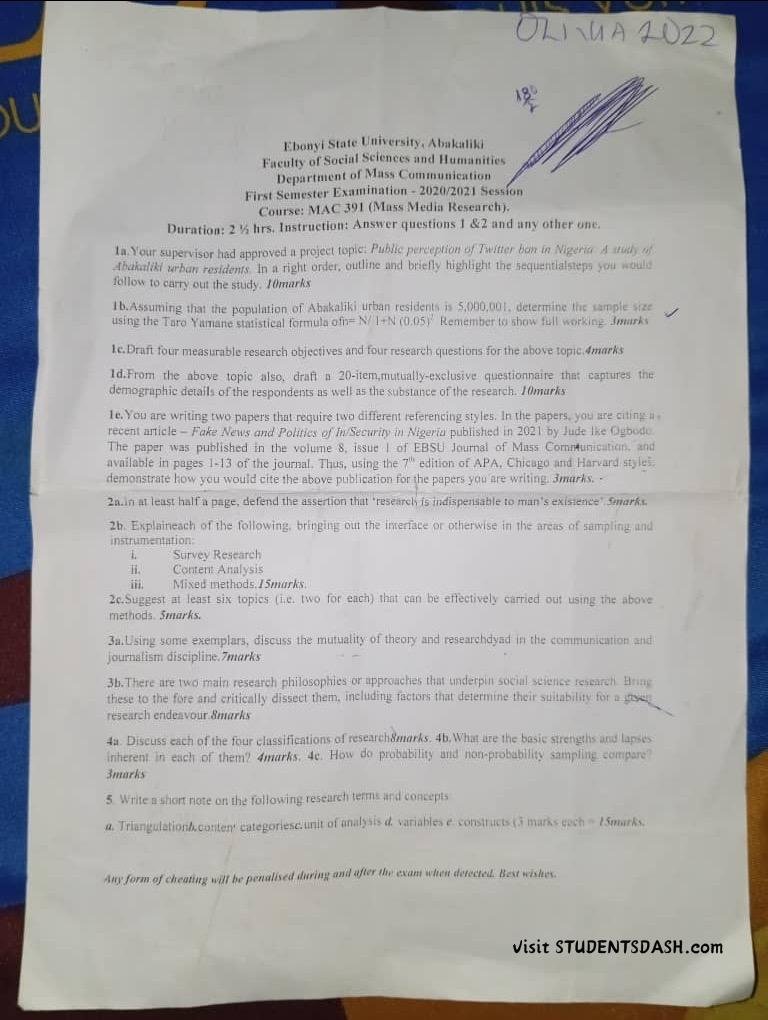
Title: MAC 391 Past Questions and Answers URL: https://studentsdash.com/mac-391-past-questions-and-answers-3/ -------------------------------------------------- ANSWER TO QUESTION 1 a. Steps for Carrying Out the Study To conduct the study on “Role of radio in the campaign against street drugs (Mkpulumma and Colos) among youths in Ebonyi State: A study of Salt FM Abakaliki,” the following steps should be followed: 1. Identification of Research Problem: Clearly define the problem by examining how radio influences youths in drug-related campaigns. 2. Review of Related Literature: Gather and analyze past studies on the topic to understand existing knowledge gaps. 3. Formulation of Research Objectives and Hypotheses: Develop measurable objectives and hypotheses based on the study’s focus. 4. Research Design and Methodology: Decide on the research approach (quantitative, qualitative, or mixed methods), data collection methods, and sampling techniques. 5. Population and Sample Selection: Identify the study population (Ebonyi youths) and determine the appropriate sample size using a statistical formula. 6. Instrument Design and Validation: Develop questionnaires or interview guides and validate them through pilot studies. 7. Data Collection: Administer the research instruments and collect data from selected respondents. 8. Data Analysis and Interpretation: Use statistical tools to analyze collected data and interpret the results in line with research questions. 9. Presentation of Findings: Report findings using tables, charts, and narratives. 10. Conclusion and Recommendations: Summarize key findings, conclude the study, and provide recommendations for future research and policy implementations. b. Sample Size Determination using Taro Yamane Formula The Taro Yamane formula for sample size determination is: Thus, the appropriate sample size for the study is approximately 400 respondents. c. Research Objectives, Questions, and Hypotheses Research Objectives: 1. To examine the influence of Salt FM Abakaliki’s radio campaigns on youth perception of street drugs. 2. To assess the effectiveness of radio programs in discouraging drug use among youths in Ebonyi State. Research Questions: 1. How does Salt FM Abakaliki’s campaign influence youth perception of street drugs? 2. How effective are radio programs in discouraging drug use among Ebonyi State youths? Alternate Hypotheses: 1. H₁: Salt FM Abakaliki’s campaign has a significant influence on youth perception of street drugs. 2. H₁: Radio programs are effective in discouraging drug use among Ebonyi State youths. d. 15-Item Multiple-Choice Questionnaire Section A: Demographics 1. What is your age? • a) 15-20 • b) 21-25 • c) 26-30 • d) 31 and above 2. What is your gender? • a) Male • b) Female • c) Others 3. What is your highest level of education? • a) Secondary school • b) OND/NCE • c) HND/B.Sc • d) Postgraduate 4. What is your occupation? • a) Student • b) Trader • c) Civil servant • d) Others Section B: Substance of the Study 5. Have you ever listened to a radio program about drug abuse? • a) Yes • b) No 6. How often do you listen to Salt FM Abakaliki? • a) Daily • b) Occasionally • c) Rarely • d) Never 7. Do you think radio programs can change youth attitudes toward drugs? • a) Strongly agree • b) Agree • c) Disagree • d) Strongly disagree 8. Which of these radio campaigns have you heard about drug abuse? • a) Drug-Free Ebonyi • b) Youth Against Drugs • c) Say No to Mkpulumma & Colos • d) None 9. Have you taken drugs such as Mkpulumma or Colos before? • a) Yes • b) No 10. If yes, did a radio program influence your decision to stop? • a) Yes • b) No 11. Which media do you think is most effective in drug abuse awareness? • a) Radio • b) Television • c) Social media • d) Newspapers 12. What do you think is the major cause of drug abuse among youths? • a) Peer pressure • b) Unemployment • c) Family issues • d) Media influence 13. How would you rate the effectiveness of Salt FM’s anti-drug campaigns? • a) Very effective • b) Moderately effective • c) Not effective 14. Do you think more radio programs should be used for drug awareness? • a) Yes • b) No 15. Would you recommend radio campaigns as a primary strategy for reducing drug abuse? • a) Yes • b) No e. APA 7th Edition Citation of the Article In-text citation: (Ogbodo, 2021) Reference list entry: Ogbodo, J. I. (2021). Mixing nonsense with substance: Negotiating satirical and investigative journalism hybrid genre in Nigerian publishing. African Journalism Studies, 2(4), 137-152. 2 ANSWER TO QUESTION 2 a. Steps for Conducting the Study To conduct the study on “Newspaper framing of Mmesoma fake UTME result saga: A content analysis of The Punch and Daily Sun,” the following steps should be followed: 1. Identify the Research Problem: Establish the relevance of the topic by analyzing how newspapers framed the Mmesoma fake UTME result saga. 2. Review of Related Literature: Examine existing studies on newspaper framing and media coverage of similar issues to identify gaps. 3. Formulate Research Objectives and Questions: Develop specific objectives and research questions to guide the study. 4. Select Research Design and Methodology: Choose content analysis as the research design, define content categories, and decide on coding units. 5. Define the Population and Sampling Technique: Identify all newspaper articles published on the topic within the selected period and determine the sampling technique (e.g., purposive sampling). 6. Develop the Coding Guide: Establish coding categories (e.g., positive, negative, neutral framing) and operational definitions for consistency. 7. Conduct Pilot Study: Test the coding guide with a small sample to ensure reliability and consistency. 8. Data Collection: Analyze relevant newspaper articles from The Punch and Daily Sun within the selected timeframe. 9. Data Analysis and Interpretation: Use descriptive statistics to analyze frequency and patterns of newspaper framing. 10. Discussion of Findings: Compare findings with existing literature and provide explanations for observed trends. 11. Conclusion and Recommendations: Summarize key findings and suggest improvements in media framing practices. ⸻ b. Determining the Unit of Analysis The unit of analysis refers to the specific elements to be studied within the newspaper content. Since the period of study is 4 months, the unit of analysis can be determined as follows: 1. Identify Relevant Newspaper Articles: Search The Punch and Daily Sun archives for all articles related to the Mmesoma fake UTME result saga. 2. Categorize Articles by Publication Dates: Select all articles published within the chosen 4-month timeframe. 3. Break Down the Content into Smaller Units: The unit of analysis could be: • Entire articles • Paragraphs • Headlines • Images/captions 4. Choose the Most Suitable Unit: Since the study is on newspaper framing, the best unit of analysis would be headlines, lead paragraphs, and full articles related to the saga. ⸻ c. Sample Size Determination Using Constructed and Manifest Content Formats • Constructed Content Format: Involves selecting specific newspaper issues systematically (e.g., picking two newspapers per week over four months). • Manifest Content Format: Involves analyzing all visible content directly related to the topic within the selected period. Sample Size Calculation: • Assuming an average of 5 relevant articles per week from both newspapers, for 4 months (16 weeks): • Total articles = 5 × 16 = 80 • Sample selection: A systematic or purposive sampling technique can be used to select a representative 50% of the total articles (i.e., 40 articles ). ⸻ d. Calculating Inter-Rater Reliability Inter-rater reliability (IRR) is calculated using Cohen’s Kappa formula or Percentage Agreement formula : Thus, the inter-rater reliability is 69.2% , indicating moderate agreement between the coders. ⸻ e. Can the Topic Be Effectively Studied Using Content Analysis? Yes , content analysis is an appropriate method for studying the topic. Reasons include: 1. Media Framing Analysis: Content analysis helps to identify how newspapers portray events—whether in a positive, negative, or neutral tone. 2. Quantifiable Data: It allows researchers to measure the frequency of specific frames (e.g., victim-blaming, investigative reporting). 3. Comparative Study: It enables a comparison of framing patterns between The Punch and Daily Sun over time. 4. Unobtrusive Method: Since content analysis examines existing articles, it does not require interaction with respondents, reducing bias. 5. Replicability: The study can be replicated in future research to assess trends in media framing of similar issues. ⸻ Final Thoughts This study effectively applies content analysis to evaluate how Nigerian newspapers framed the Mmesoma fake UTME result saga, offering insights into media bias and framing patterns. 3 ANSWER TO QUESTION 3 a. Defending the Assertion: “Research is to see what everybody else has seen, and to think what nobody else has thought.” This statement means that research is not just about looking at things but thinking about them in a new way. Many people see the same things every day, but only researchers ask deep questions and find new ideas from them. For example, before Isaac Newton, people saw fruits fall from trees, but he asked why they fall and discovered gravity. In the same way, people read newspapers, but a researcher can study how newspapers report news and find out if they are biased or not. 1. Research Helps Us Discover New Things • Science and Medicine: Doctors and scientists study diseases and develop cures instead of just watching people fall sick. • Media and Communication: Researchers study how newspapers report events and if they are fair or one-sided. • Business and Society: Economists study how people spend money and what affects the economy. 2. Research is About Asking the Right Questions Many people see problems but do not ask questions about them. A good researcher thinks differently and tries to find answers that others may not have thought about. 3. Conclusion This statement means that research is about looking at the world differently. Instead of just accepting things the way they are, researchers try to understand why things happen and how to improve them. b. Explanation of Research Methods i. Survey Research What is it? Survey research is a method where a researcher asks people questions to gather information. It is commonly used in studies about people’s opinions, behaviors, or experiences. How it Works with Sampling and Instruments: • Sampling: Researchers cannot ask everybody, so they select a group of people (sample) that represents the whole population. They may use random selection or choose people based on certain characteristics. • Instruments: The main tool used is a questionnaire, which contains questions for people to answer. These can be yes/no questions, multiple-choice, or open-ended questions. Example: If a researcher wants to study how students feel about the Mmesoma UTME saga, they can give a questionnaire to 100 students from different universities and analyze their answers. ii. Content Analysis What is it? Content analysis is a method used to study media content (newspapers, TV, social media, etc.). It helps researchers find patterns in how information is presented. How it Works with Sampling and Instruments: • Sampling: The researcher picks a number of articles or news reports that are related to the topic. For example, they may select all newspaper articles about Mmesoma within a 4-month period. • Instruments: The main tool is a coding sheet, which is used to record how many times certain words, themes, or ideas appear in the news. Example: If a researcher wants to study how The Punch and Daily Sun framed Mmesoma’s case, they can count how many times the newspapers used words like “fraud”, “mistake”, or “victim”. iii. Mixed Methods What is it? Mixed methods research means using both survey research (asking people questions) and content analysis (studying media content) to get a better understanding of a topic. How it Works with Sampling and Instruments: • Sampling: The researcher can use a mix of survey sampling (selecting people to answer questions) and content sampling (selecting newspapers or TV reports to analyze). • Instruments: The researcher uses both questionnaires (for surveys) and coding sheets (for content analysis). Example: A researcher studying the Mmesoma UTME saga can: 1. Use surveys to ask students if they think the media was fair to her. 2. Use content analysis to check if newspapers used negative or positive words in their reports. 3. Combine the results to get a complete understanding of the media framing. Final Thoughts These three research methods help researchers collect information, analyze patterns, and understand how events are reported. The choice of method depends on the research topic and the type of data needed. 4 ANSWER TO QUESTION 4 a. Content Categories Content categories are the different groups or themes used in content analysis to classify information. When researchers analyze media content (e.g., newspapers, TV programs, or social media posts), they divide the content into specific categories based on the topic being studied. Example: If a researcher is studying how newspapers reported the Mmesoma UTME saga, they may create categories like “fraud,” “victim,” “investigation,” and “public reaction” to organize the information. ⸻ b. Unit of Analysis The unit of analysis is the main thing a researcher is studying in a research project. It can be individuals, groups, organizations, events, or media content. Example: • If a study is about students’ opinions on UTME exams, the unit of analysis is students . • If a study is analyzing newspaper articles, the unit of analysis is each article . The unit of analysis helps researchers focus on what exactly they are measuring. ⸻ c. Interview Guided An interview-guided research method is a type of data collection where the researcher uses prepared questions to guide a discussion with participants. It can be structured (fixed questions), semi-structured (flexible questions), or unstructured (free discussion). Example: If a researcher wants to understand how journalists reported the Mmesoma saga, they can interview newspaper editors and reporters to ask them about their experiences and decision-making processes. ⸻ d. Research Philosophy Research philosophy refers to the beliefs and assumptions that guide a researcher’s approach to studying a topic. It helps determine how data is collected, analyzed, and interpreted . There are different types of research philosophies, such as: • Positivism – Believes research should be based on facts and numbers (scientific approach). • Interpretivism – Focuses on understanding people’s experiences and perspectives (qualitative approach). • Pragmatism – Uses a mix of both methods depending on the research problem. Example: A study on newspaper framing of Mmesoma can use interpretivism to analyze how different newspapers presented the story and the meanings behind their words. ⸻ e. Documentation in Research Documentation in research refers to keeping records of all sources, data, and findings during a study. It ensures that research is organized, transparent, and verifiable . Researchers document their work by: • Keeping notes from interviews or surveys • Saving media content used in content analysis • Citing books, articles, and websites properly • Writing a research report with full details Example: If a researcher studies newspaper framing of Mmesoma, they must document all articles analyzed, interview transcripts, and citations used to support their findings. ⸻ Final Thoughts These research terms help guide how studies are conducted, ensuring that information is properly collected, analyzed, and documented.
MAC 391 Past Questions and Answers 2022
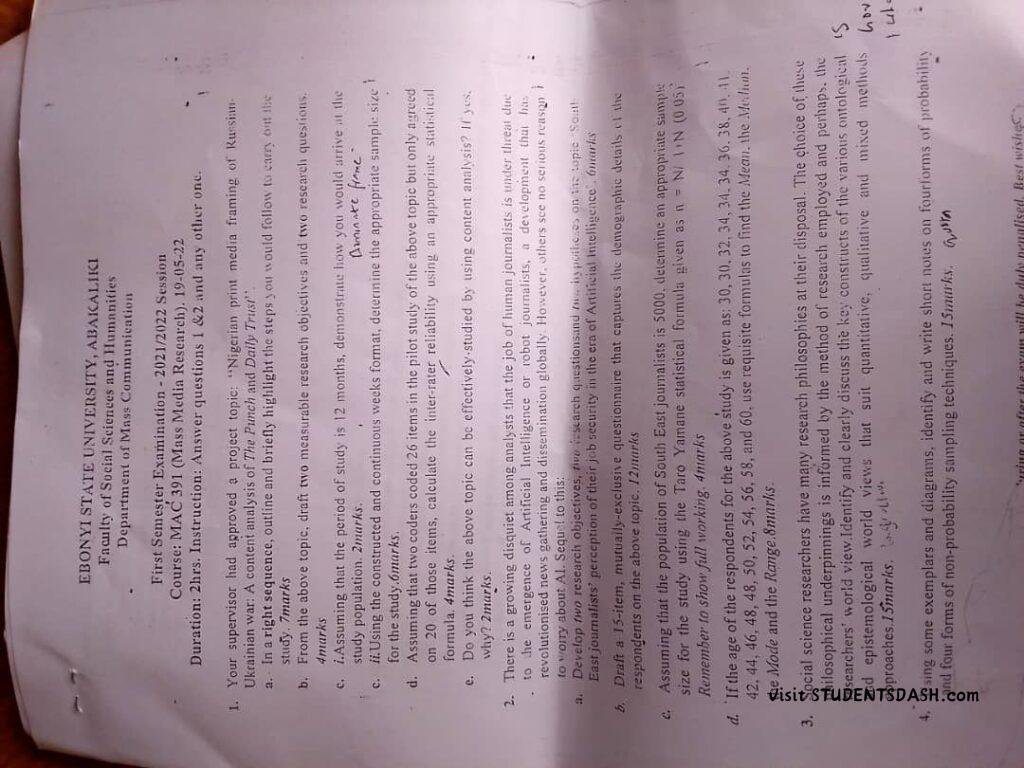
Title: MAC 391 Past Questions and Answers 2022 URL: https://studentsdash.com/mac-391-past-questions-and-answers-2022/ -------------------------------------------------- Question 1 (a) Outline and Briefly Highlight the Steps to Carry Out the Study For the project titled “Nigerian Print Media Framing of the Russian-Ukraine War,” the following steps can be adopted: Problem Identification and Justification: Clearly state the research problem by highlighting the importance of understanding how Nigerian newspapers portray the Russia-Ukraine conflict. Justify the study by discussing the potential impact of media framing on public perception and policy. Literature Review: Conduct a review of existing studies on media framing, conflict reporting, and international news coverage. Identify gaps in the literature that the current study will address. Theoretical/Conceptual Framework Selection: Choose relevant theories such as Framing Theory or Agenda-Setting Theory to guide the analysis. Define key concepts and variables related to framing in print media. Research Design and Methodology: Decide on a content analysis approach to systematically examine newspaper articles. Determine whether to use a quantitative method (frequency counts, coding) or a mixed-method approach if qualitative insights are also desired. Sampling Strategy: Define the population (e.g., Nigerian newspapers such as The Guardian, Punch, Vanguard) and the period of study (for instance, a selected 12-month period). Choose an appropriate sampling technique (systematic or purposive sampling) to select the articles for analysis. Instrument Development: Develop a coding sheet for content analysis that lists possible frames (e.g., conflict, economic, human-interest frames) and criteria for measurement. If applicable, prepare questionnaires or interview guides for gathering additional qualitative data. Data Collection: Collect relevant newspaper issues from archives or online sources covering the period under study. Train research assistants (if any) to ensure consistency in coding. Data Analysis: Use statistical tools to analyze the frequency and prominence of identified frames. Apply qualitative analysis if the study involves thematic coding. Interpretation and Discussion: Interpret the results in relation to the research objectives and the theoretical framework. Discuss the implications of the findings on media practices and public opinion. Conclusion and Recommendations: Summarize the main findings of the study. Provide recommendations for media practitioners and suggestions for future research. (b) Draft Two Measurable Research Objectives and Two Research Questions Research Objectives: Objective 1: To quantitatively determine the frequency of specific frames (e.g., conflict, economic, human-interest) used in Nigerian print media when reporting the Russian-Ukraine war. Objective 2: To assess the prominence of the Russian-Ukraine war coverage in Nigerian newspapers in terms of placement (e.g., front page vs. inner pages) and headline size. Research Questions: Research Question 1: What are the dominant frames employed by Nigerian newspapers in their coverage of the Russian-Ukraine war? Research Question 2: How does the prominence of the Russian-Ukraine war coverage (measured by article placement and headline characteristics) vary among selected Nigerian newspapers? Question 3 Social science research is underpinned by various research philosophies, and the choice of philosophy often aligns with the researcher’s method and world view. Three important world views—constructivist, rationalist, and mixed-method—correspond respectively to qualitative, quantitative, and mixed-method approaches. Below is a discussion of each: Constructivist World View Nature of Reality: Constructivism posits that reality is subjective and socially constructed. In this view, multiple, context-dependent realities exist, and meaning is developed through social interaction. Research Focus: It is most appropriate for qualitative research where the aim is to explore and understand the nuanced perceptions, experiences, and meanings individuals attach to their social world. Methodological Implications: Researchers adopt methods such as in-depth interviews, focus group discussions, and participant observation to gather rich, descriptive data. They actively engage with participants to co-create knowledge, acknowledging that their interpretations are influenced by their own perspectives. Relevance in Mass Communication: When investigating media representations, audience reception, or journalistic practices, constructivism allows for an in-depth understanding of how different stakeholders construct meanings from media messages. Rationalist World View Nature of Reality: The rationalist perspective (often linked with positivism) assumes that reality is objective, stable, and measurable. It emphasizes the use of logic, deduction, and empirical evidence to arrive at truths about the world. Research Focus: This worldview underpins quantitative research methods, focusing on testing hypotheses, measuring variables, and establishing cause-effect relationships. Methodological Implications: Researchers use surveys, experiments, and content analysis with standardized instruments to collect numerical data. Statistical techniques are then applied to generalize findings to broader populations. Relevance in Mass Communication: In studies such as audience measurement, media effects, and framing analysis, the rationalist approach provides clear, replicable data that can be statistically analyzed to yield objective insights into media behavior and its impact on society. Mixed-Method World View Nature of Reality: The mixed-method approach is grounded in pragmatism—a belief that both subjective experiences and objective measurements are essential to comprehensively understand complex phenomena. Research Focus: It bridges the gap between constructivist and rationalist perspectives by integrating qualitative and quantitative methods. Researchers seek to capitalize on the strengths of both approaches to address research questions that are multifaceted. Methodological Implications: Mixed-method research typically involves the collection of both numerical data (via surveys or experiments) and narrative data (through interviews or focus groups). Data triangulation enhances the validity of the research by allowing cross-verification of findings. Relevance in Mass Communication: In media studies, mixed-methods enable researchers to analyze content quantitatively (e.g., frequency of specific frames in news articles) while also exploring the underlying meanings through qualitative analysis (e.g., in-depth interviews with journalists). This comprehensive approach offers a more robust understanding of media phenomena. Conclusion In summary, the constructivist world view is ideal for qualitative research that delves into the subjective meanings behind media practices, while the rationalist world view supports quantitative research aiming at objectivity and generalization. The mixed-method world view provides a pragmatic framework that combines the strengths of both to offer a holistic perspective. The choice of these philosophies in social science research is crucial as it shapes the research design, methods, and interpretation of findings, ultimately influencing the depth and breadth of insights in mass communication studies. Below is a refined model answer for Question 4 with corrected English, formatted in a clear, exam-appropriate style. Question 4 A. Probability Sampling Techniques Probability sampling involves random selection, ensuring that each member of the population has a known and non-zero chance of being selected. This approach enhances the representativeness and generalizability of the findings. Simple Random Sampling Definition: Every individual in the population has an equal chance of being selected. Example: If you have a list of 1,000 journalists, you could use a random number generator to select 100 names. Diagram: Imagine a container with 1,000 numbered balls. A random drawing of 100 balls represents the selection process. Systematic Sampling Definition: You select every kth element from an ordered list after a random starting point. Example: From a list of 500 newspaper articles, if you need 50, you might select every 10th article after randomly choosing a number between 1 and 10 as your starting point. Diagram: Visualize a numbered list; after picking a random starting point (say, number 4), you then select every 10th item (4, 14, 24, etc.). Stratified Sampling Definition: The population is divided into homogeneous subgroups (strata) based on a specific characteristic (e.g., region, type of media), and random samples are drawn from each stratum. Example: Divide journalists into strata based on regions (North, South, East, West) and randomly select a proportionate number of respondents from each region. Diagram: Picture a pie chart divided into slices representing each stratum, with random selections made from each slice proportionate to its size. Cluster Sampling Definition: The population is divided into clusters (often based on geographical areas or organizational units), and a random sample of clusters is selected. Then, all or a random sample of individuals within these clusters are studied. Example: If newspapers are spread across several cities, randomly select a few cities (clusters) and then sample all or a subset of articles or journalists within those cities. Diagram: Imagine a map with several clusters (circles). Randomly choose a few circles, and then within each selected circle, list all the units (e.g., journalists or articles). B. Non-Probability Sampling Techniques Non-probability sampling does not ensure that every member of the population has a known chance of being selected, which may limit generalizability but is often more practical for exploratory research. Convenience Sampling Definition: Participants are selected based on their availability and willingness to participate. Example: Surveying journalists who are present at a media conference because they are easily accessible. Diagram: Picture a group of people gathered in one location; the researcher selects participants from those readily available. Purposive (Judgmental) Sampling Definition: The researcher deliberately selects participants based on specific characteristics or expertise relevant to the study. Example: Choosing experienced editors or media analysts for in-depth interviews on media framing due to their expertise. Diagram: Imagine a Venn diagram where one circle represents “Expertise”; the researcher selects individuals who clearly fall within this circle. Quota Sampling Definition: The researcher ensures that the sample reflects certain characteristics in the same proportions as in the population by setting quotas for different subgroups. Example: If 60% of media professionals in the population are male and 40% are female, the sample is drawn to reflect these percentages. Diagram: Visualize a bar chart with two bars (Male and Female) where the height of each bar in the sample matches the corresponding proportion in the population. Snowball Sampling Definition: Existing study participants recruit future participants from among their acquaintances. This technique is useful for accessing hard-to-reach populations. Example: Interviewing a few investigative journalists who then refer other experts in the field to the researcher. Diagram: Imagine a branching tree diagram where an initial participant leads to several referrals, which further branch out to additional participants. Summary Diagram A simple table can help visualize the categorization of these techniques: Probability Sampling Non-Probability Sampling Simple Random Sampling Convenience Sampling Systematic Sampling Purposive Sampling Stratified Sampling Quota Sampling Cluster Sampling Snowball Sampling


MAN 201 Past Questions and Answers
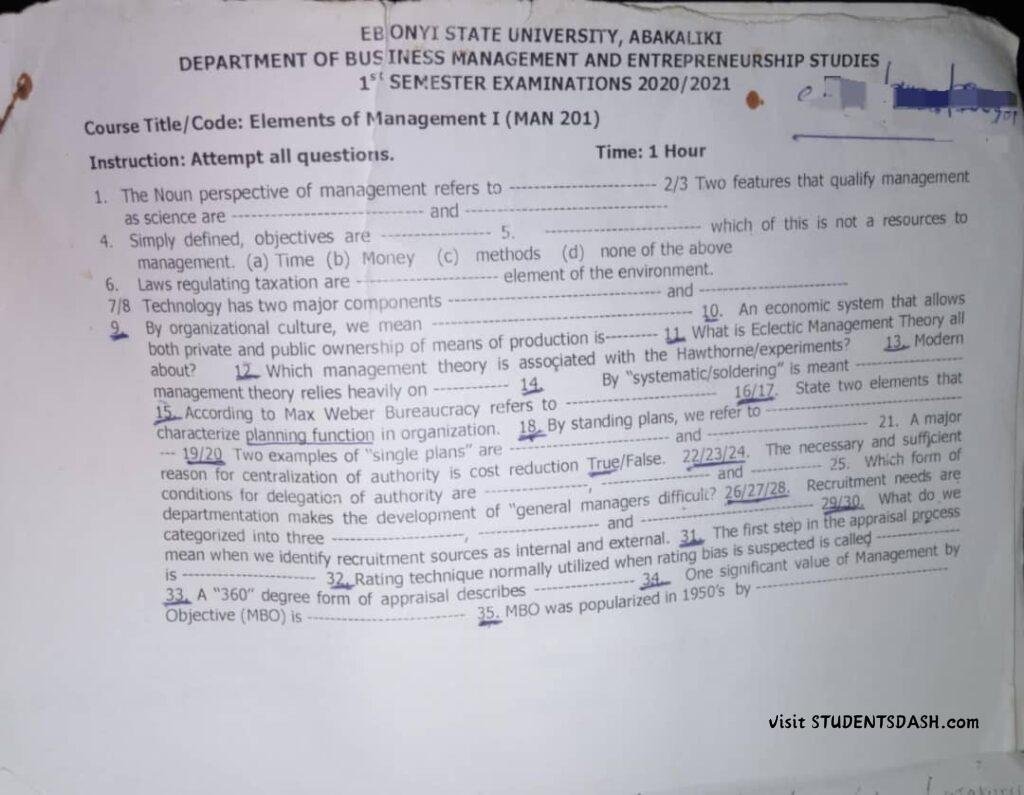
Title: MAN 201 Past Questions and Answers URL: https://studentsdash.com/man-201-past-questions-and-answers-4/ -------------------------------------------------- EBONYI STATE UNIVERSITY, ABAKALIKI DEPARTMENT OF BUSINESS MANAGEMENT & ENTREPRENEURSHIP FIRST SEMESTER EXAMINATION 2022/2023 SESSION COURSE TITLE: ELEMENTS OF MANAGEMENT I COURSE CODE: MAN 201 TIME: 1 Hour INSTRUCTION: Attempt all questions. 40 answers are required in all. You are to attempt the questions serially. Rules and procedures were the major interest of bureaucratic management school. Classical theory dominates modern school/theory of management. Administrative management school is all about managing organization and structure. In not more than two sentences each, explain the underlined words in the definition of planning – “The conscious systematic process” of making decision about goals and activities that individuals/groups/organizations as a whole will pursue in future. Conscious: This means that planning is deliberate and intentional, not done by accident. Systematic process: This implies that planning follows an organized step-by-step method. Goals: These are the targets or objectives that an organization aims to achieve. Future: Planning is forward-looking; it focuses on what will happen or needs to be achieved later. Explain briefly what you understand by primacy of planning, planning is pervasive: Primacy of planning: Planning is the first and most important function of management; it lays the foundation for all other managerial functions. Planning is pervasive: Planning is needed at all levels of management and in all departments. Two elements of organizational structures are work specialization and chain of command. Three principles of co-ordination are early start, continuity, and direct contact. Another name for 360° appraisal is multi-source feedback. A major problem associated with central tendency appraisal is rating everyone as average. Halo and Horns appraisal refers to letting one trait influence the entire evaluation. Appraisal techniques include the following except: (iv) Ranking method Staffing involves: recruitment, selection, training and development of employees. Two major sources of recruitment are: internal and external. The staff that placement process recruits fall into three broad categories, namely: skilled, semi-skilled, and unskilled. The communication process has three basic elements namely: sender, message, and receiver. By informal organization communication/grapevine we mean: the unofficial flow of information within an organization. What does horizontal communication entail? Communication between employees or departments at the same level of the organizational hierarchy. Two components central to the phenomenon of leadership are: influence and followership. By position power is meant: power that comes from one’s official rank or title. The central theme in trait approach to leadership is: inherent qualities or characteristics of a leader. By position power is meant: legitimate authority granted by an organization. The central theme in trait approach to leadership is: the belief that leaders are born, not made. Leadership is: the ability to influence others toward achieving group goals. Summarize your understanding of the following ideas: 24. Management is a discipline: Management is a field of study with theories, principles, and practices aimed at improving organizational efficiency. Management is a universal process: Management principles apply to all types of organizations, whether private, public, small, or large. Management is a profession: Management requires specialized knowledge and training, and it follows ethical codes and standards. Management as a noun: Refers to the people or group responsible for directing and controlling an organization. Management is a process: It involves a series of interrelated functions like planning, organizing, leading, and controlling.
 Quiz
GST 201 Past Questions Practice
Practice GST 201 Past Questions and Answers...
 Quiz
 Quiz
EBSU-GST 105 Past Questions Practice
Are you preparing for your GST 105 exam at Ebonyi State University? We’ve got you cov...
 Quiz
ECO 101 Past Questions Practice
Prepare effectively for your ECO 101 exam with our updated past questions and answers...
 Quiz
Phy 107 Past Questions Practice
Practice Phy 107 ( PHY 191) Past Questions and Answers...
 Quiz
MTH 101 Past Questions Practice
Prepare effectively for your MAT 101 (MTH 101) exam with our updated past questions a...

What Does “Sent to Institutions” Mean on NELFUND? What Students Should Know
If you recently applied or reapplied for the NELFUND student loan...