




MAC 301 Past Questions and Answers
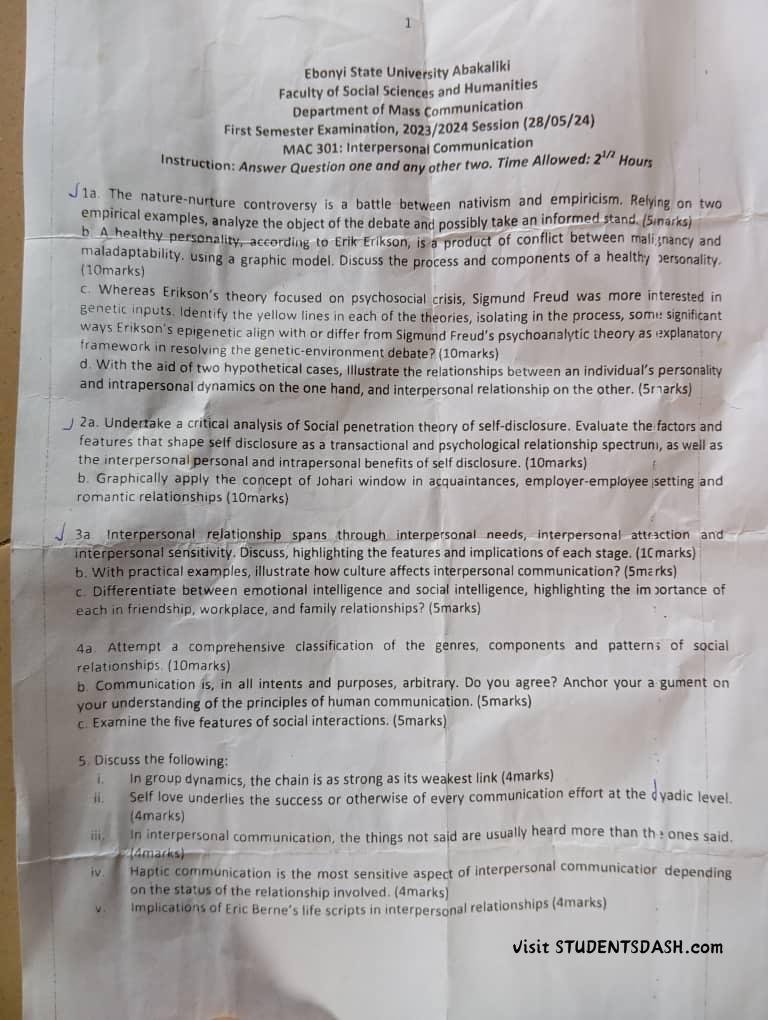
Title: MAC 301 Past Questions and Answers URL: https://studentsdash.com/mac-301-past-questions-and-answers-3/ -------------------------------------------------- Question 1a: A healthy personality, according to Erik Erikson, is a product of conflict between malignancy and maladaptability. Using a graphic model, discuss the process and components of healthy personality. (10 marks) Answer: Erik Erikson’s theory of psychosocial development explains personality as a lifelong process influenced by social interactions and conflicts at different stages of life. He proposed eight stages, each characterized by a central conflict that must be resolved for healthy personality development. Components of a Healthy Personality: 1. Trust vs. Mistrust (0-1 year): A child learns to trust their environment if caregivers provide consistent care. Otherwise, mistrust develops. 2. Autonomy vs. Shame and Doubt (1-3 years): Children develop independence if encouraged. If overly controlled, they feel shame and doubt. 3. Initiative vs. Guilt (3-6 years): Children begin to take initiative. If they are criticized too much, they develop guilt. 4. Industry vs. Inferiority (6-12 years): Children develop a sense of competence through achievements. Failure leads to feelings of inferiority. 5. Identity vs. Role Confusion (12-18 years): Adolescents explore their identity. Failure to establish a sense of self results in role confusion. 6. Intimacy vs. Isolation (18-40 years): Young adults seek meaningful relationships. Failure results in loneliness and isolation. 7. Generativity vs. Stagnation (40-65 years): Adults focus on contributing to society. If not, they feel stagnant. 8. Integrity vs. Despair (65+ years): People reflect on their lives. A sense of fulfillment leads to integrity, while regret results in despair. Graphic Model Representation: A diagram illustrating Erikson’s eight stages can be used, showing each stage as a step in personal growth. Each step represents the conflict and its positive or negative outcome. Question 1b: Whereas Erikson’s theory focused more on psychosocial crises, Sigmund Freud was more interested in genetic inputs. Identify the yellow lines in each of the two theories, isolating the process, some significant ways Erikson’s perspective aligns with or differ from Sigmund Freud’s psychoanalytic theory as an explanatory framework in resolving the genetic-environment debate? (10 marks) Answer: Erik Erikson and Sigmund Freud both explored personality development, but they had different perspectives on the role of genetics and the environment. Freud’s Psychoanalytic Theory (Genetic Inputs Focus) Freud’s theory emphasizes that personality is primarily shaped by innate biological drives (genetics) and early childhood experiences. He proposed that human development occurs in five psychosexual stages: 1. Oral Stage (0-1 year): Focus on mouth-related activities; fixation leads to dependency. 2. Anal Stage (1-3 years): Control over bodily functions; fixation can lead to orderliness or messiness. 3. Phallic Stage (3-6 years): Identification with the same-sex parent; Oedipus/Electra complex. 4. Latency Stage (6-12 years): Sexual energy is dormant, and social skills develop. 5. Genital Stage (12+ years): Sexual urges reawaken, focusing on mature relationships. Freud believed that unresolved conflicts at any stage could lead to personality disorders. Erikson’s Psychosocial Theory (Environmental and Social Influence) Erikson expanded on Freud’s work by emphasizing the role of social interactions rather than biological instincts. His eight-stage model (as discussed in Q1a) focuses on how personal growth is shaped by life challenges, rather than just early childhood experiences. Yellow Lines (Similarities) Between Erikson and Freud 1. Stage Development: Both theorists agree that personality develops in stages. 2. Early Childhood Influence: Freud’s first three stages align with Erikson’s first three (Trust vs. Mistrust, Autonomy vs. Shame, Initiative vs. Guilt). 3. Unresolved Conflicts Affect Personality: Both suggest that unresolved crises at one stage affect future behavior. Key Differences Aspect Freud’s Psychoanalytic Theory Erikson’s Psychosocial Theory Focus Biological drives (genetics) Social interactions (environment) Stages Five psychosexual stages Eight psychosocial stages Development Stops? Ends at puberty (Genital Stage) Continues throughout life Crisis Nature Fixation on childhood experiences Conflict between social demands and personal growth Genetic-Environment Debate Resolution Freud’s theory leans towards the nature (genetic) side, while Erikson’s theory supports the nurture (environmental) aspect. However, Erikson acknowledges that biological factors influence behavior, but they interact with social experiences to shape personality. Question 1c: Employ real-life examples to illustrate the subtle and overt relationships between personality development and intrapersonal dynamics on one hand, and between an individual’s personality and interpersonal relationship on the other. (5 marks) Answer: Personality development is shaped by both intrapersonal dynamics (how a person relates to themselves) and interpersonal relationships (how they relate to others). 1. Relationship Between Personality Development and Intrapersonal Dynamics Intrapersonal dynamics involve self-perception, emotions, and personal growth. A person’s personality affects their thought process, decision-making, and ability to handle stress. Example: • A student who is naturally introverted may struggle with self-confidence but, over time, develops strong analytical and independent thinking skills. • Someone with a high level of self-awareness may have better emotional regulation and be more resilient in handling failures. 2. Relationship Between Personality and Interpersonal Relationships Personality influences how individuals interact with others. An extroverted person tends to form friendships easily, while an introverted person might struggle with social interactions. Examples: • A friendly and outgoing person (high in agreeableness) tends to have a wide social circle and easily makes friends. • A highly conscientious employee is reliable and organized, making them a preferred team member in the workplace. • A person with an anxious personality may struggle with trust in relationships, leading to conflicts in friendships or romantic partnerships. In summary, a person’s internal traits (intrapersonal) affect how they relate with themselves, while their personality also influences how they build and maintain relationships with others. Question 2a: Undertake a critical analysis of Social Penetration Theory of self-disclosure. Evaluate the factors and features that shape self-disclosure as a transactional and psychological relationship spectrum, as well as the personal and interpersonal benefits of self-disclosure. (10 marks) Answer: Social Penetration Theory (SPT) – Overview The Social Penetration Theory (SPT) was developed by Irwin Altman and Dalmas Taylor (1973) to explain how relationships develop through self-disclosure—the process of revealing personal information to others. The theory compares human relationships to an onion, where deeper levels of intimacy are achieved by peeling away outer layers of personal information. Critical Analysis of Social Penetration Theory SPT suggests that self-disclosure occurs in four stages: 1. Orientation Stage: People share general and superficial information. 2. Exploratory Affective Stage: Casual friendships form, and more personal opinions are shared. 3. Affective Stage: Deeper personal details, emotions, and vulnerabilities are disclosed. 4. Stable Stage: Open, honest, and deep sharing occurs, forming long-term bonds. However, not all relationships progress through these stages, and too much self-disclosure too quickly can push people away (social depenetration). Factors and Features That Shape Self-Disclosure 1. Trust and Reciprocity: People tend to disclose information when they trust the other person and expect the same in return. 2. Cultural Background: Some cultures encourage openness, while others value privacy. 3. Personality: Extroverts tend to disclose more, while introverts are more reserved. 4. Social Context: People disclose differently in professional settings versus personal relationships. 5. Relationship Type: Romantic relationships often involve deeper disclosure than casual friendships. Self-Disclosure as a Transactional and Psychological Relationship Spectrum • Transactional: Self-disclosure is a two-way exchange—when one person shares, the other is encouraged to reciprocate, strengthening the relationship. • Psychological: It affects emotions, self-image, and relationship satisfaction. Openness can improve well-being, while lack of disclosure may cause emotional distress. Personal and Interpersonal Benefits of Self-Disclosure ✅ Personal Benefits: • Increases self-awareness and emotional relief. • Reduces stress by sharing burdens with others. • Enhances mental well-being. ✅ Interpersonal Benefits: • Strengthens trust and intimacy in relationships. • Improves communication and understanding. • Helps resolve conflicts by expressing thoughts and feelings openly. In summary, Social Penetration Theory explains how relationships grow through self-disclosure, but this process depends on trust, personality, culture, and the social environment. Question 2b: Graphically explain the concept of Johari Window in acquaintances, employer-employee setting, and romantic relationships. (5 marks) Answer: The Johari Window is a psychological tool developed by Joseph Luft and Harrington Ingham (1955) to help people understand their self-awareness and how they relate to others. It consists of four quadrants that represent different levels of self-disclosure and perception. The Four Quadrants of the Johari Window Quadrant Description Open Area (Known to Self & Others) Information about yourself that both you and others are aware of. Example: Your name, hobbies, or public opinions. Blind Spot (Unknown to Self, Known to Others) Things others see in you but you are unaware of. Example: A habit you don’t notice but others observe. Hidden Area (Known to Self, Unknown to Others) Personal information you keep private. Example: Secrets, fears, or personal struggles. Unknown Area (Unknown to Self & Others) Aspects of your personality or potential that neither you nor others recognize. Example: Talents you haven’t discovered yet. Graphical Representation of Johari Window (Since I can’t draw directly here, you can imagine a 2×2 grid labeled with the four quadrants or sketch it on paper.) Application of Johari Window in Different Relationships 1. Acquaintances: • The Open Area is small because little is known about each other. • The Hidden Area is large as people don’t easily disclose personal details to acquaintances. 2. Employer-Employee Setting: • The Blind Spot is common because employees may have weaknesses or strengths they don’t recognize, but their employer sees them. • Self-awareness through feedback can help reduce the blind spot. 3. Romantic Relationships: • The Open Area is large as partners share personal information. • The Hidden Area may shrink over time as trust builds. • Effective communication helps reduce the Unknown Area, allowing the couple to understand each other better. Conclusion The Johari Window is a useful tool for understanding self-awareness and improving communication in different types of relationships. The goal is to expand the Open Area by reducing the Blind Spot and Hidden Area, leading to better understanding and trust. Question 3a: “What you do speaks so loud that I cannot hear what you say.” Discuss the dimensions, channels, functions, and dysfunctions of this communication principle. (10 marks) Answer: The statement “What you do speaks so loud that I cannot hear what you say” emphasizes the power of non-verbal communication over verbal communication. It means that actions often speak louder than words, and when there is a contradiction between what someone says and what they do, people tend to believe the actions rather than the words. 1. Dimensions of This Communication Principle This principle highlights the different aspects of communication: • Verbal vs. Non-Verbal: Non-verbal cues (gestures, facial expressions, posture) often carry more weight than spoken words. • Consistency: When actions and words align, communication is effective. If they contradict, confusion arises. • Perception: How a message is received depends more on behavior than just spoken words. 2. Channels of This Communication Principle Communication occurs through various channels: • Body Language: Facial expressions, eye contact, posture, and gestures. • Tone of Voice: Even if words are positive, a sarcastic tone can change the meaning. • Actions: People believe repeated behaviors more than promises. • Written Communication: The way a message is structured (e.g., choice of words in a letter or email) reflects the sender’s intent. 3. Functions of This Communication Principle This principle serves several important functions in communication: • Clarifies Intentions: Actions reinforce or contradict spoken messages. • Builds Trust and Credibility: When actions match words, credibility increases. • Influences Social Interactions: People form opinions based on observed behavior. • Regulates Relationships: Trust is maintained when actions and words are consistent. 4. Dysfunctions of This Communication Principle When there is a contradiction between words and actions, it can lead to: • Miscommunication: People may misunderstand the intended message. • Loss of Trust: If someone repeatedly says one thing but does another, credibility is damaged. • Workplace Issues: Employees lose faith in leaders who say one thing but act differently. • Relationship Problems: If a partner constantly promises to change but doesn’t, trust is broken. Conclusion This communication principle highlights the importance of actions in effective communication. People tend to trust what they see and experience rather than what they are told. Therefore, to maintain credibility and build strong relationships, words and actions must align. Question 3b: With practical examples, illustrate how culture affects interpersonal communication. (5 marks) Answer: Culture plays a major role in shaping how people communicate and interact with others. It influences language, gestures, personal space, and even the level of formality in conversations. Cultural differences can either enhance or hinder interpersonal communication, depending on how well people understand and adapt to them. 1. Language and Communication Styles • Some cultures (e.g., Western cultures) are direct and explicit, meaning they value straightforward communication. • Others (e.g., Asian and African cultures) use indirect and implicit communication, where messages are conveyed through context, tone, and body language. Example: In Nigeria, people may use proverbs to pass messages indirectly, while Americans tend to be more straightforward. 2. Use of Gestures and Body Language • Gestures mean different things in different cultures. • Example: A thumbs-up is positive in the USA but offensive in some Middle Eastern countries. • Example: In Japan, direct eye contact can be seen as disrespectful, but in Nigeria, it is often seen as a sign of confidence. 3. Personal Space and Physical Contact • Some cultures value personal space (e.g., the United States and Germany), while others (e.g., Latin America and Nigeria) are comfortable with close contact. • Example: In Nigeria, greetings often involve handshakes, while in some Asian countries, people prefer bowing. 4. Formality and Respect in Communication • Some cultures emphasize respect through titles and honorifics (e.g., using “Sir” or “Ma” in Nigeria). • Example: In Yoruba culture, younger people must kneel (females) or prostrate (males) when greeting elders, while in Western cultures, a simple handshake or nod is enough. 5. Perception of Silence • In some cultures (e.g., Japan and China), silence is a sign of respect and deep thinking. • In others (e.g., the USA and Nigeria), silence in a conversation can be seen as awkward or rude. Conclusion Culture strongly affects how people communicate, and misunderstandings can occur if cultural differences are not respected. Effective interpersonal communication requires cultural awareness and sensitivity to avoid misinterpretations. Question 4a: Discuss the five features of social interactions. (10 marks) Answer: Social interaction refers to the way individuals relate, communicate, and behave towards one another in society. It forms the foundation of relationships, culture, and communication. The five key features of social interactions are: 1. Reciprocity • Social interactions involve a give-and-take process where people expect responses from others. • Example: When someone greets you, they expect a greeting in return. 2. Social Roles and Status • People behave based on their social roles (e.g., teacher, student, parent, employee). • Social status influences interactions; higher status individuals (e.g., managers) may interact differently with subordinates. • Example: A student interacts with a lecturer respectfully, while they might be more casual with friends. 3. Norms and Rules • Society has unwritten rules that guide interactions. • These norms differ across cultures and settings (e.g., workplace vs. home). • Example: In Nigeria, it is customary to greet elders first as a sign of respect. 4. Symbols and Communication • Social interactions rely on verbal and non-verbal symbols such as language, gestures, and facial expressions. • Example: A smile signals friendliness, while a frown may indicate displeasure. 5. Context and Environment • The setting of an interaction affects its nature (formal vs. informal). • Example: Conversations at work are more professional compared to casual talks with friends. Conclusion Social interactions are shaped by reciprocity, roles, norms, symbols, and context. Understanding these features improves communication and relationships in different social settings. Question 4b: Differentiate between emotional intelligence and social intelligence, highlighting the importance of each in friendship, workplace, and family relationships. (5 marks) Answer: 1. Emotional Intelligence (EI) Emotional intelligence refers to the ability to recognize, understand, and manage one’s own emotions , as well as understand and influence the emotions of others. 2. Social Intelligence (SI) Social intelligence is the ability to navigate social situations, build relationships, and effectively interact with others in different environments. 3. Key Differences Emotional Intelligence (EI) Social Intelligence (SI) Focuses on self-awareness and managing emotions. Focuses on understanding social cues and interacting well with others. Helps control anger, stress, and emotional reactions. Helps in building social connections and adapting to different groups. Example: Managing frustration calmly. Example: Knowing how to respond in social gatherings. 4. Importance in Different Relationships Relationship Type Importance of EI Importance of SI Friendship Helps in understanding friends’ emotions and supporting them. Helps in making new friends and maintaining friendships. Workplace Aids in handling stress, teamwork, and conflict resolution. Helps in networking, leadership, and teamwork. Family Encourages patience, empathy, and strong bonds. Helps in handling family conflicts and maintaining harmony. Conclusion Both emotional intelligence and social intelligence are important for maintaining healthy relationships in different areas of life. While EI helps in managing emotions, SI helps in understanding social dynamics and improving communication. Question 5a: Interpersonal relationships span through interpersonal needs, interpersonal attraction, and interpersonal sensitivity. Discuss, highlighting the features and implications of each stage. (6 marks) Answer: Interpersonal relationships develop based on different factors that influence how individuals interact and connect with others. These include interpersonal needs, interpersonal attraction, and interpersonal sensitivity. 1. Interpersonal Needs Interpersonal needs refer to the basic social and emotional needs that drive human interactions. According to psychologist William Schutz, there are three key interpersonal needs: • Inclusion: The need to belong and feel accepted. • Control: The need for influence and leadership in relationships. • Affection: The need for love, care, and emotional closeness. Implication: When interpersonal needs are met, relationships thrive; when ignored, individuals may feel lonely or disconnected. 2. Interpersonal Attraction This refers to the force that draws people together and makes them want to establish relationships. It can be based on: • Physical attraction (appearance) • Social attraction (personality) • Task attraction (skills and abilities) • Similarity (shared interests and values) Implication: Strong interpersonal attraction leads to friendships, romantic relationships, and teamwork. Lack of attraction may cause weak or short-lived connections. 3. Interpersonal Sensitivity This is the ability to perceive, understand, and respond appropriately to others’ emotions and behaviors. It involves: • Empathy: Understanding others’ feelings. • Active listening: Paying close attention to verbal and non-verbal cues. • Adaptability: Adjusting responses based on the situation. Implication: High interpersonal sensitivity helps in conflict resolution, improves emotional bonds, and strengthens communication. Conclusion Interpersonal relationships are influenced by the need for connection (interpersonal needs), the reasons people feel drawn to others (interpersonal attraction), and the ability to understand and respond to others (interpersonal sensitivity). A balance of these factors ensures strong, healthy, and lasting relationships. Question 5b: Discuss interpersonal conflicts and their resolution techniques. (4 marks) Answer: 1. What is Interpersonal Conflict? Interpersonal conflict occurs when two or more people disagree or clash due to differences in opinions, values, interests, or goals. It can happen in friendships, workplaces, families, and romantic relationships. 2. Types of Interpersonal Conflicts • Personal Conflicts: Arise from misunderstandings or emotional issues. • Workplace Conflicts: Occur due to competition, authority struggles, or miscommunication. • Cultural Conflicts: Stem from differences in traditions, beliefs, or societal norms. 3. Conflict Resolution Techniques Technique Description Communication Open and honest discussion helps clarify misunderstandings. Compromise Both parties give up something to reach a fair agreement. Negotiation A structured discussion where both sides find a mutually acceptable solution. Mediation A neutral third party helps in resolving disputes. Active Listening Paying attention and acknowledging the other person’s perspective. 4. Conclusion Interpersonal conflicts are normal but must be handled effectively to maintain healthy relationships. Using resolution techniques like communication, compromise, and mediation can help restore harmony and prevent future conflicts.
MAC 302 Past Questions and Answers 2024
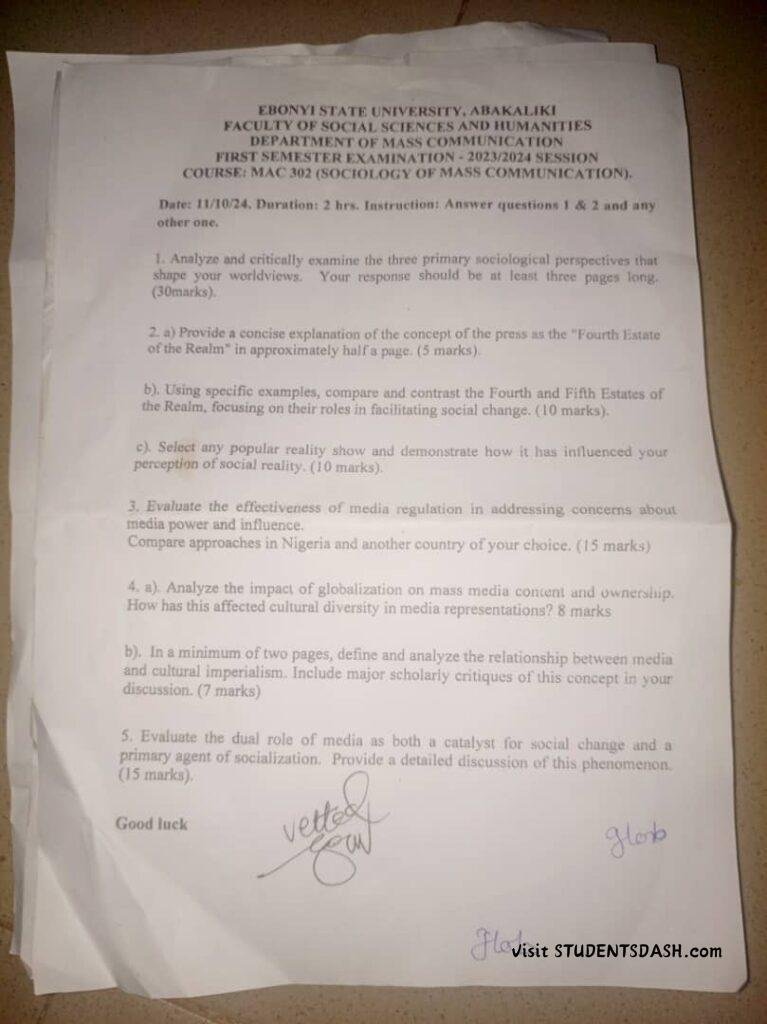
Title: MAC 302 Past Questions and Answers 2024 URL: https://studentsdash.com/mac-302-past-questions-and-answers-2024/ -------------------------------------------------- 1. Analyze and critically examine the three primary sociological perspectives that shape your worldviews. (30 marks). In sociology, there are three main perspectives that help us understand society and human behavior. These are Functionalism, Conflict Theory, and Symbolic Interactionism. Each one explains the society in a different way and they also shape the way I look at life. Functionalism Perspective: Functionalism sees society as a system made up of different parts that work together to keep society stable. Just like the human body has organs that perform different roles, society has institutions like family, school, government, religion, and economy that perform special roles. For example, the family raises children, schools teach knowledge, religion gives morals, and government enforces laws. This perspective makes me appreciate order and unity. It makes me believe that everyone has a role to play in society, no matter how small. However, its weakness is that it sometimes ignores inequality and poverty. It can claim that everything has a function, even suffering, which is not always fair. Conflict Perspective: Conflict theory, from Karl Marx, sees society as a place of struggle. People and groups fight for power, money, and resources. For example, in Nigeria, politicians enjoy wealth while ordinary people suffer poverty. This shows inequality. The media, schools, and even religion can sometimes support the powerful. This perspective shapes my worldview by making me question fairness in society. It shows me that social change comes when people fight injustice. For example, the #EndSARS protest showed young people fighting against police brutality. The weakness of this theory is that it sometimes makes it look like everything is conflict, ignoring peaceful cooperation. Symbolic Interactionism Perspective: Symbolic interactionism looks at daily life and small interactions between people. It explains how we give meaning to words, symbols, and gestures. For example, a handshake can mean respect, agreement, or friendship. Clothes, language, and emojis on WhatsApp also carry meaning. This shapes my worldview by making me value communication. It helps me see how people can misunderstand each other when they interpret symbols differently. The weakness is that it focuses too much on small interactions and sometimes ignores bigger issues like politics and economy. Conclusion: When I put all three perspectives together, I understand society better. Functionalism teaches me about order, conflict theory teaches me about injustice and change, while symbolic interactionism teaches me about communication and meaning. They shape how I view the world and guide how I interact with people every day. 2. a) Provide a concise explanation of the concept of the press as the “Fourth Estate of the Realm” in approximately half a page. (5 marks). The press is called the “Fourth Estate of the Realm” because it plays a powerful role in society, just like the three main arms of government — the executive, legislature, and judiciary. The press acts as a watchdog over those in power. It informs the public, exposes corruption, and holds leaders accountable. For example, newspapers, television, and online media report government actions, criticize wrong policies, and give citizens a voice. The press shapes opinions and can bring about social change. That is why it is called the Fourth Estate — it balances power and protects democracy. 2. b) Using specific examples, compare and contrast the Fourth and Fifth Estates of the Realm, focusing on their roles in facilitating social change. (10 marks). The Fourth Estate refers to the traditional press such as newspapers, radio, and television, while the Fifth Estate refers to digital media, especially social media platforms like Twitter (X), Facebook, blogs, and YouTube. Both estates promote social change, but they do so in different ways. The Fourth Estate uses professional journalism. For example, The Guardian Newspaper or Channels TV can expose corruption or poor governance. The Fifth Estate uses ordinary citizens who share news, campaigns, and opinions online. For example, during the #EndSARS protest, Twitter and Facebook played a big role in mobilizing youths and spreading information. The Fourth Estate is more structured, regulated, and trusted for accuracy, while the Fifth Estate is more flexible, fast, and interactive. However, the Fifth Estate can also spread misinformation quickly. Together, both estates influence society and contribute to social change. 2. c) Select any popular reality show and demonstrate how it has influenced your perception of social reality. (10 marks). A popular reality show I can use is Big Brother Naija (BBNaija). This show brings different people from various backgrounds to live together in one house, competing for money and fame. The show has influenced my perception of social reality in many ways. It shows me how people from different tribes and lifestyles can live together. It also reflects real issues like love, friendship, betrayal, and competition, which happen in everyday life. However, it has also influenced me to see how society celebrates fame and money. Some people believe BBNaija promotes immorality, while others see it as entertainment and an opportunity for success. For me, it shows both the positive and negative sides of modern Nigerian society. 3. Evaluate the effectiveness of media regulation in addressing concerns about media power and influence. Compare approaches in Nigeria and another country of your choice. (15 marks). Media regulation means the laws, policies, and guidelines that control how the media operates. It ensures that the media does not abuse its power and influence. In Nigeria, media regulation is done by bodies like the National Broadcasting Commission (NBC) and Nigerian Press Council. These agencies monitor content on TV, radio, and newspapers. For example, NBC sometimes fines TV stations for showing offensive content or hate speech. However, in practice, media regulation in Nigeria is sometimes weak and influenced by politics. Some government leaders use regulation to silence critics instead of protecting the public. In contrast, in a country like the United States, media regulation is done by the Federal Communications Commission (FCC). The FCC regulates radio, TV, and internet services. Unlike Nigeria, where politics interferes a lot, the US system gives more freedom to the press, although there are still rules about obscenity, copyright, and fake news. When I compare both, I see that Nigeria struggles with press freedom because regulation is often misused, while countries like the US focus more on protecting both the public and freedom of expression. This shows that regulation is effective only when it is fair and not used for oppression. 4. a) Analyze the impact of globalization on mass media content and ownership. How has this affected cultural diversity in media representations? (8 marks). Globalization has made the world more connected through technology, internet, and international trade. In mass media, globalization has changed both content and ownership. Big international companies like CNN, BBC, and Netflix now dominate the media space, meaning that Western culture spreads widely. Nigerian youths now consume American music, movies, and fashion more than local culture. This has reduced cultural diversity because many local traditions and languages are not represented enough. For example, Nollywood films sometimes copy Hollywood styles instead of promoting Nigerian culture. At the same time, globalization also gives Nigeria a chance to show its culture to the world, like how Afrobeats music became popular globally. So globalization has both positive and negative impacts — it promotes exchange of ideas but also risks erasing smaller cultures. 4. b) In a minimum of two pages, define and analyze the relationship between media and cultural imperialism. Include major scholarly critiques of this concept in your discussion. (7 marks). Cultural imperialism means the domination of one culture over another, often through media. It happens when powerful countries like the US use their movies, music, fashion, and news to influence weaker countries. The media plays a big role in this because TV, films, and the internet spread Western culture everywhere. For example, Nigerian children grow up watching Disney and Hollywood movies instead of local folktales. American celebrities influence fashion and lifestyle more than African leaders or stars. Scholars like Herbert Schiller argue that cultural imperialism makes developing countries lose their identity. It creates dependency because people consume foreign content more than their own. However, critics say cultural imperialism is not total. People in weaker countries also adapt and reshape foreign culture to fit their local needs. For example, Nigerians took hip-hop and turned it into Afro-hip-hop with local flavor. Nollywood films also mix Western styles with African traditions. In conclusion, media and cultural imperialism are connected because media spreads culture widely. But cultural imperialism is not absolute, as local cultures also fight back and survive. 5. Evaluate the dual role of media as both a catalyst for social change and a primary agent of socialization. Provide a detailed discussion of this phenomenon. (15 marks). The media plays two important roles in society. It can bring social change and also act as an agent of socialization. As a catalyst for social change, media exposes problems, mobilizes people, and spreads new ideas. For example, during the #EndSARS protest, social media helped Nigerians unite and fight against police brutality. Internationally, the Arab Spring protests were driven by social media. This shows how media can push governments and societies to change. As a primary agent of socialization, media teaches values, norms, and behaviors. Children learn how to dress, talk, and behave from TV, cartoons, music, and the internet. Media introduces people to global culture, fashion, technology, and even moral lessons through films and adverts. The dual role shows that media is very powerful. It can shape how people see themselves and also change the entire society. While it can be positive, it can also spread harmful values like violence, drug use, or immorality. Therefore, society must use media wisely. Conclusion: Media is both a teacher and a change agent. It helps us socialize into culture and also gives us the power to demand a better future.
 Quiz
GST 201 Past Questions Practice
Practice GST 201 Past Questions and Answers...
 Quiz
 Quiz
EBSU-GST 105 Past Questions Practice
Are you preparing for your GST 105 exam at Ebonyi State University? We’ve got you cov...
 Quiz
ECO 101 Past Questions Practice
Prepare effectively for your ECO 101 exam with our updated past questions and answers...
 Quiz
Phy 107 Past Questions Practice
Practice Phy 107 ( PHY 191) Past Questions and Answers...
 Quiz
MTH 101 Past Questions Practice
Prepare effectively for your MAT 101 (MTH 101) exam with our updated past questions a...

What Does “Sent to Institutions” Mean on NELFUND? What Students Should Know
If you recently applied or reapplied for the NELFUND student loan...