Studentsdash
New Search

Results for "Past Questions"

1,029 found

Matched Resources

1,029 total results
Matching Categories
Past Questions

EBSU Supplementary Admission 2026_2027_ Meaning, Who Can Apply and What Candidates Should Know

Title: EBSU Supplementary Admission 2026/2027: Meaning, Who Can Apply and What Candidates Should Know URL: https://studentsdash.com/ebsu-supplementary-admission/ -------------------------------------------------- Many candidates waiting for EBSU admission 2026/2027 may start hearing about supplementary admission . Some students may hear people say: EBSU supplementary form is out. EBSU will still release supplementary admission. You can still change course through supplementary. Candidates who were not admitted may still have another chance. But before you believe everything you hear, it is important to understand what supplementary admission means and how candidates should handle it. This article will explain EBSU supplementary admission , who may need it, what candidates should check, and mistakes to avoid. To stay updated on EBSU admission, supplementary admission, JAMB CAPS, clearance, and freshers’ updates, download the Studentsdash app here: Download Studentsdash App You can also find EBSU departmental group links through Studentsdash Communities : Join Studentsdash Communities What Is EBSU Supplementary Admission? Supplementary admission is another admission opportunity that may come after the main admission list or admission batches. It is usually for candidates who were not admitted in the first admission process but may still be considered for another course or available space. For example, if a candidate applied for a very competitive course and did not get admission, the school may later provide another opportunity for candidates to apply for available courses, if supplementary admission is announced. But candidates should understand one thing: Supplementary admission is not automatic. You must wait for official information before taking any step. Does Supplementary Admission Mean Admission Is Guaranteed? No. Supplementary admission does not mean everybody who applies will be admitted. It only means there may be another opportunity for candidates to be considered. Your admission still depends on things like: Your JAMB score Your O’Level result Available space Course requirement Correct subject combination Successful application School admission process So do not see supplementary admission as automatic admission. Who May Need EBSU Supplementary Admission? Supplementary admission may be useful for candidates who were not admitted into their first-choice course. It may also help candidates whose JAMB score is not strong enough for their chosen course but may fit another available department. For example, if a candidate applied for Medicine , Nursing , Law , Medical Laboratory Science , Computer Science , or another competitive course but was not admitted, the candidate may need to check if there are other courses available later. But do not rush to change course or pay anybody without official instructions. Why Candidates Should Be Careful Admission season is when many fake updates start moving around. Some people may claim that supplementary admission is out when it is not. Some may send fake links. Some may ask you to pay money to get your name on the list. Some may say they can help you get admission if you give them your JAMB details. Be careful. Do not pay anyone because of fear. Do not use random links. Do not give your JAMB login details to people you do not trust. What To Check Before Applying for Supplementary Admission If EBSU announces supplementary admission, do not rush immediately. First, check these things: Is the update from a trusted source? Is the portal link correct? What courses are available? What is the required JAMB score? Does your O’Level result match the course? Is there a payment involved? Can you generate invoice from the official portal? Will the course be okay for you? Do not apply blindly. Check Your JAMB CAPS First Before thinking about supplementary admission, keep checking your JAMB CAPS . Your admission may still be processing. You may see: Not Admitted Admission in Progress Congratulations, you have been offered admission If your CAPS still shows Not Admitted , it does not always mean admission is over. Admission can come in batches, so keep checking. Confirm Your O’Level Upload Your O’Level result is very important. If your O’Level result is not uploaded on JAMB CAPS, your admission may be delayed or affected. Before applying for any supplementary option, confirm that your WAEC , NECO , NABTEB , or combined result is properly uploaded. Do not assume it is uploaded. Visit a trusted CBT centre if you are not sure. Check Your Course Cut-Off Mark Some candidates are not admitted because their score is below the cut-off mark for their course. That is why you should check your course requirement. If your score is not enough for your first-choice course, supplementary admission may give you a chance to consider another course, if available. But make sure the new course matches your score and O’Level subjects. Do Not Choose Any Course Just Because You Want Admission This is very important. Some students may become desperate and choose any course during supplementary admission. Do not do that. Before choosing another course, ask yourself: Can I study this course? Do I understand what the course is about? Does my O’Level result match it? Can I continue with it for four or more years? Will I be comfortable if I get admitted into it? Admission is important, but you should still make a wise decision. Can Supplementary Admission Change Your Course? In some cases, supplementary admission may involve choosing another available course. This means a candidate who was not admitted into one course may be considered for another department. But this depends on the school’s instruction at that time. Do not assume. Wait for proper information and follow the right process. Should You Pay for Supplementary Admission? If supplementary admission is officially announced and payment is required, candidates should pay only through the correct school portal or approved payment process. Do not pay into personal accounts. Do not pay through random links. Do not send money to someone who claims they can help you. Always generate invoice properly and keep your receipt safe. What If You Are Still Seeing Not Admitted? If your CAPS is still showing Not Admitted , stay calm. Check your O’Level upload. Check your course cut-off mark. Check the EBSU portal. Follow trusted updates. Do not panic because your friend has been admitted. Your own admission may still come later, or you may need to wait for other admission options if they are announced. Use Studentsdash App To Stay Updated Supplementary admission updates can be confusing because many people may start posting different things online. To avoid missing real updates, download the Studentsdash app here: Download Studentsdash App You can use the app to follow EBSU admission updates, JAMB CAPS guides, Post UTME information, clearance updates, school fees updates, and freshers’ tips. Join Studentsdash Communities for Departmental Links If you are admitted or waiting for admission, joining the right student community can help you stay informed. You can find EBSU departmental group links through: Studentsdash Communities Departmental groups can help you get updates about clearance, registration, lectures, course materials, and other student information. Mistakes To Avoid During Supplementary Admission Do not believe every WhatsApp update. Do not pay fake admission agents. Do not use random links. Do not choose a course blindly. Do not ignore your O’Level upload. Do not forget to check your JAMB CAPS. Do not give your JAMB password to strangers. Do not wait until the last minute if supplementary admission is officially announced. Do not panic because others have been admitted. Final Advice EBSU supplementary admission may be another opportunity for candidates who were not admitted in the first admission process, but candidates must be careful. Do not rush. Do not pay fake agents. Do not choose a course without checking your score and O’Level subjects. Do not use random links. Keep checking JAMB CAPS, follow the EBSU portal, and stay updated through trusted platforms. To stay updated on EBSU admission, supplementary admission, JAMB CAPS, clearance, and freshers’ guides, download the Studentsdash app here: Download Studentsdash App You can also find EBSU departmental group links through: Studentsdash Communities For questions and guidance, join Studentsdash on Telegram through t.me/studentsdash or call/message 07075012541 . Studentsdash is available to help EBSU aspirants and freshers stay updated and avoid costly mistakes during the admission process.
Image Post
Past Questions

EBSU-BIO 101 Past Questions and Answers

Title: EBSU-BIO 101 Past Questions and Answers URL: https://studentsdash.com/ebsu-bio-101-past-questions-and-answers/ -------------------------------------------------- Which of the following is the basic unit of life? a) Tissue b) Organ c) Cell d) Organism Answer: c) Cell What is the primary function of ribosomes in a cell? a) Energy production b) Protein synthesis c) DNA replication d) Lipid storage Answer: b) Protein synthesis Which process do plants use to convert sunlight into chemical energy? a) Cellular respiration b) Photosynthesis c) Fermentation d) Glycolysis Answer: b) Photosynthesis What type of bond holds the two strands of DNA together? a) Ionic bonds b) Covalent bonds c) Hydrogen bonds d) Metallic bonds Answer: c) Hydrogen bonds In the context of genetics, what does the term “phenotype” refer to? a) The genetic makeup of an organism b) The physical appearance of an organism c) The number of chromosomes d) The evolutionary history of an organism Answer: b) The physical appearance of an organism Which of the following is NOT a characteristic of living organisms? a) Growth b) Metabolism c) Reproduction d) Inertia Answer: d) Inertia What is the function of the cell membrane? a) Energy production b) Protection against pathogens c) Regulation of entry and exit of substances d) Storage of genetic information Answer: c) Regulation of entry and exit of substances Which macromolecule is primarily responsible for storing and transmitting genetic information? a) Proteins b) Carbohydrates c) Lipids d) Nucleic acids Answer: d) Nucleic acids What is the role of enzymes in biological reactions? a) They increase the temperature of the reaction. b) They slow down the reaction rate. c) They lower the activation energy needed for the reaction. d) They change the products of the reaction. Answer: c) They lower the activation energy needed for the reaction. Which organelle is known as the powerhouse of the cell? a) Nucleus b) Golgi apparatus c) Mitochondria d) Endoplasmic reticulum Answer: c) Mitochondria What is the main component of the cell wall in plants? a) Protein b) Lipid c) Cellulose d) Nucleic acid Answer: c) Cellulose Which organelle is responsible for photosynthesis? a) Chloroplast b) Mitochondria c) Ribosome d) Nucleus Answer: a) Chloroplast Which of the following processes occurs in the mitochondria? a) Photosynthesis b) Glycolysis c) Krebs cycle d) Protein synthesis Answer: c) Krebs cycle The primary structure of proteins is determined by which of the following? a) Hydrogen bonds b) Peptide bonds c) Ionic bonds d) Disulfide bridges Answer: b) Peptide bonds What is the role of chlorophyll in plants? a) Absorbs water b) Absorbs light energy c) Stores carbohydrates d) Synthesizes proteins Answer: b) Absorbs light energy Which of the following is a type of RNA that carries amino acids to the ribosome? a) mRNA b) tRNA c) rRNA d) sRNA Answer: b) tRNA What is the term for a group of similar cells that perform a specific function? a) Organ b) Tissue c) Organ system d) Organism Answer: b) Tissue Which of the following is a function of the cytoskeleton? a) Energy production b) Structural support c) Protein synthesis d) DNA replication Answer: b) Structural support What is the primary function of the Golgi apparatus? a) DNA synthesis b) Modifying and packaging proteins c) Lipid synthesis d) Energy production Answer: b) Modifying and packaging proteins Which type of cell division produces gametes? a) Mitosis b) Binary fission c) Meiosis d) Budding Answer: c) Meiosis What structure in plant cells allows for turgor pressure? a) Cell membrane b) Cytoplasm c) Cell wall d) Chloroplast Answer: c) Cell wall Which of the following is a prokaryotic organism? a) Fungi b) Bacteria c) Plants d) Animals Answer: b) Bacteria What is the main purpose of cellular respiration? a) To produce glucose b) To convert energy stored in food into usable energy c) To synthesize proteins d) To remove waste products Answer: b) To convert energy stored in food into usable energy What is the liquid portion of the cell that contains organelles? a) Cytoplasm b) Nucleoplasm c) Plasma d) Protoplasm Answer: a) Cytoplasm Which of the following is a characteristic of enzymes? a) They are consumed in the reaction. b) They are specific to their substrates. c) They increase the activation energy. d) They function at all temperatures. Answer: b) They are specific to their substrates. What is the role of the nucleolus in a cell? a) DNA replication b) Ribosome production c) Protein synthesis d) Energy production Answer: b) Ribosome production Which type of macromolecule are enzymes classified as? a) Nucleic acids b) Carbohydrates c) Lipids d) Proteins Answer: d) Proteins What process describes the movement of water across a semi-permeable membrane? a) Active transport b) Osmosis c) Diffusion d) Filtration Answer: b) Osmosis Which part of the neuron receives signals? a) Axon b) Dendrites c) Soma d) Synapse Answer: b) Dendrites Which of the following organelles is involved in the synthesis of lipids? a) Ribosome b) Smooth endoplasmic reticulum c) Golgi apparatus d) Rough endoplasmic reticulum Answer: b) Smooth endoplasmic reticulum What is the function of the lysosome? a) Energy production b) Digestion of macromolecules c) Protein synthesis d) DNA replication Answer: b) Digestion of macromolecules Which of the following is a product of glycolysis? a) Oxygen b) Carbon dioxide c) Pyruvate d) Glucose Answer: c) Pyruvate In which part of the cell does transcription occur? a) Cytoplasm b) Nucleus c) Ribosome d) Mitochondria Answer: b) Nucleus What is the primary role of the rough endoplasmic reticulum? a) Lipid synthesis b) Protein synthesis c) Carbohydrate metabolism d) Energy production Answer: b) Protein synthesis Which organ system is primarily responsible for transporting nutrients and gases? a) Digestive system b) Respiratory system c) Circulatory system d) Nervous system Answer: c) Circulatory system What is the basic structural and functional unit of life? a) Tissue b) Cell c) Organ d) Organism Answer: b) Cell Which process is used by cells to expel waste materials? a) Endocytosis b) Exocytosis c) Osmosis d) Diffusion Answer: b) Exocytosis Which component of the cell is selectively permeable? a) Cytoplasm b) Cell wall c) Cell membrane d) Nucleus Answer: c) Cell membrane Which organelle is responsible for detoxifying harmful substances? a) Ribosome b) Smooth endoplasmic reticulum c) Golgi apparatus d) Mitochondria Answer: b) Smooth endoplasmic reticulum What is the primary energy carrier in cells? a) Glucose b) ATP c) ADP d) NADH Answer: b) ATP Which of the following is a function of the skeletal system? a) Producing hormones b) Protecting vital organs c) Transporting nutrients d) Regulating temperature Answer: b) Protecting vital organs What is the main purpose of the integumentary system? a) To support the body b) To protect against pathogens c) To facilitate movement d) To control body functions Answer: b) To protect against pathogens Which phase of the cell cycle involves DNA replication? a) G1 phase b) S phase c) G2 phase d) M phase Answer: b) S phase Which of the following structures is found in prokaryotic cells? a) Nucleus b) Mitochondria c) Ribosomes d) Endoplasmic reticulum Answer: c) Ribosomes Which component of the cell is responsible for energy production? a) Ribosomes b) Mitochondria c) Golgi apparatus d) Nucleus Answer: b) Mitochondria What type of macromolecule are enzymes? a) Nucleic acids b) Carbohydrates c) Proteins d) Lipids Answer: c) Proteins Which of the following is a characteristic of eukaryotic cells? a) Lack of nucleus b) Membrane-bound organelles c) Circular DNA d) Unicellular only Answer: b) Membrane-bound organelles What is the function of the pancreas in the digestive system? a) Producing bile b) Absorbing nutrients c) Producing digestive enzymes d) Storing glycogen Answer: c) Producing digestive enzymes Which type of transport does NOT require energy? a) Active transport b) Passive transport c) Endocytosis d) Exocytosis Answer: b) Passive transport What is the term for the variety of life in the world or in a particular habitat? a) Population b) Community c) Biodiversity d) Ecosystem Answer: c) Biodiversity

Image Post
Past Questions

EBSU-CHEM 101 Past Questions and Answers

Title: EBSU-CHEM 101 Past Questions and Answers URL: https://studentsdash.com/ebsu-chem-101-past-questions-and-answers/ -------------------------------------------------- What is the atomic number of an element? a) The number of protons in an atom b) The total number of neutrons and protons c) The total number of electrons d) The mass of the atom Answer: a) The number of protons in an atom What is the main characteristic of ionic compounds? a) They have low melting points. b) They conduct electricity in solid form. c) They are formed by the transfer of electrons. d) They are usually gases at room temperature. Answer: c) They are formed by the transfer of electrons. What is the pH scale used to measure? a) Temperature b) Pressure c) Acidity or basicity d) Concentration of solutions Answer: c) Acidity or basicity What is the primary component of air? a) Oxygen b) Nitrogen c) Carbon dioxide d) Argon Answer: b) Nitrogen What is a molecule? a) The smallest particle of an element b) A group of atoms bonded together c) A charged particle d) A pure substance made of one type of atom Answer: b) A group of atoms bonded together What is the law of conservation of mass? a) Mass can be created or destroyed. b) Mass cannot be created or destroyed in a chemical reaction. c) Mass is always lost in a chemical reaction. d) Mass is only conserved in physical changes. Answer: b) Mass cannot be created or destroyed in a chemical reaction. Which of the following is a characteristic of metals? a) Brittle and non-lustrous b) Good conductors of heat and electricity c) High ionization energy d) Poor thermal conductors Answer: b) Good conductors of heat and electricity What is an exothermic reaction? a) A reaction that absorbs heat b) A reaction that releases heat c) A reaction that occurs at high temperatures d) A reaction that involves gases Answer: b) A reaction that releases heat What is the formula for calculating density? a) Mass × Volume b) Mass / Volume c) Volume / Mass d) Mass + Volume Answer: b) Mass / Volume Which of the following elements is a noble gas? a) Oxygen b) Nitrogen c) Argon d) Carbon Answer: c) Argon What is the principle behind chromatography? a) Separating based on density b) Separating based on solubility c) Separating based on boiling points d) Separating based on size Answer: b) Separating based on solubility What is an isotope? a) Atoms of the same element with different numbers of protons b) Atoms of different elements with the same mass c) Atoms of the same element with different numbers of neutrons d) Atoms that have lost or gained electrons Answer: c) Atoms of the same element with different numbers of neutrons What is the boiling point of water at standard atmospheric pressure? a) 0°C b) 50°C c) 100°C d) 212°C Answer: c) 100°C Which type of bond involves the sharing of electron pairs between atoms? a) Ionic bond b) Covalent bond c) Metallic bond d) Hydrogen bond Answer: b) Covalent bond What does a balanced chemical equation represent? a) The physical state of reactants b) The exact amounts of reactants used c) The conservation of mass during a reaction d) The speed of a reaction Answer: c) The conservation of mass during a reaction Which of the following is not a state of matter? a) Solid b) Liquid c) Gas d) Plasma Answer: d) Plasma What is the process of a solid turning directly into a gas called? a) Evaporation b) Condensation c) Sublimation d) Freezing Answer: c) Sublimation What is the primary purpose of a catalyst in a chemical reaction? a) To increase the temperature b) To speed up the reaction without being consumed c) To decrease the concentration of reactants d) To change the direction of the reaction Answer: b) To speed up the reaction without being consumed What is the main component of table salt? a) Sodium b) Chlorine c) Sodium chloride d) Potassium Answer: c) Sodium chloride What is the term for a reaction that occurs without the addition of heat? a) Endothermic b) Exothermic c) Spontaneous d) Non-spontaneous Answer: c) Spontaneous What does the term “oxidation” refer to in chemistry? a) The loss of electrons b) The gain of electrons c) The formation of ionic bonds d) The breaking of covalent bonds Answer: a) The loss of electrons Which type of reaction occurs when an acid and a base react to form water and salt? a) Synthesis b) Decomposition c) Neutralization d) Redox Answer: c) Neutralization What is the significance of the mole in chemistry? a) It represents the mass of a substance. b) It is a unit for measuring volume. c) It is a counting unit for particles. d) It is used to measure energy. Answer: c) It is a counting unit for particles. What is the process of a liquid turning into a solid called? a) Freezing b) Melting c) Condensation d) Evaporation Answer: a) Freezing What is an alloy? a) A compound made of two different elements b) A mixture of metals c) A pure metal d) A gas solution Answer: b) A mixture of metals Which of the following is a property of acids? a) Bitter taste b) Slippery feel c) Sour taste d) Turns litmus blue Answer: c) Sour taste What is the main characteristic of a base? a) It has a pH less than 7. b) It turns litmus paper red. c) It has a slippery feel. d) It reacts with metals to produce hydrogen gas. Answer: c) It has a slippery feel. Which of the following elements is found in organic compounds? a) Nitrogen b) Carbon c) Oxygen d) All of the above Answer: d) All of the above What is the difference between an element and a compound? a) Elements are pure substances; compounds are mixtures. b) Compounds can be broken down into simpler substances; elements cannot. c) Elements are made of molecules; compounds are not. d) All of the above Answer: b) Compounds can be broken down into simpler substances; elements cannot. What does the term “endothermic” mean in a chemical reaction? a) It releases heat. b) It absorbs heat. c) It occurs spontaneously. d) It requires a catalyst. Answer: b) It absorbs heat. What is the purpose of using indicators in chemistry? a) To separate substances b) To measure temperature c) To identify pH levels d) To increase reaction rates Answer: c) To identify pH levels What is the smallest unit of a chemical element? a) Atom b) Molecule c) Ion d) Compound Answer: a) Atom What type of reaction involves the breakdown of a compound into simpler substances? a) Synthesis b) Decomposition c) Combustion d) Single displacement Answer: b) Decomposition What is the term for a negatively charged ion? a) Cation b) Anion c) Neutral d) Molecule Answer: b) Anion Which of the following is a characteristic of covalent bonds? a) High melting points b) Formed between metals and nonmetals c) Shared electron pairs d) Conduct electricity in solution Answer: c) Shared electron pairs What is the purpose of using a titration in chemistry? a) To determine the mass of a sample b) To separate mixtures c) To find the concentration of a solution d) To measure temperature changes Answer: c) To find the concentration of a solution What happens to the particles in a solid when it is heated? a) They move closer together. b) They gain energy and move more freely. c) They remain stationary. d) They turn into a gas. Answer: b) They gain energy and move more freely. What is a saturated solution? a) A solution that contains no solute. b) A solution that can dissolve more solute. c) A solution that has reached its maximum solute capacity. d) A solution that contains only pure solvent. Answer: c) A solution that has reached its maximum solute capacity. What type of reaction is combustion? a) Synthesis b) Decomposition c) Redox d) Neutralization Answer: c) Redox What is the primary purpose of a buffer solution? a) To change pH rapidly b) To maintain a stable pH c) To increase acidity d) To dilute a solution Answer: b) To maintain a stable pH What is the effect of increasing pressure on the solubility of gases in liquids? a) Solubility decreases b) Solubility remains the same c) Solubility increases d) It causes precipitation Answer: c) Solubility increases What is the primary component of most biological molecules? a) Nitrogen b) Oxygen c) Carbon d) Hydrogen Answer: c) Carbon Which of the following is a characteristic of acids? a) They turn litmus paper blue. b) They produce hydroxide ions in solution. c) They have a sour taste. d) They have a pH greater than 7. Answer: c) They have a sour taste. What is the difference between a physical change and a chemical change? a) Physical changes do not alter the substance’s composition. b) Chemical changes are reversible. c) Physical changes require energy. d) Chemical changes do not involve changes in energy. Answer: a) Physical changes do not alter the substance’s composition. What is the term for the energy needed to start a reaction? a) Activation energy b) Free energy c) Thermal energy d) Kinetic energy Answer: a) Activation energy What is a common characteristic of alkali metals? a) They are found in nature in pure form. b) They are very reactive, especially with water. c) They have high melting points. d) They are poor conductors of electricity. Answer: b) They are very reactive, especially with water. What is the significance of the periodic table? a) It lists all known elements in alphabetical order. b) It organizes elements based on their properties and atomic numbers. c) It predicts chemical reactions. d) It shows the history of chemistry. Answer: b) It organizes elements based on their properties and atomic numbers. What happens to the temperature of a substance during a phase change? a) It increases continuously. b) It decreases continuously. c) It remains constant. d) It fluctuates. Answer: c) It remains constant. What is a common use for sodium bicarbonate (baking soda)? a) As a preservative b) As an antacid c) As a fuel d) As a flavor enhancer Answer: b) As an antacid Which of the following best describes a covalent bond? a) The attraction between positively and negatively charged ions. b) The sharing of electron pairs between atoms. c) The transfer of electrons from one atom to another. d) A bond formed by a metal and a non-metal. Answer: b) The sharing of electron pairs between atoms.

Image Post
Past Questions

EBSU-CHEM 102 Past Questions and Answers

Title: EBSU-CHEM 102 Past Questions and Answers URL: https://studentsdash.com/ebsu-chem-102-past-questions-and-answers/ -------------------------------------------------- 1. What is the basic unit of matter? A) Molecule B) Atom C) Compound D) Element Answer: B) Atom 2. Which of the following is a chemical change? A) Ice melting B) Sugar dissolving in water C) Iron rusting D) Water boiling Answer: C) Iron rusting 3. What is the atomic number of an element? A) Number of neutrons B) Number of protons C) Number of electrons D) Total number of particles Answer: B) Number of protons 4. Which of the following is a strong acid? A) Acetic acid B) Hydrochloric acid C) Citric acid D) Carbonic acid Answer: B) Hydrochloric acid 5. What is the molar mass of water (H₂O)? A) 16 g/mol B) 18 g/mol C) 20 g/mol D) 22 g/mol Answer: B) 18 g/mol 6. In the periodic table, elements are arranged by increasing: A) Mass B) Density C) Atomic number D) Volume Answer: C) Atomic number 7. What type of bond involves the sharing of electron pairs between atoms? A) Ionic bond B) Covalent bond C) Metallic bond D) Hydrogen bond Answer: B) Covalent bond 8. Which of the following elements is a noble gas? A) Oxygen B) Nitrogen C) Argon D) Hydrogen Answer: C) Argon 9. What is the pH of a neutral solution at 25°C? A) 0 B) 7 C) 14 D) 10 Answer: B) 7 10. Which of the following compounds is an alkane? A) C₂H₄ B) C₃H₈ C) C₂H₂ D) C₃H₆ Answer: B) C₃H₈ 11. What is the principle behind chromatography? A) Boiling point B) Density C) Solubility D) Diffusion Answer: C) Solubility 12. Which of the following is a characteristic of metals? A) Brittle B) Poor conductors of heat C) Malleable D) Dull appearance Answer: C) Malleable 13. Which reaction type involves the combination of two or more substances to form a single product? A) Decomposition B) Single replacement C) Synthesis D) Combustion Answer: C) Synthesis 14. In a chemical equation, what do the coefficients represent? A) The physical state of the reactants B) The number of moles of a substance C) The temperature of the reaction D) The pressure of the system Answer: B) The number of moles of a substance 15. What is the main product of the complete combustion of hydrocarbons? A) Carbon monoxide B) Carbon dioxide C) Water D) Both B and C Answer: D) Both B and C 16. Which of the following is a property of acids? A) Bitter taste B) Slippery feel C) Sour taste D) Turns litmus blue Answer: C) Sour taste 17. What is Avogadro’s number? A) 6.022 × 10²³ B) 1.602 × 10⁻¹⁹ C) 3.14 × 10² D) 9.81 × 10² Answer: A) 6.022 × 10²³ 18. What is the main characteristic of ionic compounds? A) They have low melting points B) They conduct electricity in solid form C) They are formed from metals and nonmetals D) They are typically gases at room temperature Answer: C) They are formed from metals and nonmetals 19. Which gas is produced during the reaction of an acid with a metal? A) Oxygen B) Nitrogen C) Hydrogen D) Carbon dioxide Answer: C) Hydrogen 20. In an endothermic reaction, energy is: A) Released B) Absorbed C) Neither released nor absorbed D) Converted to mass Answer: B) Absorbed 21. What is the molecular formula for glucose? A) C₆H₁₂O₆ B) C₁₂H₂₂O₁₁ C) C₆H₁₂O D) C₆H₁₁O₆ Answer: A) C₆H₁₂O₆ 22. Which of the following elements is most electronegative? A) Sodium B) Chlorine C) Magnesium D) Calcium Answer: B) Chlorine 23. What is the main purpose of a buffer solution? A) To change pH drastically B) To maintain pH stability C) To neutralize acids only D) To increase acidity Answer: B) To maintain pH stability 24. Which of the following is not a type of isomerism? A) Structural isomerism B) Geometric isomerism C) Optical isomerism D) Nuclear isomerism Answer: D) Nuclear isomerism 25. What type of radiation is emitted during radioactive decay? A) Alpha particles B) Beta particles C) Gamma rays D) All of the above Answer: D) All of the above 26. Which of the following compounds has a tetrahedral molecular geometry? A) Water (H₂O) B) Methane (CH₄) C) Ammonia (NH₃) D) Carbon dioxide (CO₂) Answer: B) Methane (CH₄) 27. What is the main function of a catalyst in a chemical reaction? A) To change the reaction products B) To lower the activation energy C) To increase the temperature D) To absorb heat Answer: B) To lower the activation energy 28. What is a polar molecule? A) A molecule with an even distribution of charge B) A molecule with a net dipole moment C) A molecule that does not dissolve in water D) A molecule that is highly reactive Answer: B) A molecule with a net dipole moment 29. Which of the following elements has the highest atomic mass? A) Hydrogen B) Carbon C) Oxygen D) Uranium Answer: D) Uranium 30. What type of intermolecular force is present in water? A) Ionic bonds B) Covalent bonds C) Hydrogen bonds D) Metallic bonds Answer: C) Hydrogen bonds 31. Which law states that the volume of a gas is directly proportional to its temperature at constant pressure? A) Boyle’s Law B) Charles’s Law C) Avogadro’s Law D) Gay-Lussac’s Law Answer: B) Charles’s Law 32. In a titration, what is the purpose of the indicator? A) To measure the volume B) To determine the endpoint of the reaction C) To increase the reaction rate D) To dilute the solution Answer: B) To determine the endpoint of the reaction 33. Which of the following represents a saturated hydrocarbon? A) C₂H₄ B) C₃H₆ C) C₅H₁₂ D) C₄H₈ Answer: C) C₅H₁₂ 34. Which gas law relates pressure and volume at constant temperature? A) Avogadro’s Law B) Boyle’s Law C) Charles’s Law D) Ideal Gas Law Answer: B) Boyle’s Law 35. What is the chemical formula for sulfuric acid? A) H₂SO₄ B) H₂SO₃ C) HSO₄ D) H₃SO₄ Answer: A) H₂SO₄ 36. Which of the following statements about metals is correct? A) They are good insulators of heat B) They are generally brittle C) They conduct electricity D) They have a dull appearance Answer: C) They conduct electricity 37. In an experiment, the quantity of solute in a solution is increased. This process is known as: A) Dilution B) Concentration C) Saturation D) Filtration Answer: B) Concentration 38. The periodic trend that describes the ability of an atom to attract electrons is called: A) Electronegativity B) Ionization energy C) Atomic radius D) Electron affinity Answer: A) Electronegativity 39. Which of the following is a property of bases? A) Taste sour B) React with metals to produce hydrogen gas C) Feel slippery D) Turn litmus paper red Answer: C) Feel slippery 40. Which type of reaction involves the breakdown of a compound into simpler substances? A) Synthesis B) Decomposition C) Single replacement D) Double replacement Answer: B) Decomposition 41. The term “stoichiometry” refers to: A) The study of energy changes in reactions B) The calculation of reactants and products in chemical reactions C) The behavior of gases D) The arrangement of electrons in atoms Answer: B) The calculation of reactants and products in chemical reactions 42. What is the primary function of a reagent in a chemical reaction? A) To act as a catalyst B) To change color C) To react and form products D) To dilute the solution Answer: C) To react and form products 43. Which of the following compounds is an example of a nonpolar molecule? A) H₂O B) NH₃ C) CO₂ D) CH₃OH Answer: C) CO₂ 44. In which state of matter do particles have the least energy? A) Solid B) Liquid C) Gas D) Plasma Answer: A) Solid 45. Which type of mixture has a uniform composition throughout? A) Heterogeneous mixture B) Homogeneous mixture C) Colloid D) Suspension Answer: B) Homogeneous mixture 46. Which element is commonly used in the manufacture of glass? A) Silicon B) Calcium C) Iron D) Sodium Answer: A) Silicon 47. The energy required to remove an electron from an atom is called: A) Electronegativity B) Ionization energy C) Electron affinity D) Atomic radius Answer: B) Ionization energy 48. In which type of bond do electrons transfer from one atom to another? A) Covalent bond B) Ionic bond C) Metallic bond D) Hydrogen bond Answer: B) Ionic bond 49. Which gas law states that the pressure of a gas is inversely proportional to its volume at constant temperature? A) Charles’s Law B) Boyle’s Law C) Gay-Lussac’s Law D) Ideal Gas Law Answer: B) Boyle’s Law 50. Which of the following best describes a solution? A) A mixture of solids B) A homogeneous mixture of two or more substances C) A substance with a fixed composition D) A heterogeneous mixture of liquids Answer: B) A homogeneous mixture of two or more substances

Image Post
Past Questions

EBSU-CHEM 108 Past Questions and Answers

Title: EBSU-CHEM 108 Past Questions and Answers URL: https://studentsdash.com/ebsu-chem-108-past-questions-and-answers/ -------------------------------------------------- 1. What is the primary purpose of using a balance in the laboratory? A) To measure volume B) To measure mass C) To mix solutions D) To heat substances Answer: B) To measure mass 2. Which of the following is a safety precaution when working with acids? A) Always use glass containers B) Pour acid into water, not water into acid C) Wear gloves only D) Work in a closed space Answer: B) Pour acid into water, not water into acid 3. In titration, the solution of known concentration is called the: A) Titrant B) Analyte C) Solvent D) Indicator Answer: A) Titrant 4. What is the purpose of using an indicator in a titration? A) To increase the reaction rate B) To change color at the endpoint C) To dilute the solution D) To react with the solvent Answer: B) To change color at the endpoint 5. Which piece of equipment is used to measure the volume of a liquid accurately? A) Beaker B) Graduated cylinder C) Erlenmeyer flask D) Test tube Answer: B) Graduated cylinder 6. Which of the following techniques is used to separate mixtures based on differences in boiling points? A) Filtration B) Distillation C) Chromatography D) Centrifugation Answer: B) Distillation 7. What is the purpose of a fume hood in a laboratory? A) To provide additional storage B) To protect users from harmful fumes C) To increase temperature D) To reduce noise Answer: B) To protect users from harmful fumes 8. In chromatography, the stationary phase is: A) The mobile solvent B) The phase that remains fixed C) The phase that moves D) The heat source Answer: B) The phase that remains fixed 9. What is the first step you should take in case of a chemical spill? A) Clean it up immediately B) Alert your instructor C) Ignore it D) Add more chemicals Answer: B) Alert your instructor 10. Which instrument is used to measure pH? A) Thermometer B) pH meter C) Spectrophotometer D) Calorimeter Answer: B) pH meter 11. The process of removing impurities from a solution is known as: A) Filtration B) Extraction C) Crystallization D) Purification Answer: D) Purification 12. When heating a liquid in a test tube, you should: A) Point the open end toward yourself B) Heat the liquid quickly C) Use a boiling chip D) Cover the test tube with a stopper Answer: C) Use a boiling chip 13. What is the purpose of a Bunsen burner in the laboratory? A) To cool substances B) To provide heat C) To measure gases D) To hold samples Answer: B) To provide heat 14. Which of the following techniques would be best for separating a solid from a liquid? A) Filtration B) Distillation C) Evaporation D) Chromatography Answer: A) Filtration 15. In a lab, how should you dispose of broken glassware? A) In the regular trash B) In a designated glass disposal container C) By throwing it in the sink D) By burying it in the ground Answer: B) In a designated glass disposal container 16. What does the term “meniscus” refer to? A) The curve of a liquid in a tube B) The temperature of a liquid C) The density of a liquid D) The volume of a liquid Answer: A) The curve of a liquid in a tube 17. When measuring liquid volume, you should read the meniscus at: A) The top of the curve B) The bottom of the curve C) Eye level D) Any position Answer: C) Eye level 18. What is the correct order for the steps in the scientific method? A) Observation, Hypothesis, Experiment, Conclusion B) Experiment, Hypothesis, Observation, Conclusion C) Conclusion, Experiment, Observation, Hypothesis D) Hypothesis, Observation, Conclusion, Experiment Answer: A) Observation, Hypothesis, Experiment, Conclusion 19. Which of the following indicates a chemical reaction has occurred? A) Change in color B) Formation of gas C) Formation of a precipitate D) All of the above Answer: D) All of the above 20. When performing a dilution, which equation is commonly used? A) C₁V₁ = C₂V₂ B) C = m/V C) V = m/p D) P = F/A Answer: A) C₁V₁ = C₂V₂ 21. A reagent that changes color in response to pH is called a: A) Solvent B) Titrant C) Buffer D) Indicator Answer: D) Indicator 22. What type of glassware is best for mixing solutions? A) Beaker B) Volumetric flask C) Graduated cylinder D) Test tube Answer: A) Beaker 23. In a reaction, the limiting reagent is: A) The reagent present in excess B) The reagent that gets completely consumed C) The reagent that determines the reaction rate D) The reagent that forms the desired product Answer: B) The reagent that gets completely consumed 24. Which of the following is NOT a common method of separation? A) Filtration B) Distillation C) Activation D) Chromatography Answer: C) Activation 25. When performing a titration, the endpoint is reached when: A) The solution is colorless B) The solution turns pink C) The indicator changes color D) The solution bubbles Answer: C) The indicator changes color 26. Which of the following substances is most likely to be used as a primary standard in titrations? A) Sulfuric acid B) Sodium chloride C) Potassium hydrogen phthalate (KHP) D) Hydrochloric acid Answer: C) Potassium hydrogen phthalate (KHP) 27. The correct way to dilute an acid is to: A) Add acid to water B) Add water to acid C) Mix acid and water in equal proportions D) Heat the acid before dilution Answer: A) Add acid to water 28. Which piece of equipment is used to heat substances evenly? A) Bunsen burner B) Hot plate C) Test tube D) Beaker Answer: B) Hot plate 29. When measuring temperature in a laboratory, which instrument is used? A) Barometer B) Graduated cylinder C) Thermometer D) pH meter Answer: C) Thermometer 30. The process of converting a solid directly into a gas is called: A) Evaporation B) Sublimation C) Condensation D) Melting Answer: B) Sublimation 31. Which of the following is an example of a physical change? A) Burning wood B) Melting ice C) Rusting iron D) Digesting food Answer: B) Melting ice 32. What is the main reason for using a control in an experiment? A) To save time B) To provide a comparison C) To confuse the results D) To increase complexity Answer: B) To provide a comparison 33. In a laboratory, what does “MSDS” stand for? A) Material Safety Data Sheet B) Main Safety Data Sheet C) Mandatory Safety Data Sheet D) Mixed Safety Data Sheet Answer: A) Material Safety Data Sheet 34. When performing a reaction, what is a common indicator that a gas is produced? A) Color change B) Bubbles C) Temperature change D) Precipitate formation Answer: B) Bubbles 35. Which type of solution has a pH greater than 7? A) Neutral B) Acidic C) Basic D) Weak Answer: C) Basic 36. A saturated solution is one that: A) Contains no solute B) Contains more solute than can dissolve C) Contains the maximum amount of solute that can dissolve D) Is in equilibrium with its solid phase Answer: C) Contains the maximum amount of sol ute that can dissolve 37. In an experiment, a hypothesis is: A) A conclusion based on data B) A testable prediction C) A proven theory D) An observation Answer: B) A testable prediction 38. What type of bond is formed when electrons are shared between atoms? A) Ionic bond B) Covalent bond C) Metallic bond D) Hydrogen bond Answer: B) Covalent bond 39. Which laboratory technique is used to determine the melting point of a substance? A) Filtration B) Chromatography C) Recrystallization D) Melting point determination Answer: D) Melting point determination 40. The best way to ensure accurate measurements in a lab is to: A) Use the same instrument for all measurements B) Estimate the readings C) Calibrate instruments regularly D) Avoid using controls Answer: C) Calibrate instruments regularly 41. Which type of glassware is used to prepare and store standard solutions? A) Beaker B) Volumetric flask C) Graduated cylinder D) Erlenmeyer flask Answer: B) Volumetric flask 42. What is the term for the heat energy required to raise the temperature of a unit mass of a substance by one degree Celsius? A) Heat capacity B) Enthalpy C) Specific heat D) Thermal energy Answer: C) Specific heat 43. Which of the following substances can act as a buffer? A) Strong acids B) Strong bases C) A weak acid and its salt D) Water Answer: C) A weak acid and its salt 44. What is the primary use of a spectrophotometer in the lab? A) To measure mass B) To measure pH C) To measure absorbance of light D) To heat substances Answer: C) To measure absorbance of light 45. Which type of reaction occurs when an acid reacts with a base? A) Oxidation B) Reduction C) Neutralization D) Precipitation Answer: C) Neutralization 46. A characteristic of a chemical change is that it: A) Is reversible B) Does not produce new substances C) Involves energy change D) Always involves physical properties Answer: C) Involves energy change 47. Which of the following is a strong acid? A) Acetic acid B) Hydrochloric acid C) Citric acid D) Carbonic acid Answer: B) Hydrochloric acid 48. What is the purpose of a reagent in a chemical reaction? A) To provide heat B) To act as a catalyst C) To undergo a chemical change D) To dilute a solution Answer: C) To undergo a chemical change 49. Which of the following is an intensive property? A) Mass B) Volume C) Temperature D) Total energy Answer: C) Temperature 50. What type of bond is responsible for the high boiling point of water? A) Ionic bonds B) Covalent bonds C) Hydrogen bonds D) Van der Waals forces Answer: C) Hydrogen bonds

Image Post
Past Questions

EBSU-CHEM 191 Past Questions and Answers

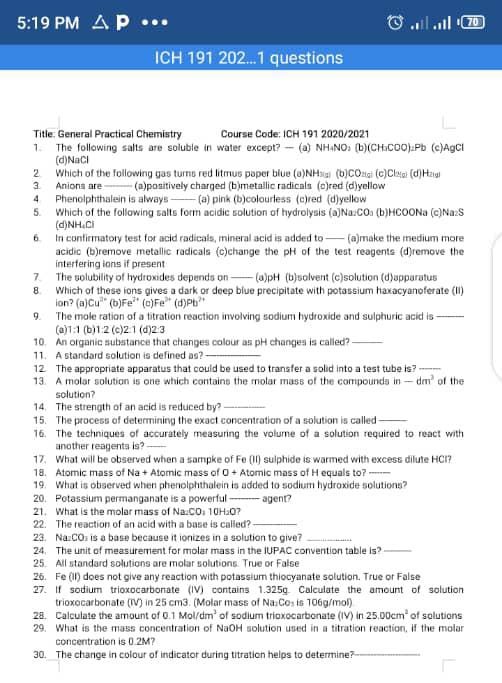
Title: EBSU-CHEM 191 Past Questions and Answers URL: https://studentsdash.com/ebsu-chem-191-past-questions-and-answers/ -------------------------------------------------- What is the purpose of a Bunsen burner in the laboratory? a) To heat substances b) To measure volume c) To mix solutions d) To cool samples Answer: a) To heat substances Which piece of equipment is used to accurately measure liquid volumes? a) Beaker b) Graduated cylinder c) Test tube d) Erlenmeyer flask Answer: b) Graduated cylinder What is the correct way to mix an acid with water? a) Add water to acid b) Add acid to water c) Mix equal parts of both d) They should never be mixed Answer: b) Add acid to water Identify the part of the microscope labeled “A.” a) Ocular lens b) Objective lens c) Stage d) Base Answer: b) Objective lens What is the role of a fume hood in the laboratory? a) To store chemicals b) To protect against harmful vapors c) To mix solutions d) To heat samples Answer: b) To protect against harmful vapors What is the main safety equipment required when handling chemicals? a) Gloves b) Goggles c) Lab coat d) All of the above Answer: d) All of the above Which piece of equipment is used to heat liquids in a laboratory? a) Test tube b) Hot plate c) Beaker d) Pipette Answer: b) Hot plate What is the term for a substance that speeds up a chemical reaction without being consumed? a) Catalyst b) Reactant c) Solvent d) Product Answer: a) Catalyst Which of the following indicates a chemical change? a) Melting ice b) Dissolving sugar in water c) Rust forming on iron d) Boiling water Answer: c) Rust forming on iron What is the purpose of a control in an experiment? a) To test the hypothesis b) To provide a comparison c) To eliminate variables d) To ensure accuracy Answer: b) To provide a comparison Which laboratory equipment is used to measure mass? a) Graduated cylinder b) Bunsen burner c) Balance d) Thermometer Answer: c) Balance What is the primary purpose of a titration? a) To heat solutions b) To determine concentration c) To mix reagents d) To separate mixtures Answer: b) To determine concentration Identify the type of reaction: A + B → C + D. a) Decomposition b) Synthesis c) Double displacement d) Single displacement Answer: b) Synthesis What is the pH of a neutral solution? a) 0 b) 7 c) 14 d) 10 Answer: b) 7 Which method is used to separate a solid from a liquid? a) Filtration b) Distillation c) Evaporation d) Chromatography Answer: a) Filtration What type of bond is formed by the sharing of electrons? a) Ionic bond b) Covalent bond c) Metallic bond d) Hydrogen bond Answer: b) Covalent bond What is the term for the amount of substance in a given volume? a) Concentration b) Molarity c) Density d) Mass Answer: a) Concentration Which piece of equipment is used for heating small samples in a laboratory? a) Beaker b) Test tube c) Petri dish d) Erlenmeyer flask Answer: b) Test tube What is the effect of increasing temperature on reaction rates? a) Decreases reaction rates b) No effect c) Increases reaction rates d) Makes reactions reversible Answer: c) Increases reaction rates What does the term “molar mass” refer to? a) The mass of one mole of a substance b) The volume of a mole of gas c) The density of a substance d) The number of atoms in a molecule Answer: a) The mass of one mole of a substance What is the primary function of an incubator in a laboratory? a) To store chemicals b) To provide a controlled environment c) To mix solutions d) To heat samples Answer: b) To provide a controlled environment What is the process of converting a liquid to a gas called? a) Evaporation b) Condensation c) Sublimation d) Freezing Answer: a) Evaporation Which piece of lab equipment is used to contain reactions and has a narrow neck? a) Beaker b) Erlenmeyer flask c) Petri dish d) Graduated cylinder Answer: b) Erlenmeyer flask What is the primary purpose of chromatography? a) To measure pH b) To separate mixtures c) To heat samples d) To mix solutions Answer: b) To separate mixtures Identify the type of reaction where two compounds exchange ions. a) Synthesis b) Decomposition c) Single displacement d) Double displacement Answer: d) Double displacement What is the term for a homogeneous mixture of two or more substances? a) Solution b) Suspension c) Colloid d) Alloy Answer: a) Solution Which of the following indicates a physical change? a) Burning wood b) Rusting iron c) Melting ice d) Digesting food Answer: c) Melting ice What safety equipment should be worn when working with hazardous chemicals? a) Gloves b) Safety goggles c) Lab coat d) All of the above Answer: d) All of the above What is the primary purpose of a reflux condenser? a) To cool vapors b) To heat solutions c) To mix chemicals d) To separate components Answer: a) To cool vapors What is the chemical formula for water? a) H2O b) CO2 c) O2 d) CH4 Answer: a) H2O Identify the process where a solid changes directly to a gas. a) Sublimation b) Evaporation c) Melting d) Condensation Answer: a) Sublimation Which type of reaction absorbs heat? a) Exothermic b) Endothermic c) Combustion d) Decomposition Answer: b) Endothermic What is the purpose of a spectrophotometer in the lab? a) To measure temperature b) To analyze light absorption c) To mix solutions d) To measure pressure Answer: b) To analyze light absorption Identify the method used to separate a soluble solid from a liquid. a) Filtration b) Distillation c) Evaporation d) Chromatography Answer: c) Evaporation What is the primary role of a buffer solution? a) To change pH rapidly b) To resist changes in pH c) To act as a solvent d) To provide nutrients Answer: b) To resist changes in pH What is the result of mixing an acid with a base? a) A chemical change b) A physical change c) No reaction d) Only a color change Answer: a) A chemical change Which piece of equipment is used for precise measurements of mass? a) Balance b) Graduated cylinder c) Pipette d) Beaker ** Answer:** a) Balance What is the term for the temperature at which a liquid becomes a gas? a) Freezing point b) Melting point c) Boiling point d) Condensation point Answer: c) Boiling point What type of glassware is used for boiling and mixing liquids? a) Beaker b) Test tube c) Petri dish d) Graduated cylinder Answer: a) Beaker What is the function of a thermometer in the laboratory? a) To measure pH b) To measure temperature c) To measure volume d) To measure mass Answer: b) To measure temperature Which type of chemical bond involves the transfer of electrons? a) Ionic bond b) Covalent bond c) Metallic bond d) Hydrogen bond Answer: a) Ionic bond What is the term for a solution that has more solute than it can dissolve at a given temperature? a) Unsaturated b) Saturated c) Supersaturated d) Diluted Answer: c) Supersaturated Identify the type of reaction that produces heat and light. a) Combustion b) Synthesis c) Decomposition d) Neutralization Answer: a) Combustion What is the main purpose of a laboratory notebook? a) To store samples b) To record experiments and results c) To measure volumes d) To organize supplies Answer: b) To record experiments and results What does the term “solute” refer to in a solution? a) The liquid part b) The solid part c) The substance being dissolved d) The total amount of substance Answer: c) The substance being dissolved Which laboratory process is used to purify a liquid by boiling and condensing? a) Filtration b) Distillation c) Chromatography d) Evaporation Answer: b) Distillation What is the purpose of a drying agent? a) To cool substances b) To absorb moisture c) To speed up reactions d) To mix solutions Answer: b) To absorb moisture What type of change occurs when ice melts? a) Chemical change b) Physical change c) Nuclear change d) Thermal change Answer: b) Physical change What is the primary purpose of a safety shower in a lab? a) To wash hands b) To cool samples c) To rinse off chemicals d) To measure water Answer: c) To rinse off chemicals What is the process called when a gas turns into a liquid? a) Evaporation b) Condensation c) Freezing d) Sublimation Answer: b) Condensation

Image Post
Practice Quizzes (6) View all quizzes
Relevant Articles (1) Visit blog
Link copied to clipboard!