
EBSU PHY 108 Past Questions and Answers
Title: EBSU PHY 108 Past Questions and Answers URL: https://studentsdash.com/ebsu-phy-108-past-questions-and-answers/ -------------------------------------------------- 1. If ( F ) is the force acting on the test charge ( q ), the electric field intensity ( E ) could be given by: A) ( E = \frac{F}{q} ) B) ( E = \frac{q}{F} ) C) ( E = F \cdot q ) D) ( E = \frac{F^2}{q} ) Answer: A) ( E = \frac{F}{q} ) 2. The Coulomb force ( F ) between two point charges ( q_1 ) and ( q_2 ) placed at a distance ( r ) is: A) ( F = k \frac{q_1 q_2}{r^2} ) B) ( F = k \frac{q_1 + q_2}{r} ) C) ( F = k \frac{q_1 – q_2}{r^2} ) D) ( F = k \frac{q_1 q_2}{r} ) Answer: A) ( F = k \frac{q_1 q_2}{r^2} ) 3. Find the focal length ( f ) of a mirror whose radius of curvature ( R ) is given by: A) ( f = \frac{R}{2} ) B) ( f = R ) C) ( f = \frac{2R}{3} ) D) ( f = 2R ) Answer: A) ( f = \frac{R}{2} ) 4. What is the beat frequency of two waves with frequencies ( f_1 ) and ( f_2 )? A) ( |f_1 + f_2| ) B) ( |f_1 – f_2| ) C) ( \frac{f_1 + f_2}{2} ) D) ( \frac{f_1 – f_2}{2} ) Answer: B) ( |f_1 – f_2| ) 5. If the frequency of a guitar string is ( f ), what is the frequency of the second harmonic? A) ( \frac{f}{2} ) B) ( f ) C) ( 2f ) D) ( 3f ) Answer: C) ( 2f ) 6. Which of the following waves can be transmitted through solids, liquids, and gases? A) Transverse waves B) Electromagnetic waves C) Mechanical waves D) Longitudinal waves Answer: D) Longitudinal waves 7. If the power of a lens is ( P ), its focal length ( f ) is: A) ( f = \frac{1}{P} ) B) ( f = P ) C) ( f = \frac{2}{P} ) D) ( f = P^2 ) Answer: A) ( f = \frac{1}{P} ) 8. Two points A and B are maintained at a potential of ( V_A ) and ( V_B ) respectively. The work done in moving 50 electrons from A to B is: A) ( W = 50 e (V_B – V_A) ) B) ( W = 50 e (V_A – V_B) ) C) ( W = 0 ) D) ( W = 50 (V_B + V_A) ) Answer: A) ( W = 50 e (V_B – V_A) ) 9. The unit of electric field strength is: A) Volt B) Ampere C) Newton per Coulomb D) Ohm Answer: C) Newton per Coulomb 10. What type of mirror always produces a virtual image? A) Plane mirror B) Convex mirror C) Concave mirror D) Both A and B Answer: D) Both A and B 11. The frequency of a wave is inversely proportional to its: A) Wavelength B) Amplitude C) Speed D) Energy Answer: A) Wavelength 12. What is the relationship between the angles of incidence and refraction given by Snell’s law? A) ( n_1 \sin(\theta_1) = n_2 \sin(\theta_2) ) B) ( n_1 + n_2 = \theta_1 + \theta_2 ) C) ( n_1 = n_2 ) D) ( \theta_1 + \theta_2 = 90^\circ ) Answer: A) ( n_1 \sin(\theta_1) = n_2 \sin(\theta_2) ) 13. Which of the following is a characteristic of a sound wave? A) It can travel through a vacuum B) It requires a medium to travel C) It travels faster than light D) It is an electromagnetic wave Answer: B) It requires a medium to travel 14. The phenomenon of a wave bending around an obstacle is known as: A) Reflection B) Refraction C) Diffraction D) Dispersion Answer: C) Diffraction 15. What is the principle behind the operation of a transformer? A) Conservation of energy B) Faraday’s Law of Induction C) Coulomb’s Law D) Ohm’s Law Answer: B) Faraday’s Law of Induction 16. In a circuit, what device is used to store electrical energy? A) Resistor B) Capacitor C) Inductor D) Diode Answer: B) Capacitor 17. The speed of light in a vacuum is approximately: A) ( 3 \times 10^6 ) m/s B) ( 3 \times 10^8 ) m/s C) ( 3 \times 10^4 ) m/s D) ( 3 \times 10^{10} ) m/s Answer: B) ( 3 \times 10^8 ) m/s 18. The critical angle for total internal reflection occurs when: A) Light travels from a medium of higher refractive index to lower refractive index B) Light travels from a medium of lower refractive index to higher refractive index C) The angle of incidence is equal to the angle of refraction D) None of the above Answer: A) Light travels from a medium of higher refractive index to lower refractive index 19. The Doppler effect is observed when: A) An object is moving away from a stationary observer B) An object is stationary and the observer is moving C) There is a change in frequency due to relative motion between a source and an observer D) All of the above Answer: C) There is a change in frequency due to relative motion between a source and an observer 20. What is the formula for calculating the electric potential energy ( U ) between two charges ( q_1 ) and ( q_2 ) separated by a distance ( r )? A) ( U = k \frac{q_1 q_2}{r} ) B) ( U = k \frac{q_1 q_2}{r^2} ) C) ( U = \frac{q_1 q_2}{r} ) D) ( U = k \frac{q_1 + q_2}{r} ) Answer: A) ( U = k \frac{q_1 q_2}{r} ) 21. A convex lens is used to: A) Diverge light rays B) Converge light rays C) Reflect light rays D) Absorb light rays Answer: B) Converge light rays 22. Which of the following is true about electromagnetic waves? A) They can travel through a vacuum. B) They require a medium to propagate. C) They have a frequency of zero. D) They cannot travel in a vacuum. Answer: A) They can travel through a vacuum. 23. The amplitude of a wave is: A) The distance between two consecutive crests B) The maximum displacement from the rest position C) The time period of the wave D) The speed of the wave Answer: B) The maximum displacement from the rest position 24. In a series circuit, the total voltage is equal to: A) The sum of the individual voltages across each component B) The product of the individual voltages C) The highest voltage in the circuit D) The average of the voltages Answer: A) The sum of the individual voltages across each component 25. What is the primary function of a transformer? A) To convert AC to DC B) To increase or decrease AC voltage C) To store electrical energy D) To measure current Answer: B) To increase or decrease AC voltage 26. In which type of wave do particles of the medium move perpendicular to the direction of wave propagation? A) Longitudinal waves B) Transverse waves C) Surface waves D) None of the above Answer: B) Transverse waves 27. The work done in moving a charge ( q ) through a potential difference ( V ) is given by: A) ( W = qV ) B) ( W = \frac{q}{V} ) C) ( W = V^2/q ) D) ( W = q + V ) Answer: A) ( W = qV ) 28. Which phenomenon explains the bending of light as it passes from one medium to another? A) Reflection B) Refraction C) Diffraction D) Dispersion Answer: B) Refraction 29. The SI unit of capacitance is: A) Volt B) Ampere C) Farad D) Coulomb Answer: C) Farad 30. The primary cause of the Doppler effect is: A) Change in amplitude B) Change in frequency due to relative motion C) Change in wavelength D) All of the above Answer: B) Change in frequency due to relative motion 31. A standing wave is formed by: A) Two waves traveling in the same direction B) Two waves traveling in opposite directions C) A single wave reflecting back D) None of the above Answer: B) Two waves traveling in opposite directions 32. The speed of sound is generally fastest in: A) Air B) Water C) Steel D) Vacuum Answer: C) Steel 33. The frequency of a wave can be calculated using: A) ( f = \frac{1}{T} ) B) ( f = \lambda \cdot T ) C) ( f = v \cdot \lambda ) D) Both A and C Answer: D) Both A and C 34. Which of the following laws states that the total current entering a junction equals the total current leaving the junction? A) Ohm’s Law B) Kirchhoff’s Current Law C) Faraday’s Law D) Coulomb’s Law Answer: B) Kirchhoff’s Current Law 35. An object moving in a circular path at constant speed has: A) Zero acceleration B) Constant velocity C) Constant acceleration D) Increasing speed Answer: C) Constant acceleration 36. The lens formula for thin lenses is given by: A) ( \frac{1}{f} = \frac{1}{d_o} + \frac{1}{d_i} ) B) ( f = d_o + d_i ) C) ( f = d_o \cdot d_i ) D) ( \frac{1}{f} = d_o – d_i ) Answer: A) ( \frac{1}{f} = \frac{1}{d_o} + \frac{1}{d_i} ) 37. The property of light that allows it to change direction when passing from one medium to another is: A) Reflection B) Refraction C) Absorption D) Transmission Answer: B) Refraction 38. The resistance ( R ) in a circuit can be calculated using: A) ( R = \frac{V}{I} ) B) ( R = VI ) C) ( R = V + I ) D) ( R = \frac{I}{V} ) Answer: A) ( R = \frac{V}{I} ) 39. Which of the following devices converts mechanical energy into electrical energy? A) Generator B) Motor C) Transformer D) Resistor Answer: A) Generator 40. The electric field inside a conductor in electrostatic equilibrium is: A) Maximum B) Minimum C) Zero D) Constant Answer: C) Zero 41. What is the primary purpose of a capacitor in an electric circuit? A) To store energy B) To increase current C) To decrease voltage D) To measure resistance Answer: A) To store energy 42. The force on a charged particle moving in a magnetic field is given by: A) ( F = qE ) B) ( F = qvB \sin(\theta) ) C) ( F = mv^2/r ) D) ( F = k \frac{q_1 q_2}{r^2} ) Answer: B) ( F = qvB \sin(\theta) ) 43. The frequency of electromagnetic waves is directly proportional to: A) Wavelength B) Speed of light C) Amplitude D) Energy Answer: D) Energy 44. The work done on an object is equal to: A) The force multiplied by the distance moved B) The mass times the acceleration C) The change in momentum D) All of the above Answer: A) The force multiplied by the distance moved 45. When light travels from a medium with a lower refractive index to a higher refractive index, it: A) Bends away from the normal B) Bends towards the normal C) Travels in a straight line D) Gets absorbed Answer: B) Bends towards the normal 46. The intensity of a sound wave is proportional to the square of its: A) Frequency B) Amplitude C) Wavelength D) Speed Answer: B) Amplitude 47. The law that describes the relationship between the current and voltage in an electrical circuit is known as: A) Newton’s Law B) Ohm’s Law C) Faraday’s Law D) Kirchhoff’s Law Answer: B) Ohm’s Law 48. In an electromagnetic wave, the electric and magnetic fields are: A) In phase and perpendicular to each other B) Out of phase and parallel to each other C) In phase and parallel to each other D) Perpendicular and independent Answer: A) In phase and perpendicular to each other 49. The phenomenon where light separates into its constituent colors when passing through a prism is called: A) Reflection B) Refraction C) Diffraction D) Dispersion Answer: D) Dispersion 50. Which of the following statements about sound waves is true? A) They are electromagnetic waves. B) They can travel through a vacuum. C) They are longitudinal waves. D) They have no frequency. Answer: C) They are longitudinal waves.
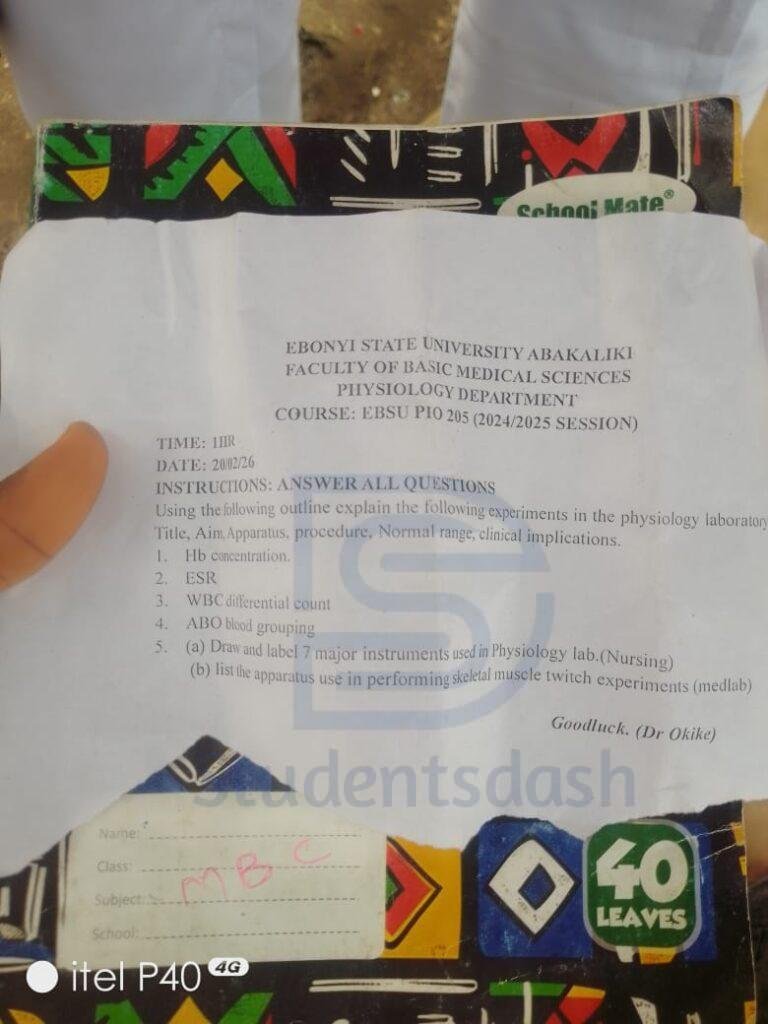
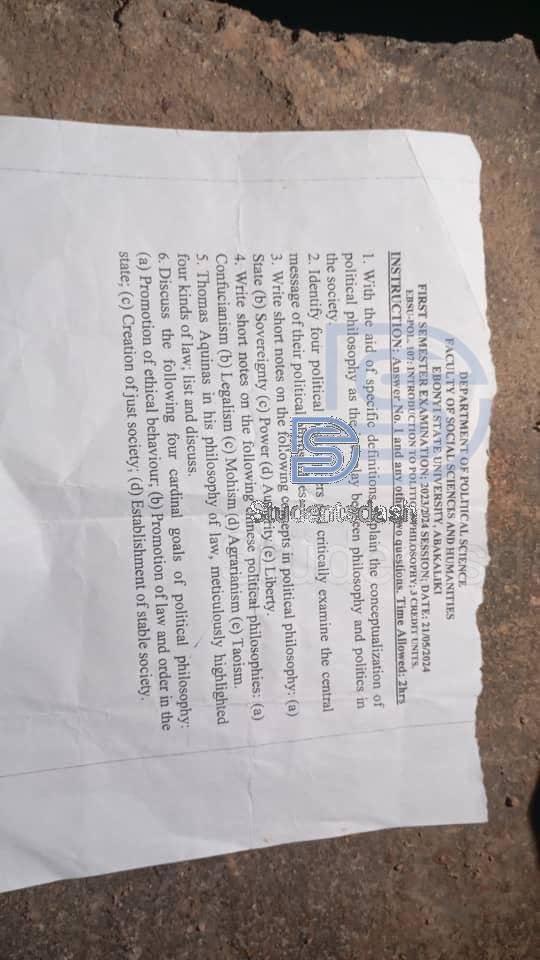
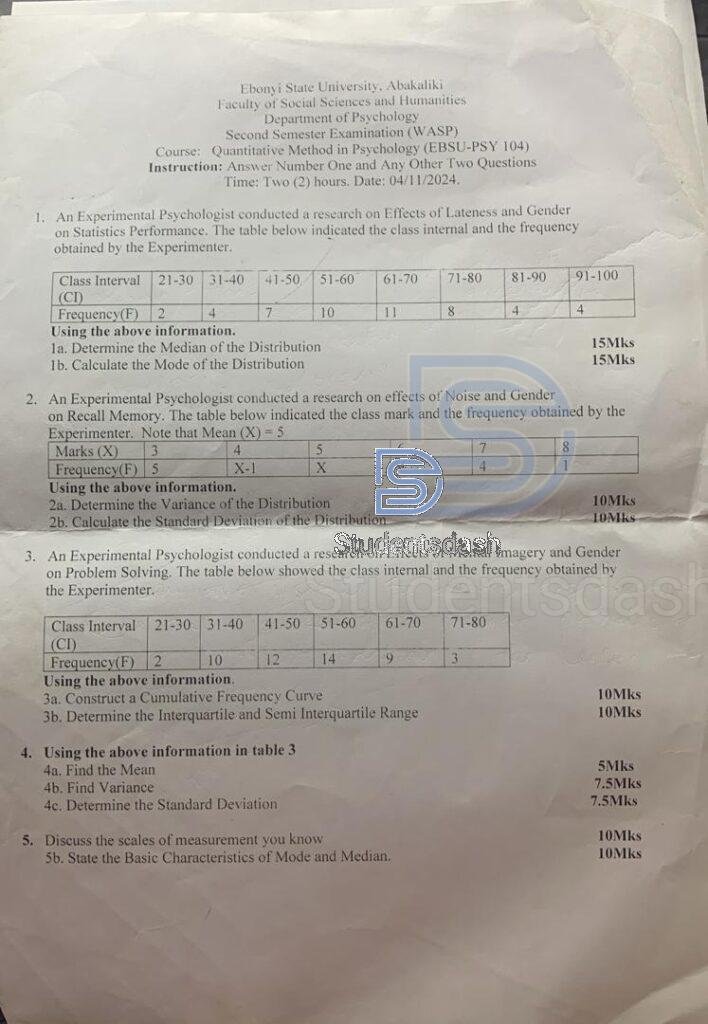
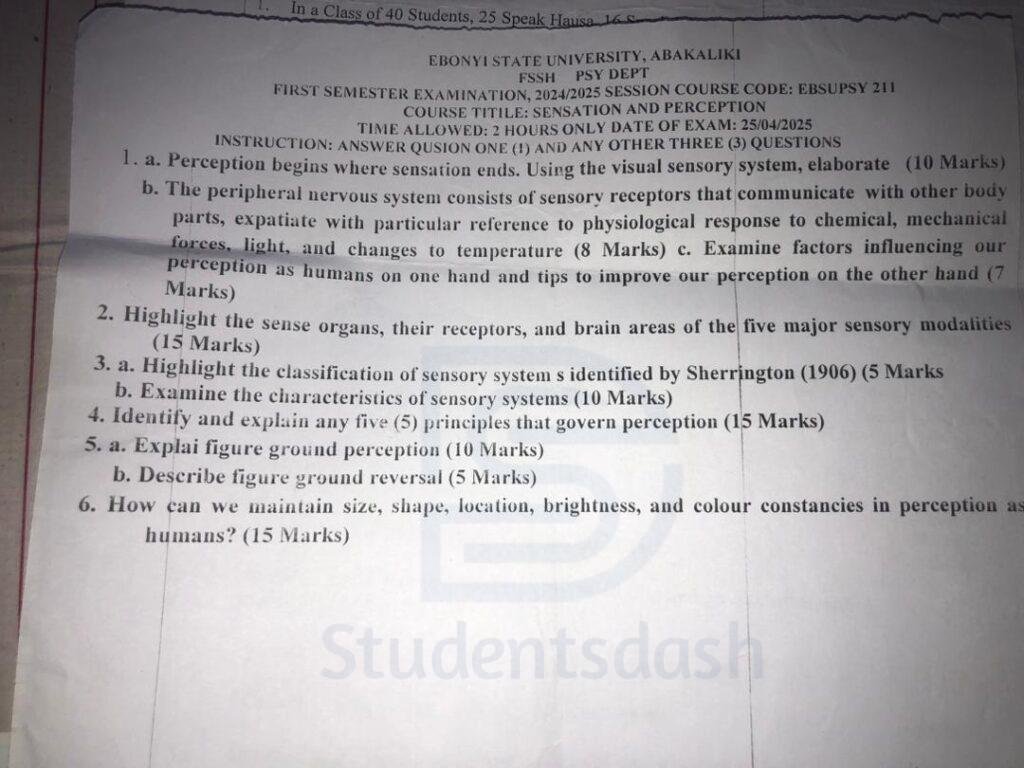
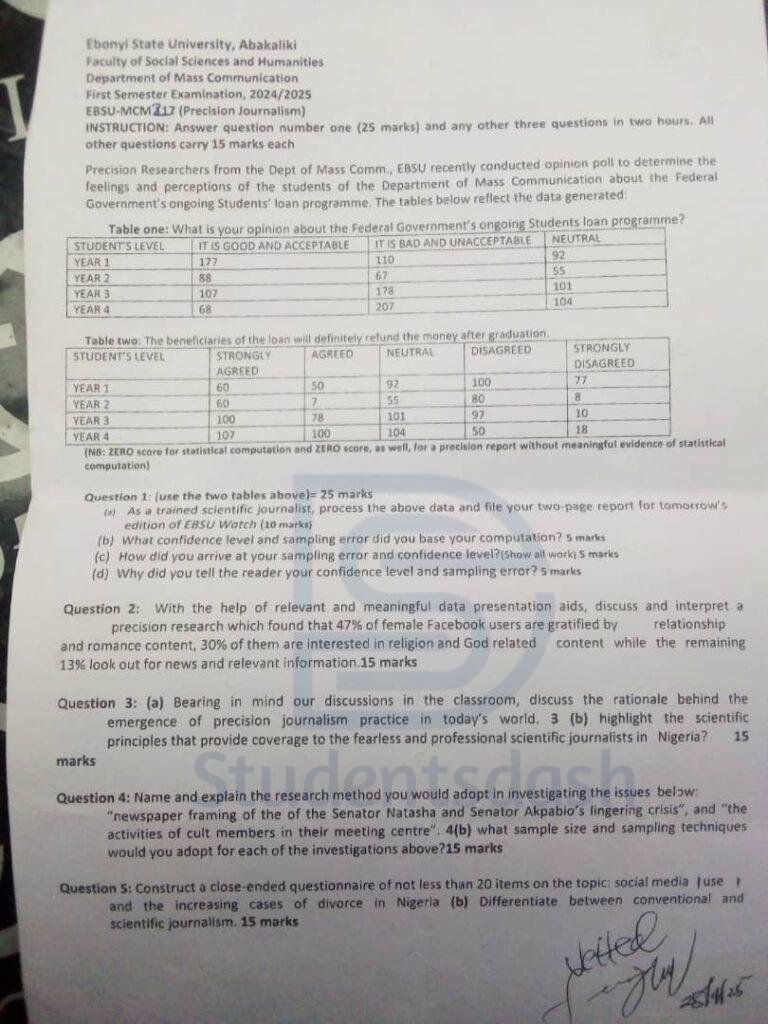
EBSU PSY 211 Past Questions and Answers
Title: EBSU PSY 211 Past Questions and Answers URL: https://studentsdash.com/ebsu-psy-211-past-questions-and-answers/ -------------------------------------------------- EBSU PSY 211 SENSATION AND PERCEPTION Past Questions and Answers
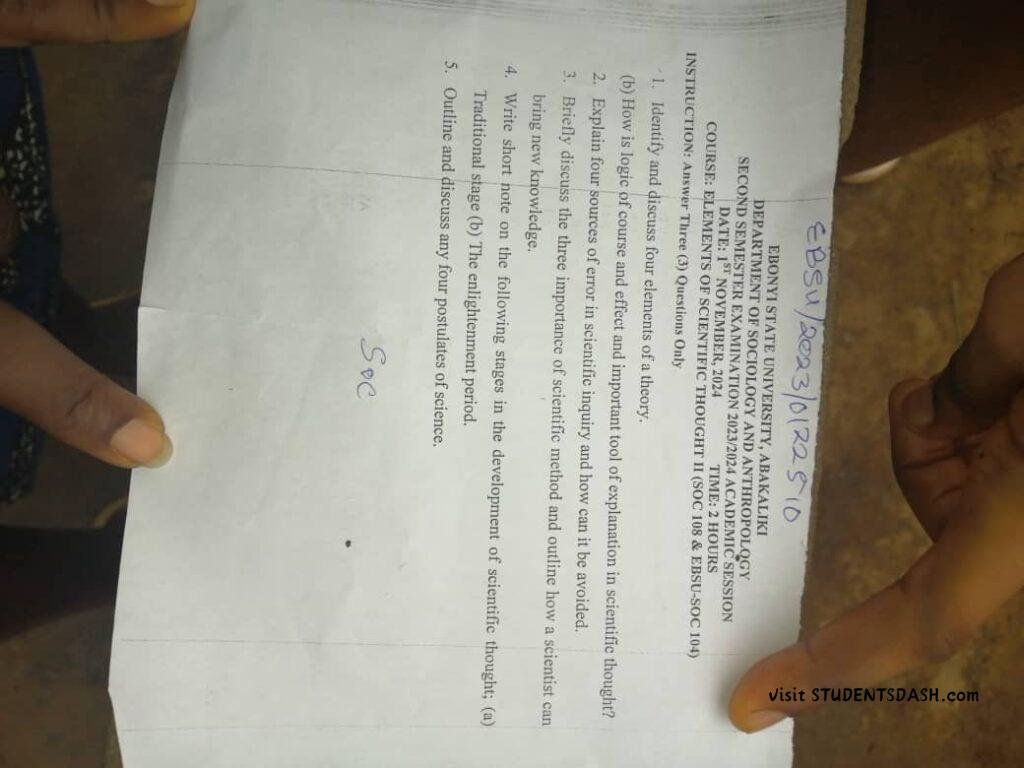
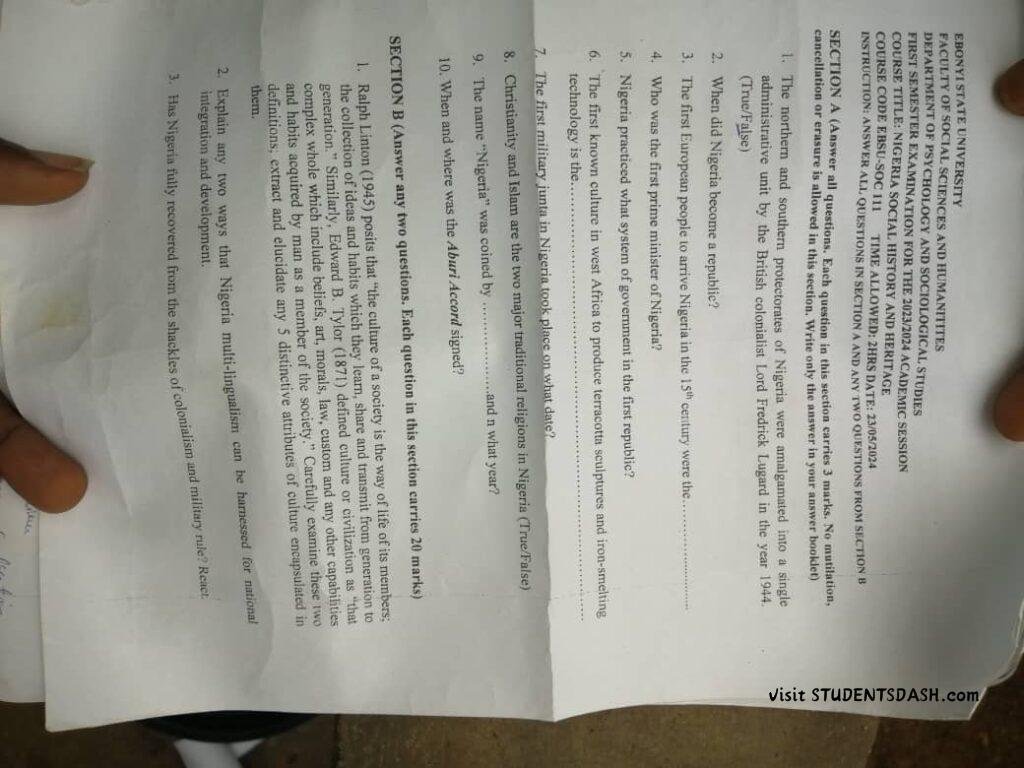
 Quiz
GST 201 Past Questions Practice
Practice GST 201 Past Questions and Answers...
 Quiz
 Quiz
EBSU-GST 105 Past Questions Practice
Are you preparing for your GST 105 exam at Ebonyi State University? We’ve got you cov...
 Quiz
ECO 101 Past Questions Practice
Prepare effectively for your ECO 101 exam with our updated past questions and answers...
 Quiz
Phy 107 Past Questions Practice
Practice Phy 107 ( PHY 191) Past Questions and Answers...
 Quiz
MTH 101 Past Questions Practice
Prepare effectively for your MAT 101 (MTH 101) exam with our updated past questions a...

What Does “Sent to Institutions” Mean on NELFUND? What Students Should Know
If you recently applied or reapplied for the NELFUND student loan...