Past Questions
Aureons GST 111 EXAM PQ&A - Studentsdash
View and download Aureons GST 111 EXAM PQ&A - Studentsdash
Free

View and download Aureons GST 111 EXAM PQ&A - Studentsdash
First Semester Course Chapter 1: Development of Entrepreneurship and Intrapreneurship Chapter 2: Nigerian Entrepreneurship Business Environment Chapter 3: Property and Intellectual Rights Chapter 4: Technological Entrepreneurship Chapter 5: Management of Innovation Second Semester Course Chapter 6: Family Business and Succession Planning Chapter 7: Women Entrepreneurship Chapter 8: Business Opportunity Evaluation Chapter 9: The Future of Entrepreneurship and Intrapreneurship Chapter 10: Entrepreneurship and Business FailurePRACTICE QUESTIONS1. Which of the following best describes entrepreneurship? A. Managing government agencies B. Creating and exploiting business opportunities C. Working as a paid employee D. Supervising public enterprises Answer: B2. Intrapreneurship refers to: A. Starting a business outside an organization B. Entrepreneurship within an existing organization C. International trade activities D. Government-sponsored businesses Answer: B3. The primary goal of an entrepreneur is to: A. Avoid competition B. Maximize opportunities and create value C. Depend entirely on government support D. Eliminate all business risks Answer: B4. Which factor contributed significantly to the growth of entrepreneurship in Nigeria? A. Increase in unemployment B. Reduction in innovation C. Decline in education D. Elimination of private ownership Answer: A5. An entrepreneur is generally regarded as: A. A risk avoider B. A policy maker C. A risk bearer D. A civil servant Answer: C6. Which of the following is NOT a characteristic of successful entrepreneurs? A. Creativity B. Initiative C. Dependence D. Persistence Answer: C7. Opportunity recognition is important because it: A. Eliminates competition B. Helps identify viable business ideas C. Guarantees profit D. Removes uncertainty Answer: B8. Which environmental factor directly affects business operations? A. Climate B. Political policies C. Geography D. Tradition Answer: B9. The business environment consists of: A. Internal factors only B. External factors only C. Internal and external factors D. Government factors alone Answer: C10. Which of the following is a component of the economic environment? A. Taxation B. Culture C. Religion D. Language Answer: A11. Intellectual property rights protect: A. Physical assets only B. Creative and innovative works C. Land ownership D. Natural resources Answer: B12. A patent grants protection to: A. Business names B. Inventions C. Advertisements D. Buildings Answer: B13. Copyright mainly protects: A. Literary and artistic works B. Industrial equipment C. Real estate D. Trade associations Answer: A14. A trademark is used to: A. Protect inventions B. Identify goods and services C. Register companies D. Protect land ownership Answer: B15. Which agency is responsible for company registration in Nigeria? A. EFCC B. CAC C. NAFDAC D. SON Answer: B16. Technological entrepreneurship involves: A. Using technology to create business value B. Farming activities C. Public administration D. Political campaigns Answer: A17. Innovation can best be defined as: A. Copying existing products B. Introducing useful new ideas C. Avoiding change D. Eliminating competition Answer: B18. Process innovation focuses on: A. Improving production methods B. Increasing taxes C. Hiring more workers D. Reducing education Answer: A19. Product innovation involves: A. Creating or improving products B. Changing company ownership C. Increasing office space D. Merging businesses Answer: A20. Which of the following is a source of innovation? A. Research and development B. Ignorance C. Isolation D. Tradition alone Answer: A21. Family business succession planning is concerned with: A. Business liquidation B. Transfer of leadership and ownership C. Government ownership D. Employee dismissal Answer: B22. A major challenge facing family businesses is: A. Leadership transition B. Unlimited capital C. Excessive innovation D. Lack of ownership Answer: A23. Succession planning helps to: A. Ensure business continuity B. Increase business failure C. Reduce productivity D. Eliminate leadership Answer: A24. Women entrepreneurship contributes to: A. Economic development B. Economic stagnation C. Industrial decline D. Market failure Answer: A25. One challenge faced by women entrepreneurs is: A. Excessive government support B. Limited access to finance C. Too many opportunities D. Unlimited resources Answer: B26. Business opportunity evaluation is the process of: A. Assessing the viability of a business idea B. Hiring employees C. Paying taxes D. Closing a business Answer: A27. Market demand is important because it: A. Determines customer interest B. Eliminates competitors C. Guarantees profit D. Removes risk Answer: A28. Feasibility studies are conducted to: A. Test business viability B. Register trademarks C. Recruit staff D. Pay dividends Answer: A29. Which factor should be considered before investing in a business opportunity? A. Market size B. Personal emotions C. Family pressure D. Political popularity Answer: A30. Entrepreneurship contributes to economic growth through: A. Job creation B. Unemployment C. Inflation only D. Market closure Answer: A31. The future of entrepreneurship is likely to be influenced most by: A. Technology B. Isolation C. Tradition alone D. Population decline Answer: A32. Digital entrepreneurship involves: A. Using digital technologies for business B. Farming with machines C. Political campaigning D. Manual production only Answer: A33. Globalization creates opportunities for entrepreneurs by: A. Expanding market access B. Eliminating customers C. Reducing trade D. Restricting innovation Answer: A34. Business failure occurs when a business: A. Cannot sustain operations B. Makes profit C. Expands successfully D. Increases market share Answer: A35. One common cause of business failure is: A. Poor management B. Effective planning C. Strong leadership D. Market research Answer: A36. Lack of adequate capital can lead to: A. Business failure B. Increased productivity C. Better management D. Stronger innovation Answer: A37. A business plan serves as: A. A roadmap for business operations B. A tax document C. A trademark certificate D. A legal judgment Answer: A38. Which of the following is a source of entrepreneurial finance? A. Personal savings B. Examination fees C. Utility bills D. School uniforms Answer: A39. Entrepreneurs are expected to: A. Identify and solve problems B. Avoid decision making C. Depend on luck D. Ignore customers Answer: A40. Creativity differs from innovation because creativity involves: A. Generating ideas B. Implementing ideas C. Marketing products D. Registering companies Answer: A41. Which of the following best defines risk? A. Certainty of outcomes B. Possibility of loss or uncertainty C. Guaranteed success D. Fixed returns Answer: B42. An entrepreneur's willingness to take calculated risks is known as: A. Risk tolerance B. Risk elimination C. Risk avoidance D. Risk transfer Answer: A43. The process of introducing a new product into the market is called: A. Commercialization B. Liquidation C. Privatization D. Regulation Answer: A44. Which of the following encourages entrepreneurship? A. Access to finance B. High bureaucracy C. Political instability D. Corruption Answer: A45. The ability to influence others toward achieving goals is: A. Leadership B. Accounting C. Marketing D. Forecasting Answer: A46. A monopoly market is characterized by: A. One seller B. Many sellers C. Free entry D. Perfect competition Answer: A47. Customer satisfaction is important because it: A. Encourages repeat patronage B. Reduces revenue C. Eliminates demand D. Causes business failure Answer: A48. Which of the following is an example of technological innovation? A. Mobile banking B. Traditional barter trade C. Manual record keeping D. Handwritten inventory Answer: A49. A competitive advantage enables a business to: A. Perform better than rivals B. Avoid customers C. Ignore markets D. Eliminate production Answer: A50. The ultimate objective of entrepreneurship is to: A. Create value and wealth B. Increase unemployment C. Prevent innovation D. Eliminate competition Answer: A51. Which of the following best explains entrepreneurial vision? A. Ability to predict exact profits B. Ability to see future opportunities C. Ability to avoid competition D. Ability to borrow money Answer: B52. A business idea becomes an opportunity when it: A. Is written down B. Solves a market need C. Is discussed with friends D. Receives government approval Answer: B53. Which of the following is an internal source of business finance? A. Bank loan B. Venture capital C. Retained earnings D. Government grant Answer: C54. SWOT analysis is used to identify: A. Customers and suppliers only B. Strengths, Weaknesses, Opportunities and Threats C. Assets and liabilities D. Profits and losses Answer: B55. The "S" in SWOT stands for: A. Security B. Strategy C. Strength D. Sales Answer: C56. Which of the following is a threat to business growth? A. New competitors B. Skilled workers C. Improved technology D. Customer loyalty Answer: A57. Entrepreneurial success depends largely on: A. Luck alone B. Government employment C. Effective planning and execution D. Family influence Answer: C58. Market research helps entrepreneurs to: A. Understand customer needs B. Eliminate taxes C. Reduce population D. Avoid innovation Answer: A59. Which of the following is NOT a function of management? A. Planning B. Organizing C. Controlling D. Gambling Answer: D60. A feasibility study is carried out before: A. Starting a business B. Paying salaries C. Recruiting staff D. Purchasing land Answer: A61. Which of the following is an example of a tangible asset? A. Patent B. Trademark C. Machinery D. Copyright Answer: C62. The entrepreneur who introduces a new product is acting as: A. Innovator B. Auditor C. Politician D. Teacher Answer: A63. The process of converting ideas into useful products is: A. Innovation B. Observation C. Regulation D. Forecasting Answer: A64. Which of the following is a major objective of intellectual property rights? A. Protect innovation B. Increase taxation C. Reduce competition D. Eliminate production Answer: A65. A patent holder enjoys: A. Exclusive rights to an invention B. Tax exemption C. Political power D. Unlimited funding Answer: A66. The most important resource in entrepreneurship is: A. Human capital B. Buildings C. Vehicles D. Furniture Answer: A67. Which of the following is an example of intrapreneurship? A. Employee developing a new product in a company B. Student opening a shop C. Farmer cultivating crops D. Trader importing goods Answer: A68. Entrepreneurship education aims to: A. Develop entrepreneurial skills B. Increase unemployment C. Eliminate innovation D. Discourage creativity Answer: A69. Which factor influences consumer buying behaviour? A. Culture B. Gravity C. Altitude D. Weather alone Answer: A70. The process of identifying business opportunities is called: A. Opportunity recognition B. Risk transfer C. Product testing D. Downsizing Answer: A71. Which of the following is a feature of successful entrepreneurs? A. Self-confidence B. Fear of change C. Indecisiveness D. Laziness Answer: A72. Business ethics refers to: A. Moral principles guiding business behaviour B. Tax regulations C. Product pricing D. Government policy Answer: A73. The first stage in the innovation process is: A. Idea generation B. Commercialization C. Distribution D. Evaluation Answer: A74. A franchise is: A. A business arrangement using an established brand B. A government agency C. A non-profit organization D. A cooperative society Answer: A75. Which of the following is a source of entrepreneurial opportunities? A. Market gaps B. Laziness C. Corruption D. Population decline Answer: A76. The entrepreneur who starts multiple businesses is known as: A. Portfolio entrepreneur B. Social entrepreneur C. Technical entrepreneur D. Bureaucrat Answer: A77. A social entrepreneur primarily focuses on: A. Solving social problems B. Political campaigns C. Tax collection D. Military activities Answer: A78. Which of the following is a micro-environment factor? A. Customers B. Inflation C. Government policy D. Exchange rate Answer: A79. Inflation affects businesses by: A. Increasing operating costs B. Eliminating customers C. Reducing competition D. Increasing patents Answer: A80. Business expansion is often associated with: A. Growth B. Failure C. Liquidation D. Downsizing Answer: A81. Which of the following is NOT an entrepreneurial skill? A. Creativity B. Leadership C. Risk management D. Dependency Answer: D82. An entrepreneur's ability to recover from setbacks is called: A. Resilience B. Monopoly C. Inflation D. Delegation Answer: A83. Which type of innovation involves changes in organizational structure? A. Organizational innovation B. Product innovation C. Service innovation D. Market innovation Answer: A84. A business opportunity is attractive when: A. Demand exceeds supply B. Competition is high C. Costs exceed revenue D. Market demand is absent Answer: A85. Venture capital is usually provided to: A. High-growth businesses B. Government ministries C. Secondary schools D. Religious groups Answer: A86. Which of the following best describes succession planning? A. Preparing future leaders B. Recruiting customers C. Paying taxes D. Closing a business Answer: A87. One major advantage of family businesses is: A. Strong commitment B. Frequent conflict C. High turnover D. Lack of trust Answer: A88. Women entrepreneurship promotes: A. Inclusive economic growth B. Political instability C. Market failure D. Unemployment Answer: A89. Which of the following is a barrier to women entrepreneurship? A. Limited funding access B. Increased education C. Technology adoption D. Networking Answer: A90. Which document outlines business objectives and strategies? A. Business plan B. Receipt C. Invoice D. Memo Answer: A91. The process of attracting customers is known as: A. Marketing B. Forecasting C. Auditing D. Budgeting Answer: A92. Which of the following is a key component of a business plan? A. Market analysis B. Weather report C. School timetable D. Family history Answer: A93. A mission statement explains: A. Purpose of the business B. Amount of profit C. Employee salaries D. Tax obligations Answer: A94. Entrepreneurial failure can result from: A. Poor financial management B. Customer satisfaction C. Innovation D. Strategic planning Answer: A95. Which of the following is an external source of finance? A. Bank loan B. Retained earnings C. Owner's savings D. Personal assets Answer: A96. The future of entrepreneurship is expected to rely heavily on: A. Digital technology B. Manual processes only C. Isolation D. Trade barriers Answer: A97. E-commerce is an example of: A. Digital entrepreneurship B. Agricultural entrepreneurship C. Industrial relations D. Public administration Answer: A98. A competitive market is characterized by: A. Several sellers B. One seller only C. No buyers D. Government ownership Answer: A99. Which factor is most important in evaluating a business opportunity? A. Profit potential B. Family influence C. Personal preference D. Political support Answer: A100. The primary objective of entrepreneurship education is to: A. Develop entrepreneurial mindset and skills B. Increase dependence on government jobs C. Discourage innovation D. Promote unemployment Answer: A101. Which of the following best describes an entrepreneur's tolerance for uncertainty? A. Ability to avoid all risks B. Ability to operate despite unknown outcomes C. Ability to predict the future D. Ability to eliminate competition Answer: B102. A prototype is primarily used to: A. Test a product idea B. Register a business C. Hire employees D. Reduce taxes Answer: A103. Which of the following is a common reason startups fail? A. Lack of market demand B. Excessive innovation C. Strong leadership D. Effective planning Answer: A104. The process of gathering information about competitors is known as: A. Competitive analysis B. Product design C. Auditing D. Benchmarking Answer: A105. Which stage comes after idea generation in innovation? A. Idea evaluation B. Liquidation C. Downsizing D. Delegation Answer: A106. An entrepreneur who identifies opportunities before others demonstrates: A. Alertness B. Weakness C. Dependence D. Carelessness Answer: A107. Which factor is most important when selecting a business location? A. Access to customers B. Colour of the building C. Personal preference D. Weather alone Answer: A108. Intellectual property theft may result in: A. Legal action B. Increased innovation C. Government grants D. Tax reduction Answer: A109. Which of the following is a legal form of business ownership? A. Sole proprietorship B. Friendship C. Family gathering D. Association Answer: A110. A partnership exists when: A. Two or more persons own a business B. Government owns a business C. One person owns a business D. Employees own a company Answer: A111. A corporation is usually characterized by: A. Separate legal existence B. Unlimited liability C. Single ownership D. Informal structure Answer: A112. Which of the following is an advantage of incorporation? A. Limited liability B. Unlimited debt C. Reduced ownership D. No regulations Answer: A113. Market segmentation involves: A. Dividing customers into groups B. Increasing taxes C. Reducing production D. Eliminating competitors Answer: A114. Customer loyalty is often achieved through: A. Quality service B. Poor communication C. High complaints D. Low standards Answer: A115. A business model explains: A. How a business creates and earns value B. Employee attendance C. Government policies D. Tax calculations Answer: A116. Which of the following is a benefit of innovation? A. Competitive advantage B. Reduced productivity C. Increased inefficiency D. Market decline Answer: A117. An entrepreneur's network can provide: A. Information and opportunities B. Inflation C. Regulations D. Tax liabilities Answer: A118. Which of the following is a macro-environment factor? A. Inflation B. Customers C. Suppliers D. Employees Answer: A119. A recession generally affects businesses by: A. Reducing consumer spending B. Increasing demand automatically C. Eliminating competition D. Increasing profits Answer: A120. Which of the following is an example of social entrepreneurship? A. Creating affordable healthcare solutions B. Selling luxury cars C. Importing electronics D. Exporting crude oil Answer: A121. The process of introducing a new technology into business operations is called: A. Technology adoption B. Diversification C. Privatization D. Delegation Answer: A122. Which leadership style encourages employee participation? A. Democratic B. Autocratic C. Dictatorial D. Bureaucratic Answer: A123. Business sustainability refers to: A. Long-term business survival B. Short-term gains only C. Market monopoly D. Employee turnover Answer: A124. Which of the following is a key feature of entrepreneurial thinking? A. Opportunity focus B. Fear of change C. Dependency D. Rigidity Answer: A125. The entrepreneur who starts a business after retirement is known as: A. Lifestyle entrepreneur B. Necessity entrepreneur C. Student entrepreneur D. Portfolio entrepreneur Answer: A126. Which of the following best measures business performance? A. Profitability B. Building size C. Number of chairs D. Office colour Answer: A127. Risk management involves: A. Identifying and controlling risks B. Eliminating all uncertainty C. Ignoring threats D. Avoiding decisions Answer: A128. A business opportunity with high demand and low competition is: A. Attractive B. Weak C. Unprofitable D. Risk-free Answer: A129. Which of the following is a challenge facing entrepreneurs? A. Access to capital B. Unlimited funding C. Excessive profits D. Lack of customers Answer: A130. Franchising allows entrepreneurs to: A. Use an established business system B. Avoid paying fees C. Ignore regulations D. Eliminate competition Answer: A131. Which factor encourages technological entrepreneurship? A. Research and development B. Resistance to change C. Poor infrastructure D. Low literacy Answer: A132. The process of assessing business risks before investment is: A. Risk analysis B. Product design C. Forecasting D. Auditing Answer: A133. Family businesses often benefit from: A. Shared values B. Constant conflicts C. Weak commitment D. High turnover Answer: A134. Which of the following can threaten family business continuity? A. Poor succession planning B. Effective communication C. Leadership development D. Strong governance Answer: A135. Which of the following promotes women entrepreneurship? A. Access to finance B. Gender discrimination C. Social barriers D. Unequal opportunities Answer: A136. Opportunity cost refers to: A. Value of the next best alternative forgone B. Business profit C. Tax obligation D. Production cost Answer: A137. Which of the following is an entrepreneurial resource? A. Information B. Laziness C. Uncertainty D. Inflation Answer: A138. The future of entrepreneurship is likely to emphasize: A. Innovation and technology B. Isolation C. Manual systems only D. Reduced connectivity Answer: A139. Business diversification involves: A. Expanding into new products or markets B. Reducing customers C. Closing branches D. Avoiding innovation Answer: A140. Which of the following contributes to business failure? A. Poor cash flow management B. Effective budgeting C. Strategic planning D. Innovation Answer: A141. A cash flow statement shows: A. Movement of cash in and out B. Employee records C. Customer complaints D. Inventory levels Answer: A142. Which of the following is a source of startup capital? A. Angel investors B. Customers only C. Competitors D. Auditors Answer: A143. An angel investor typically provides: A. Early-stage financing B. Tax collection services C. Product distribution D. Government regulation Answer: A144. Entrepreneurship contributes to society through: A. Wealth creation B. Increased dependency C. Reduced innovation D. Market stagnation Answer: A145. Which of the following is an example of a business opportunity? A. Unmet customer need B. Poor infrastructure C. Economic recession D. Inflation Answer: A146. A strategic plan provides: A. Long-term direction B. Daily attendance records C. Tax receipts D. Product labels Answer: A147. The process of bringing a product to market is: A. Commercialization B. Regulation C. Diversification D. Liquidation Answer: A148. Which of the following improves innovation capability? A. Continuous learning B. Resistance to change C. Poor communication D. Isolation Answer: A149. A successful entrepreneur is often: A. Opportunity-driven B. Fear-driven C. Dependent D. Passive Answer: A150. Which of the following is a sign of business growth? A. Increased market share B. Reduced sales C. Declining profits D. Customer loss Answer: A151. Which management function determines future objectives? A. Planning B. Directing C. Staffing D. Controlling Answer: A152. Entrepreneurship helps reduce: A. Unemployment B. Productivity C. Innovation D. Investment Answer: A153. Which factor is most critical for startup survival? A. Cash flow B. Furniture C. Office size D. Decorations Answer: A154. Market penetration involves: A. Increasing sales in existing markets B. Closing operations C. Selling assets D. Reducing customers Answer: A155. Which of the following is a benefit of networking? A. Access to opportunities B. Increased taxation C. Reduced knowledge D. Business closure Answer: A156. Business ethics promotes: A. Trust and credibility B. Fraud C. Corruption D. Dishonesty Answer: A157. Which of the following is a non-financial reward of entrepreneurship? A. Independence B. Dividend payment C. Salary increase D. Tax refund Answer: A158. The entrepreneur who acquires an existing business is pursuing: A. Business acquisition B. Liquidation C. Downsizing D. Outsourcing Answer: A159. A business that fails to adapt to change may: A. Lose competitiveness B. Increase market share C. Improve performance D. Gain customers Answer: A160. Innovation is most effective when it: A. Creates customer value B. Increases costs only C. Reduces quality D. Ignores demand Answer: A161. Which of the following is a barrier to innovation? A. Resistance to change B. Research activities C. Technology adoption D. Collaboration Answer: A162. A scalable business is one that: A. Can grow without proportional cost increases B. Cannot expand C. Depends on one customer D. Avoids technology Answer: A163. Entrepreneurial ecosystems consist of: A. Institutions supporting entrepreneurship B. Rivers and forests C. Political parties D. Religious organizations only Answer: A164. Which of the following strengthens competitive advantage? A. Innovation B. Complacency C. Inefficiency D. Delay Answer: A165. Business failure may occur due to: A. Inadequate planning B. Strong management C. Customer satisfaction D. Effective leadership Answer: A166. The process of assigning tasks to others is: A. Delegation B. Liquidation C. Segmentation D. Innovation Answer: A167. Which of the following is an example of a growth strategy? A. Market development B. Business closure C. Downsizing D. Retrenchment Answer: A168. Entrepreneurial opportunities often arise from: A. Problems and challenges B. Routine activities only C. Government employment D. Business failure Answer: A169. Which of the following is an indicator of innovation success? A. Customer acceptance B. Increased complaints C. Reduced quality D. Declining sales Answer: A170. The process of monitoring business performance is: A. Control B. Planning C. Forecasting D. Organizing Answer: A171. Which of the following helps entrepreneurs make informed decisions? A. Accurate information B. Assumptions alone C. Rumours D. Guesswork Answer: A172. A patent generally protects: A. New inventions B. Customer records C. Business debts D. Employee files Answer: A173. Which of the following is a key source of entrepreneurial motivation? A. Desire for achievement B. Fear of responsibility C. Dependence D. Laziness Answer: A174. Sustainable entrepreneurship balances: A. Economic, social and environmental goals B. Politics and religion C. Competition and monopoly D. Profit and taxation Answer: A175. Which of the following is a common startup challenge? A. Limited resources B. Unlimited demand C. Excessive profits D. No competition Answer: A176. Business intelligence helps entrepreneurs: A. Make better decisions B. Avoid planning C. Reduce innovation D. Ignore trends Answer: A177. Which of the following is an example of process innovation? A. Automated production system B. New company logo C. Business registration D. Employee transfer Answer: A178. The entrepreneur's reward for risk-taking is: A. Profit B. Tax C. Salary D. Interest Answer: A179. A customer-focused business primarily aims to: A. Satisfy customer needs B. Reduce quality C. Increase complaints D. Ignore feedback Answer: A180. Which of the following is a source of competitive advantage? A. Unique value proposition B. High costs C. Poor service D. Delayed delivery Answer: A181. Business continuity planning prepares a firm for: A. Unexpected disruptions B. Routine operations only C. Product advertising D. Recruitment Answer: A182. Which of the following is an entrepreneurial competency? A. Opportunity recognition B. Dependency C. Fear of risk D. Indifference Answer: A183. The main objective of market analysis is to: A. Understand customers and competitors B. Increase taxes C. Reduce profits D. Avoid planning Answer: A184. Which of the following can improve business performance? A. Effective leadership B. Poor communication C. Weak planning D. Conflict Answer: A185. A disruptive innovation: A. Changes existing markets significantly B. Maintains the status quo C. Reduces competition D. Eliminates customers Answer: A186. Which of the following is a financial risk? A. Cash shortage B. Customer complaint C. Employee conflict D. Product defect Answer: A187. Entrepreneurship is often associated with: A. Value creation B. Resource wastage C. Dependence D. Unemployment Answer: A188. A business incubator supports entrepreneurs by: A. Providing resources and guidance B. Collecting taxes C. Selling products D. Auditing accounts Answer: A189. Which of the following improves customer retention? A. Excellent service B. Poor quality C. Delayed response D. High complaints Answer: A190. Strategic entrepreneurship combines: A. Innovation and strategic management B. Accounting and taxation C. Marketing and auditing D. Production and sales Answer: A191. Which of the following is a major goal of innovation management? A. Transform ideas into value B. Increase bureaucracy C. Reduce productivity D. Eliminate creativity Answer: A192. The ability to identify market gaps is a sign of: A. Entrepreneurial alertness B. Weakness C. Carelessness D. Dependence Answer: A193. Which of the following best defines a startup? A. Newly established business venture B. Government ministry C. Non-profit association D. Cooperative society Answer: A194. Business expansion into foreign markets is known as: A. Internationalization B. Downsizing C. Segmentation D. Delegation Answer: A195. Which of the following can increase business survival? A. Adaptability B. Rigidity C. Resistance to change D. Poor planning Answer: A196. Entrepreneurial success is often measured by: A. Achievement of business goals B. Number of employees alone C. Office size D. Business age only Answer: A197. The process of evaluating alternative courses of action is: A. Decision-making B. Delegation C. Recruitment D. Innovation Answer: A198. Which of the following is an example of intellectual property? A. Trademark B. Inventory C. Equipment D. Building Answer: A199. An entrepreneur creates value by: A. Combining resources effectively B. Avoiding opportunities C. Ignoring customers D. Reducing innovation Answer: A200. Entrepreneurship is ultimately concerned with: A. Identifying opportunities and creating value B. Avoiding risk completely C. Eliminating competition D. Depending on government employment Answer: A201. Joseph noticed that students around his campus spend long hours searching for accommodation. He developed a mobile application that connects students directly with landlords. The entrepreneurial skill demonstrated by Joseph is: A. Risk avoidance B. Opportunity recognition C. Product duplication D. Market saturation Answer: B202. Which of the following statements about entrepreneurship is TRUE? A. Entrepreneurs always work alone B. Entrepreneurs completely avoid risk C. Entrepreneurs identify and exploit opportunities D. Entrepreneurs depend solely on government support Answer: C203. The success of an entrepreneurial venture depends largely on: A. Availability of opportunities only B. Effective management of resources C. Government ownership D. Family background alone Answer: B204. Statement I: Innovation involves introducing something new. Statement II: Every invention automatically becomes an innovation.A. Both statements are trueB. Both statements are falseC. Statement I is true, Statement II is falseD. Statement I is false, Statement II is trueAnswer: C205. A major reason many small businesses fail within the first few years is: A. Excessive customer loyalty B. Poor financial planning C. Too much innovation D. High employee commitment Answer: B206. True or False: "An intrapreneur operates within an existing organization to create innovative solutions."A. TrueB. FalseAnswer: A207. Which of the following is NOT usually considered during business opportunity evaluation? A. Market demand B. Profit potential C. Availability of customers D. Entrepreneur's zodiac sign Answer: D208. A patent protects: A. Trade names only B. New inventions C. Financial records D. Employee contracts Answer: B209. Statement I: Family businesses contribute significantly to economic growth. Statement II: Succession planning is unnecessary in family businesses.A. I and II are trueB. I and II are falseC. I is true, II is falseD. I is false, II is trueAnswer: C210. The major objective of market research is to: A. Increase tax payments B. Understand market needs C. Reduce production D. Eliminate competition Answer: B211. Which of the following best explains technological entrepreneurship? A. Use of technology to create business value B. Manufacturing alone C. Government employment D. Agricultural production Answer: A212. True or False: "Copyright grants exclusive rights to literary, artistic and creative works."A. TrueB. FalseAnswer: A213. An entrepreneur who establishes a business mainly to solve social problems is known as: A. Technical entrepreneur B. Portfolio entrepreneur C. Social entrepreneur D. Family entrepreneur Answer: C214. Which of the following is a characteristic of successful entrepreneurs? A. Fear of uncertainty B. Persistence C. Dependence D. Indecisiveness Answer: B215. Statement I: Innovation can improve competitiveness. Statement II: Innovation always guarantees success.A. Both trueB. Both falseC. I true, II falseD. I false, II trueAnswer: C216. A business plan serves primarily as: A. A strategic guide B. A tax document C. A legal certificate D. A loan repayment schedule Answer: A217. Which of the following is considered an external environmental factor? A. Employees B. Organizational culture C. Government policies D. Management style Answer: C218. True or False: "The availability of resources alone guarantees entrepreneurial success."A. TrueB. FalseAnswer: B219. One major challenge facing women entrepreneurs in developing countries is: A. Unlimited access to finance B. Limited access to funding C. Excessive government support D. Lack of business opportunities Answer: B220. The entrepreneur's reward for bearing risk is: A. Salary B. Rent C. Interest D. Profit Answer: D221. Chukwuemeka developed a mobile payment application after observing that many traders in rural communities lacked access to banking services. The entrepreneurial function demonstrated in this scenario is: A. Innovation B. Delegation C. Forecasting D. Regulation Answer: A222. Which of the following statements concerning entrepreneurship is correct? A. Entrepreneurs eliminate all forms of risk B. Entrepreneurs create value through opportunities C. Entrepreneurs rely solely on government support D. Entrepreneurs avoid competition Answer: B223. An entrepreneur who continuously introduces new methods of production is primarily performing the role of: A. Innovator B. Investor C. Employee D. Regulator Answer: A224. The major reason for conducting a feasibility study before starting a business is to: A. Estimate the viability of the business idea B. Register the company C. Recruit employees D. Determine tax rates Answer: A225. The Nigerian business environment is greatly influenced by: A. Political and economic factors B. Family traditions only C. Religious practices alone D. Climatic conditions only Answer: A226. Which of the following best describes an opportunity in entrepreneurship? A. A gap that can create value B. A government regulation C. A financial statement D. A business location Answer: A227. The process of converting an idea into a commercially useful product is known as: A. Innovation B. Invention C. Delegation D. Monitoring Answer: A228. Which of the following is NOT a characteristic of successful entrepreneurs? A. Creativity B. Persistence C. Dependency D. Initiative Answer: C229. One major objective of intellectual property rights is to: A. Protect creators from unauthorized use B. Increase government revenue C. Reduce innovation D. Prevent competition Answer: A230. A trademark is primarily used to protect: A. Brand identity B. Inventions C. Buildings D. Business loans Answer: A231. Which of the following statements is correct? A. True B. False "Every innovation is an invention." Answer: B232. The entrepreneur who establishes a business to address social challenges while generating income is known as: A. Social entrepreneur B. Portfolio entrepreneur C. Technical entrepreneur D. Lifestyle entrepreneur Answer: A233. The major purpose of succession planning in family businesses is to: A. Ensure continuity B. Increase taxation C. Eliminate competition D. Reduce ownership Answer: A234. Which of the following is most likely to hinder women entrepreneurship? A. Limited access to finance B. Business networking C. Government incentives D. Educational opportunities Answer: A235. A business opportunity should be rejected if: A. Costs outweigh benefits B. Demand exists C. Customers are available D. Growth potential exists Answer: A236. Which of the following best explains intrapreneurship? A. Innovation within an organization B. Business ownership by government C. Agricultural production D. Foreign investment Answer: A237. The most important purpose of market research is to: A. Understand customer needs B. Increase taxes C. Eliminate competitors D. Register trademarks Answer: A238. Which of the following statements is correct regarding patents? A. They protect inventions B. They protect buildings C. They protect customer databases D. They protect salaries Answer: A239. An entrepreneur's willingness to take calculated risks is known as: A. Risk tolerance B. Risk elimination C. Risk avoidance D. Risk transfer Answer: A240. Which factor contributes most to business failure? A. Poor management B. Strong leadership C. Customer satisfaction D. Innovation Answer: A241. The entrepreneur who discovers a market need and creates a solution is said to have: A. Opportunity recognition skills B. Accounting skills C. Auditing skills D. Secretarial skills Answer: A242. Which of the following best describes technological entrepreneurship? A. Creation of technology-driven businesses B. Manufacturing alone C. Government employment D. Public administration Answer: A243. Which statement is correct? A. True B. False "Innovation can exist without creating value." Answer: B244. The economic contribution of entrepreneurship includes: A. Job creation B. Increased dependency C. Reduced productivity D. Market stagnation Answer: A245. A business plan helps entrepreneurs to: A. Define objectives and strategies B. Avoid customers C. Eliminate competition D. Ignore risks Answer: A246. Which of the following is considered a macro-environmental factor? A. Inflation B. Employees C. Customers D. Suppliers Answer: A247. A patent owner enjoys: A. Exclusive rights to an invention B. Exclusive rights to land C. Tax exemption D. Unlimited funding Answer: A248. The process of evaluating a business opportunity involves assessing: A. Market demand B. Weather conditions only C. Personal emotions D. Political affiliations Answer: A249. Which of the following is a source of entrepreneurial opportunities? A. Unmet customer needs B. Population decline C. Business closure D. Tax increases Answer: A250. Which statement best describes innovation management? A. Coordinating activities that support innovation B. Collecting taxes C. Conducting elections D. Regulating imports Answer: A251. The primary objective of entrepreneurship education is to: A. Develop entrepreneurial competencies B. Increase dependence on government jobs C. Eliminate creativity D. Reduce innovation Answer: A252. Which of the following is most likely to improve business sustainability? A. Adaptability B. Rigidity C. Resistance to change D. Complacency Answer: A253. An entrepreneur's network is important because it provides: A. Information and resources B. Inflation C. Competition D. Taxation Answer: A254. Which of the following statements is correct? A. True B. False "All entrepreneurs are innovators, but not all innovators are entrepreneurs." Answer: A255. A major challenge facing startups is: A. Access to finance B. Excessive profits C. Too many customers D. Unlimited resources Answer: A256. The ability to recover quickly from setbacks is known as: A. Resilience B. Diversification C. Delegation D. Regulation Answer: A257. Which of the following is an example of product innovation? A. Introduction of a foldable smartphone B. Recruitment of workers C. Relocation of office D. Tax payment Answer: A258. Family businesses often face challenges relating to: A. Leadership succession B. Product quality C. Customer demand D. Technology adoption Answer: A259. Which of the following best explains a competitive advantage? A. An attribute that makes a business superior to rivals B. A government policy C. A legal document D. A business license Answer: A260. The future of entrepreneurship will most likely be driven by: A. Technology and innovation B. Isolation C. Bureaucracy D. Manual operationsAnswer: A261. Which of the following best explains entrepreneurial alertness? A. Ability to identify opportunities others overlook B. Ability to avoid all risks C. Ability to predict government policies D. Ability to eliminate competition Answer: A262. A business that consistently fails to satisfy customers is likely to experience: A. Declining sales B. Increased loyalty C. Market dominance D. Higher demand Answer: A263. Which statement is correct? A. True B. False "A copyright protects literary, artistic and musical works." Answer: A264. The process of introducing an existing product into a new market is known as: A. Market development B. Product development C. Diversification D. Liquidation Answer: A265. An entrepreneur who starts a business due to lack of employment opportunities is called: A. Necessity entrepreneur B. Social entrepreneur C. Portfolio entrepreneur D. Corporate entrepreneur Answer: A266. Which factor is most important when evaluating a new business opportunity? A. Market demand B. Colour of the logo C. Office decoration D. Personal friendship Answer: A267. A major advantage of family businesses is: A. Strong commitment among members B. Unlimited access to finance C. Absence of conflicts D. Government ownership Answer: A268. Which of the following may cause business failure? A. Poor record keeping B. Strategic planning C. Innovation D. Customer retention Answer: A269. Innovation is most successful when: A. It creates value for customers B. It increases costs only C. It reduces quality D. It ignores market needs Answer: A270. Which statement is correct? A. True B. False "An entrepreneur and an intrapreneur perform identical roles under identical conditions." Answer: B271. The role of entrepreneurship in economic development includes: A. Wealth creation B. Reduction of productivity C. Elimination of innovation D. Increase in dependency Answer: A272. Which of the following is an example of process innovation? A. Automated inventory system B. New company name C. Staff recruitment D. Office relocation Answer: A273. The entrepreneur's ability to influence and motivate others is known as: A. Leadership B. Forecasting C. Auditing D. Benchmarking Answer: A274. A business incubator assists entrepreneurs through: A. Mentorship and support services B. Tax collection C. Product taxation D. Legal prosecution Answer: A275. Which of the following best describes a startup? A. A newly established business venture B. A government ministry C. A cooperative society D. A trade union Answer: A276. Statement I: Risk is unavoidable in entrepreneurship. Statement II: Successful entrepreneurs learn to manage risks.A. Both statements are trueB. Both statements are falseC. I is true, II is falseD. I is false, II is trueAnswer: A277. Which of the following contributes significantly to women entrepreneurship? A. Access to education B. Gender discrimination C. Social exclusion D. Lack of capital Answer: A278. The purpose of a mission statement is to: A. Explain the organization's purpose B. State employee salaries C. Describe office location D. Determine tax obligations Answer: A279. Which factor can hinder technological entrepreneurship in Nigeria? A. Poor infrastructure B. Innovation C. Skilled manpower D. Research activities Answer: A280. Intellectual property rights encourage innovation by: A. Rewarding creators B. Eliminating competition C. Reducing profits D. Increasing taxes Answer: A281. Which of the following is NOT part of a business plan? A. Market analysis B. Financial projections C. Strategic objectives D. Family history Answer: D282. The process of dividing customers into smaller groups is known as: A. Market segmentation B. Product positioning C. Diversification D. Franchising Answer: A283. Which statement is correct? A. True B. False "A patent can protect a new machine invented by an entrepreneur." Answer: A284. A competitive advantage can be achieved through: A. Superior quality B. Poor customer service C. Delayed delivery D. Inefficiency Answer: A285. One major reason entrepreneurs conduct market research is to: A. Understand customer preferences B. Eliminate all competition C. Avoid innovation D. Reduce product quality Answer: A286. Which of the following is a source of startup capital? A. Personal savings B. Weather reports C. Trade unions D. Religious doctrines Answer: A287. The future of entrepreneurship is expected to rely heavily on: A. Digital technologies B. Manual processes alone C. Isolation D. Bureaucracy Answer: A288. Which factor is most likely to increase business growth? A. Customer satisfaction B. Poor management C. High employee turnover D. Lack of planning Answer: A289. An entrepreneur introducing solar-powered irrigation systems to farmers is primarily creating: A. Technological innovation B. Political reform C. Social conflict D. Economic recession Answer: A290. Which statement best explains entrepreneurship? A. Creating value through opportunity exploitation B. Avoiding uncertainty completely C. Depending on government jobs D. Reducing competition Answer: A291. A major objective of succession planning is to: A. Prepare future leaders B. Increase business taxes C. Reduce business ownership D. Eliminate competition Answer: A292. Which of the following is an external business environment factor? A. Government regulations B. Employee morale C. Organizational culture D. Internal policies Answer: A293. Statement I: Creativity involves generating ideas. Statement II: Innovation involves implementing useful ideas.A. Both statements are trueB. Both statements are falseC. I is true, II is falseD. I is false, II is trueAnswer: A294. Which factor may discourage entrepreneurship in Nigeria? A. Inconsistent government policies B. Market opportunities C. Innovation support D. Business education Answer: A295. A social entrepreneur primarily aims to: A. Solve social problems sustainably B. Maximize taxes C. Eliminate employment D. Promote monopolies Answer: A296. The process of expanding business operations into another country is: A. Internationalization B. Segmentation C. Delegation D. Downsizing Answer: A297. Which of the following is a common cause of startup failure? A. Poor cash flow management B. Effective planning C. Strong leadership D. Market demand Answer: A298. An entrepreneur's reputation can influence: A. Customer trust B. Weather patterns C. Population growth D. Inflation rates Answer: A299. Which statement is correct? A. True B. False "Every business opportunity automatically becomes a successful business." Answer: B300. Entrepreneurship ultimately contributes to: A. Economic development and value creation B. Unemployment growth C. Market stagnation D. Reduced innovation Answer: A301. Which of the following is a major benefit of innovation management? A. Improved competitiveness B. Reduced creativity C. Increased inefficiency D. Elimination of opportunities Answer: A302. The entrepreneur who owns several unrelated businesses is known as: A. Portfolio entrepreneur B. Social entrepreneur C. Lifestyle entrepreneur D. Necessity entrepreneur Answer: A303. A trademark mainly protects: A. Brand identity B. Buildings C. Equipment D. Salaries Answer: A304. Which factor is most important for business sustainability? A. Adaptability to change B. Resistance to change C. Isolation D. Complacency Answer: A305. A business opportunity exists when: A. A need can be satisfied profitably B. Competition disappears completely C. Government guarantees profit D. Risks are eliminated Answer: A306. Which of the following best describes opportunity recognition? A. Identifying unmet needs in the market B. Registering a company C. Hiring employees D. Paying taxes Answer: A307. Women entrepreneurship contributes to: A. Economic inclusion B. Unemployment C. Reduced productivity D. Market decline Answer: A308. The primary purpose of a feasibility study is: A. Determine viability B. Recruit staff C. Pay taxes D. Register patents Answer: A309. Which of the following may strengthen a family business? A. Clear succession plans B. Leadership conflicts C. Poor communication D. Nepotism Answer: A310. Which statement is correct? A. True B. False "Business failure always results from lack of capital." Answer: B311. An entrepreneur who identifies a gap in the transportation sector and develops a ride-hailing application is primarily demonstrating: A. Opportunity recognition B. Market avoidance C. Risk elimination D. Business liquidation Answer: A312. Which of the following best explains business failure? A. Inability to sustain operations B. Increase in profits C. Expansion of market share D. Growth in customer base Answer: A313. Statement I: Entrepreneurship creates employment opportunities. Statement II: Entrepreneurship contributes to economic growth.A. Both statements are trueB. Both statements are falseC. I is true, II is falseD. I is false, II is trueAnswer: A314. A family business that fails to prepare future leaders may experience: A. Succession crisis B. Market dominance C. Customer loyalty D. Increased productivity Answer: A315. Which of the following is a characteristic of innovative entrepreneurs? A. Creativity B. Dependency C. Fear of change D. Indecisiveness Answer: A316. The process of legally protecting a company's logo is through: A. Trademark registration B. Patent registration C. Licensing D. Auditing Answer: A317. An entrepreneur introducing online medical consultations is practicing: A. Technological entrepreneurship B. Political entrepreneurship C. Agricultural management D. Industrial relations Answer: A318. Which factor is most likely to discourage foreign investment in Nigeria? A. Policy inconsistency B. Market opportunities C. Skilled labour D. Innovation Answer: A319. Which statement is correct? A. True B. False "Every successful entrepreneur starts with abundant capital." Answer: B320. The ability to make sound decisions under uncertainty is an entrepreneurial: A. Competency B. Weakness C. Limitation D. Liability Answer: A321. Which of the following is a benefit of intellectual property protection? A. Encourages innovation B. Eliminates competition C. Reduces creativity D. Increases unemployment Answer: A322. Business opportunities are most likely to emerge from: A. Problems requiring solutions B. Business failures alone C. Government policies only D. Competition alone Answer: A323. A woman who establishes a business despite financial and cultural barriers demonstrates: A. Entrepreneurial resilience B. Business failure C. Market saturation D. Resource wastage Answer: A324. Which of the following is an example of product innovation? A. Launching a solar-powered smartphone B. Changing office furniture C. Recruiting staff D. Relocating a business Answer: A325. A major purpose of opportunity evaluation is to determine: A. Business viability B. Political influence C. Tax obligations D. Employee attendance Answer: A326. Which statement is correct? A. True B. False "All inventions become successful commercial innovations." Answer: B327. The process of expanding into a new customer segment with an existing product is: A. Market development B. Diversification C. Downsizing D. Liquidation Answer: A328. Which of the following contributes to long-term business survival? A. Adaptability B. Rigidity C. Resistance to innovation D. Complacency Answer: A329. A business plan is important because it: A. Guides business decisions B. Eliminates risks completely C. Guarantees profits D. Prevents competition Answer: A330. The entrepreneur who acquires and manages several businesses simultaneously is: A. Portfolio entrepreneur B. Social entrepreneur C. Necessity entrepreneur D. Technical entrepreneur Answer: A331. Which of the following is NOT an element of the Nigerian business environment? A. Political factors B. Economic factors C. Social factors D. Planetary factors Answer: D332. Innovation management focuses on: A. Coordinating innovation activities B. Eliminating creativity C. Avoiding change D. Restricting development Answer: A333. Statement I: Risk is unavoidable in business. Statement II: Effective risk management improves survival.A. Both statements are trueB. Both statements are falseC. I is true, II is falseD. I is false, II is trueAnswer: A334. Which factor may increase the likelihood of business failure? A. Poor financial management B. Effective planning C. Customer satisfaction D. Innovation Answer: A335. A competitive advantage allows a business to: A. Perform better than competitors B. Eliminate customers C. Avoid planning D. Ignore market trends Answer: A336. Which of the following best describes entrepreneurship? A. Creation of value through opportunities B. Avoidance of uncertainty C. Dependence on government jobs D. Elimination of risks Answer: A337. A family business is most likely to succeed across generations when: A. Succession is planned B. Leadership is ignored C. Conflicts are encouraged D. Communication is absent Answer: A338. Which statement is correct? A. True B. False "A trademark protects a company's brand identity." Answer: A339. The major challenge facing many startups is: A. Inadequate funding B. Excessive profits C. Too many opportunities D. Unlimited resources Answer: A340. Which of the following best describes a patent? A. Exclusive right granted for an invention B. Business registration certificate C. Customer database D. Tax document Answer: A341. The ability to inspire employees towards organizational goals is: A. Leadership B. Delegation C. Auditing D. Forecasting Answer: A342. Which of the following is an example of social entrepreneurship? A. Affordable healthcare initiative B. Luxury fashion business C. Oil exploration company D. Import business Answer: A343. The future of entrepreneurship is expected to be shaped largely by: A. Technology B. Isolation C. Bureaucracy D. Traditional methods alone Answer: A344. A business opportunity should be pursued when: A. Demand and profitability exist B. No customers exist C. Costs exceed benefits D. Growth potential is absent Answer: A345. Which statement is correct? A. True B. False "Women entrepreneurs contribute significantly to economic development." Answer: A346. The purpose of market research is to: A. Gather information for decision-making B. Eliminate all competitors C. Reduce innovation D. Avoid planning Answer: A347. Which of the following is an entrepreneurial trait? A. Self-confidence B. Dependency C. Fearfulness D. Indifference Answer: A348. A startup that fails to adapt to customer needs may: A. Lose market relevance B. Increase customer loyalty C. Improve profitability D. Gain market dominance Answer: A349. The major aim of technological entrepreneurship is: A. Commercialize technology B. Avoid innovation C. Reduce efficiency D. Increase bureaucracy Answer: A350. Entrepreneurship education seeks to: A. Develop entrepreneurial skills B. Discourage creativity C. Increase unemployment D. Promote dependency Answer: A351. Which of the following is a source of innovation? A. Research and development B. Laziness C. Isolation D. Complacency Answer: A352. A successful entrepreneur is usually: A. Opportunity-oriented B. Risk-averse C. Passive D. Dependent Answer: A353. Statement I: Creativity generates ideas. Statement II: Innovation implements ideas.A. Both statements are trueB. Both statements are falseC. I true, II falseD. I false, II trueAnswer: A354. Which factor is critical in evaluating a business opportunity? A. Market demand B. Office colour C. Family preference D. Personal friendship Answer: A355. Which of the following can strengthen women entrepreneurship? A. Access to capital B. Gender bias C. Social restrictions D. Limited education Answer: A356. Business sustainability requires: A. Continuous adaptation B. Resistance to change C. Isolation D. Stagnation Answer: A357. Which statement is correct? A. True B. False "Poor cash flow management can lead to business failure." Answer: A358. An entrepreneur who develops a digital learning platform is engaging in: A. Technological entrepreneurship B. Political administration C. Public service D. Industrial regulation Answer: A359. Which of the following best explains customer value? A. Benefits received relative to cost B. Product price only C. Business profit D. Tax obligations Answer: A360. The entrepreneur's reward for bearing risk is: A. Profit B. Salary C. Rent D. Interest Answer: A361. Which of the following may improve business growth? A. Innovation B. Poor planning C. Inefficiency D. Complacency Answer: A362. A family business succession plan should focus on: A. Leadership continuity B. Office decoration C. Product packaging D. Employee uniforms Answer: A363. Which statement is correct? A. True B. False "Intellectual property rights discourage innovation." Answer: B364. Market segmentation helps businesses: A. Target specific customer groups B. Eliminate customers C. Avoid planning D. Reduce quality Answer: A365. The major purpose of entrepreneurship is: A. Value creation B. Risk elimination C. Market destruction D. Unemployment Answer: A366. Which factor contributes to entrepreneurial success? A. Persistence B. Laziness C. Fear of change D. Indecision Answer: A367. A business that continually introduces improved products demonstrates: A. Innovation B. Stagnation C. Liquidation D. Downsizing Answer: A368. Which of the following is a major benefit of networking? A. Access to opportunities B. Reduced knowledge C. Business failure D. Customer loss Answer: A369. Statement I: Entrepreneurship creates jobs. Statement II: Entrepreneurship promotes economic growth.A. Both statements are trueB. Both statements are falseC. I true, II falseD. I false, II trueAnswer: A370. Which of the following is a challenge facing entrepreneurs? A. Access to finance B. Excessive demand C. Unlimited resources D. Absence of competition Answer: A371. A patent is granted for: A. Inventions B. Buildings C. Vehicles D. Employees Answer: A372. Which of the following can contribute to business failure? A. Poor leadership B. Effective management C. Innovation D. Customer satisfaction Answer: A373. Entrepreneurship contributes to society through: A. Wealth creation B. Economic stagnation C. Reduced productivity D. Market decline Answer: A374. Which statement is correct? A. True B. False "Innovation and creativity mean exactly the same thing." Answer: B375. A business opportunity exists when: A. A need can be profitably satisfied B. Risks are absent C. Competition disappears D. Government guarantees success Answer: A376. Which factor influences consumer behaviour? A. Culture B. Weather only C. Building colour D. Geography alone Answer: A377. Women entrepreneurship can be encouraged through: A. Financial support programs B. Gender discrimination C. Social exclusion D. Limited education Answer: A378. Which of the following is an example of process innovation? A. Automated payment system B. New company slogan C. Office relocation D. Staff promotion Answer: A379. The entrepreneur who introduces a new business concept into the market acts as: A. Innovator B. Auditor C. Accountant D. Regulator Answer: A380. A strong business plan should contain: A. Financial projections B. Family history C. Political opinions D. Religious doctrines Answer: A381. Which statement is correct? A. True B. False "A copyright protects literary and artistic works." Answer: A382. A business survives competition mainly through: A. Competitive advantage B. Luck alone C. Government favour D. Isolation Answer: A383. Entrepreneurship education helps individuals: A. Develop entrepreneurial competencies B. Depend on government jobs C. Avoid opportunities D. Reduce creativity Answer: A384. Which of the following is an entrepreneurial resource? A. Information B. Laziness C. Ignorance D. Indifference Answer: A385. The future entrepreneur is expected to be: A. Technology-driven B. Change-resistant C. Isolated D. Passive Answer: A386. Which factor promotes innovation? A. Continuous learning B. Fear of failure C. Resistance to change D. Complacency Answer: A387. A startup's success is most dependent on: A. Creating value for customers B. Office size C. Company logo D. Furniture quality Answer: A388. Which statement is correct? A. True B. False "Family businesses never experience leadership conflicts." Answer: B389. The process of identifying business opportunities is known as: A. Opportunity recognition B. Diversification C. Liquidation D. Delegation Answer: A390. Which of the following best explains entrepreneurship? A. Opportunity identification and value creation B. Elimination of risk C. Dependence on employment D. Avoidance of competition Answer: A391. A major objective of innovation management is to: A. Transform ideas into value B. Eliminate creativity C. Reduce productivity D. Increase bureaucracy Answer: A392. Which factor may discourage entrepreneurship? A. Inadequate infrastructure B. Access to finance C. Business education D. Innovation support Answer: A393. An entrepreneur's reputation affects: A. Customer trust B. Weather conditions C. Population growth D. Exchange rates Answer: A394. Which statement is correct? A. True B. False "All risks in business can be completely eliminated." Answer: B395. Which of the following contributes to business growth? A. Customer satisfaction B. Poor service C. Inefficiency D. Delayed response Answer: A396. A family business is likely to fail after the founder's exit if: A. Succession planning is absent B. Leadership development exists C. Communication is effective D. Governance is strong Answer: A397. Which of the following is a key entrepreneurial competency? A. Opportunity recognition B. Dependency C. Fearfulness D. Indifference Answer: A398. Technological entrepreneurship involves: A. Using technology to create value B. Avoiding innovation C. Eliminating competition D. Reducing productivity Answer: A399. Which of the following best defines innovation? A. Successful implementation of useful ideas B. Mere generation of ideas C. Avoidance of change D. Reduction of productivity Answer: A400. Entrepreneurship ultimately promotes: A. Economic development and wealth creation B. Economic stagnation C. Unemployment growth D. Reduced innovation Answer: A
Are you preparing for Medical Jurisprudence, Nursing Law and Ethics, or Legal Aspects of Nursing?Studentsdash has made this complete Medical Jurisprudence study material available to help nursing students prepare better for exams.The PDF covers topics such as:PAST QUESTION: https://studentsdash.com.ng/material/law-151-past-questions-and-answers-1788377132Introduction to Medical JurisprudencePrinciples of Nursing EthicsEthics of Nursing PracticeMedical NegligenceAssault, Battery and False ImprisonmentConsent and Patients' RightsLaws Relating to Nursing Practice in NigeriaLiving Wills and Advance DirectivesImportant Nigerian statutes and landmark casesPRACTICE CBT ASPECT: https://studentsdash.com.ng/quiz/law-152-medical-jurisprudence-exam-practiceDownload and study the PDF below.Studentsdash helps students with study materials, past questions, CBT practice and exam preparation resources.🌐 studentsdash.com.ng📱 @studentsdashWhatsApp: 07075012541Share with other Nursing students who may need it.
View and download Aureons PHY 107 Exam PQ&A - Studentsdash
View and download Aureons CHM 107 EXAM PQ&A 3 - Studentsdash
View and download Aureons BIO 101 EXAM PQ&A - Studentsdash
Download Phy 192 (PHY 108) Past Questions and Answers PDF below
PUL 101 Past Questions and Answers legal Methods
Prepare smart with COS 107 past questions and answers for EBSU 100 level students.
MTH 101 (MAT 101) Past Questions and AnswersTAKE MTH 101 EXAM PRACTICE
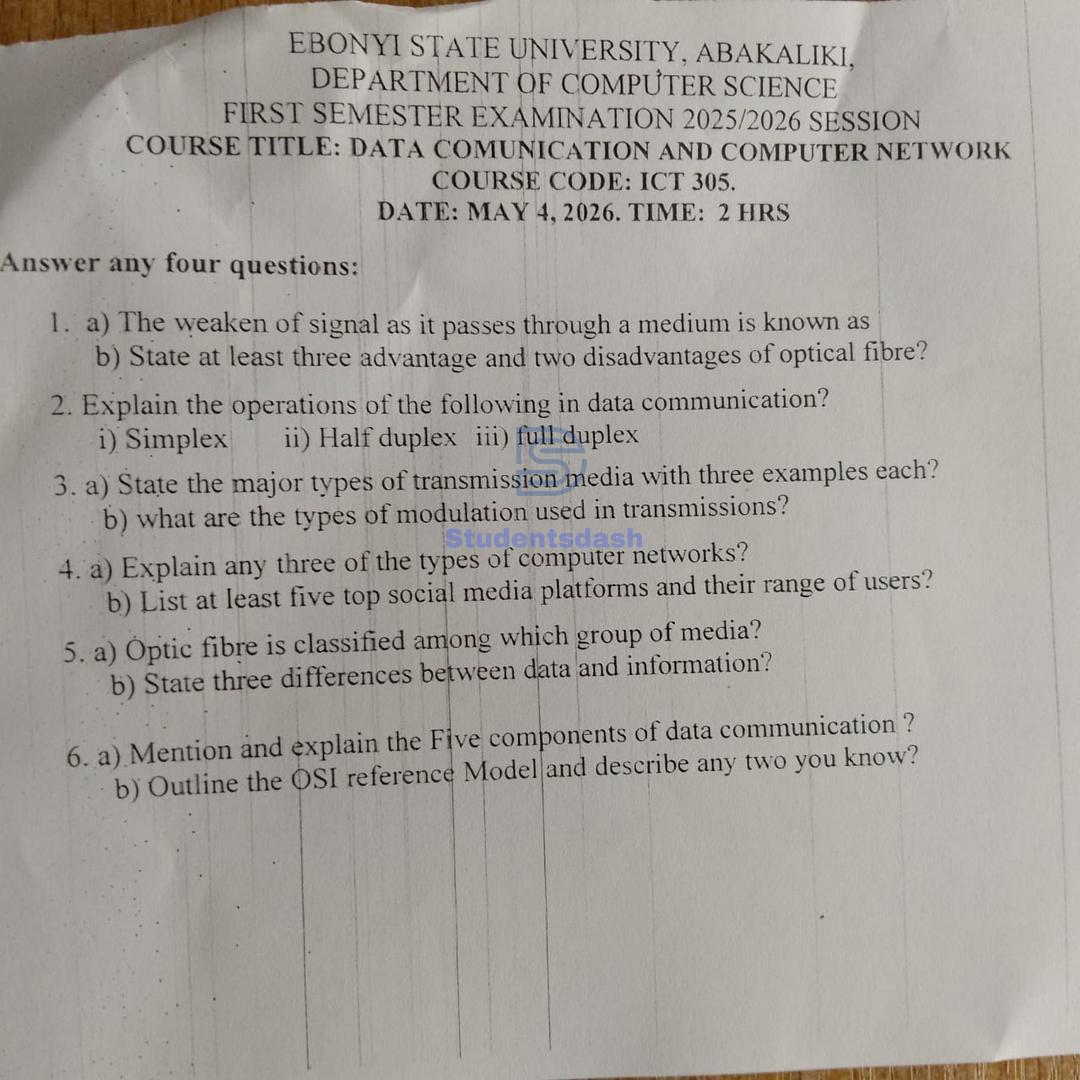
Data communication and computer network
 Quiz
Practice GST 201 Past Questions and Answers...
 Quiz
 Quiz
Are you preparing for your GST 105 exam at Ebonyi State University? We’ve got you cov...
 Quiz
Prepare effectively for your ECO 101 exam with our updated past questions and answers...
 Quiz
Practice Phy 107 ( PHY 191) Past Questions and Answers...
 Quiz
Prepare effectively for your MAT 101 (MTH 101) exam with our updated past questions a...

If you recently applied or reapplied for the NELFUND student loan...