
All Study Materials & Past Questions
Explore over 10,000+ verified lecture notes, exam past questions, summaries, and course guides.
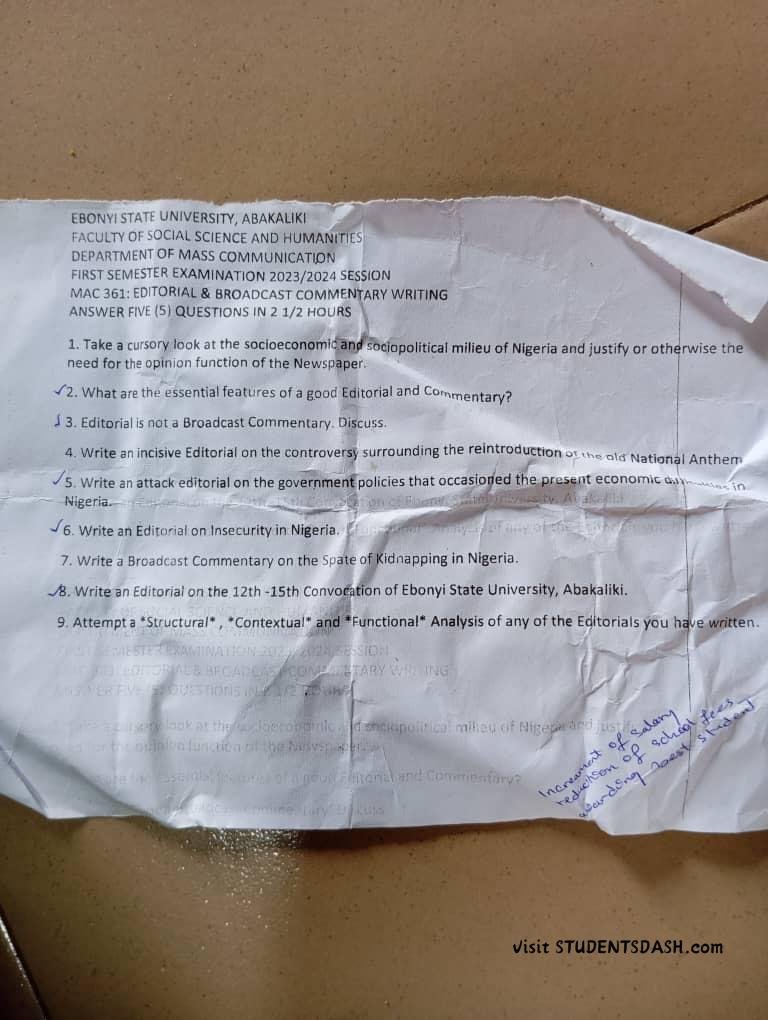

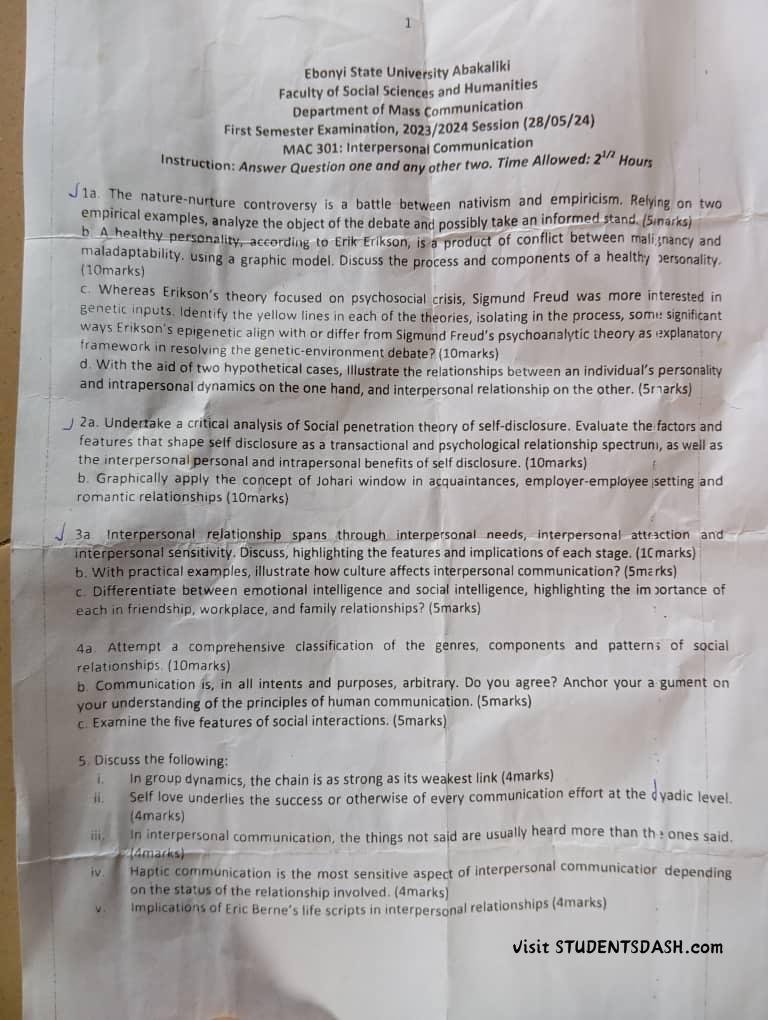
MAC 301 Past Questions and Answers
Title: MAC 301 Past Questions and Answers URL: https://studentsdash.com/mac-301-past-questions-and-answers-3/ -------------------------------------------------- Question 1a: A healthy personality, according to Erik Erikson, is a product of conflict between malignancy and maladaptability. Using a graphic model, discuss the process and components of healthy personality. (10 marks) Answer: Erik Erikson’s theory of psychosocial development explains personality as a lifelong process influenced by social interactions and conflicts at different stages of life. He proposed eight stages, each characterized by a central conflict that must be resolved for healthy personality development. Components of a Healthy Personality: 1. Trust vs. Mistrust (0-1 year): A child learns to trust their environment if caregivers provide consistent care. Otherwise, mistrust develops. 2. Autonomy vs. Shame and Doubt (1-3 years): Children develop independence if encouraged. If overly controlled, they feel shame and doubt. 3. Initiative vs. Guilt (3-6 years): Children begin to take initiative. If they are criticized too much, they develop guilt. 4. Industry vs. Inferiority (6-12 years): Children develop a sense of competence through achievements. Failure leads to feelings of inferiority. 5. Identity vs. Role Confusion (12-18 years): Adolescents explore their identity. Failure to establish a sense of self results in role confusion. 6. Intimacy vs. Isolation (18-40 years): Young adults seek meaningful relationships. Failure results in loneliness and isolation. 7. Generativity vs. Stagnation (40-65 years): Adults focus on contributing to society. If not, they feel stagnant. 8. Integrity vs. Despair (65+ years): People reflect on their lives. A sense of fulfillment leads to integrity, while regret results in despair. Graphic Model Representation: A diagram illustrating Erikson’s eight stages can be used, showing each stage as a step in personal growth. Each step represents the conflict and its positive or negative outcome. Question 1b: Whereas Erikson’s theory focused more on psychosocial crises, Sigmund Freud was more interested in genetic inputs. Identify the yellow lines in each of the two theories, isolating the process, some significant ways Erikson’s perspective aligns with or differ from Sigmund Freud’s psychoanalytic theory as an explanatory framework in resolving the genetic-environment debate? (10 marks) Answer: Erik Erikson and Sigmund Freud both explored personality development, but they had different perspectives on the role of genetics and the environment. Freud’s Psychoanalytic Theory (Genetic Inputs Focus) Freud’s theory emphasizes that personality is primarily shaped by innate biological drives (genetics) and early childhood experiences. He proposed that human development occurs in five psychosexual stages: 1. Oral Stage (0-1 year): Focus on mouth-related activities; fixation leads to dependency. 2. Anal Stage (1-3 years): Control over bodily functions; fixation can lead to orderliness or messiness. 3. Phallic Stage (3-6 years): Identification with the same-sex parent; Oedipus/Electra complex. 4. Latency Stage (6-12 years): Sexual energy is dormant, and social skills develop. 5. Genital Stage (12+ years): Sexual urges reawaken, focusing on mature relationships. Freud believed that unresolved conflicts at any stage could lead to personality disorders. Erikson’s Psychosocial Theory (Environmental and Social Influence) Erikson expanded on Freud’s work by emphasizing the role of social interactions rather than biological instincts. His eight-stage model (as discussed in Q1a) focuses on how personal growth is shaped by life challenges, rather than just early childhood experiences. Yellow Lines (Similarities) Between Erikson and Freud 1. Stage Development: Both theorists agree that personality develops in stages. 2. Early Childhood Influence: Freud’s first three stages align with Erikson’s first three (Trust vs. Mistrust, Autonomy vs. Shame, Initiative vs. Guilt). 3. Unresolved Conflicts Affect Personality: Both suggest that unresolved crises at one stage affect future behavior. Key Differences Aspect Freud’s Psychoanalytic Theory Erikson’s Psychosocial Theory Focus Biological drives (genetics) Social interactions (environment) Stages Five psychosexual stages Eight psychosocial stages Development Stops? Ends at puberty (Genital Stage) Continues throughout life Crisis Nature Fixation on childhood experiences Conflict between social demands and personal growth Genetic-Environment Debate Resolution Freud’s theory leans towards the nature (genetic) side, while Erikson’s theory supports the nurture (environmental) aspect. However, Erikson acknowledges that biological factors influence behavior, but they interact with social experiences to shape personality. Question 1c: Employ real-life examples to illustrate the subtle and overt relationships between personality development and intrapersonal dynamics on one hand, and between an individual’s personality and interpersonal relationship on the other. (5 marks) Answer: Personality development is shaped by both intrapersonal dynamics (how a person relates to themselves) and interpersonal relationships (how they relate to others). 1. Relationship Between Personality Development and Intrapersonal Dynamics Intrapersonal dynamics involve self-perception, emotions, and personal growth. A person’s personality affects their thought process, decision-making, and ability to handle stress. Example: • A student who is naturally introverted may struggle with self-confidence but, over time, develops strong analytical and independent thinking skills. • Someone with a high level of self-awareness may have better emotional regulation and be more resilient in handling failures. 2. Relationship Between Personality and Interpersonal Relationships Personality influences how individuals interact with others. An extroverted person tends to form friendships easily, while an introverted person might struggle with social interactions. Examples: • A friendly and outgoing person (high in agreeableness) tends to have a wide social circle and easily makes friends. • A highly conscientious employee is reliable and organized, making them a preferred team member in the workplace. • A person with an anxious personality may struggle with trust in relationships, leading to conflicts in friendships or romantic partnerships. In summary, a person’s internal traits (intrapersonal) affect how they relate with themselves, while their personality also influences how they build and maintain relationships with others. Question 2a: Undertake a critical analysis of Social Penetration Theory of self-disclosure. Evaluate the factors and features that shape self-disclosure as a transactional and psychological relationship spectrum, as well as the personal and interpersonal benefits of self-disclosure. (10 marks) Answer: Social Penetration Theory (SPT) – Overview The Social Penetration Theory (SPT) was developed by Irwin Altman and Dalmas Taylor (1973) to explain how relationships develop through self-disclosure—the process of revealing personal information to others. The theory compares human relationships to an onion, where deeper levels of intimacy are achieved by peeling away outer layers of personal information. Critical Analysis of Social Penetration Theory SPT suggests that self-disclosure occurs in four stages: 1. Orientation Stage: People share general and superficial information. 2. Exploratory Affective Stage: Casual friendships form, and more personal opinions are shared. 3. Affective Stage: Deeper personal details, emotions, and vulnerabilities are disclosed. 4. Stable Stage: Open, honest, and deep sharing occurs, forming long-term bonds. However, not all relationships progress through these stages, and too much self-disclosure too quickly can push people away (social depenetration). Factors and Features That Shape Self-Disclosure 1. Trust and Reciprocity: People tend to disclose information when they trust the other person and expect the same in return. 2. Cultural Background: Some cultures encourage openness, while others value privacy. 3. Personality: Extroverts tend to disclose more, while introverts are more reserved. 4. Social Context: People disclose differently in professional settings versus personal relationships. 5. Relationship Type: Romantic relationships often involve deeper disclosure than casual friendships. Self-Disclosure as a Transactional and Psychological Relationship Spectrum • Transactional: Self-disclosure is a two-way exchange—when one person shares, the other is encouraged to reciprocate, strengthening the relationship. • Psychological: It affects emotions, self-image, and relationship satisfaction. Openness can improve well-being, while lack of disclosure may cause emotional distress. Personal and Interpersonal Benefits of Self-Disclosure ✅ Personal Benefits: • Increases self-awareness and emotional relief. • Reduces stress by sharing burdens with others. • Enhances mental well-being. ✅ Interpersonal Benefits: • Strengthens trust and intimacy in relationships. • Improves communication and understanding. • Helps resolve conflicts by expressing thoughts and feelings openly. In summary, Social Penetration Theory explains how relationships grow through self-disclosure, but this process depends on trust, personality, culture, and the social environment. Question 2b: Graphically explain the concept of Johari Window in acquaintances, employer-employee setting, and romantic relationships. (5 marks) Answer: The Johari Window is a psychological tool developed by Joseph Luft and Harrington Ingham (1955) to help people understand their self-awareness and how they relate to others. It consists of four quadrants that represent different levels of self-disclosure and perception. The Four Quadrants of the Johari Window Quadrant Description Open Area (Known to Self & Others) Information about yourself that both you and others are aware of. Example: Your name, hobbies, or public opinions. Blind Spot (Unknown to Self, Known to Others) Things others see in you but you are unaware of. Example: A habit you don’t notice but others observe. Hidden Area (Known to Self, Unknown to Others) Personal information you keep private. Example: Secrets, fears, or personal struggles. Unknown Area (Unknown to Self & Others) Aspects of your personality or potential that neither you nor others recognize. Example: Talents you haven’t discovered yet. Graphical Representation of Johari Window (Since I can’t draw directly here, you can imagine a 2×2 grid labeled with the four quadrants or sketch it on paper.) Application of Johari Window in Different Relationships 1. Acquaintances: • The Open Area is small because little is known about each other. • The Hidden Area is large as people don’t easily disclose personal details to acquaintances. 2. Employer-Employee Setting: • The Blind Spot is common because employees may have weaknesses or strengths they don’t recognize, but their employer sees them. • Self-awareness through feedback can help reduce the blind spot. 3. Romantic Relationships: • The Open Area is large as partners share personal information. • The Hidden Area may shrink over time as trust builds. • Effective communication helps reduce the Unknown Area, allowing the couple to understand each other better. Conclusion The Johari Window is a useful tool for understanding self-awareness and improving communication in different types of relationships. The goal is to expand the Open Area by reducing the Blind Spot and Hidden Area, leading to better understanding and trust. Question 3a: “What you do speaks so loud that I cannot hear what you say.” Discuss the dimensions, channels, functions, and dysfunctions of this communication principle. (10 marks) Answer: The statement “What you do speaks so loud that I cannot hear what you say” emphasizes the power of non-verbal communication over verbal communication. It means that actions often speak louder than words, and when there is a contradiction between what someone says and what they do, people tend to believe the actions rather than the words. 1. Dimensions of This Communication Principle This principle highlights the different aspects of communication: • Verbal vs. Non-Verbal: Non-verbal cues (gestures, facial expressions, posture) often carry more weight than spoken words. • Consistency: When actions and words align, communication is effective. If they contradict, confusion arises. • Perception: How a message is received depends more on behavior than just spoken words. 2. Channels of This Communication Principle Communication occurs through various channels: • Body Language: Facial expressions, eye contact, posture, and gestures. • Tone of Voice: Even if words are positive, a sarcastic tone can change the meaning. • Actions: People believe repeated behaviors more than promises. • Written Communication: The way a message is structured (e.g., choice of words in a letter or email) reflects the sender’s intent. 3. Functions of This Communication Principle This principle serves several important functions in communication: • Clarifies Intentions: Actions reinforce or contradict spoken messages. • Builds Trust and Credibility: When actions match words, credibility increases. • Influences Social Interactions: People form opinions based on observed behavior. • Regulates Relationships: Trust is maintained when actions and words are consistent. 4. Dysfunctions of This Communication Principle When there is a contradiction between words and actions, it can lead to: • Miscommunication: People may misunderstand the intended message. • Loss of Trust: If someone repeatedly says one thing but does another, credibility is damaged. • Workplace Issues: Employees lose faith in leaders who say one thing but act differently. • Relationship Problems: If a partner constantly promises to change but doesn’t, trust is broken. Conclusion This communication principle highlights the importance of actions in effective communication. People tend to trust what they see and experience rather than what they are told. Therefore, to maintain credibility and build strong relationships, words and actions must align. Question 3b: With practical examples, illustrate how culture affects interpersonal communication. (5 marks) Answer: Culture plays a major role in shaping how people communicate and interact with others. It influences language, gestures, personal space, and even the level of formality in conversations. Cultural differences can either enhance or hinder interpersonal communication, depending on how well people understand and adapt to them. 1. Language and Communication Styles • Some cultures (e.g., Western cultures) are direct and explicit, meaning they value straightforward communication. • Others (e.g., Asian and African cultures) use indirect and implicit communication, where messages are conveyed through context, tone, and body language. Example: In Nigeria, people may use proverbs to pass messages indirectly, while Americans tend to be more straightforward. 2. Use of Gestures and Body Language • Gestures mean different things in different cultures. • Example: A thumbs-up is positive in the USA but offensive in some Middle Eastern countries. • Example: In Japan, direct eye contact can be seen as disrespectful, but in Nigeria, it is often seen as a sign of confidence. 3. Personal Space and Physical Contact • Some cultures value personal space (e.g., the United States and Germany), while others (e.g., Latin America and Nigeria) are comfortable with close contact. • Example: In Nigeria, greetings often involve handshakes, while in some Asian countries, people prefer bowing. 4. Formality and Respect in Communication • Some cultures emphasize respect through titles and honorifics (e.g., using “Sir” or “Ma” in Nigeria). • Example: In Yoruba culture, younger people must kneel (females) or prostrate (males) when greeting elders, while in Western cultures, a simple handshake or nod is enough. 5. Perception of Silence • In some cultures (e.g., Japan and China), silence is a sign of respect and deep thinking. • In others (e.g., the USA and Nigeria), silence in a conversation can be seen as awkward or rude. Conclusion Culture strongly affects how people communicate, and misunderstandings can occur if cultural differences are not respected. Effective interpersonal communication requires cultural awareness and sensitivity to avoid misinterpretations. Question 4a: Discuss the five features of social interactions. (10 marks) Answer: Social interaction refers to the way individuals relate, communicate, and behave towards one another in society. It forms the foundation of relationships, culture, and communication. The five key features of social interactions are: 1. Reciprocity • Social interactions involve a give-and-take process where people expect responses from others. • Example: When someone greets you, they expect a greeting in return. 2. Social Roles and Status • People behave based on their social roles (e.g., teacher, student, parent, employee). • Social status influences interactions; higher status individuals (e.g., managers) may interact differently with subordinates. • Example: A student interacts with a lecturer respectfully, while they might be more casual with friends. 3. Norms and Rules • Society has unwritten rules that guide interactions. • These norms differ across cultures and settings (e.g., workplace vs. home). • Example: In Nigeria, it is customary to greet elders first as a sign of respect. 4. Symbols and Communication • Social interactions rely on verbal and non-verbal symbols such as language, gestures, and facial expressions. • Example: A smile signals friendliness, while a frown may indicate displeasure. 5. Context and Environment • The setting of an interaction affects its nature (formal vs. informal). • Example: Conversations at work are more professional compared to casual talks with friends. Conclusion Social interactions are shaped by reciprocity, roles, norms, symbols, and context. Understanding these features improves communication and relationships in different social settings. Question 4b: Differentiate between emotional intelligence and social intelligence, highlighting the importance of each in friendship, workplace, and family relationships. (5 marks) Answer: 1. Emotional Intelligence (EI) Emotional intelligence refers to the ability to recognize, understand, and manage one’s own emotions , as well as understand and influence the emotions of others. 2. Social Intelligence (SI) Social intelligence is the ability to navigate social situations, build relationships, and effectively interact with others in different environments. 3. Key Differences Emotional Intelligence (EI) Social Intelligence (SI) Focuses on self-awareness and managing emotions. Focuses on understanding social cues and interacting well with others. Helps control anger, stress, and emotional reactions. Helps in building social connections and adapting to different groups. Example: Managing frustration calmly. Example: Knowing how to respond in social gatherings. 4. Importance in Different Relationships Relationship Type Importance of EI Importance of SI Friendship Helps in understanding friends’ emotions and supporting them. Helps in making new friends and maintaining friendships. Workplace Aids in handling stress, teamwork, and conflict resolution. Helps in networking, leadership, and teamwork. Family Encourages patience, empathy, and strong bonds. Helps in handling family conflicts and maintaining harmony. Conclusion Both emotional intelligence and social intelligence are important for maintaining healthy relationships in different areas of life. While EI helps in managing emotions, SI helps in understanding social dynamics and improving communication. Question 5a: Interpersonal relationships span through interpersonal needs, interpersonal attraction, and interpersonal sensitivity. Discuss, highlighting the features and implications of each stage. (6 marks) Answer: Interpersonal relationships develop based on different factors that influence how individuals interact and connect with others. These include interpersonal needs, interpersonal attraction, and interpersonal sensitivity. 1. Interpersonal Needs Interpersonal needs refer to the basic social and emotional needs that drive human interactions. According to psychologist William Schutz, there are three key interpersonal needs: • Inclusion: The need to belong and feel accepted. • Control: The need for influence and leadership in relationships. • Affection: The need for love, care, and emotional closeness. Implication: When interpersonal needs are met, relationships thrive; when ignored, individuals may feel lonely or disconnected. 2. Interpersonal Attraction This refers to the force that draws people together and makes them want to establish relationships. It can be based on: • Physical attraction (appearance) • Social attraction (personality) • Task attraction (skills and abilities) • Similarity (shared interests and values) Implication: Strong interpersonal attraction leads to friendships, romantic relationships, and teamwork. Lack of attraction may cause weak or short-lived connections. 3. Interpersonal Sensitivity This is the ability to perceive, understand, and respond appropriately to others’ emotions and behaviors. It involves: • Empathy: Understanding others’ feelings. • Active listening: Paying close attention to verbal and non-verbal cues. • Adaptability: Adjusting responses based on the situation. Implication: High interpersonal sensitivity helps in conflict resolution, improves emotional bonds, and strengthens communication. Conclusion Interpersonal relationships are influenced by the need for connection (interpersonal needs), the reasons people feel drawn to others (interpersonal attraction), and the ability to understand and respond to others (interpersonal sensitivity). A balance of these factors ensures strong, healthy, and lasting relationships. Question 5b: Discuss interpersonal conflicts and their resolution techniques. (4 marks) Answer: 1. What is Interpersonal Conflict? Interpersonal conflict occurs when two or more people disagree or clash due to differences in opinions, values, interests, or goals. It can happen in friendships, workplaces, families, and romantic relationships. 2. Types of Interpersonal Conflicts • Personal Conflicts: Arise from misunderstandings or emotional issues. • Workplace Conflicts: Occur due to competition, authority struggles, or miscommunication. • Cultural Conflicts: Stem from differences in traditions, beliefs, or societal norms. 3. Conflict Resolution Techniques Technique Description Communication Open and honest discussion helps clarify misunderstandings. Compromise Both parties give up something to reach a fair agreement. Negotiation A structured discussion where both sides find a mutually acceptable solution. Mediation A neutral third party helps in resolving disputes. Active Listening Paying attention and acknowledging the other person’s perspective. 4. Conclusion Interpersonal conflicts are normal but must be handled effectively to maintain healthy relationships. Using resolution techniques like communication, compromise, and mediation can help restore harmony and prevent future conflicts.
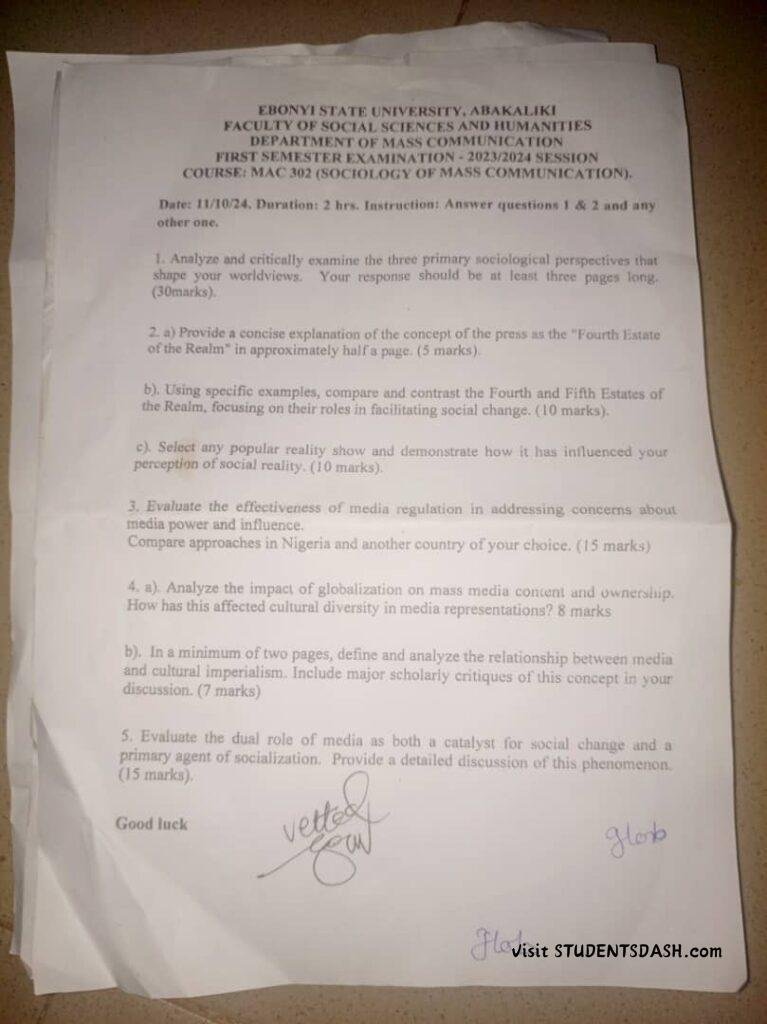
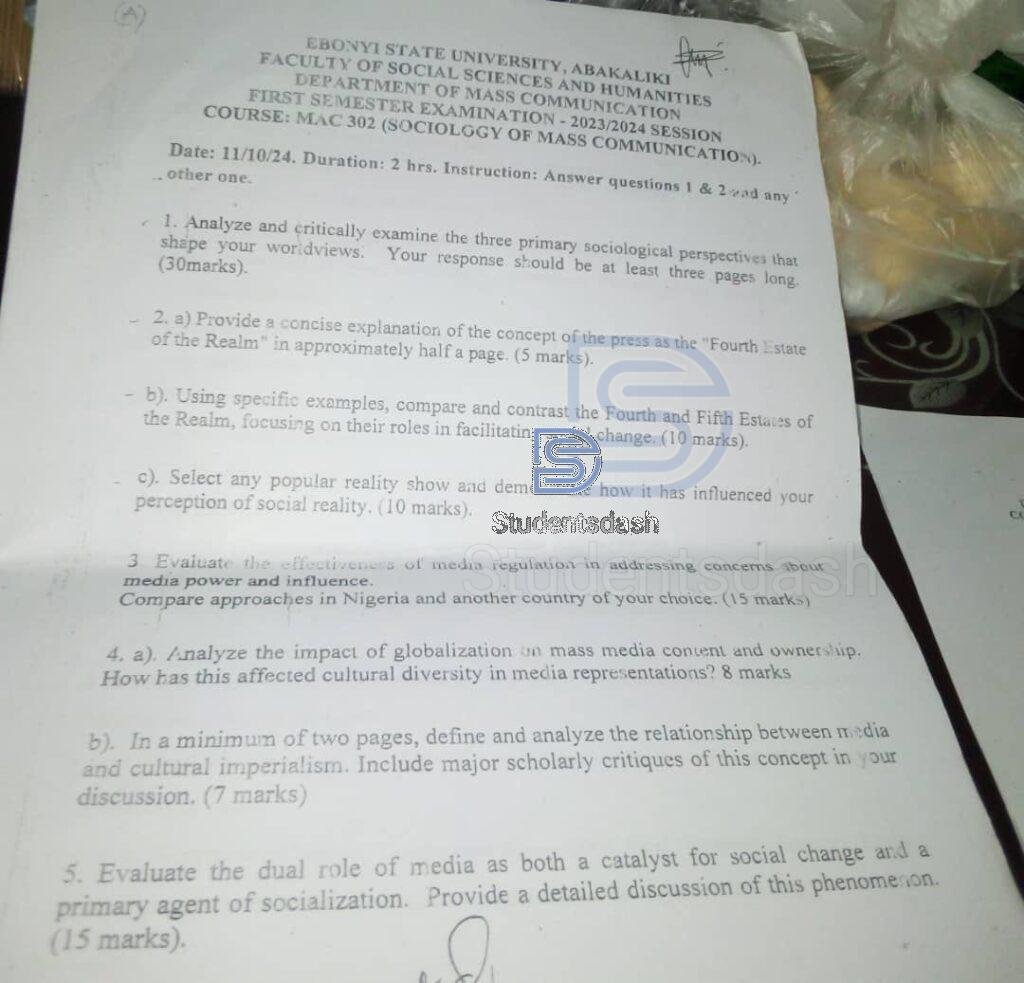
MAC 302 Past Questions and Answers 2024
Title: MAC 302 Past Questions and Answers 2024 URL: https://studentsdash.com/mac-302-past-questions-and-answers-2024/ -------------------------------------------------- 1. Analyze and critically examine the three primary sociological perspectives that shape your worldviews. (30 marks). In sociology, there are three main perspectives that help us understand society and human behavior. These are Functionalism, Conflict Theory, and Symbolic Interactionism. Each one explains the society in a different way and they also shape the way I look at life. Functionalism Perspective: Functionalism sees society as a system made up of different parts that work together to keep society stable. Just like the human body has organs that perform different roles, society has institutions like family, school, government, religion, and economy that perform special roles. For example, the family raises children, schools teach knowledge, religion gives morals, and government enforces laws. This perspective makes me appreciate order and unity. It makes me believe that everyone has a role to play in society, no matter how small. However, its weakness is that it sometimes ignores inequality and poverty. It can claim that everything has a function, even suffering, which is not always fair. Conflict Perspective: Conflict theory, from Karl Marx, sees society as a place of struggle. People and groups fight for power, money, and resources. For example, in Nigeria, politicians enjoy wealth while ordinary people suffer poverty. This shows inequality. The media, schools, and even religion can sometimes support the powerful. This perspective shapes my worldview by making me question fairness in society. It shows me that social change comes when people fight injustice. For example, the #EndSARS protest showed young people fighting against police brutality. The weakness of this theory is that it sometimes makes it look like everything is conflict, ignoring peaceful cooperation. Symbolic Interactionism Perspective: Symbolic interactionism looks at daily life and small interactions between people. It explains how we give meaning to words, symbols, and gestures. For example, a handshake can mean respect, agreement, or friendship. Clothes, language, and emojis on WhatsApp also carry meaning. This shapes my worldview by making me value communication. It helps me see how people can misunderstand each other when they interpret symbols differently. The weakness is that it focuses too much on small interactions and sometimes ignores bigger issues like politics and economy. Conclusion: When I put all three perspectives together, I understand society better. Functionalism teaches me about order, conflict theory teaches me about injustice and change, while symbolic interactionism teaches me about communication and meaning. They shape how I view the world and guide how I interact with people every day. 2. a) Provide a concise explanation of the concept of the press as the “Fourth Estate of the Realm” in approximately half a page. (5 marks). The press is called the “Fourth Estate of the Realm” because it plays a powerful role in society, just like the three main arms of government — the executive, legislature, and judiciary. The press acts as a watchdog over those in power. It informs the public, exposes corruption, and holds leaders accountable. For example, newspapers, television, and online media report government actions, criticize wrong policies, and give citizens a voice. The press shapes opinions and can bring about social change. That is why it is called the Fourth Estate — it balances power and protects democracy. 2. b) Using specific examples, compare and contrast the Fourth and Fifth Estates of the Realm, focusing on their roles in facilitating social change. (10 marks). The Fourth Estate refers to the traditional press such as newspapers, radio, and television, while the Fifth Estate refers to digital media, especially social media platforms like Twitter (X), Facebook, blogs, and YouTube. Both estates promote social change, but they do so in different ways. The Fourth Estate uses professional journalism. For example, The Guardian Newspaper or Channels TV can expose corruption or poor governance. The Fifth Estate uses ordinary citizens who share news, campaigns, and opinions online. For example, during the #EndSARS protest, Twitter and Facebook played a big role in mobilizing youths and spreading information. The Fourth Estate is more structured, regulated, and trusted for accuracy, while the Fifth Estate is more flexible, fast, and interactive. However, the Fifth Estate can also spread misinformation quickly. Together, both estates influence society and contribute to social change. 2. c) Select any popular reality show and demonstrate how it has influenced your perception of social reality. (10 marks). A popular reality show I can use is Big Brother Naija (BBNaija). This show brings different people from various backgrounds to live together in one house, competing for money and fame. The show has influenced my perception of social reality in many ways. It shows me how people from different tribes and lifestyles can live together. It also reflects real issues like love, friendship, betrayal, and competition, which happen in everyday life. However, it has also influenced me to see how society celebrates fame and money. Some people believe BBNaija promotes immorality, while others see it as entertainment and an opportunity for success. For me, it shows both the positive and negative sides of modern Nigerian society. 3. Evaluate the effectiveness of media regulation in addressing concerns about media power and influence. Compare approaches in Nigeria and another country of your choice. (15 marks). Media regulation means the laws, policies, and guidelines that control how the media operates. It ensures that the media does not abuse its power and influence. In Nigeria, media regulation is done by bodies like the National Broadcasting Commission (NBC) and Nigerian Press Council. These agencies monitor content on TV, radio, and newspapers. For example, NBC sometimes fines TV stations for showing offensive content or hate speech. However, in practice, media regulation in Nigeria is sometimes weak and influenced by politics. Some government leaders use regulation to silence critics instead of protecting the public. In contrast, in a country like the United States, media regulation is done by the Federal Communications Commission (FCC). The FCC regulates radio, TV, and internet services. Unlike Nigeria, where politics interferes a lot, the US system gives more freedom to the press, although there are still rules about obscenity, copyright, and fake news. When I compare both, I see that Nigeria struggles with press freedom because regulation is often misused, while countries like the US focus more on protecting both the public and freedom of expression. This shows that regulation is effective only when it is fair and not used for oppression. 4. a) Analyze the impact of globalization on mass media content and ownership. How has this affected cultural diversity in media representations? (8 marks). Globalization has made the world more connected through technology, internet, and international trade. In mass media, globalization has changed both content and ownership. Big international companies like CNN, BBC, and Netflix now dominate the media space, meaning that Western culture spreads widely. Nigerian youths now consume American music, movies, and fashion more than local culture. This has reduced cultural diversity because many local traditions and languages are not represented enough. For example, Nollywood films sometimes copy Hollywood styles instead of promoting Nigerian culture. At the same time, globalization also gives Nigeria a chance to show its culture to the world, like how Afrobeats music became popular globally. So globalization has both positive and negative impacts — it promotes exchange of ideas but also risks erasing smaller cultures. 4. b) In a minimum of two pages, define and analyze the relationship between media and cultural imperialism. Include major scholarly critiques of this concept in your discussion. (7 marks). Cultural imperialism means the domination of one culture over another, often through media. It happens when powerful countries like the US use their movies, music, fashion, and news to influence weaker countries. The media plays a big role in this because TV, films, and the internet spread Western culture everywhere. For example, Nigerian children grow up watching Disney and Hollywood movies instead of local folktales. American celebrities influence fashion and lifestyle more than African leaders or stars. Scholars like Herbert Schiller argue that cultural imperialism makes developing countries lose their identity. It creates dependency because people consume foreign content more than their own. However, critics say cultural imperialism is not total. People in weaker countries also adapt and reshape foreign culture to fit their local needs. For example, Nigerians took hip-hop and turned it into Afro-hip-hop with local flavor. Nollywood films also mix Western styles with African traditions. In conclusion, media and cultural imperialism are connected because media spreads culture widely. But cultural imperialism is not absolute, as local cultures also fight back and survive. 5. Evaluate the dual role of media as both a catalyst for social change and a primary agent of socialization. Provide a detailed discussion of this phenomenon. (15 marks). The media plays two important roles in society. It can bring social change and also act as an agent of socialization. As a catalyst for social change, media exposes problems, mobilizes people, and spreads new ideas. For example, during the #EndSARS protest, social media helped Nigerians unite and fight against police brutality. Internationally, the Arab Spring protests were driven by social media. This shows how media can push governments and societies to change. As a primary agent of socialization, media teaches values, norms, and behaviors. Children learn how to dress, talk, and behave from TV, cartoons, music, and the internet. Media introduces people to global culture, fashion, technology, and even moral lessons through films and adverts. The dual role shows that media is very powerful. It can shape how people see themselves and also change the entire society. While it can be positive, it can also spread harmful values like violence, drug use, or immorality. Therefore, society must use media wisely. Conclusion: Media is both a teacher and a change agent. It helps us socialize into culture and also gives us the power to demand a better future.

MAC 321 Past Questions and Answers 2019_2020
Title: MAC 321 Past Questions and Answers 2019/2020 URL: https://studentsdash.com/mac-321-past-questions-and-answers-2019-2020/ -------------------------------------------------- Question 1: “The quality of a good photograph is dependent on some major variables. How can the angle of view, magnification, and perspective be used to achieve the desired purpose?” Answer: The quality of a photograph is determined by several factors, including the angle of view, magnification, and perspective . These elements influence how an image is perceived and interpreted. 1. Angle of View: The angle of view refers to the position from which a photograph is taken. It plays a crucial role in storytelling and composition. There are different angles a photographer can use: High Angle: Taken from above the subject, making it appear smaller, weaker, or vulnerable. Low Angle: Taken from below, making the subject appear dominant, powerful, or larger than life. Eye Level: Captures the subject at normal eye height, providing a natural and balanced view. Bird’s Eye View: A shot from directly above, giving a unique and often dramatic perspective. Worm’s Eye View: Taken from ground level, making the subject look towering and grand. 2. Magnification: Magnification refers to how much the subject is enlarged in the frame. It is influenced by the camera lens and the distance between the camera and the subject. It affects the details captured in an image: Close-up Shots: Show fine details, making the subject more intimate and engaging. Medium Shots: Balance subject and background, often used in storytelling. Long Shots: Capture a wider scene, placing the subject in a broader context. Photographers use zoom lenses or move closer to the subject to achieve the desired magnification level. 3. Perspective: Perspective refers to the spatial relationship between objects in an image and how depth is portrayed. It affects how the viewer perceives size and distance. Linear Perspective: Parallel lines converge towards a vanishing point, creating depth. Forced Perspective: Manipulating objects in the frame to appear larger or smaller than they actually are. Aerial Perspective: Uses lighting, haze, and contrast to create a sense of depth. By carefully adjusting angle of view, magnification, and perspective , a photographer can enhance the visual impact, convey emotions, and guide the viewer’s attention to specific elements in a photograph. Question 2: “The purpose of composition is to heighten the effect of the picture. Discuss.” Answer: Composition in photography refers to the arrangement of elements within a frame to create a visually appealing and meaningful image. The primary goal of composition is to enhance the impact of a picture by guiding the viewer’s eye and emphasizing the subject or message of the photograph . A well-composed image improves storytelling, evokes emotions, and maintains balance and harmony. Ways Composition Heightens the Effect of a Picture Rule of Thirds: The rule of thirds divides the image into a 3×3 grid. Placing the subject at one of the intersection points rather than the center makes the composition more dynamic and engaging. This technique helps to direct the viewer’s attention naturally. Leading Lines: Leading lines are natural or artificial lines within an image that guide the viewer’s eyes toward the subject. Examples include roads, railways, rivers, or architectural elements that create depth and movement. Framing: Using elements like windows, doorways, tree branches, or other objects to enclose the subject can help draw focus and add context to the image. Framing isolates the subject and adds depth to the picture. Balance and Symmetry: A well-balanced image creates harmony, whether symmetrical (mirror-like) or asymmetrical (creative placement of elements). Asymmetrical balance can make an image more interesting by positioning the subject off-center. Depth and Perspective: Adding foreground, midground, and background elements enhances the three-dimensional feel of a photograph. Perspective techniques, such as converging lines or a shallow depth of field, can create emphasis and draw the viewer into the image. Contrast and Color Composition: Contrast in light and shadow makes images more striking. Complementary colors (e.g., blue and orange, red and green) can enhance the visual appeal of the photo. Simplicity and Minimalism: A clutter-free image with a single, strong subject is often more powerful than a chaotic composition. Negative space (empty areas around the subject) can help highlight the main focus. Conclusion Composition is a crucial element in photography that helps to heighten the effect of a picture by improving its structure, storytelling, and emotional impact . By using composition techniques effectively, photographers can create images that are not only visually appealing but also communicate a clear and compelling message. Question 3: “With the aid of a good diagram, explain the concept of the tripartite nature of news judgment.” Answer: The tripartite nature of news judgment refers to the three essential factors that determine whether a news story is worth publishing or broadcasting. These three elements are: Audience Interest: News should be relevant to the target audience. A story that interests one group may not appeal to another. Factors such as location, demographics, and culture influence what people consider newsworthy. Timeliness: A story must be fresh or recent to be considered news. The more current an event, the more impact it has. Stories that are delayed lose their value. Significance (Impact and Consequence): The importance of the story and how it affects people determine its newsworthiness. A story with a broader impact (such as political changes, natural disasters, or economic issues) is more newsworthy than one with limited reach. Diagram Representation A simple diagram for the tripartite nature of news judgment: +--------------------+ | Newsworthiness | +--------------------+ / | \ / | \ / | \ +------------+ +------------+ +------------+ | Audience | | Timeliness | | Significance | | Interest | | | | & Impact | +------------+ +------------+ +------------+ Conclusion The tripartite nature of news judgment helps journalists and editors decide what makes a story newsworthy. By considering audience interest, timeliness, and significance , media organizations ensure they deliver relevant and impactful news. Question 4a: “What is a photo essay? Examine the digital demands of a photo essay.” Answer: A photo essay is a series of photographs arranged in a way that tells a story or conveys a specific message. Unlike a single image, a photo essay provides a more detailed narrative by combining multiple pictures with captions or brief text descriptions . Types of Photo Essays: Thematic Photo Essay: Focuses on a single theme or issue, such as poverty, climate change, or street life. Narrative Photo Essay: Tells a story in a sequential order, such as a wedding or a day in the life of a worker. Digital Demands of a Photo Essay: With advancements in digital media, modern photo essays require: High-resolution images to maintain quality across different platforms. Proper sequencing to create a logical and engaging visual story. Captions and brief texts to provide context and enhance meaning. Digital platforms and social media integration to reach a wider audience. Editing and post-processing software like Adobe Lightroom or Photoshop for enhancement. Question 4b: “Explain four (4) qualities of a good picture story.” Answer: A good picture story must be well-structured and visually compelling. Key qualities include: Strong Narrative Flow: The images should tell a coherent story from start to finish. There should be a logical sequence that engages the viewer. Emotional Impact: The images should evoke emotions such as joy, sadness, or curiosity. A good picture story connects with the audience on a personal level. Clear Subject and Focus: Each photo should have a clear subject that stands out. Avoid clutter or unnecessary distractions. Technical Excellence: Proper lighting, sharpness, and composition enhance storytelling. Poorly captured or low-quality images reduce the effectiveness of the story. Question 5a: “Trace the historical development of photojournalism in Nigeria.” Answer: Photojournalism in Nigeria has evolved over the decades, influenced by technological advancements and historical events. Colonial Era (1900s – 1960s): Early photojournalism in Nigeria was influenced by British colonial rule. Newspapers such as The West African Pilot used photographs to document events. Post-Independence (1960s – 1980s): The Nigerian Civil War (1967-1970) increased the demand for photojournalists. Photographers documented war scenes, political movements, and cultural shifts. Military Rule and Media Censorship (1980s – 1999): Journalists faced restrictions under military regimes. Photojournalists risked arrest for publishing politically sensitive images. Democratic Era (1999 – Present): The rise of private media and digital photography expanded photojournalism. Social media and online platforms have made photojournalism more accessible. Question 5b: “What type of pictures can be used by a photojournalist to make up stories?” Answer: A photojournalist can use various types of pictures to build a story, including: News Photos: Images capturing breaking news events like protests, accidents, or natural disasters. Feature Photos: Pictures that tell human-interest stories, such as a day in the life of a market woman. Portraits: Individual or group portraits of key figures in the story, such as political leaders or victims of a crisis. Action Shots: Dynamic images capturing movement, like a football match or a rescue operation. Environmental Photos: Images that provide context to a story, such as photos of flood-affected areas. Candid Shots: Unstaged photos that capture real, spontaneous moments. Conclusion Photojournalism plays a key role in storytelling by using different types of images to capture reality, evoke emotions, and provide insight into events . PAPER 2 THERE Question 1: “One of the commonsensical definitions of investigative and interpretative reporting is ‘that it is a report that reveals the news behind the news.’ Give and explain at least two definitions of this concept. Who is an investigative reporter? What are the features/qualities expected of him or her?” Answer: Definitions of Investigative and Interpretative Reporting Investigative Reporting as In-Depth Journalism: Investigative reporting is a form of journalism that involves in-depth research and fact-finding to uncover hidden truths, corruption, or issues of public interest. It goes beyond surface-level reporting and requires detailed analysis. Interpretative Reporting as Contextual Journalism: Interpretative reporting not only presents facts but also provides explanations, background analysis, and expert opinions to help the audience understand complex issues. Who is an Investigative Reporter? An investigative reporter is a journalist who conducts extensive research to uncover facts that are not readily available to the public. This journalist digs deeper into issues of corruption, crime, governance, and human rights to bring hidden information to light. Qualities of an Investigative Reporter Curiosity and Persistence: Investigative reporters must be highly curious and persistent in seeking the truth. Strong Analytical Skills: They must analyze data, documents, and witness accounts to piece together facts. Courage and Objectivity: Investigative journalism often involves risks. A good reporter must be fearless yet remain neutral and fact-based. Ethical Standards: They must maintain high ethical standards by verifying facts before publication. Excellent Research and Writing Skills: Effective investigative reporting requires thorough research and the ability to communicate findings clearly. Question 2: “Recent investigations revealed that professional Investigative and Interpretative journalists are no more celebrated. Some scholars attribute this finding to myriad of untold hazards in the act while others hold that quackery and fear are the cause. Review these points and take a stand on what could be described as the major internal and external challenges of contemporary investigative reporting.” Answer: Investigative journalism has declined due to both internal and external challenges . Internal Challenges Quackery in Journalism: Many self-proclaimed “journalists” lack professional training, leading to false or poorly researched reports. Lack of Funding: Investigative journalism requires extensive resources, but many media houses lack the funds to support deep investigations. Fear and Censorship: Journalists fear for their safety due to threats from powerful individuals or organizations. Declining Public Interest: In the digital era, audiences often prefer quick news rather than in-depth reports. External Challenges Government and Political Pressure: Many governments restrict press freedom, making it difficult for journalists to expose corruption. Legal Risks and Defamation Lawsuits: Investigative journalists risk lawsuits from individuals or corporations exposed in their reports. Technological Challenges: Digital surveillance and hacking make it harder for journalists to protect confidential sources. My Stand While fear and quackery play a role in the decline of investigative journalism, the bigger issue is external pressure from political and corporate interests . Journalists need more protection, financial support, and public backing to thrive. Question 3: “Outline and extensively explain the critical steps that should be followed in developing and writing a good investigative and interpretative report. What should be in an investigative reporting?” Answer: Steps in Writing an Investigative and Interpretative Report Identifying the Topic: Choose a story of public interest that requires deep investigation. Gathering Information: Use multiple sources, including documents, interviews, and expert opinions. Verifying Facts: Cross-check all data to ensure accuracy before reporting. Structuring the Report: Organize the report into an introduction, background, evidence, and conclusion. Writing Clearly and Objectively: Use simple language and avoid personal bias. What Should Be in an Investigative Report? A strong lead that captures attention. A clear narrative with evidence-based facts . Quotations from credible sources . Photographs or documents as supporting evidence . A conclusion that calls for action or further investigation . Question 4: “The beauty of an investigative report lies in its in-depth nature of interpretation. Discuss the importance of interpretative reporting in print journalism and how it contributes to the development of a society.” Answer: Importance of Interpretative Reporting in Print Journalism Provides Deeper Understanding: Helps readers understand complex issues by giving context and expert analysis. Encourages Critical Thinking: Challenges people to think beyond surface-level information. Holds Leaders Accountable: Exposes corruption and mismanagement. Informs Public Policy: Investigative reports influence government decisions and reforms. How It Contributes to Society Promotes transparency and good governance . Encourages civic engagement and activism . Protects human rights by exposing injustices. Conclusion Interpretative reporting is essential for an informed and democratic society as it provides in-depth analysis and holds the powerful accountable . Question 5: “An investigative report is of no social use until it is adequately, accurately, and appropriately interpreted for public consumption. Discuss.” Answer: Investigative journalism is only useful if the public understands it. Why Accurate Interpretation Matters Avoids Misinformation: If a report is unclear, people may misinterpret the findings. Increases Impact: A well-explained report encourages action from policymakers and citizens. Enhances Credibility: Clear and factual reports build trust in the media. Simplifies Complex Issues: Some investigations involve technical details (e.g., financial fraud). Proper interpretation helps make them understandable. Conclusion An investigative report must be clear, factual, and easy to interpret to create social impact. If it is not properly explained, it loses its value to society .

MAC 322 Past Questions and Answers
Title: MAC 322 Past Questions and Answers URL: https://studentsdash.com/mac-322-past-questions-and-answers/ -------------------------------------------------- ANSWERS Q1 Draft Speech for Israeli Prime Minister, Benjamin Netanyahu Topic Statement: General Purpose: To persuade. Specific Purpose: To convince the United States Congress to give Israel stronger support in the Middle East conflict. Thesis: Only through deliberate and consistent U.S. backing can peace and security be sustained in the region. Introduction: Mr. Speaker, distinguished members of Congress, I bring to you the voice of Israel, a nation that has known war, sacrifice, and resilience. The bond between our two nations is built on democracy, freedom, and justice. Today, I come not only to speak for my people but to remind us of the shared destiny that ties us together. Body: The Reality of the Threat Israel faces daily existential dangers from terrorism and hostility in Gaza, Lebanon, and beyond. These threats are not only against Israel but against democracy and civilization. If terrorism grows stronger in Israel, it weakens freedom everywhere. The Necessity of U.S. Support Israel remains America’s strongest ally in the Middle East. With American military, diplomatic, and economic support, we can confront extremism effectively. A secure Israel means a more stable Middle East, which ultimately benefits the entire world. The Path to Lasting Peace Peace cannot be built on weakness. True peace requires deterrence, strength, and partnership. Israel does not seek endless wars; we seek peace. But peace cannot be pursued in isolation — it must be strengthened by allies who share the same dream. Conclusion: Honorable members, history will not only remember the battles we fought, but the peace we made together. Let Israel and the United States stand side by side, so that freedom can triumph over fear and the generations to come will inherit a safer and brighter world. Thank you. Q2 Draft Speech for Palestinian Leader, Mahmoud Abbas at the United Nations General Assembly Topic Statement: General Purpose: To inform and persuade. Specific Purpose: To draw global attention to the situation in Gaza and Lebanon. Thesis: The Palestinian people deserve peace, justice, and dignity, and the global community must act deliberately to end the cycle of suffering. Introduction: Mr. President, distinguished delegates, I stand before you with a heavy heart yet a hopeful spirit. My people in Gaza and Lebanon have lived for decades under the weight of war, displacement, and hopelessness. Today, I speak not just for Palestine but for humanity, for justice, and for the peace the United Nations was created to uphold. Body: Defining the Subject of the Lesson on Ground The situation in Gaza and Lebanon is defined by humanitarian crises, displacement of families, loss of innocent lives, and persistent political instability. This is not merely a regional concern; it is a matter of global conscience. Outlining the Problem and the Justification for Its Discussion Palestinians live under conditions that deny them freedom, basic rights, and hope. The escalation of violence and military attacks continues to rob children of their future. This problem demands urgent global attention because justice delayed is justice denied. Objectives, Purpose, Significance, and Expectations Objective: To end violence and ensure the recognition of Palestinian statehood. Purpose: To appeal for peace, justice, and international intervention. Significance: A stable Palestine means a stable Middle East. Expectations: I call for international solidarity, humanitarian aid, and renewed peace talks under the supervision of the United Nations. Strategies, Tactics, and Audience Focus Strategies: Use of emotional appeals, evidence of human suffering, and appeals to international law. Tactics: Quoting UN resolutions, highlighting humanitarian data, and making moral appeals. Audience Focus: To appeal to the conscience of world leaders and the empathy of ordinary citizens watching across the globe. Main Points, Supporting Ideas, and Sub-points Main Point 1: The humanitarian crisis in Gaza and Lebanon (support: statistics of casualties, images of displacement, testimonies). Main Point 2: The need for justice and recognition of Palestinian statehood (support: UN resolutions, global precedents). Main Point 3: The urgent call for peace and global solidarity (support: appeal to shared humanity and moral obligation). Conclusion: Distinguished delegates, the voice of Palestine is the voice of every oppressed people yearning for freedom. Let the United Nations rise to its true calling — to defend justice, to protect the weak, and to give hope where despair has reigned too long. Peace for Palestine is peace for the world. Thank you. Perfect. Here’s Q3, written in assignment style, clear and ready for submission. Q3 (a) “The Danger of a Single Story” Speech Area: Informative and persuasive. Speech Type: Awareness-raising speech. Speech Title: The Danger of a Single Story. General Purpose: To inform the audience about the harm of stereotypes. Specific Purpose: To persuade the audience to embrace diverse perspectives and avoid limiting others to single narratives. Thesis Statement: When people are defined by a single story, their identity is reduced, their dignity undermined, and stereotypes are reinforced. Outline: Introduction (Strategy – story/illustration): Begin with an anecdote about how stereotypes distort truth and perception. Main Point 1: A single story creates stereotypes that are incomplete and misleading. Supporting idea: Stories about Africa often focus on poverty, ignoring innovation and culture. Main Point 2: Single stories rob people of dignity. Supporting idea: They reduce people to one dimension, ignoring their complexity. Main Point 3: Multiple stories create balance and truth. Supporting idea: Hearing diverse stories helps us understand humanity better. Concluding Technique: Call to action – encourage the audience to seek multiple perspectives before making judgments. Transitions: Move logically from definition of a single story → its effects → solution through diversity of stories. (b) “What a Friend We Have in Friendship” Speech Area: Inspirational/ceremonial. Speech Type: Motivational speech. Speech Title: What a Friend We Have in Friendship. General Purpose: To inspire appreciation of friendship. Specific Purpose: To emphasize the importance, loyalty, and value of true friendship in life. Thesis Statement: True friendship provides comfort, trust, and strength in both joy and adversity. Outline: Introduction (Strategy – quotation/attention grabber): Begin with a short quote or proverb on friendship. Main Point 1: Friendship is a source of support. Supporting idea: Friends share burdens and celebrate victories. Main Point 2: Friendship is based on trust and loyalty. Supporting idea: Trust makes relationships strong even in trials. Main Point 3: Friendship shapes character and adds meaning to life. Supporting idea: Friends influence our values and guide us toward growth. Concluding Technique: End with a call to appreciate, nurture, and protect true friendships. Transitions: From the definition of friendship → benefits → influence on personal growth. Q4 (a) Critical Analysis of “The Danger of a Single Story” i. Mindset of the Speaker and Overall Style of the Speech The speaker, Chimamanda Ngozi Adichie, approaches the speech with a mindset of advocacy for diversity, representation, and truth. She believes strongly that narratives shape perception, and when only one story is told, it limits understanding. Her overall style is conversational, simple, and personal. She uses anecdotes from her life and her encounters with stereotypes to connect emotionally with her audience. ii. Contextual, Structural, and Rhetorical Significance Contextual: The speech addresses global issues of cultural misunderstanding, prejudice, and stereotyping. Structural: It follows a logical sequence: defining the “single story,” illustrating its effects, and offering solutions through multiple stories. Rhetorical: The speech relies heavily on storytelling, repetition of key phrases, and the balance of logos (reason) with pathos (emotion). iii. Rhetorical Devices and Emotional Appeal Devices: Anecdotes, contrast, repetition, humor, and vivid imagery. Emotional Appeal: She evokes empathy by narrating her own experiences of being stereotyped and by highlighting the consequences of narrow narratives. This humanizes the issue and makes it relatable to a global audience. (b) Recall of a Speech Exercise in Class In one of our class exercises, I delivered a short speech on the topic “The Power of Education.” Introduction: I began with a quotation: “Education is the most powerful weapon which you can use to change the world” (Nelson Mandela). This quotation served as my attention-grabber and set the tone for my argument. Body: I explained how education liberates the mind from ignorance. I gave examples of how education drives social and economic development. I emphasized how education promotes peace and global understanding. At each stage, I used simple examples, such as how literacy changes the life of a rural child, to strengthen my point. Conclusion: I ended with a call to action, urging my audience to value education not only as a personal achievement but as a tool for societal transformation. Justification of Strategies: I chose a quotation as my introduction because it gave authority to my speech. I used logical points supported by examples to maintain credibility (logos) and concluded with a call to action to make my audience reflect personally (pathos). Q5 (a) Critical Analysis of a Classical Speech One of the classical speeches I studied in this course was Martin Luther King Jr.’s “I Have a Dream.” i. Mindset of the Speaker and Overall Style of the Speech Dr. King spoke with the mindset of hope, justice, and equality. His speech reflected deep faith in the possibility of racial harmony in America. His style was highly rhetorical, emotional, and poetic. He employed rhythm, repetition, and vivid imagery to capture the hearts of his listeners. ii. Contextual, Structural, and Rhetorical Significance Contextual: The speech was delivered during the Civil Rights Movement, addressing the oppression of Black people in America. Structural: The speech moved from describing the problem of racial injustice to presenting a vision of a hopeful future. Rhetorical: The use of anaphora (“I have a dream”) gave the speech power and rhythm. The metaphorical language painted a vivid picture of freedom and equality. iii. Rhetorical Devices and Emotional Appeal Devices: Repetition, metaphor, parallelism, contrast, and biblical allusions. Emotional Appeal: Dr. King appealed to both the pain of injustice and the hope of redemption. His speech inspired empathy, faith, and courage in his audience. (b) Features, Uses, and Misuses of Modes of Speech Delivery There are four main modes of speech delivery: manuscript, memorized, impromptu, and extemporaneous. Manuscript Delivery Features: Reading word-for-word from a written text. Uses: Suitable for formal occasions such as state addresses or legal presentations. Misuses: Over-reliance on the script may lead to poor eye contact and monotony. Memorized Delivery Features: Speech is fully committed to memory. Uses: Effective for short, formal speeches such as toasts or stage performances. Misuses: Forgetting lines may break flow and reduce confidence. Impromptu Delivery Features: Delivered with little or no preparation. Uses: Useful in interviews, debates, or unexpected situations. Misuses: May lead to disorganized thoughts or shallow arguments if not managed well. Extemporaneous Delivery Features: Speech is well-prepared but delivered in a natural, conversational style with the aid of brief notes. Uses: Common in academic presentations, lectures, and professional talks. Misuses: Over-preparation may still make the speech rigid; under-preparation can lead to rambling. Conclusion: Each delivery mode has its strengths, but the most effective depends on the context, audience, and purpose of the speech. A skilled speaker chooses wisely and avoids misuses that can weaken communication.

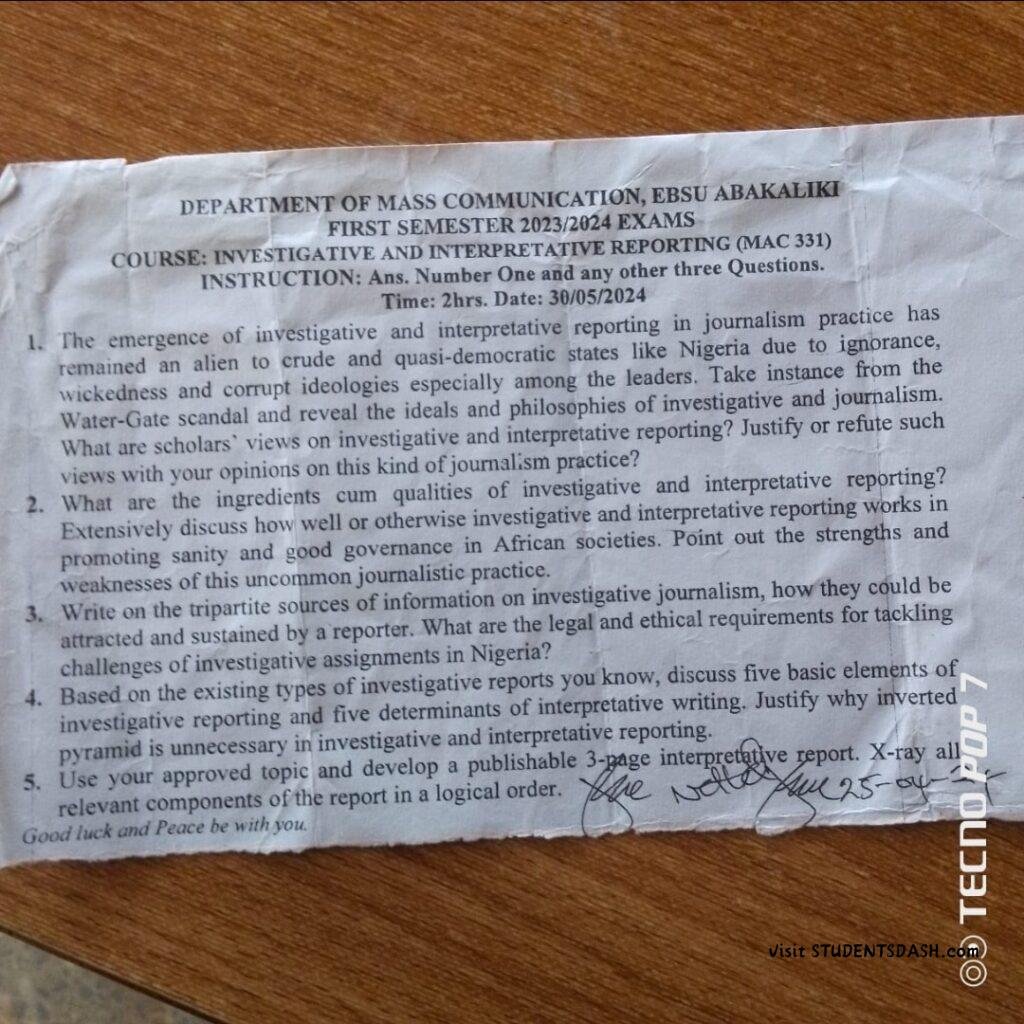

MAC 331 Past Questions and Answers 2022_2023
Title: MAC 331 Past Questions and Answers 2022/2023 URL: https://studentsdash.com/mac-331-past-questions-and-answers-2022-2023/ -------------------------------------------------- ANSWER TO QUESTION 1 (a) Draft three suitable topics for public relations research. One must be the one approved in class. The Role of Social Media in Crisis Management for Public Relations. Effectiveness of Town Hall Meetings in Enhancing Student-Management Relations. (This is the approved one). The Impact of Public Relations on Brand Reputation in Nigeria. (b) From topic one, state three objectives of the study. To examine how town hall meetings improve communication between students and management in Ebonyi State University. To assess the effectiveness of town hall meetings in addressing students’ complaints and concerns. To determine students’ perception of town hall meetings as a public relations strategy. (c) From the objectives, deduce your research questions. How do town hall meetings improve communication between students and management? How effective are town hall meetings in resolving students’ complaints and concerns? What is the perception of students regarding town hall meetings as a public relations strategy? (d) State the null hypothesis. Null Hypothesis (H₀): Town hall meetings have no significant effect on student-management relations in Ebonyi State University. ANSWER TO QUESTION 2 Public Relations practitioners who ignore research are as dangerous as generals who go to war blind of the enemy’s signal. Discuss this statement in relation to the relevance of research to the practice of public relations. Research is an essential part of public relations. The statement means that PR practitioners who ignore research are like military generals who enter a battlefield without knowing their enemy’s position, strategies, or strengths. Just as a general must gather intelligence before making war decisions, a PR practitioner must use research to make informed communication strategies. Importance of Research in Public Relations: Understanding the Target Audience – Research helps PR professionals understand the audience they are communicating with, including their interests, needs, and expectations. Without research, PR campaigns may fail to connect with the intended audience. Crisis Management – In times of crisis, PR research helps to identify the root cause of the issue, analyze public perception, and develop an appropriate response to protect an organization’s image. Measuring Campaign Effectiveness – Through research, PR experts can evaluate whether their campaigns are achieving the desired results or if adjustments are needed. Competitor Analysis – Just as a general studies their enemy, PR professionals use research to analyze competitors and position their organization better in the market. Media Strategy – Research helps PR experts determine the best media platforms (social media, TV, radio, newspapers) to use for their campaigns. Conclusion: Ignoring research in PR is risky because it leads to poor decision-making, wasted resources, and potential damage to an organization’s reputation. A PR practitioner who relies on assumptions rather than facts is setting themselves up for failure. ANSWER TO QUESTION 3 Distinguish between the following terms with relevant examples: (a) Probability and Non-Probability Sampling Probability Sampling : This is when every member of a population has an equal chance of being selected for research. It is more scientific and reduces bias. Example: Randomly selecting students from a school to participate in a survey. Non-Probability Sampling : Here, selection is based on convenience or judgment, and not everyone has an equal chance of being chosen. Example: Interviewing only students who are available at a particular time. (b) Participant and Non-Participant Observation Participant Observation : The researcher actively engages in the group they are studying to get a deeper understanding. Example: A journalist joining a protest to observe the behavior of protesters. Non-Participant Observation : The researcher observes from a distance without direct involvement. Example: A PR professional watching how customers react to a new product in a supermarket. (c) Personal and Panel Interview Personal Interview : A one-on-one interaction between the interviewer and the interviewee. Example: A journalist interviewing a celebrity. Panel Interview : A group of interviewers questioning a single candidate. Example: A company interviewing a job applicant with multiple interviewers present. (d) Survey and Content Analysis Survey : A research method that involves asking questions to a group of people to gather data. Example: Conducting a questionnaire to assess public opinion on a political candidate. Content Analysis : A method of studying and interpreting recorded communication, such as newspaper articles, social media posts, or TV shows. Example: Analyzing how the media portrays women in political campaigns. ANSWER TO QUESTION 4 PR Manager organizing a seminar on skill acquisition among Ebonyi youths (a) Who are your target audience? Secondary school leavers Unemployed youths University students Small business owners Local community leaders (b) Which medium will you use to inform the audience about the upcoming events? Social media (Facebook, WhatsApp, Instagram) Radio announcements Flyers and posters in strategic locations Word-of-mouth communication through community leaders (c) What are the strengths and weaknesses of your chosen medium? Medium Strengths Weaknesses Social Media Fast and wide reach, low cost Some people may not have internet access Radio Announcements Reaches a large audience, especially in rural areas Limited to people who listen to that station Flyers/Posters Physical presence in the community, affordable Can be ignored or torn down Word of Mouth Builds trust and credibility Slow and difficult to control the message ANSWER TO QUESTION 5 PR Research on “Effectiveness of Town Hall Meeting as a Medium for Enhancing Students/Management Relations in EBSU” (a) Four Objectives of the Study: To assess how town hall meetings improve communication between students and management. To evaluate the participation level of students in town hall meetings. To identify the challenges affecting the effectiveness of town hall meetings. To recommend strategies to improve student-management communication through town hall meetings. (b) Completing the Percentage Column in the Table Category Frequency Percentage Bi-Annually 120 40% Annually 80 26.67% Quarterly 50 16.67% Monthly 50 16.67% Total 300 100% Percentage Calculation Formula: Percentage=(FrequencyTotal Frequency)×100\text{Percentage} = \left( \frac{\text{Frequency}}{\text{Total Frequency}} \right) \times 100 (c) Represent the information using a histogram A histogram is a bar graph that shows the frequency of each category. You can draw a simple histogram with the X-axis labeled with time categories (Bi-Annually, Annually, Quarterly, Monthly) and the Y-axis showing percentages (0% to 50%) . (d) Interpretation of Data Bi-Annual meetings are the most common (40%) , meaning most student-management engagements happen every six months. Annual meetings (26.67%) indicate that some interactions are held only once a year, which may be inadequate. Quarterly and monthly meetings (16.67% each) suggest that only a few meetings happen frequently. Conclusion: The data shows that students and management interact mainly on a bi-annual and annual basis , which may not be enough to address urgent issues. A more frequent approach (quarterly or monthly meetings) would enhance communication and problem resolution.
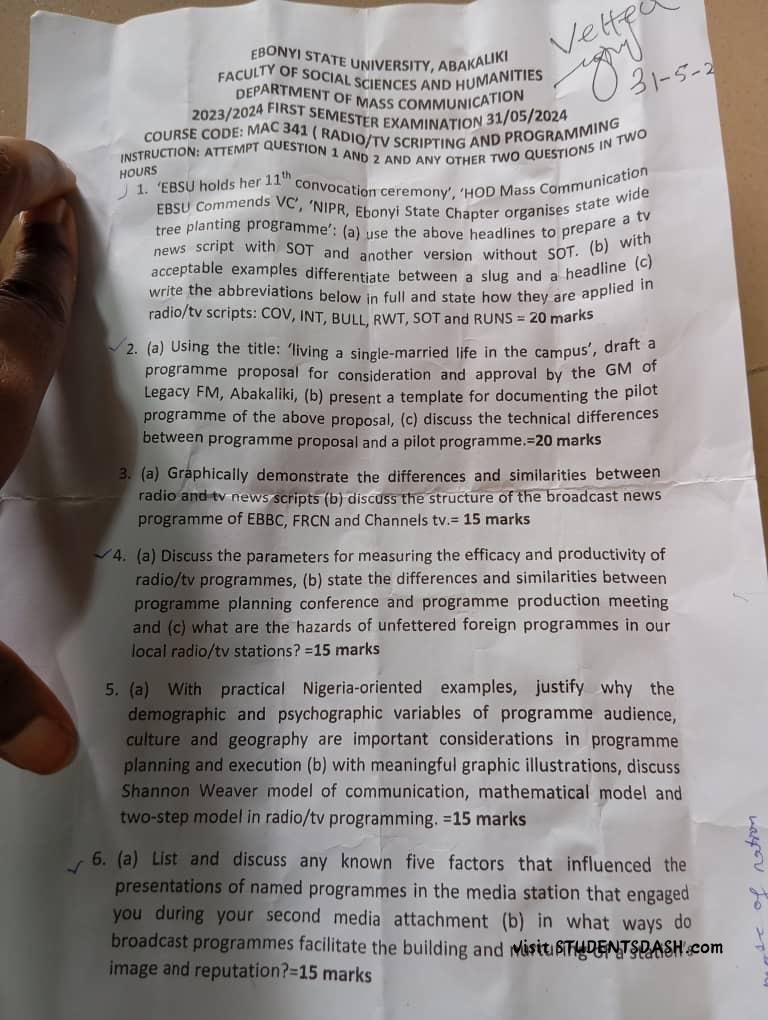
MAC 341 Past Questions and Answers
Title: MAC 341 Past Questions and Answers URL: https://studentsdash.com/mac-341-past-questions-and-answers-3/ -------------------------------------------------- Question 1 “‘EBSU holds her 11th convocation ceremony,’ ‘HOD Mass Communication EBSU Commends VC,’ ‘NIPR, Ebonyi State Chapter organizes state-wide tree planting programme’: (a) Use the above headlines to prepare a TV news script with SOT and another version without SOT. (b) Give acceptable examples of differences between a slug and a headline. (c) Write the abbreviations below in full and state how they are applied in TV news scripts: COV, INT, BULL, RWT, SOT, and RUNS.” (a) TV News Scripts (i) TV News Script With SOT Anchor (On-Camera): Good evening and welcome to EBSU Television News. I am [Anchor Name]. Today, Ebonyi State University held its 11th convocation ceremony. The event attracted many graduates, their families, and top university officials. During the ceremony, the Head of the Mass Communication Department praised the Vice-Chancellor for his commitment to academic excellence. (Cut to Video Footage – Voiceover): The convocation took place at the main auditorium of the university. Graduates in various fields celebrated their achievements as proud parents and well-wishers looked on. (SOT – Sound on Tape from HOD Mass Communication): “We are truly grateful to the Vice-Chancellor for his visionary leadership and support. Our department has seen a lot of positive changes.” (Anchor Continues On-Camera): In a related development, the Nigerian Institute of Public Relations, Ebonyi State Chapter, has launched a state-wide tree planting programme. The aim is to promote environmental awareness and preserve our green heritage. (SOT – Sound on Tape from NIPR Official): “This tree planting initiative will help reduce deforestation and encourage everyone to protect the environment.” (Anchor Concludes): That’s it on our top stories. Stay tuned for more updates. I am [Anchor Name], thanks for watching. (ii) TV News Script Without SOT Anchor (On-Camera): Hello and welcome to EBSU Television News. I am [Anchor Name]. Ebonyi State University has successfully held its 11th convocation ceremony. Many students received their degrees, while the Head of the Mass Communication Department commended the Vice-Chancellor for his dedication to improving the school’s academic standards. In another story, the Nigerian Institute of Public Relations, Ebonyi State Chapter, has organized a state-wide tree planting programme. The goal is to boost environmental sustainability and remind people about the importance of preserving nature. That’s our news for today. Join us again next time. I am [Anchor Name], signing off. (b) Differences Between a Slug and a Headline Purpose Slug : A short label or code used inside the newsroom or production team to identify a story. It is not usually shown to the public. Headline : A clear, attention-grabbing title meant for the public or audience to see. Length Slug : Often just one or two words (e.g., “EBSU-CONVO” or “TREE-PLANT”). Headline : Usually a complete phrase or sentence that summarizes the story (e.g., “EBSU Holds 11th Convocation Ceremony”). Usage Slug : Helps reporters, editors, and producers keep track of stories in a newsroom system or script. Headline : Appears in print, on websites, or on TV screens to inform or attract viewers’/readers’ attention. (c) Abbreviations in TV News Scripts COV (Coverage) Full Meaning : Coverage Usage : Indicates video footage or pictures covering an event. In a script, you might see “COV of convocation ceremony” to show that there is video footage of the event. INT (Interview) Full Meaning : Interview Usage : Signals that an interview segment is included. The script might say “INT with HOD Mass Comm” to show there is a direct interview with the Head of Department. BULL (Bulletin) Full Meaning : Bulletin Usage : Used for short news summaries or breaking news updates. It can also refer to a full news bulletin. RWT (Read With Tape) Full Meaning : Read With Tape Usage : Tells the anchor to keep reading while the video or audio tape plays in the background. The anchor’s voice continues over the footage. SOT (Sound On Tape) Full Meaning : Sound On Tape Usage : Indicates a recorded voice or sound from a newsmaker or interviewee. It’s often used to include direct quotes or statements in a report. RUNS (Running Time) Full Meaning : Running Time Usage : Shows how long a segment, video, or entire news story will last. For example, “RUNS: 1 minute, 30 seconds.” Summary TV news scripts can include SOT (actual recorded voices) or exclude them (fully narrated by the anchor). Slug vs. Headline : The slug is internal and short, while the headline is public-facing and more descriptive. Abbreviations like COV, INT, BULL, RWT, SOT, and RUNS help the production team plan how to present each story on air. Question 2 (a) Using the title: living a single-married life in the campus’, draft a programme proposal for consideration and approval by the GM of Legacy FM, Abakaliki, (b) present a template for documenting the pilot programme of the above proposal, (c) discuss the technical differences between programme proposal and a pilot programme.=20 mark (a) Programme Proposal for “Living a Single-Married Life in the Campus” Title: Living a Single-Married Life in the Campus Introduction & Background: This programme proposal is designed for Legacy FM, Abakaliki, and explores the unique phenomenon of single students adopting lifestyles similar to those of married couples while living on campus. The show seeks to delve into the dynamics of these relationships, examine their impact on academic life, and discuss how they shape personal growth and campus culture. Objectives: Inform: Educate the audience on the emerging trend of “single-married” relationships on campus. Engage: Provide a platform for students to share personal experiences, challenges, and successes. Advise: Incorporate expert opinions from counselors and relationship experts to offer advice and support. Entertain: Deliver a compelling mix of interviews, discussions, and live call-in sessions that resonate with the campus community. Programme Format & Structure: Duration: 30 minutes per episode Frequency: Weekly (suggested Friday evenings at 7:00 PM, when campus engagement is high) Segments Include: Opening: Introduction by the host outlining the topic of the day. Feature Interviews: Pre-recorded and live interviews with students, faculty, and experts. Listener Interaction: Live call-ins and social media feedback. Expert Insights: Advice from relationship counselors or academic mentors. Closing: Summary of discussions and preview of the next episode. Target Audience: University students, young adults, and the wider academic community in Abakaliki who are interested in social trends and relationship dynamics. Production & Technical Requirements: Personnel: Programme host, scriptwriter, audio technician, production assistant, guest coordinator Equipment: Studio recording setup, microphones, mixing console, editing software, telephone integration for live call-ins Budget: Detailed cost projections covering production costs, staffing, marketing, and guest expenses (to be attached as an annex). Marketing & Promotion: On-air teasers and interviews before the programme launch Social media campaigns targeting students and campus groups Collaboration with campus organizations to boost visibility Approval Request: This proposal is submitted for the consideration and approval of the GM of Legacy FM, Abakaliki. With your support, we believe this programme will provide engaging, relevant content that meets the informational and entertainment needs of our audience. (b) Template for Documenting the Pilot Programme Below is a template to document the pilot episode of “Living a Single-Married Life in the Campus”: Title of Programme: Living a Single-Married Life in the Campus Date of Recording: [Insert Date] Location: Legacy FM Studio, Abakaliki Participants: Programme Host: [Name] Guests: [List names & roles, e.g., student representatives, relationship expert, campus counselor] Technical Crew: Audio technician, producer, editor, etc. Synopsis: A brief overview of the pilot episode covering the phenomenon of single students living like married couples, including featured interviews, listener call-ins, and expert opinions. Objectives: To introduce the concept and gauge audience interest To test the programme format and technical setup To collect feedback for refining future episodes Episode Structure: Opening Segment: Introduction and overview of the topic Feature Interviews/Discussions: Recorded and live interviews Listener Interaction: Call-in segment and social media feedback Expert Insight: Tips and advice from a relationship counselor Closing: Summary of the discussion and teaser for the next episode Technical Requirements: Studio recording facilities High-quality microphones and audio recording equipment Mixing console and editing software Telecommunication setup for live call-ins Backup recording systems Expected Outcomes: Assessment of audience engagement and feedback Evaluation of technical performance (sound quality, editing flow) Identification of areas for content and production improvement Determination of overall feasibility for the regular programme schedule (c) Technical Differences Between a Programme Proposal and a Pilot Programme Programme Proposal: Conceptual Document: The proposal is a planning document outlining the idea, objectives, format, target audience, and resource requirements for the programme. It is used to gain approval and secure resources from management. Focus on Strategy: Emphasizes content strategy, marketing plans, budget estimations, and overall programme vision without delving into the final production quality. Documentation Level: Provides detailed descriptions, planned segments, and anticipated outcomes, but it remains theoretical until production begins. Pilot Programme: Actual Production: A pilot is a trial run of the programme where the concept is put into practice. It is a fully produced episode used to test the format, content flow, and technical quality. Technical Execution: Involves hands-on elements such as recording, editing, sound mixing, and integrating live call-ins. The pilot reflects the actual production environment and technical requirements. Feedback and Evaluation: The pilot is broadcast (or trialed) to gather real audience feedback, which helps in making necessary adjustments to the format, pacing, and technical components before a full launch. Refinement Stage: While the proposal lays out the plan, the pilot is a practical experiment that often reveals unforeseen challenges or opportunities that require technical refinements and content tweaks. Summary: The programme proposal is a strategic document meant to outline the vision, objectives, and requirements to secure approval and resources. The pilot programme is an actual test broadcast that focuses on executing and refining the technical and content elements of the proposal. Together, they serve as planning and validation tools to ensure the programme meets both creative and technical standards before regular broadcasting. Question 3 (a) Graphically demonstrate the differences and similarities between radio and tv news scripts (b) discuss the structure of the broadcast news programme of EBBC, FRCN and Channels tv. = 15 marks 3. (a) Graphical Demonstration of the Differences and Similarities Between Radio and TV News Scripts Below is a text-based Venn diagram that highlights the similarities (in the overlapping area) and differences (in the non-overlapping areas) between radio and TV news scripts: [Radio News Scripts] [TV News Scripts] ------------------------ ---------------------------- | - Audio-only content | | - Audio + visual content | | - Rely on sound cues | | - Use visuals (video, graphics) | | - Detailed sound effects and tone | | - Visual shot descriptions and editing cues | | - Emphasis on intonation and pacing | | - Emphasis on camera angles, scene transitions | ------------------------ ---------------------------- \ / \ Similarities / \ ---------------- / | - Both require a clear structure and script format | | - They include elements like headlines, body, and conclusions | | - Accuracy, clarity, and brevity are essential | | - Both may include interviews and sound bites (SOT) | \ ---------------- / you can leave this number 3 and pick another to answer this is a drawing but it may confuse u as I didn’t arrange it well yet Explanation of the Diagram: Radio News Scripts: Unique Features: Rely exclusively on audio, so they include detailed cues about sound effects, music, and pauses. Emphasis on vocal modulation, intonation, and pacing to convey the message effectively. Must describe scenes using sound since there are no visuals. TV News Scripts: Unique Features: Combine both audio and visual elements. Include instructions for camera shots, visuals, graphics, and on-screen text. Use SOT (Sound On Tape) as well as visual cues to enhance storytelling. Similarities (Intersection): Both scripts require clarity, proper structure (introduction, body, and conclusion), and factual accuracy. Both include elements such as headlines, interviews, and sound bites (SOT), albeit used differently. 3. (b) Structure of the Broadcast News Programme of EBBC, FRCN, and Channels TV Although each broadcasting organization may have its own unique style and emphasis, the overall structure of their broadcast news programmes typically follows these key segments: 1. Opening/Headlines Introduction: The programme starts with a brief, attention-grabbing introduction by the news anchor. A summary of the top stories is provided to give viewers an overview of the day’s major news. 2. Main News Segments Local and National News: EBBC (Ebonyi Broadcasting Commission): Focuses on state and local issues, highlighting news relevant to the Ebonyi community. May include a mix of political, social, and community stories. FRCN (Federal Radio Corporation of Nigeria): Although primarily a radio institution, its broadcast news programmes (and any televised content) focus on national affairs, government policies, and key national developments. Channels TV: Covers national and international news extensively, with in-depth analysis on major stories. Often uses multiple segments to cover different aspects of a story. 3. Specialized Segments Interviews & Expert Analysis: All three networks include interviews with newsmakers, experts, and on-the-ground reporters. Expert analysis helps to provide context and deeper understanding of the news. Weather, Sports, and Business: Segments dedicated to weather updates, sports scores, and business news are common. These segments provide quick updates and are often interspersed throughout the programme. 4. Interactive/Live Segments Viewer/Listener Engagement: Live call-ins, social media interactions, or audience feedback sessions are sometimes incorporated. This helps in building a connection with the audience and providing real-time updates. 5. Closing/Sign-Off Summary & Teasers: The programme concludes with a summary of the major stories. Teasers for upcoming news segments or follow-up stories are provided. The anchor signs off, often with a reminder to tune in for the next broadcast. Key Points: Consistency: Despite differences in target audiences and specific regional focuses, the core structure (headlines, main news, specialized segments, and closing) remains similar across EBBC, FRCN, and Channels TV. Tailoring Content: EBBC places more emphasis on local issues affecting the Ebonyi community. FRCN and Channels TV tend to offer a broader national or international perspective, incorporating more in-depth analysis and comprehensive coverage. Presentation Style: Channels TV is known for its dynamic presentation and use of graphics, while FRCN might lean more on audio storytelling (especially in radio broadcasts), and EBBC balances both to cater to its local audience. Question 4 (a) Discuss the parameters for measuring the efficacy and productivity of radio/tv programmes, (b) state the differences and similarities between programme planning conference and programme production meeting and (c) what are the hazards of unfettered foreign programmes in our local radio/tv stations? =15 marks Below is an expanded answer to Question 4 with parts (a), (b), and (c): 4. (a) Parameters for Measuring the Efficacy and Productivity of Radio/TV Programmes To assess how effective and productive a programme is, media managers and producers often look at several key parameters: Audience Reach and Ratings: • The number of viewers or listeners reached (using tools like Nielsen ratings or other audience measurement systems). • Market share compared to competitor programmes. Engagement and Feedback: • Levels of audience interaction via call-ins, social media responses, and website visits. • Viewer/listener comments and survey responses indicating satisfaction. Content Quality and Relevance: • Alignment of the programme content with audience interests and local issues. • Consistency in delivering accurate, timely, and balanced news or entertainment. Advertising Revenue and Sponsorship: • The programme’s ability to attract advertisers, often linked to its reach and engagement. • Cost-effectiveness in production relative to the revenue generated. Technical and Production Quality: • Audio-visual quality, smooth editing, and overall production values. • Efficiency in the use of resources and adherence to broadcast schedules. Impact and Influence: • The extent to which the programme influences public opinion or drives social action. • Indicators such as follow-up stories, public discourse, or policy discussions that emerge as a result of the programme. 4. (b) Differences and Similarities Between a Programme Planning Conference and a Programme Production Meeting Differences: Purpose and Timing: • Programme Planning Conference: Occurs in the conceptual and pre-production phase. Focuses on brainstorming ideas, setting objectives, determining target audience, budgeting, and outlining the overall vision of the programme. • Programme Production Meeting: Takes place during the production phase. Deals with the operational aspects such as finalizing scripts, coordinating technical elements, scheduling, and addressing production issues. Content Focus: • Planning Conference: Emphasizes content strategy, creative direction, and marketing plans. • Production Meeting: Concentrates on technical execution, detailed scheduling, and coordination of the production team (e.g., hosts, technicians, editors). Similarities: Collaboration and Communication: • Both meetings require active participation from producers, directors, and key team members to ensure clear communication and coordinated efforts. Goal of Programme Success: • Whether planning or production, both meetings are crucial in ensuring that the final output aligns with the intended quality, message, and audience expectations. Decision-Making: • Both involve making decisions that will affect the programme’s content and delivery, though at different stages of the production cycle. 4. (c) Hazards of Unfettered Foreign Programmes in Local Radio/TV Stations Introducing a high volume of foreign programmes without proper regulation can lead to several hazards: Cultural Erosion: • Local cultures and traditions might be overshadowed by dominant foreign content. • Loss of indigenous languages and traditional practices as local stories get sidelined. Economic Impact on Local Media: • Reduced opportunities for local talent and production companies, leading to job losses. • Local programmes may struggle to compete for airtime and advertising revenue, weakening the local media industry. Quality and Relevance Issues: • Foreign programmes may not address local issues or reflect local realities, making them less relevant to the audience. • There might be a mismatch in content values, leading to viewer disinterest or even backlash. Regulatory and Content Control Challenges: • Difficulty in enforcing content standards and ensuring that all programmes adhere to local broadcasting regulations. • Potential for the dissemination of inappropriate or culturally insensitive material. Audience Alienation: • An overabundance of foreign content can alienate the audience, who may prefer programmes that speak directly to their experiences, challenges, and cultural context. Question 5 (a) With practical Nigeria-oriented examples, justify why the demographic and psychographic variables of programme audience, culture and geography are important considerations in programme planning and execution (b) with meaningful graphic illustrations, discuss Shannon Weaver model of communication, mathematical model and two-step model in radio/tv programming. =15 marks Below is an expanded, detailed answer to Question 5 , divided into parts (a) and (b): 5. (a) Importance of Demographic and Psychographic Variables, Culture, and Geography in Programme Planning and Execution When planning and executing radio/TV programmes in Nigeria, understanding the audience is key. This includes: 1. Demographic Variables Age, Gender, and Education: Example: A youth-focused music and lifestyle programme on a popular station in Lagos must use contemporary language and references relevant to university students or young professionals. In contrast, a programme aimed at older listeners in Northern Nigeria may feature traditional music, discussions on farming, or local politics in Hausa. Income and Occupation: Example: Economic talk shows or business news programmes can be tailored to audiences in urban centers like Abuja or Lagos, where viewers are likely to have higher disposable incomes and professional interests. 2. Psychographic Variables Interests, Attitudes, and Lifestyles: Example: A programme on Nollywood films should consider the audience’s passion for local cinema and storytelling. For instance, channels targeting fans of Nigerian movies will include celebrity interviews, behind-the-scenes content, and discussions that resonate with the viewers’ lifestyle and aspirations. Values and Beliefs: Example: Religious programmes that cater to predominantly Muslim or Christian communities must align content with the moral and ethical values held by these groups, using culturally sensitive language and context. 3. Culture and Geography Cultural Diversity: Nigeria’s diverse ethnic groups (Yoruba, Igbo, Hausa, etc.) have unique traditions and languages. Example: A radio programme in the Yoruba language might incorporate local proverbs, traditional music, and folklore to create a deep cultural connection with the audience. Geographic Considerations: Urban audiences in mega-cities like Lagos may prefer fast-paced, modern content, while rural audiences might favor programmes that address local issues such as agriculture, traditional practices, or community events. Example: A news bulletin in the Niger Delta region might incorporate issues like oil production and environmental challenges, which are directly relevant to the local populace. Justification: Tailoring content by considering these demographic and psychographic factors, as well as cultural and geographic differences, ensures that programmes are relevant, engaging, and reflective of the audience’s realities. This targeted approach helps maximize audience reach, enhances viewer loyalty, and improves the overall efficacy of the programme. 5. (b) Models of Communication in Radio/TV Programming with Graphic Illustrations Effective communication in broadcasting is explained through various models. Here, we discuss three models with text-based graphic illustrations. 1. Shannon-Weaver Model of Communication Diagram: Sender │ ▼ Encoding │ ▼ Message ──► Channel ──► Receiver │ ▲ ▼ │ Noise Feedback Explanation: Sender: The originator (e.g., a news anchor) creates the message. Encoding: The sender converts thoughts into a broadcast message. Message: The actual content (news, information, or entertainment). Channel: The medium (radio waves, TV signals). Noise: Any interference (technical issues, signal disruptions) that may distort the message. Receiver: The audience who decodes and interprets the message. Feedback: Viewers’ responses (call-ins, social media comments) that help improve future communication. In radio/TV, this model ensures clarity by addressing potential noise and leveraging feedback for continuous improvement. 2. Mathematical Model of Communication Diagram: [Input Information] │ ▼ Encoding Process │ ▼ Signal Transmission │ (Channel Capacity & Noise Factors) ▼ Decoding Process │ ▼ [Output Information] Explanation: Input and Output Information: The model quantifies the amount of information transmitted. Encoding/Decoding: Uses mathematical formulas (e.g., probability and entropy measures) to determine how much of the message is successfully conveyed. Channel Capacity: Defines the maximum rate at which information can be reliably transmitted. Noise Factors: Quantitatively assesses how interference can distort the message. In TV and radio broadcasting, this model guides the technical setup (like digital broadcasting) to maximize signal clarity and minimize losses. 3. Two-Step Flow Model of Communication Diagram: Media Source │ ▼ Opinion Leaders │ ▼ Mass Audience Explanation: Media Source: The original content is broadcast to the public. Opinion Leaders: Influential individuals (e.g., popular radio DJs, TV presenters, social media influencers) interpret and reframe the message before passing it on. Mass Audience: The general public, whose opinions are shaped by the opinion leaders’ interpretation. In Nigerian broadcasting, opinion leaders play a critical role; for example, a well-respected celebrity might discuss a news item on their social media, influencing how their fans perceive the original TV story. Summary: Demographic and Psychographic Considerations: Ensure that content is tailored to the specific needs, interests, and cultural contexts of Nigerian audiences, enhancing engagement and relevance. Communication Models: Shannon-Weaver Model emphasizes the process of encoding/decoding with attention to noise and feedback. Mathematical Model introduces quantitative measures to optimize information transfer. Two-Step Flow Model highlights the role of opinion leaders in shaping public perception. Question 6 6. (a) List and discuss any known five factors that influenced the presentations of named programmes in the media station that engaged you during your second media attachment (b) in what ways do broadcast programmes facilitate the building and nurturing of a station’s image and reputation?=15 marks Below is an expanded answer to Question 6 in two parts: (a) and (b). 6. (a) Five Factors Influencing Programme Presentations Based on my second media attachment experience at [Name of the Media Station], the following five factors significantly influenced the presentation of the programmes: Audience Preferences and Demographics Explanation: Programmes are tailored to match the tastes, language, and cultural nuances of the target audience. For example, a morning news programme aimed at young professionals in an urban center might use a fast-paced, modern presentation style with interactive social media elements, while a community-focused segment in a rural setting may incorporate local dialects and traditional music to resonate with its audience. Station Policy and Editorial Guidelines Explanation: Every media station operates under specific editorial policies and ethical guidelines that shape content, tone, and presentation. During my attachment, I observed that programmes strictly adhered to these guidelines—ensuring impartiality, accuracy, and appropriateness—thus maintaining the station’s credibility. The guidelines also dictate how sensitive issues are handled on-air. Production Resources and Technical Facilities Explanation: The availability and quality of technical resources (such as cameras, editing software, and studio equipment) directly impact how a programme is presented. High-end equipment allowed for visually engaging segments with professional graphics and clear audio, whereas limited resources often required more straightforward, less stylized presentations. This factor is critical in maintaining high production values and viewer engagement. Presenter Skills and On-Air Personalities Explanation: The competencies, charisma, and communication skills of presenters greatly influence the programme’s overall appeal. For instance, a confident, articulate presenter can effectively engage the audience, making the content more relatable and trustworthy. Personal presentation style, including voice modulation and body language, plays a key role in how information is received by the audience. Market Competition and Branding Strategy Explanation: To stand out in a competitive media landscape, stations design programmes that align with a unique brand identity. This involves the use of signature graphics, theme music, and consistent messaging. For example, a station known for its innovative approach might experiment with interactive segments and digital integration, while another with a reputation for hard-hitting news maintains a formal, no-nonsense presentation style. Such strategies not only attract viewers but also reinforce the station’s market position. 6. (b) How Broadcast Programmes Build and Nurture a Station’s Image and Reputation Establishing Credibility and Trust Explanation: Consistent delivery of accurate, unbiased, and high-quality content builds trust among the audience. When viewers or listeners can rely on a station for truthful information and insightful analysis, the station’s reputation as a credible source is strengthened. Enhancing Brand Identity Explanation: The style, tone, and unique presentation features (such as signature jingles, visual themes, and on-air personas) help create a distinctive brand identity. This differentiation makes the station easily recognizable and memorable, encouraging audience loyalty. Engaging the Audience Explanation: Interactive elements such as live call-ins, social media integration, and community-driven segments foster a sense of involvement. When audiences actively participate and feel that their opinions matter, it enhances viewer connection and deepens the station’s relationship with its community. Demonstrating Professionalism and Innovation Explanation: High production values and a commitment to continual improvement—by adopting new technologies and innovative content formats—signal a station’s dedication to excellence. This professionalism not only impresses audiences but also attracts quality advertisers and partnerships, further boosting the station’s reputation. Reflecting Social Responsibility Explanation: Programmes that address local issues, promote cultural values, and contribute to community development build a positive image. When a station actively participates in social causes and public interest initiatives, it is viewed as more than just a media outlet—it becomes a trusted community partner. Summary: (a) The presentation of programmes during my media attachment was influenced by audience demographics, editorial policies, available technical resources, presenter qualities, and the station’s competitive branding strategies. (b) Broadcast programmes enhance a station’s image by establishing credibility, reinforcing a unique brand identity, engaging viewers, showcasing professionalism, and reflecting social responsibility.

MAC 351 Past Questions and Answers
Title: MAC 351 Past Questions and Answers URL: https://studentsdash.com/mac-351-past-questions-and-answers/ -------------------------------------------------- 1. (a) Draft three suitable topics for public relations research. Number one must be the one approved for you in the class. From topic one, Approved topic: “The Role of Social Media in Improving Public Image of Government Agencies in Nigeria” Other suitable topics: 2. “How Public Relations Can Help Fight Fake News in Nigerian Media” 3. “Effectiveness of Corporate Social Responsibility (CSR) in Building Brand Loyalty in Nigeria” (b) Three objectives of the study: To find out how social media is being used by government agencies for public relations. To know the kind of content government agencies post that help improve their public image. To examine how people respond to and engage with the PR efforts of government agencies on social media. (c) Research questions based on the objectives: How do government agencies in Nigeria use social media for public relations? What type of posts or content do they share to build a positive public image? How do Nigerians react or respond to these public relations efforts online? (d) Null Hypotheses: Government agencies do not use social media effectively for public relations in Nigeria. The content posted by government agencies on social media does not have any effect on their public image. There is no significant relationship between how people respond on social media and the public image of government agencies. 2. Public Relations practitioners who ignore research are as dangerous as generals who go to war blind of the enemy’s signal. Discuss this statement in relation to the relevance of research to the practice of public relations. This statement tells us that ignoring research in PR is like a general going to battle without knowing the enemy’s position; it is very dangerous and unwise. Public Relations is not only about sending messages out it is also about understanding the environment, the audience, and the overall impact of those messages. Research provides a solid base of facts and data that guides all PR activities. Understanding the Audience: Before launching any PR campaign, it is important to know who you are addressing. Research gives valuable information about the audience’s age, interests, habits, and needs. For instance, if a government agency wants to improve its public image using social media, research can show which social media platforms the majority of people use and what type of content they prefer. Without this research, the agency might use the wrong platform or post messages that do not connect with the audience. Developing Effective Strategies: Research helps PR practitioners to build strategies that are specific and effective. By studying past campaigns and current trends, PR professionals can learn what works well and what does not. For example, if research indicates that the audience reacts better to visual content over text, the strategy can shift to include more videos and images. This kind of informed planning minimizes risks and prevents wasted resources. Measuring Impact and Improving Future Campaigns: Research does not stop after the campaign is launched. It also includes monitoring and evaluation. This step is crucial because it tells the PR practitioner if the campaign achieved its goals or not. Surveys, focus groups, and data analytics offer clear insights into audience reactions and behavior changes. Without such feedback, PR professionals would be unaware if the message was misunderstood or if it failed to generate the desired response. Avoiding Misinterpretations and Crisis Situations: Ignoring research can lead to misinterpretations that may cause a crisis or backlash. For example, a company that launches a new product without understanding the cultural sensitivities of its audience might end up offending potential customers. Research helps to identify such pitfalls in advance, so that the message can be crafted carefully to avoid negative consequences. Making Informed Decisions: Much like generals who require updated intelligence to plan their attack, PR practitioners need current information to make informed decisions. Research provides the evidence and data that back up every decision made in a PR campaign from setting the objectives to choosing the medium of communication and timing the release of information. This process helps in building trust and credibility with the audience as they see consistent and well-informed communication. Real-Life Examples: Consider a situation where a public relations team ignores research and launches a campaign with messages that are too generic. The audience may feel that the campaign does not speak to their unique needs, leading to a lack of interest and engagement. In contrast, a campaign that used research to understand its audience might highlight specific issues of concern, use relatable language, and ultimately achieve a more positive response. In conclusion, research in PR is like a navigation tool. Without it, practitioners are bound to make errors, misjudge the audience, and eventually face failure in their efforts to communicate effectively. Just as a general would never enter battle without proper intelligence on enemy positions, a PR practitioner should never ignore research as it is essential for planning, executing, and evaluating a successful public relations strategy. 3. Distinguish between the following with relevant examples where applicable. (a) Probability Sampling vs. Non-Probability Sampling Probability Sampling In probability sampling, every member of the population has a known and equal chance of being selected. This method is random and minimizes bias, making the findings more reliable and generalizable. Example: If you are surveying students at EBSU about their use of social media, you might use a simple random sampling where you randomly select names from the student list. This ensures each student has an equal chance of being chosen. Non-Probability Sampling In non-probability sampling, not everyone in the population has a chance of being selected because the selection process is not random. This approach is easier and less expensive but can introduce bias because the sample might not represent the entire population. Example: You might survey only the students who pass by a specific location (convenience sampling) or select students based on their active presence on social media (purposive sampling). Here, the findings may not represent all EBSU students accurately. (b) Participant Observation vs. Non-Participant Observation Participant Observation In participant observation, the researcher actively joins in the activities of the group being studied while still observing. This method helps the researcher gain a deeper insight into the behaviors, attitudes, and social dynamics of the group. Example: A PR student might join a campus event to see how public relations messages are received by the audience and take part in discussions to understand the underlying sentiments. Non-Participant Observation In non-participant observation, the researcher observes the group or situation without taking part. This method is used to get an unbiased perspective and minimize the researcher’s influence on the observed environment. Example: Instead of joining the event, the researcher sits in the audience and quietly observes how people interact, noting behaviors and reactions without any involvement. (c) Personal Interview vs. Panel Interview Personal Interview A personal interview is a one-on-one conversation between the interviewer and the interviewee. It can be structured (with a set list of questions) or unstructured (more like an open conversation). Example: Interviewing a single PR manager face-to-face about their experiences with media relations to gather in-depth insights. Panel Interview In a panel interview, more than one interviewer is involved, and they may interview one candidate together or ask questions as a group. Alternatively, “panel interviews” can refer to a scenario where the same group of respondents is interviewed over a period of time to study changes in opinions or behavior (this is sometimes called a panel study). Example: A panel interview might involve a group of experts in public relations discussing the effectiveness of a new PR strategy, or a regular interview with the same group of students to track changes in their media consumption habits over a semester. (d) Survey vs. Content Analysis Survey A survey is a method of collecting data by asking people questions through questionnaires or interviews. It is used to gather information on opinions, behaviors, or characteristics from a sample that represents a larger population. Example: Distributing a questionnaire to EBSU students to collect their views on government public relations efforts on social media. Content Analysis Content analysis involves examining and analyzing communications and documents (like news articles, social media posts, or advertisements) to identify patterns, themes, or biases. It is used to study the content of communication without interacting directly with the audience. Example: Analyzing the tone and messages in media articles about a government policy to understand how the information is presented to the public. 4. The organization you are working for as a PR Manager is organizing a seminar on the Relevance of Skill Acquisition among Ebonyi Youths (a) Who are your target audience? Our target audience includes Ebonyi youths between the ages of 18 to 35 years. This group covers a mix of secondary and tertiary students, young job seekers, aspiring entrepreneurs, and entry-level employees. They are the ones who can benefit most from the seminar by learning new skills and improving their career prospects. We might also include recent graduates and young professionals who are interested in developing practical skills for today’s competitive job market. (b) Which medium will you use to inform the audience about the upcoming events? For this seminar, I will use social media as the main medium to reach out to the target audience. Platforms like Facebook, WhatsApp, and Instagram are popular among youths in Ebonyi State. These platforms allow us to share engaging content, such as event details, attractive visuals, and reminders, and they provide the option for audience interaction through comments and messages. (c) What are the strengths and weaknesses of your chosen medium? Strengths: Wide Reach: Social media platforms have many users, making it easy to reach a large number of Ebonyi youths quickly. Cost-Effective: Sharing posts, creating event pages, and sending direct messages are low-cost or free, which is suitable for limited budgets. Interactivity: Social media allows for real-time engagement. Youths can ask questions, share the event with friends, and leave feedback. Visual Appeal: Using images, short videos, and infographics can catch the attention of the audience and make the event more appealing. Weaknesses: Information Overload: Social media is crowded with many posts, which might make it difficult for our messages to stand out. Misinformation Risk: There is a possibility of misinterpretation or spread of incorrect details if the information is not clear or gets modified as it shares. Limited Internet Access: Not all targeted youths may have steady internet access or regularly check social media platforms, which could limit reach. Short Lifespan of Posts: Social media posts can get buried quickly under new content, meaning our event information might be quickly overlooked unless regularly updated. Question 5 Percentage is 100 (e) Interpret the Data on the Table The data shows the following: Majority Preference: The highest frequency is for biannual meetings, with 120 responses (40%). This suggests that most respondents prefer or believe that town hall meetings should be held twice a year. This might mean that students and management feel biannual meetings are frequent enough to maintain good communication without being overwhelming. Moderate Preference: Annually comes next with about 26.67%. This indicates that a little more than a quarter of the respondents think that an annual meeting is sufficient. They might feel that yearly meetings are enough to touch base on important issues. Lower Preference: Both quarterly and monthly meetings have the lowest frequencies (16.67% each). This suggests that only a small portion of the respondents believe meetings should be held more frequently. It could imply concerns about the feasibility, cost, or information overload if meetings are too frequent. Overall Interpretation: The preference for biannual meetings shows a balance between having regular updates and avoiding meeting fatigue. While annual meetings might be too infrequent and quarterly or monthly meetings might be too demanding or redundant, holding the meeting twice a year seems to be seen as the most effective approach for enhancing students/management relations at Ebonyi State University.