
All Study Materials & Past Questions
Explore over 10,000+ verified lecture notes, exam past questions, summaries, and course guides.
MAC 351 Past Questions and Answers 2023_2024
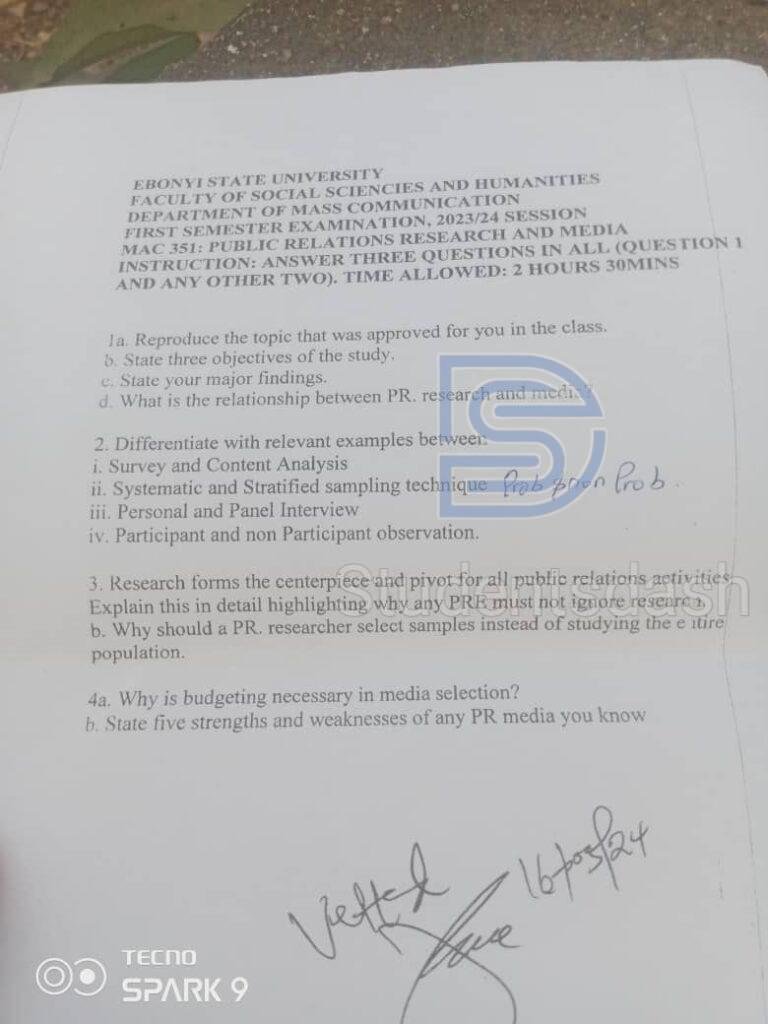
Title: MAC 351 Past Questions and Answers 2023/2024 URL: https://studentsdash.com/mac-351-past-questions-and-answers-2023-2024/ -------------------------------------------------- 1. a. My approved topic is: “The Impact of Social Media on Student Engagement at Ebonyi State University.” b. Three objectives of the study: To find out how often students use social media for learning. To identify the benefits students get from using social media. To give ideas on how to improve social media use for study. c. Major findings: Most students check social media daily for class updates. Social media helps students share notes and discuss topics. Some students get distracted by non‑academic posts. d. Relationship between PR, research and media: Research gives PR people facts about their audience. Media are the channels (like radio, social media) PR uses to talk to people. Good PR uses research to pick the right media and share the right message. 2. Differentiate with examples: i. Survey vs Content Analysis Survey: You ask people questions. Example: Give a questionnaire to 100 students about their use of social media. Content Analysis: You study texts, videos, or ads to find patterns. Example: Count how many times “exam tips” appear in five issues of the campus magazine. ii. Systematic vs Stratified Sampling Systematic Sampling: You pick every nth person from a list. Example: From a list of 200 students, choose every 10th name. Stratified Sampling: You divide population into groups (strata) then sample each group. Example: Split students by faculty (Mass Comm, Sci, Arts), then randomly pick 10 students from each faculty. iii. Personal vs Panel Interview Personal Interview: You interview different people one time each. Example: Talk to 30 students once about campus radio. Panel Interview: You interview the same group of people over time. Example: Interview the same 10 students every month about their media habits. iv. Participant vs Non‑Participant Observation Participant Observation: You join the group you study. Example: Sit in and join a student media club meeting to see how they plan events. Non‑Participant Observation: You watch without joining. Example: Observe from the back of the room how students behave in a lecture. 3a. Research is the centrepiece and pivot for all public relations activities because: Understanding the audience: Research helps us know who our audience is, what they like, and what they need. For example, a survey can tell us if students prefer Instagram or email for news. Defining clear objectives: Before any PR work, we use research to set goals (e.g., increase event attendance by 20%). This makes our campaigns focused and measurable. Choosing the right message and media: Research shows which messages connect best and which channels reach most people. For instance, content analysis of campus posts can reveal that short videos get more views than long articles. Planning and budgeting: Good research lets us plan steps and decide how much money to spend on each media outlet. It prevents wasted resourcesy on channels that won’t work. Measuring success: After a campaign, research (like polls or web analytics) tells us what worked and what didn’t. This feedback loop helps us improve future PR activities. Without solid research, PR efforts become guesses, risk failing, and waste time or money. 3b. A PR researcher selects a sample instead of studying the entire population because: Cost and time efficiency: Studying every single person (the whole population) is expensive and slow. A well‑chosen sample gives reliable results much faster. Practicality: It is often impossible to reach every individual (some may be absent, unlisted, or unreachable). A sample of 100–200 people can represent a campus of thousands. Manageable data: Handling data from a sample is easier to organize and analyze. Large datasets can be confusing and prone to error. Accuracy with proper design: If we use systematic or stratified sampling, the sample reflects the whole group’s traits. This ensures findings (like student opinions) are valid and trustworthy. Resource allocation: Limited funds and staff mean sampling lets us focus effort where it matters most. We can invest more in quality questions and analysis instead of broad coverage. By using samples correctly, PR researchers save time and money while still producing results that accurately guide PR decisions.

MAN 201 Past Questions and Answers
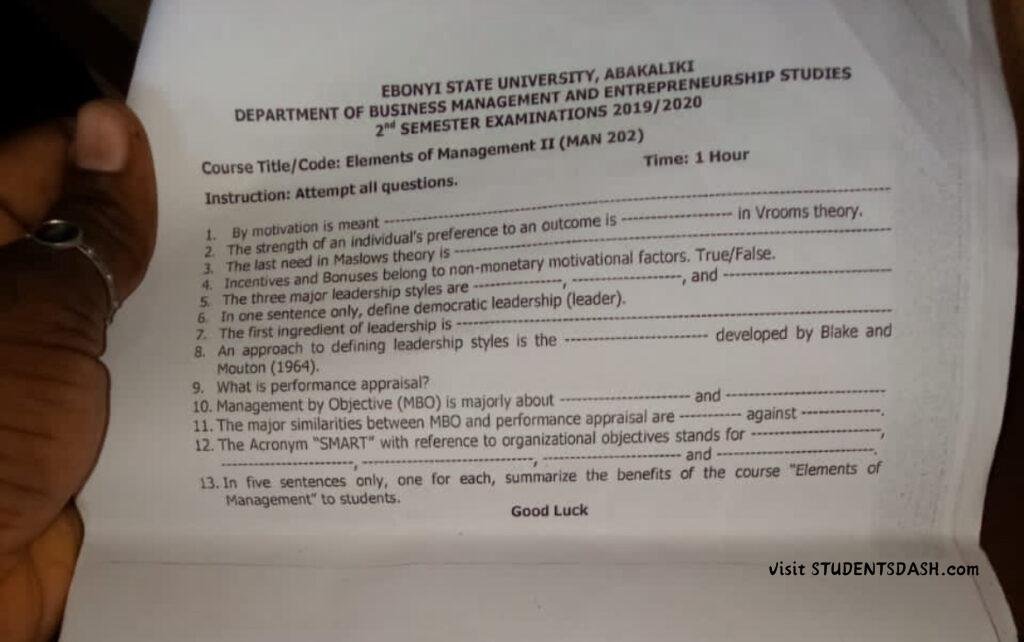
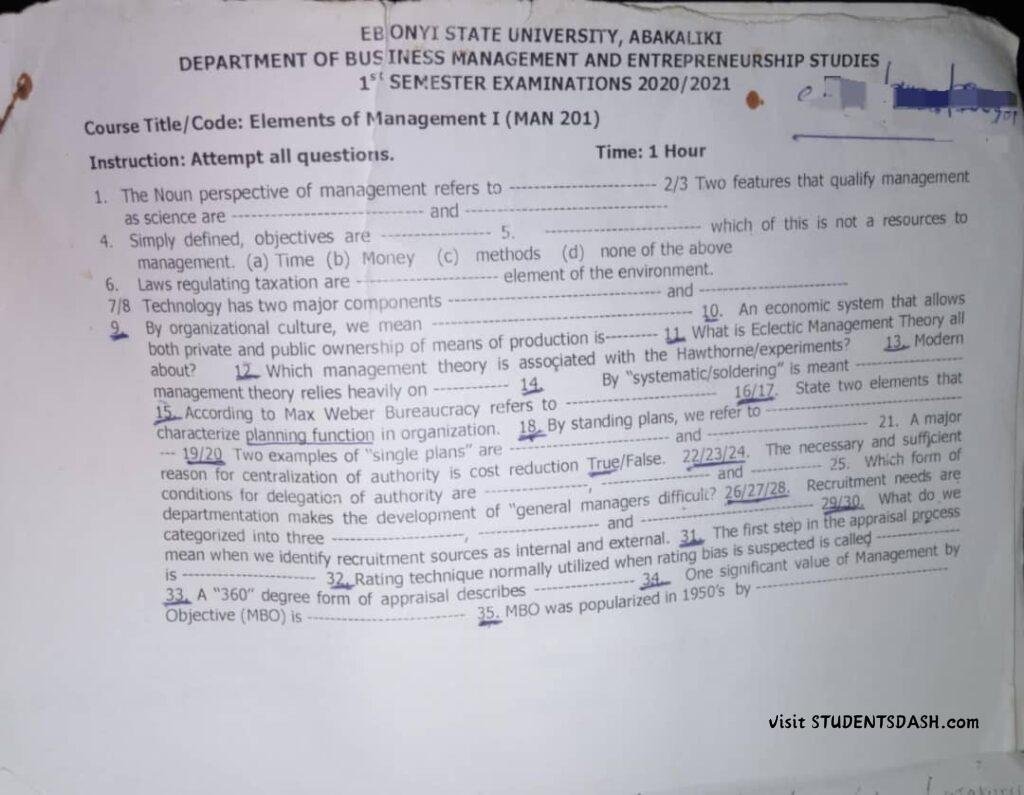
Title: MAN 201 Past Questions and Answers URL: https://studentsdash.com/man-201-past-questions-and-answers-4/ -------------------------------------------------- EBONYI STATE UNIVERSITY, ABAKALIKI DEPARTMENT OF BUSINESS MANAGEMENT & ENTREPRENEURSHIP FIRST SEMESTER EXAMINATION 2022/2023 SESSION COURSE TITLE: ELEMENTS OF MANAGEMENT I COURSE CODE: MAN 201 TIME: 1 Hour INSTRUCTION: Attempt all questions. 40 answers are required in all. You are to attempt the questions serially. Rules and procedures were the major interest of bureaucratic management school. Classical theory dominates modern school/theory of management. Administrative management school is all about managing organization and structure. In not more than two sentences each, explain the underlined words in the definition of planning – “The conscious systematic process” of making decision about goals and activities that individuals/groups/organizations as a whole will pursue in future. Conscious: This means that planning is deliberate and intentional, not done by accident. Systematic process: This implies that planning follows an organized step-by-step method. Goals: These are the targets or objectives that an organization aims to achieve. Future: Planning is forward-looking; it focuses on what will happen or needs to be achieved later. Explain briefly what you understand by primacy of planning, planning is pervasive: Primacy of planning: Planning is the first and most important function of management; it lays the foundation for all other managerial functions. Planning is pervasive: Planning is needed at all levels of management and in all departments. Two elements of organizational structures are work specialization and chain of command. Three principles of co-ordination are early start, continuity, and direct contact. Another name for 360° appraisal is multi-source feedback. A major problem associated with central tendency appraisal is rating everyone as average. Halo and Horns appraisal refers to letting one trait influence the entire evaluation. Appraisal techniques include the following except: (iv) Ranking method Staffing involves: recruitment, selection, training and development of employees. Two major sources of recruitment are: internal and external. The staff that placement process recruits fall into three broad categories, namely: skilled, semi-skilled, and unskilled. The communication process has three basic elements namely: sender, message, and receiver. By informal organization communication/grapevine we mean: the unofficial flow of information within an organization. What does horizontal communication entail? Communication between employees or departments at the same level of the organizational hierarchy. Two components central to the phenomenon of leadership are: influence and followership. By position power is meant: power that comes from one’s official rank or title. The central theme in trait approach to leadership is: inherent qualities or characteristics of a leader. By position power is meant: legitimate authority granted by an organization. The central theme in trait approach to leadership is: the belief that leaders are born, not made. Leadership is: the ability to influence others toward achieving group goals. Summarize your understanding of the following ideas: 24. Management is a discipline: Management is a field of study with theories, principles, and practices aimed at improving organizational efficiency. Management is a universal process: Management principles apply to all types of organizations, whether private, public, small, or large. Management is a profession: Management requires specialized knowledge and training, and it follows ethical codes and standards. Management as a noun: Refers to the people or group responsible for directing and controlling an organization. Management is a process: It involves a series of interrelated functions like planning, organizing, leading, and controlling.