Studentsdash
✨ Academic Library

All Study Materials & Past Questions

Explore over 10,000+ verified lecture notes, exam past questions, summaries, and course guides.

📄 1,264 materials found

Showing 397–408 of 1,264 results

Sort:
Past Questions

MAC 361 Past Questions and Answers

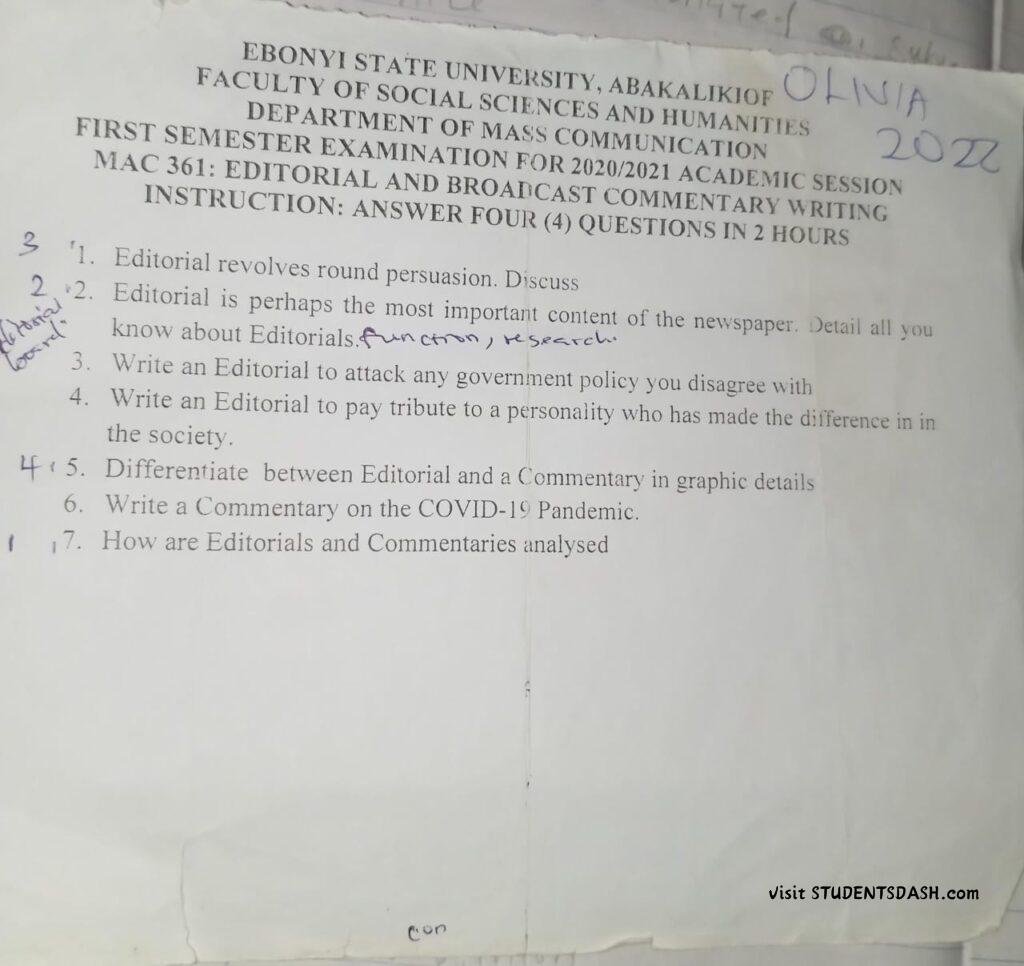
Title: MAC 361 Past Questions and Answers URL: https://studentsdash.com/mac-361-past-question-and-answers/ -------------------------------------------------- Answer 1. Editorial revolves around persuasion. Discuss. An editorial is a type of newspaper article that presents an argument or opinion on important issues. It is written by the editorial board of a newspaper or media house and is meant to guide public thinking on certain matters. One of the most important characteristics of an editorial is persuasion —it tries to convince the readers to see things from a particular perspective. Why Editorials are Persuasive Editorials use different techniques to make their arguments strong and convincing. Some of these techniques include: 1. Logical Reasoning: Editorials provide well-researched facts and logical arguments to support their opinions. 2. Emotional Appeal: They use emotional language to connect with readers’ feelings and make them take an issue seriously. 3. Authoritative Tone: Editorials are written in a confident and convincing manner, making the reader trust the argument being presented. 4. Call to Action: Many editorials end with a strong conclusion that encourages people to act in a certain way, such as supporting a policy or protesting against it. Examples of Persuasive Editorials • An editorial urging the government to increase the minimum wage by presenting facts about the cost of living. • A newspaper editorial criticizing corruption in politics and calling for more transparency. • An editorial supporting a law that bans smoking in public places, explaining the health risks involved. Editorials are persuasive because they help shape public opinion, influence government decisions, and sometimes even bring about social change. 2. Editorial is perhaps the most important content of the newspaper. Detail all you know about Editorials. Editorials are considered the heart of a newspaper because they reflect the opinions of the newspaper’s editors on important national and international issues. Unlike news articles, which are meant to be neutral, editorials take a clear stance and try to influence public thinking. Features of an Editorial 1. Opinion-Based but Factual: Even though an editorial expresses an opinion, it is based on facts, statistics, and expert analysis. 2. Influential: Editorials shape public opinion, influence government decisions, and sometimes even lead to policy changes. 3. Well-Structured: Editorials usually follow a structure that includes an introduction, body, and conclusion. The introduction presents the issue, the body provides arguments, and the conclusion gives recommendations. 4. Written in Formal but Simple Language: Editorials use a serious but understandable tone so that a wide range of people can read and understand them. Functions of an Editorial 1. Educates the Public: Editorials explain complicated issues in simple terms, helping people understand current events better. 2. Criticizes or Commends Policies: If a government policy is good, an editorial praises it. If it is bad, the editorial criticizes it and suggests improvements. 3. Advocates for Change: Many social movements start because of strong editorial pieces that draw attention to important issues. 4. Represents the Newspaper’s Voice: The editorial reflects the newspaper’s official stance on an issue, making it different from opinion articles written by individual columnists. Without editorials, newspapers would only be reporting facts without guiding the public on how to interpret or respond to them. That is why they are one of the most important parts of a newspaper. 3. Write an Editorial to Attack Any Government Policy You Disagree With. Title: The Fuel Subsidy Removal: A Burden on the Poor The recent removal of fuel subsidy by the Nigerian government has caused great suffering for millions of citizens. While the government argues that the removal will save money and boost the economy, the reality is that the policy is making life unbearable for ordinary Nigerians. Before the subsidy was removed, fuel was affordable, and transportation costs were reasonable. However, after the policy was implemented, the price of fuel more than tripled, leading to a sharp increase in the cost of transportation, food, and basic goods. This has placed a heavy financial burden on poor and middle-class Nigerians, who are already struggling to survive. The government promised that the money saved from the subsidy removal would be used to improve infrastructure, healthcare, and education. But months have passed, and Nigerians have not seen any real benefits. Instead, what we see are politicians living in luxury while the common man suffers. If the government truly cares about the people, it should introduce measures to reduce the suffering caused by this policy. This includes providing alternative fuel sources, increasing the minimum wage, and putting in place programs to support small businesses. Until these steps are taken, the fuel subsidy removal will remain an anti-people policy that should be reconsidered. 4. Write an Editorial to Pay Tribute to a Personality Who Has Made a Difference in Society. Title: Ngozi Okonjo-Iweala: A Symbol of Excellence and Integrity Dr. Ngozi Okonjo-Iweala has proven to the world that Nigerians are capable of great leadership. As the first African and first woman to become the Director-General of the World Trade Organization (WTO), she has shown exceptional intelligence, dedication, and integrity. Throughout her career, Okonjo-Iweala has worked tirelessly to improve economic policies, fight corruption, and promote good governance. As Nigeria’s Minister of Finance, she helped to reduce the country’s debt and introduced policies that boosted economic growth. Despite facing many challenges, she remained committed to transparency and accountability. Her success on the international stage has inspired millions of young Nigerians, especially women, to believe in their abilities and strive for excellence. She has proven that hard work, honesty, and intelligence can take anyone to the highest levels of leadership. Nigeria and the world celebrate Dr. Ngozi Okonjo-Iweala for her remarkable achievements. She is truly a role model for the present and future generations. 5. Differentiate Between Editorial and Commentary in Graphic Details. Feature Editorial Commentary Definition A newspaper article expressing the opinion of the editorial board. A personal opinion piece by a columnist or broadcaster. Author Written by the editorial board. Written by an individual journalist or contributor. Purpose To persuade, educate, or criticize a policy or issue. To analyze and interpret events from a personal viewpoint. Tone Formal and objective. Can be informal and personal. Audience General public, policymakers, and stakeholders. Primarily for readers who follow the columnist. Examples “Why the Government Must Improve Healthcare” “My Thoughts on the Election Results” 6. Write a Commentary on the COVID-19 Pandemic. Title: The Lessons from COVID-19 The COVID-19 pandemic was one of the most challenging periods in recent history. It affected every aspect of life, from health and economy to education and social interactions. As the world recovers, it is important to reflect on the lessons learned. One major lesson is the importance of a strong healthcare system. Many countries, including Nigeria, struggled because their hospitals were not well-equipped. This shows that governments must invest more in health facilities and medical research. Another lesson is the role of technology in education and business. During the lockdown, online learning and remote work became necessary. This means that schools and businesses should continue to embrace digital tools for efficiency. Finally, the pandemic reminded us of the value of unity and kindness. People supported one another, and governments worked together to find solutions. As we move forward, these lessons should not be forgotten. 7. How Are Editorials and Commentaries Analyzed? To analyze an editorial or commentary, we look at the following: 1. Purpose: What is the writer trying to achieve? (Persuade, inform, or criticize?) 2. Arguments: Are the points well-researched and supported by facts? 3. Language and Tone: Is it formal, emotional, or logical? 4. Impact: Does it influence public opinion or lead to change? Editorials and commentaries are powerful tools in journalism. By analyzing them, readers can better understand the message and its effect on society.


Image Post
Past Questions

MAC 361 and MAC 321 Past Questions and Answers

Title: MAC 361 and MAC 321 Past Questions and Answers URL: https://studentsdash.com/mac-361-and-mac-321-past-questions-and-answers/ -------------------------------------------------- MAC 361: Editorial and Broadcast Commentary Writing. 1. Editorial revolves around persuasion. Discuss. An editorial is an article written by an editor or a group of editors in a newspaper, magazine, or broadcast that expresses opinions on current issues. Editorials are meant to persuade the audience by presenting logical arguments, facts, and emotional appeals to influence public opinion. Persuasion in editorial writing is achieved through: Logical Reasoning – The writer presents well-researched facts and figures to convince the reader. Emotional Appeal – Some editorials use emotions to connect with the audience, making them feel strongly about the issue. Authority and Credibility – When an editorial is written by a credible media house or journalist, readers are more likely to be influenced. Call to Action – Editorials often encourage people to take action, such as voting, protesting, or changing a certain behavior. For example, an editorial on climate change may persuade people to adopt environmentally friendly habits by presenting scientific evidence and emotional stories of disaster victims. 2. Editorial is perhaps the most important content of the newspaper. Detail all you know about Editorials. An editorial is a newspaper article that presents an opinion on an issue. It is often written by senior journalists or editors and reflects the newspaper’s official stance on a topic. Characteristics of an Editorial: Opinionated: Unlike news reports, which are neutral, editorials express opinions. Persuasive: They aim to influence readers’ thoughts on important issues. Well-researched: They are backed by facts, examples, and logical arguments. Call to Action: Some editorials suggest solutions or urge readers to take action. Types of Editorials: Interpretative Editorials – Explain and analyze complex issues for the readers. Critical Editorials – Criticize policies, government actions, or social issues. Tribute Editorials – Honor great individuals, such as famous leaders or heroes. Persuasive Editorials – Aim to change public opinion on a subject. For example, a newspaper editorial might support free education by highlighting its benefits and urging the government to implement it. 3. Write an Editorial to attack any government policy you disagree with. Title: The Government’s Failure in Tackling Unemployment The rate of unemployment in Nigeria is alarmingly high. Despite government promises to create jobs, thousands of graduates roam the streets without employment. This failure has increased crime, poverty, and hopelessness among Nigerian youth. One major reason for this is poor economic policies. Instead of investing in industries, agriculture, and skill development, the government spends too much on political salaries and foreign travels. Many job creation programs, such as N-Power, have failed due to corruption and poor implementation. We urge the government to focus on real economic reforms. It should provide low-interest loans for small businesses, invest in technology, and improve the ease of doing business. If urgent action is not taken, unemployment will continue to destroy the future of this country. 4. Write an Editorial to pay tribute to a personality who has made a difference in society. Title: The Legacy of Prof. Dora Akunyili Nigeria has produced many great leaders, but few have had the impact of Prof. Dora Akunyili . As the Director-General of NAFDAC, she fearlessly fought against fake drugs that were killing thousands of Nigerians. Despite threats to her life, Akunyili did not give up. She introduced strict policies, arrested corrupt manufacturers, and restored confidence in Nigeria’s drug industry. Her leadership saved countless lives and made Nigeria a safer place. Her honesty, courage, and dedication should inspire our current leaders. Nigeria needs more people like Prof. Dora Akunyili —leaders who put service above self-interest. 5. Differentiate between Editorial and a Commentary in graphic details. Feature Editorial Commentary Definition An article expressing the newspaper’s official opinion on a major issue. A personal opinion piece that reflects the writer’s views on an issue. Tone Formal and persuasive. Can be conversational, reflective, or humorous. Author Written by editors. Written by columnists, experts, or guest writers. Purpose To influence public opinion and advocate for change. To provide personal insights or analysis of an issue. Examples Editorial on why corruption must end in Nigeria. A commentary on why football brings Nigerians together. 6. Write a Commentary on the COVID-19 Pandemic. Title: Lessons from the COVID-19 Pandemic The COVID-19 pandemic changed the world in ways we never imagined. It shut down businesses, schools, and even religious gatherings. Millions of lives were lost, and global economies suffered great losses. However, the pandemic also taught us many lessons. It showed the importance of healthcare investment . Many African countries struggled because they had poor hospitals and lacked medical supplies. It also taught us the value of technology —as schools and offices moved online. Above all, COVID-19 reminded us that life is fragile , and we must always be prepared for emergencies. Governments must invest in health infrastructure, and individuals must practice good hygiene to prevent future outbreaks. 7. How are Editorials and Commentaries analyzed? Analyzing editorials and commentaries involves: Identifying the Main Idea – What issue is being discussed? Checking the Argument – Is it based on facts, logic, or emotion? Examining the Tone – Is it formal, critical, persuasive, or humorous? Evaluating the Evidence – Does the writer use statistics, examples, or expert opinions? Looking at the Conclusion – Does the article offer solutions or just criticize? For example, if an editorial supports fuel subsidy removal, we analyze whether the arguments are strong, fair, and based on real facts. Let’s now answer MAC 321: Photography and Photojournalism 1a. A picture is worth more than a thousand words. Explain this statement in relation to the news photograph. The saying “A picture is worth a thousand words” means that a single image can convey complex messages, emotions, and stories better than a long written description. In news photography , this is especially true because photographs capture real-life moments and emotions that words alone might struggle to describe. For example, during the COVID-19 pandemic , a single photo of exhausted doctors in PPE or patients struggling to breathe told the world about the crisis more effectively than a long article. Similarly, during protests or war, a powerful photo of a crying child, a burning building, or people running for safety can immediately show the seriousness of the situation. News photographs are powerful because they: Provide instant understanding – Readers can immediately see what is happening. Create emotional impact – People feel more connected to an issue when they see real images. Enhance credibility – Photos provide proof that the event actually happened. This is why every newspaper and online media platform invests in photojournalism —to tell stories in a way that words alone cannot. 1b. What four things can a news photograph do for a publication? A news photograph serves multiple purposes in a publication. Here are four key roles it plays: Attracts Attention – A striking image on the front page can make people stop and pick up the newspaper or click on an online article. Tells a Story – A single photo can summarize an entire event, helping readers understand the news quickly. Adds Credibility – Readers trust a news story more when they see real images from the scene. Evokes Emotions – A photo can make people feel sad, happy, angry, or inspired, depending on the subject. For example, a photo of a collapsed building in an earthquake-hit area immediately shows the extent of the damage and suffering, making the news more impactful. 1c. Assuming a photograph is 8” wide and 4” deep, and the finished product is to be 4” wide, find the depth of the finished product. To calculate the depth of the finished product, we use the proportionality formula : Original WidthNew Width=Original DepthNew Depth\frac{\text{Original Width}}{\text{New Width}} = \frac{\text{Original Depth}}{\text{New Depth}} Given: Original width = 8 inches Original depth = 4 inches New width = 4 inches Now, let x be the new depth: 84=4x\frac{8}{4} = \frac{4}{x} Cross-multiplying: 8x=168x = 16 x=168=2 inchesx = \frac{16}{8} = 2 \text{ inches} So, the new depth of the finished product is 2 inches . 2a. Photography functions properly with the law of optics and drawing. Explain. Photography is based on the laws of optics , which deal with how light travels and interacts with surfaces. A camera works by using a lens to focus light onto a sensor (or film in older cameras), just like the human eye focuses light onto the retina. The laws of optics help photographers control: Focus – Making an object appear sharp or blurred. Exposure – Controlling how much light enters the camera. Depth of Field – Deciding what part of the image stays in focus while the background is blurred. Similarly, photography also follows drawing principles like composition, perspective, and balance to create visually appealing images. A well-taken photograph considers framing, symmetry, and subject positioning , just like an artist does in a painting. 2b. Differentiate between: i) Tilting and Panning in Camera Operation Feature Tilting Panning Definition Moving the camera up or down while keeping it in the same position. Moving the camera side to side (left or right) while keeping it in the same position. Purpose Used to capture vertical movements, such as tall buildings or falling objects. Used to follow moving subjects, like a running athlete or a moving car. Example Filming a plane taking off from the ground. Following a football player running across the field. ii) Aperture and Diaphragm Feature Aperture Diaphragm Definition The opening in the camera lens that controls how much light enters. The part inside the lens that opens or closes to adjust the aperture size. Function Affects exposure and depth of field. Physically controls the size of the aperture. Example A small aperture (f/16) makes everything sharp, while a large aperture (f/2.8) blurs the background. The diaphragm’s blades adjust to make the aperture smaller or larger. iii) Photo Essay and Photo Sequence Feature Photo Essay Photo Sequence Definition A collection of photos that tell a complete story. A series of photos showing step-by-step actions. Structure Each photo contributes to a broader theme. Photos must be arranged in a logical order. Example A set of pictures showing the impact of climate change on farmers. A sequence showing how a footballer scores a goal. 3a. The candid photograph is factual and unarranged and tells the story as it ought to be. Explain. A candid photograph is a natural and unposed picture taken without the subject being aware. It is considered factual because it captures real-life moments as they happen, without editing or staging. For example, a journalist covering a protest may take a candid photo of a policeman spraying tear gas at protesters. The photo tells the truth of the situation as it happened, unlike staged photographs, which may be manipulated to change the story. Candid photography is important in photojournalism because: It preserves truth in news reporting. It shows genuine emotions and actions. It prevents manipulation , making the image more credible. 3b. Outline the similarities and dissimilarities between aware and semi-aware photographs. Similarities: Both capture real-life events. Both involve human subjects. Both can be used in news reporting. Dissimilarities: Feature Aware Photograph Semi-Aware Photograph Definition A photo where the subject knows they are being photographed. A photo where the subject may not fully know they are being captured. Example A celebrity posing for a picture at an event. A person smiling naturally at a camera without realizing the photographer is about to take the shot. 4a. Enumerate the steps involved in film development. Loading the Film – Place the film into a development tank in a dark room. Developing – Soak the film in a chemical solution to reveal the images. Stopping – Use another chemical to halt the developing process. Fixing – Apply a fixer to make the image permanent. Washing – Clean the film with water to remove excess chemicals. Drying – Hang the film to dry before printing the photographs. 4b. Write short notes on the following concepts: Depth of Field – The area in focus in a photograph. Angle of View – The range of a scene captured by a camera. Magnification – The process of making an image appear larger. Perspective – The way objects appear based on distance. F-Stop – A camera setting that controls the aperture size.

Image Post
Past Questions

MAC 332 Past Questions and Answers

Title: MAC 332 Past Questions and Answers URL: https://studentsdash.com/mac-332-past-questions-and-answers-2/ -------------------------------------------------- QUESTIONS AND ANSWERS 1a. As a student writer, write a publishable story on EBSU WATCH Magazine on the topic; “2023 Election Petitions and judicial rulings: Implication on the sustenance of democracy in Nigeria.” Answer: The 2023 election petitions and judicial rulings in Nigeria raised important debates about democracy. Many political parties challenged results in different states, claiming irregularities. The courts played a major role in deciding who truly won. These rulings gave citizens hope that democracy can be protected by law, but they also created tensions because some people believed the judgments favored certain parties. For democracy to be sustained, the judiciary must remain independent and fair. The outcome of these cases shows that democracy in Nigeria depends on strong institutions, respect for the rule of law, and citizens’ trust in the system. 1b. State two major disparities between magazine and newspaper article. Answer: A newspaper article is usually brief and focused on immediate news, while a magazine article is longer and more detailed. Newspapers are published daily or weekly, while magazines are often published weekly, monthly, or quarterly with more in-depth analysis. 1c. List and explain five characteristics of a magazine. Answer: Periodicity – Magazines are published at regular intervals, like weekly or monthly. Specialization – They often focus on specific topics such as fashion, sports, or politics. Attractive design – They use glossy paper, colorful images, and good layouts. Long shelf life – People keep magazines for a long time compared to newspapers. Feature-oriented – They contain detailed stories, features, and interviews rather than breaking news. 1d. Explain the concept of fortnight and its relevance to magazine publishing business. Answer: A fortnight means a period of two weeks. In magazine publishing, fortnightly editions give enough time to gather materials, design, and produce quality content. It balances timely reporting and detailed analysis, making it useful for business sustainability. 1e. Illustrate the brief history of development of magazine in Nigeria. Answer: Magazine publishing in Nigeria started in the colonial era. Early magazines like The Eagle and Nigeria Magazine appeared in the 1930s and 1940s. After independence, magazines such as Drum and Newswatch became popular, addressing politics, culture, and entertainment. Today, magazines like The News, Tell, and lifestyle publications continue the tradition, showing growth from colonial control to independent and diverse publishing. 2a. With the aid of a diagram, draw and label an organizational chart of a magazine industry. Answer: Diagram (text format): Publisher Editor-in-Chief Managing Editor Section Editors (Features, Sports, Business, etc.) Reporters/Writers Photographers Art Director Graphic Designers Advertising Manager Circulation/Marketing Manager 2b. Who is an editor? Answer: An editor is a professional who plans, reviews, corrects, and manages content in a magazine to ensure quality, accuracy, and clarity before publication. 2c. Articulate five qualities of a good editor. Answer: Good communication skills. Strong command of language. Ability to pay attention to detail. Fair judgment and decision-making. Creativity and vision. 2d. State three career positions in any magazine industry. Answer: Feature Writer. Photojournalist. Circulation/Marketing Officer. 3a. With verifiable examples, list and explain five classifications of magazine. Answer: News Magazines – e.g., Newswatch, focused on politics and current affairs. Lifestyle Magazines – e.g., Ovation, covering celebrities and events. Sports Magazines – e.g., Complete Sports, focusing on football and athletics. Fashion Magazines – e.g., ThisDay Style, covering trends and clothing. Educational Magazines – e.g., Students’ Digest, focusing on academics and youth. 3b. Articulate four factors that militated against early publishing of magazine especially in the third world countries. Answer: Low literacy levels. High cost of printing and production. Poor distribution and infrastructure. Government censorship and restrictions. 3c. Critically examine how democracy and press freedom aided the publishing of magazine. Answer: Democracy creates an environment where different opinions are allowed. Press freedom gives publishers the right to report without fear. Together, they encourage investigative journalism, the growth of independent magazines, and public access to balanced information. 4a. Define editorial policy of a typical magazine organisation. Answer: Editorial policy is the guiding principle or set of rules that determines the type of content, tone, and style a magazine publishes to maintain consistency and reputation. 4b. Explain five factors that influence editorial policy of a magazine organisation. Answer: Ownership interest. Target audience. Cultural values. Government regulations. Ethical standards. 4c. What is magazine formula? Answer: Magazine formula is the fixed structure or style a magazine follows, including layout, recurring sections, and type of content. 4d. Chronologically list and explain five factors that determine magazine formula. Answer: Target audience – defines the focus and tone. Frequency of publication – daily, weekly, or monthly. Type of content – news, fashion, sports, etc. Design/layout style – pictures, columns, and graphics. Editorial policy – guiding rules for publishing. 5a. As a young graduate that is desirous and passionate about establishing a magazine outfit, elaborate five steps involved in the establishment of a magazine outfit. Answer: Conduct market research. Develop a business plan. Secure funding. Recruit staff (editors, writers, designers). Register and launch the magazine. 5b. List and explain five principles of editing. Answer: Accuracy – ensure facts are correct. Clarity – make writing simple to understand. Brevity – remove unnecessary words. Balance – present fair opinions. Consistency – follow style rules throughout. 5c. Explain five reasons why editing is indispensable to magazine publishing. Answer: It removes errors and mistakes. It improves clarity and readability. It maintains the magazine’s standard. It ensures facts are accurate. It makes the publication professional and trustworthy.

Image Post
Past Questions

MAC 342 Past Questions and Answers

Title: MAC 342 Past Questions and Answers URL: https://studentsdash.com/mac-342-past-questions-and-answers/ -------------------------------------------------- EBONYI STATE UNIVERSITY, ABAKALIKI FACULTY OF SOCIAL SCIENCES AND HUMANITIES DEPARTMENT OF MASS COMMUNICATION SECOND SEMESTER EXAM ON PUBLIC AFFAIRS BROADCASTING 2023/2024 (MAC 342) DATE: 15/10/2024 TIME ALLOWED: 2 HOURS INSTRUCTION: ANSWER QUESTIONS ONE & TWO AND ANY OTHER TWO QUESTIONS. (1a). Prepare a programme promotion using the topic of your group assignment done in the studio. (15marks) Answer: Coming soon on EBSU Radio 99.1 FM, join us for our exciting programme titled “Youth and Nation Building”. It is a special talk show that discusses the role of young people in developing Nigeria. Don’t miss the lively interviews, educative discussions, and inspiring messages. Tune in every Wednesday by 4pm for Youth and Nation Building on EBSU Radio. Stay informed, stay empowered! (1b). In your own words, explain what we mean by programming? (5marks) Answer: Programming means the planning, selection, and arrangement of broadcast content into a schedule for radio or television to meet the needs of the audience. (2a). Explain and design a programme running order for a radio station that runs a 24hour broadcast schedule. (15marks) Answer: A 24-hour running order means dividing the day into different time belts and assigning programmes. Example: 6:00am – 9:00am: Breakfast show (news, weather, traffic updates, music) 9:00am – 12:00pm: Magazine/educational programmes 12:00pm – 2:00pm: Midday music and talk show 2:00pm – 4:00pm: Phone-in interactive programme 4:00pm – 7:00pm: Drive-time show (news, sports, interviews) 7:00pm – 10:00pm: Entertainment and drama 10:00pm – 12:00am: Night news and analysis 12:00am – 6:00am: Music, repeats, and light programmes (2b). Clearly discourse the essence of scheduling in broadcast station? (5marks) Answer: Scheduling helps to organize programmes properly, avoid clashes, meet audience needs at the right time, attract sponsorship, and maintain a steady flow of content. (3a). For a broadcast station to achieve maximum results through programming, programme department has some responsibilities and functions to perform. Identify and clearly explain at least four of such functions. (12marks) Answer: Planning: Designing programme schedules that fit the station’s goals. Content selection: Choosing suitable programmes for the audience. Supervision: Monitoring and evaluating programmes to maintain quality. Coordination: Working with producers and presenters to ensure smooth running. (3b). Explain public affairs broadcasting. (3marks) Answer: Public affairs broadcasting refers to programmes that deal with political, social, and community issues, aimed at informing and educating the public on matters that affect them. (4a). Broadcast station derive some benefits in their attempt to programme and schedule their programmes for broadcast. Identify and explain at least five of such benefits with examples? (10marks) Answer: Audience satisfaction: Example – scheduling news at 7pm when people are home. Advert revenue: Example – placing ads during prime time shows. Orderly operations: Example – avoiding programme clashes. Consistency: Example – listeners know when to expect their favourite shows. Effective resource use: Example – assigning producers/presenters to time slots efficiently. (4b). Educate me on the following (5marks) (a) Block programming (b) Stunting (c) Dress rehearsal (d) Dry-run rehearsal Answer: (a) Block programming: Grouping similar programmes together in a time belt. (b) Stunting: Using unusual content or method to attract attention. (c) Dress rehearsal: Final practice with all costumes and equipment before live show. (d) Dry-run rehearsal: Testing programme flow without costumes or full set-up. (5). Moderate a 30 minutes radio programme on a topic of your choice. indicate all the synopsis of programme presentation. (15marks) Answer: Programme Title: “Campus Health Talk” Duration: 30 minutes Synopsis/Outline: Intro (2mins): Welcome listeners, introduce topic “Stress Management for Students.” News bit (3mins): Health updates from WHO. Discussion (10mins): Talk with a guest doctor on causes and effects of stress. Phone-in segment (10mins): Listeners call to share experiences and ask questions. Closing (5mins): Summary of key points, thank guest and audience, play closing music.

Image Post
Past Questions

MAC 391 Past Questions and Answers

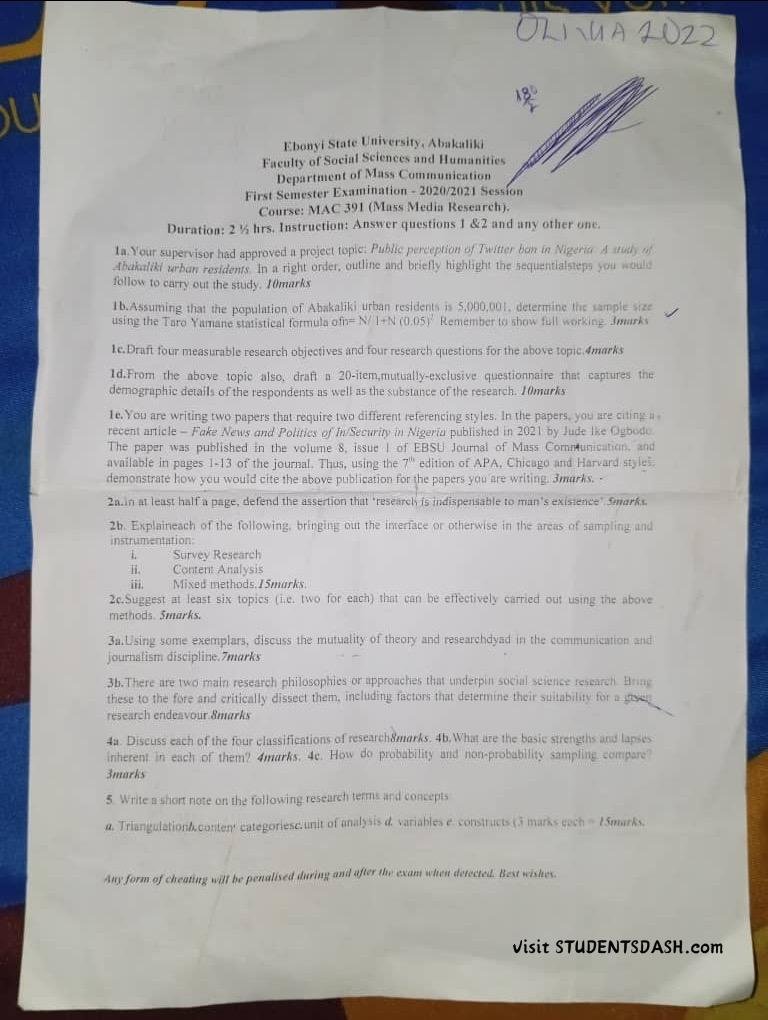
Title: MAC 391 Past Questions and Answers URL: https://studentsdash.com/mac-391-past-questions-and-answers-3/ -------------------------------------------------- ANSWER TO QUESTION 1 a. Steps for Carrying Out the Study To conduct the study on “Role of radio in the campaign against street drugs (Mkpulumma and Colos) among youths in Ebonyi State: A study of Salt FM Abakaliki,” the following steps should be followed: 1. Identification of Research Problem: Clearly define the problem by examining how radio influences youths in drug-related campaigns. 2. Review of Related Literature: Gather and analyze past studies on the topic to understand existing knowledge gaps. 3. Formulation of Research Objectives and Hypotheses: Develop measurable objectives and hypotheses based on the study’s focus. 4. Research Design and Methodology: Decide on the research approach (quantitative, qualitative, or mixed methods), data collection methods, and sampling techniques. 5. Population and Sample Selection: Identify the study population (Ebonyi youths) and determine the appropriate sample size using a statistical formula. 6. Instrument Design and Validation: Develop questionnaires or interview guides and validate them through pilot studies. 7. Data Collection: Administer the research instruments and collect data from selected respondents. 8. Data Analysis and Interpretation: Use statistical tools to analyze collected data and interpret the results in line with research questions. 9. Presentation of Findings: Report findings using tables, charts, and narratives. 10. Conclusion and Recommendations: Summarize key findings, conclude the study, and provide recommendations for future research and policy implementations. b. Sample Size Determination using Taro Yamane Formula The Taro Yamane formula for sample size determination is: Thus, the appropriate sample size for the study is approximately 400 respondents. c. Research Objectives, Questions, and Hypotheses Research Objectives: 1. To examine the influence of Salt FM Abakaliki’s radio campaigns on youth perception of street drugs. 2. To assess the effectiveness of radio programs in discouraging drug use among youths in Ebonyi State. Research Questions: 1. How does Salt FM Abakaliki’s campaign influence youth perception of street drugs? 2. How effective are radio programs in discouraging drug use among Ebonyi State youths? Alternate Hypotheses: 1. H₁: Salt FM Abakaliki’s campaign has a significant influence on youth perception of street drugs. 2. H₁: Radio programs are effective in discouraging drug use among Ebonyi State youths. d. 15-Item Multiple-Choice Questionnaire Section A: Demographics 1. What is your age? • a) 15-20 • b) 21-25 • c) 26-30 • d) 31 and above 2. What is your gender? • a) Male • b) Female • c) Others 3. What is your highest level of education? • a) Secondary school • b) OND/NCE • c) HND/B.Sc • d) Postgraduate 4. What is your occupation? • a) Student • b) Trader • c) Civil servant • d) Others Section B: Substance of the Study 5. Have you ever listened to a radio program about drug abuse? • a) Yes • b) No 6. How often do you listen to Salt FM Abakaliki? • a) Daily • b) Occasionally • c) Rarely • d) Never 7. Do you think radio programs can change youth attitudes toward drugs? • a) Strongly agree • b) Agree • c) Disagree • d) Strongly disagree 8. Which of these radio campaigns have you heard about drug abuse? • a) Drug-Free Ebonyi • b) Youth Against Drugs • c) Say No to Mkpulumma & Colos • d) None 9. Have you taken drugs such as Mkpulumma or Colos before? • a) Yes • b) No 10. If yes, did a radio program influence your decision to stop? • a) Yes • b) No 11. Which media do you think is most effective in drug abuse awareness? • a) Radio • b) Television • c) Social media • d) Newspapers 12. What do you think is the major cause of drug abuse among youths? • a) Peer pressure • b) Unemployment • c) Family issues • d) Media influence 13. How would you rate the effectiveness of Salt FM’s anti-drug campaigns? • a) Very effective • b) Moderately effective • c) Not effective 14. Do you think more radio programs should be used for drug awareness? • a) Yes • b) No 15. Would you recommend radio campaigns as a primary strategy for reducing drug abuse? • a) Yes • b) No e. APA 7th Edition Citation of the Article In-text citation: (Ogbodo, 2021) Reference list entry: Ogbodo, J. I. (2021). Mixing nonsense with substance: Negotiating satirical and investigative journalism hybrid genre in Nigerian publishing. African Journalism Studies, 2(4), 137-152. 2 ANSWER TO QUESTION 2 a. Steps for Conducting the Study To conduct the study on “Newspaper framing of Mmesoma fake UTME result saga: A content analysis of The Punch and Daily Sun,” the following steps should be followed: 1. Identify the Research Problem: Establish the relevance of the topic by analyzing how newspapers framed the Mmesoma fake UTME result saga. 2. Review of Related Literature: Examine existing studies on newspaper framing and media coverage of similar issues to identify gaps. 3. Formulate Research Objectives and Questions: Develop specific objectives and research questions to guide the study. 4. Select Research Design and Methodology: Choose content analysis as the research design, define content categories, and decide on coding units. 5. Define the Population and Sampling Technique: Identify all newspaper articles published on the topic within the selected period and determine the sampling technique (e.g., purposive sampling). 6. Develop the Coding Guide: Establish coding categories (e.g., positive, negative, neutral framing) and operational definitions for consistency. 7. Conduct Pilot Study: Test the coding guide with a small sample to ensure reliability and consistency. 8. Data Collection: Analyze relevant newspaper articles from The Punch and Daily Sun within the selected timeframe. 9. Data Analysis and Interpretation: Use descriptive statistics to analyze frequency and patterns of newspaper framing. 10. Discussion of Findings: Compare findings with existing literature and provide explanations for observed trends. 11. Conclusion and Recommendations: Summarize key findings and suggest improvements in media framing practices. ⸻ b. Determining the Unit of Analysis The unit of analysis refers to the specific elements to be studied within the newspaper content. Since the period of study is 4 months, the unit of analysis can be determined as follows: 1. Identify Relevant Newspaper Articles: Search The Punch and Daily Sun archives for all articles related to the Mmesoma fake UTME result saga. 2. Categorize Articles by Publication Dates: Select all articles published within the chosen 4-month timeframe. 3. Break Down the Content into Smaller Units: The unit of analysis could be: • Entire articles • Paragraphs • Headlines • Images/captions 4. Choose the Most Suitable Unit: Since the study is on newspaper framing, the best unit of analysis would be headlines, lead paragraphs, and full articles related to the saga. ⸻ c. Sample Size Determination Using Constructed and Manifest Content Formats • Constructed Content Format: Involves selecting specific newspaper issues systematically (e.g., picking two newspapers per week over four months). • Manifest Content Format: Involves analyzing all visible content directly related to the topic within the selected period. Sample Size Calculation: • Assuming an average of 5 relevant articles per week from both newspapers, for 4 months (16 weeks): • Total articles = 5 × 16 = 80 • Sample selection: A systematic or purposive sampling technique can be used to select a representative 50% of the total articles (i.e., 40 articles ). ⸻ d. Calculating Inter-Rater Reliability Inter-rater reliability (IRR) is calculated using Cohen’s Kappa formula or Percentage Agreement formula : Thus, the inter-rater reliability is 69.2% , indicating moderate agreement between the coders. ⸻ e. Can the Topic Be Effectively Studied Using Content Analysis? Yes , content analysis is an appropriate method for studying the topic. Reasons include: 1. Media Framing Analysis: Content analysis helps to identify how newspapers portray events—whether in a positive, negative, or neutral tone. 2. Quantifiable Data: It allows researchers to measure the frequency of specific frames (e.g., victim-blaming, investigative reporting). 3. Comparative Study: It enables a comparison of framing patterns between The Punch and Daily Sun over time. 4. Unobtrusive Method: Since content analysis examines existing articles, it does not require interaction with respondents, reducing bias. 5. Replicability: The study can be replicated in future research to assess trends in media framing of similar issues. ⸻ Final Thoughts This study effectively applies content analysis to evaluate how Nigerian newspapers framed the Mmesoma fake UTME result saga, offering insights into media bias and framing patterns. 3 ANSWER TO QUESTION 3 a. Defending the Assertion: “Research is to see what everybody else has seen, and to think what nobody else has thought.” This statement means that research is not just about looking at things but thinking about them in a new way. Many people see the same things every day, but only researchers ask deep questions and find new ideas from them. For example, before Isaac Newton, people saw fruits fall from trees, but he asked why they fall and discovered gravity. In the same way, people read newspapers, but a researcher can study how newspapers report news and find out if they are biased or not. 1. Research Helps Us Discover New Things • Science and Medicine: Doctors and scientists study diseases and develop cures instead of just watching people fall sick. • Media and Communication: Researchers study how newspapers report events and if they are fair or one-sided. • Business and Society: Economists study how people spend money and what affects the economy. 2. Research is About Asking the Right Questions Many people see problems but do not ask questions about them. A good researcher thinks differently and tries to find answers that others may not have thought about. 3. Conclusion This statement means that research is about looking at the world differently. Instead of just accepting things the way they are, researchers try to understand why things happen and how to improve them. b. Explanation of Research Methods i. Survey Research What is it? Survey research is a method where a researcher asks people questions to gather information. It is commonly used in studies about people’s opinions, behaviors, or experiences. How it Works with Sampling and Instruments: • Sampling: Researchers cannot ask everybody, so they select a group of people (sample) that represents the whole population. They may use random selection or choose people based on certain characteristics. • Instruments: The main tool used is a questionnaire, which contains questions for people to answer. These can be yes/no questions, multiple-choice, or open-ended questions. Example: If a researcher wants to study how students feel about the Mmesoma UTME saga, they can give a questionnaire to 100 students from different universities and analyze their answers. ii. Content Analysis What is it? Content analysis is a method used to study media content (newspapers, TV, social media, etc.). It helps researchers find patterns in how information is presented. How it Works with Sampling and Instruments: • Sampling: The researcher picks a number of articles or news reports that are related to the topic. For example, they may select all newspaper articles about Mmesoma within a 4-month period. • Instruments: The main tool is a coding sheet, which is used to record how many times certain words, themes, or ideas appear in the news. Example: If a researcher wants to study how The Punch and Daily Sun framed Mmesoma’s case, they can count how many times the newspapers used words like “fraud”, “mistake”, or “victim”. iii. Mixed Methods What is it? Mixed methods research means using both survey research (asking people questions) and content analysis (studying media content) to get a better understanding of a topic. How it Works with Sampling and Instruments: • Sampling: The researcher can use a mix of survey sampling (selecting people to answer questions) and content sampling (selecting newspapers or TV reports to analyze). • Instruments: The researcher uses both questionnaires (for surveys) and coding sheets (for content analysis). Example: A researcher studying the Mmesoma UTME saga can: 1. Use surveys to ask students if they think the media was fair to her. 2. Use content analysis to check if newspapers used negative or positive words in their reports. 3. Combine the results to get a complete understanding of the media framing. Final Thoughts These three research methods help researchers collect information, analyze patterns, and understand how events are reported. The choice of method depends on the research topic and the type of data needed. 4 ANSWER TO QUESTION 4 a. Content Categories Content categories are the different groups or themes used in content analysis to classify information. When researchers analyze media content (e.g., newspapers, TV programs, or social media posts), they divide the content into specific categories based on the topic being studied. Example: If a researcher is studying how newspapers reported the Mmesoma UTME saga, they may create categories like “fraud,” “victim,” “investigation,” and “public reaction” to organize the information. ⸻ b. Unit of Analysis The unit of analysis is the main thing a researcher is studying in a research project. It can be individuals, groups, organizations, events, or media content. Example: • If a study is about students’ opinions on UTME exams, the unit of analysis is students . • If a study is analyzing newspaper articles, the unit of analysis is each article . The unit of analysis helps researchers focus on what exactly they are measuring. ⸻ c. Interview Guided An interview-guided research method is a type of data collection where the researcher uses prepared questions to guide a discussion with participants. It can be structured (fixed questions), semi-structured (flexible questions), or unstructured (free discussion). Example: If a researcher wants to understand how journalists reported the Mmesoma saga, they can interview newspaper editors and reporters to ask them about their experiences and decision-making processes. ⸻ d. Research Philosophy Research philosophy refers to the beliefs and assumptions that guide a researcher’s approach to studying a topic. It helps determine how data is collected, analyzed, and interpreted . There are different types of research philosophies, such as: • Positivism – Believes research should be based on facts and numbers (scientific approach). • Interpretivism – Focuses on understanding people’s experiences and perspectives (qualitative approach). • Pragmatism – Uses a mix of both methods depending on the research problem. Example: A study on newspaper framing of Mmesoma can use interpretivism to analyze how different newspapers presented the story and the meanings behind their words. ⸻ e. Documentation in Research Documentation in research refers to keeping records of all sources, data, and findings during a study. It ensures that research is organized, transparent, and verifiable . Researchers document their work by: • Keeping notes from interviews or surveys • Saving media content used in content analysis • Citing books, articles, and websites properly • Writing a research report with full details Example: If a researcher studies newspaper framing of Mmesoma, they must document all articles analyzed, interview transcripts, and citations used to support their findings. ⸻ Final Thoughts These research terms help guide how studies are conducted, ensuring that information is properly collected, analyzed, and documented.

Image Post
Past Questions

MAC 391 Past Questions and Answers 2022

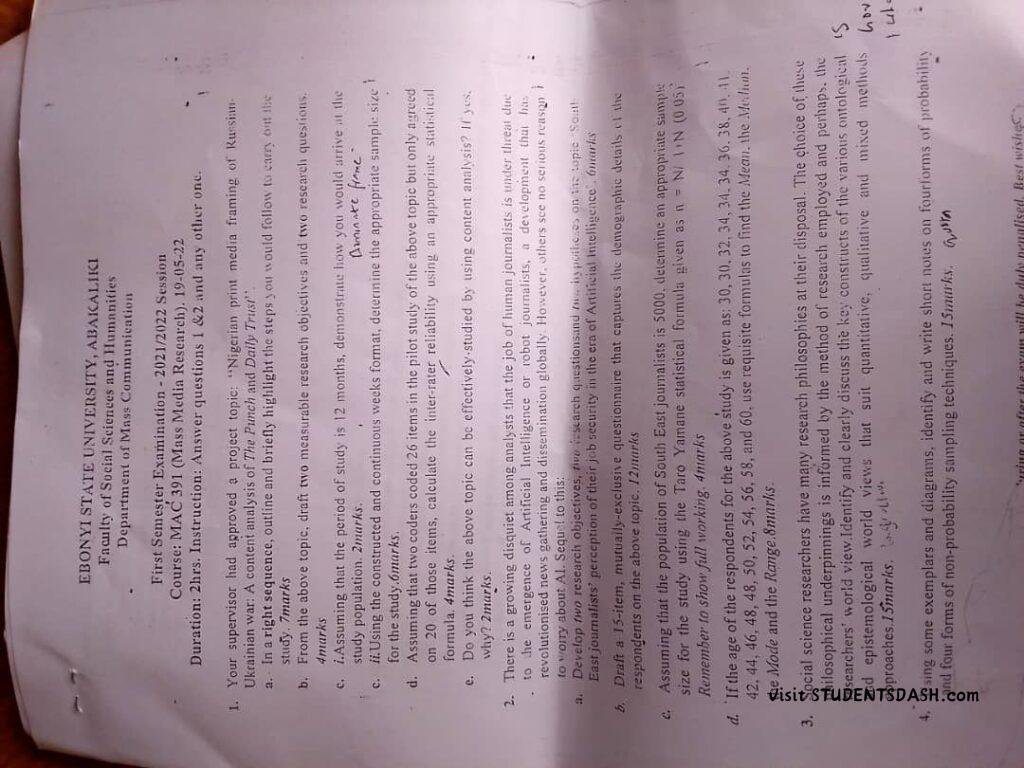
Title: MAC 391 Past Questions and Answers 2022 URL: https://studentsdash.com/mac-391-past-questions-and-answers-2022/ -------------------------------------------------- Question 1 (a) Outline and Briefly Highlight the Steps to Carry Out the Study For the project titled “Nigerian Print Media Framing of the Russian-Ukraine War,” the following steps can be adopted: Problem Identification and Justification: Clearly state the research problem by highlighting the importance of understanding how Nigerian newspapers portray the Russia-Ukraine conflict. Justify the study by discussing the potential impact of media framing on public perception and policy. Literature Review: Conduct a review of existing studies on media framing, conflict reporting, and international news coverage. Identify gaps in the literature that the current study will address. Theoretical/Conceptual Framework Selection: Choose relevant theories such as Framing Theory or Agenda-Setting Theory to guide the analysis. Define key concepts and variables related to framing in print media. Research Design and Methodology: Decide on a content analysis approach to systematically examine newspaper articles. Determine whether to use a quantitative method (frequency counts, coding) or a mixed-method approach if qualitative insights are also desired. Sampling Strategy: Define the population (e.g., Nigerian newspapers such as The Guardian, Punch, Vanguard) and the period of study (for instance, a selected 12-month period). Choose an appropriate sampling technique (systematic or purposive sampling) to select the articles for analysis. Instrument Development: Develop a coding sheet for content analysis that lists possible frames (e.g., conflict, economic, human-interest frames) and criteria for measurement. If applicable, prepare questionnaires or interview guides for gathering additional qualitative data. Data Collection: Collect relevant newspaper issues from archives or online sources covering the period under study. Train research assistants (if any) to ensure consistency in coding. Data Analysis: Use statistical tools to analyze the frequency and prominence of identified frames. Apply qualitative analysis if the study involves thematic coding. Interpretation and Discussion: Interpret the results in relation to the research objectives and the theoretical framework. Discuss the implications of the findings on media practices and public opinion. Conclusion and Recommendations: Summarize the main findings of the study. Provide recommendations for media practitioners and suggestions for future research. (b) Draft Two Measurable Research Objectives and Two Research Questions Research Objectives: Objective 1: To quantitatively determine the frequency of specific frames (e.g., conflict, economic, human-interest) used in Nigerian print media when reporting the Russian-Ukraine war. Objective 2: To assess the prominence of the Russian-Ukraine war coverage in Nigerian newspapers in terms of placement (e.g., front page vs. inner pages) and headline size. Research Questions: Research Question 1: What are the dominant frames employed by Nigerian newspapers in their coverage of the Russian-Ukraine war? Research Question 2: How does the prominence of the Russian-Ukraine war coverage (measured by article placement and headline characteristics) vary among selected Nigerian newspapers? Question 3 Social science research is underpinned by various research philosophies, and the choice of philosophy often aligns with the researcher’s method and world view. Three important world views—constructivist, rationalist, and mixed-method—correspond respectively to qualitative, quantitative, and mixed-method approaches. Below is a discussion of each: Constructivist World View Nature of Reality: Constructivism posits that reality is subjective and socially constructed. In this view, multiple, context-dependent realities exist, and meaning is developed through social interaction. Research Focus: It is most appropriate for qualitative research where the aim is to explore and understand the nuanced perceptions, experiences, and meanings individuals attach to their social world. Methodological Implications: Researchers adopt methods such as in-depth interviews, focus group discussions, and participant observation to gather rich, descriptive data. They actively engage with participants to co-create knowledge, acknowledging that their interpretations are influenced by their own perspectives. Relevance in Mass Communication: When investigating media representations, audience reception, or journalistic practices, constructivism allows for an in-depth understanding of how different stakeholders construct meanings from media messages. Rationalist World View Nature of Reality: The rationalist perspective (often linked with positivism) assumes that reality is objective, stable, and measurable. It emphasizes the use of logic, deduction, and empirical evidence to arrive at truths about the world. Research Focus: This worldview underpins quantitative research methods, focusing on testing hypotheses, measuring variables, and establishing cause-effect relationships. Methodological Implications: Researchers use surveys, experiments, and content analysis with standardized instruments to collect numerical data. Statistical techniques are then applied to generalize findings to broader populations. Relevance in Mass Communication: In studies such as audience measurement, media effects, and framing analysis, the rationalist approach provides clear, replicable data that can be statistically analyzed to yield objective insights into media behavior and its impact on society. Mixed-Method World View Nature of Reality: The mixed-method approach is grounded in pragmatism—a belief that both subjective experiences and objective measurements are essential to comprehensively understand complex phenomena. Research Focus: It bridges the gap between constructivist and rationalist perspectives by integrating qualitative and quantitative methods. Researchers seek to capitalize on the strengths of both approaches to address research questions that are multifaceted. Methodological Implications: Mixed-method research typically involves the collection of both numerical data (via surveys or experiments) and narrative data (through interviews or focus groups). Data triangulation enhances the validity of the research by allowing cross-verification of findings. Relevance in Mass Communication: In media studies, mixed-methods enable researchers to analyze content quantitatively (e.g., frequency of specific frames in news articles) while also exploring the underlying meanings through qualitative analysis (e.g., in-depth interviews with journalists). This comprehensive approach offers a more robust understanding of media phenomena. Conclusion In summary, the constructivist world view is ideal for qualitative research that delves into the subjective meanings behind media practices, while the rationalist world view supports quantitative research aiming at objectivity and generalization. The mixed-method world view provides a pragmatic framework that combines the strengths of both to offer a holistic perspective. The choice of these philosophies in social science research is crucial as it shapes the research design, methods, and interpretation of findings, ultimately influencing the depth and breadth of insights in mass communication studies. Below is a refined model answer for Question 4 with corrected English, formatted in a clear, exam-appropriate style. Question 4 A. Probability Sampling Techniques Probability sampling involves random selection, ensuring that each member of the population has a known and non-zero chance of being selected. This approach enhances the representativeness and generalizability of the findings. Simple Random Sampling Definition: Every individual in the population has an equal chance of being selected. Example: If you have a list of 1,000 journalists, you could use a random number generator to select 100 names. Diagram: Imagine a container with 1,000 numbered balls. A random drawing of 100 balls represents the selection process. Systematic Sampling Definition: You select every kth element from an ordered list after a random starting point. Example: From a list of 500 newspaper articles, if you need 50, you might select every 10th article after randomly choosing a number between 1 and 10 as your starting point. Diagram: Visualize a numbered list; after picking a random starting point (say, number 4), you then select every 10th item (4, 14, 24, etc.). Stratified Sampling Definition: The population is divided into homogeneous subgroups (strata) based on a specific characteristic (e.g., region, type of media), and random samples are drawn from each stratum. Example: Divide journalists into strata based on regions (North, South, East, West) and randomly select a proportionate number of respondents from each region. Diagram: Picture a pie chart divided into slices representing each stratum, with random selections made from each slice proportionate to its size. Cluster Sampling Definition: The population is divided into clusters (often based on geographical areas or organizational units), and a random sample of clusters is selected. Then, all or a random sample of individuals within these clusters are studied. Example: If newspapers are spread across several cities, randomly select a few cities (clusters) and then sample all or a subset of articles or journalists within those cities. Diagram: Imagine a map with several clusters (circles). Randomly choose a few circles, and then within each selected circle, list all the units (e.g., journalists or articles). B. Non-Probability Sampling Techniques Non-probability sampling does not ensure that every member of the population has a known chance of being selected, which may limit generalizability but is often more practical for exploratory research. Convenience Sampling Definition: Participants are selected based on their availability and willingness to participate. Example: Surveying journalists who are present at a media conference because they are easily accessible. Diagram: Picture a group of people gathered in one location; the researcher selects participants from those readily available. Purposive (Judgmental) Sampling Definition: The researcher deliberately selects participants based on specific characteristics or expertise relevant to the study. Example: Choosing experienced editors or media analysts for in-depth interviews on media framing due to their expertise. Diagram: Imagine a Venn diagram where one circle represents “Expertise”; the researcher selects individuals who clearly fall within this circle. Quota Sampling Definition: The researcher ensures that the sample reflects certain characteristics in the same proportions as in the population by setting quotas for different subgroups. Example: If 60% of media professionals in the population are male and 40% are female, the sample is drawn to reflect these percentages. Diagram: Visualize a bar chart with two bars (Male and Female) where the height of each bar in the sample matches the corresponding proportion in the population. Snowball Sampling Definition: Existing study participants recruit future participants from among their acquaintances. This technique is useful for accessing hard-to-reach populations. Example: Interviewing a few investigative journalists who then refer other experts in the field to the researcher. Diagram: Imagine a branching tree diagram where an initial participant leads to several referrals, which further branch out to additional participants. Summary Diagram A simple table can help visualize the categorization of these techniques: Probability Sampling Non-Probability Sampling Simple Random Sampling Convenience Sampling Systematic Sampling Purposive Sampling Stratified Sampling Quota Sampling Cluster Sampling Snowball Sampling

Image Post
Link copied to clipboard!