
Past Questions Study Materials
Explore syllabus notes, verified past questions, and solved examinations in Past Questions.

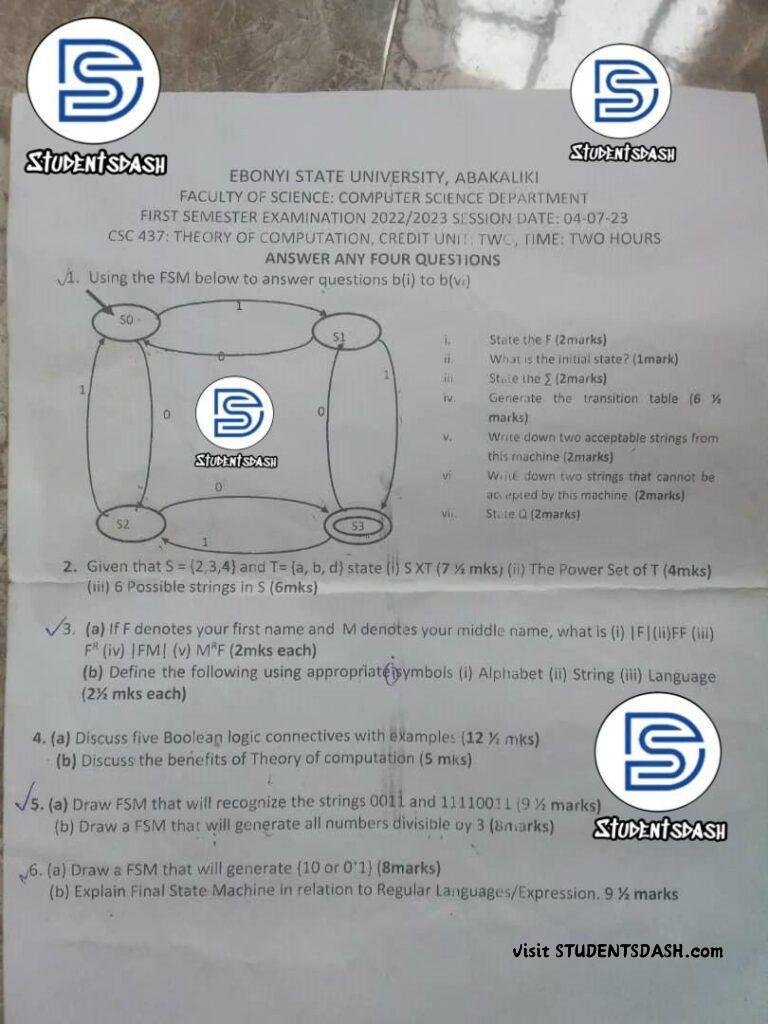

CSC 442 – Past Questions and Answers
Title: CSC 442 – Past Questions and Answers URL: https://studentsdash.com/csc-442-past-questions-and-answers-2/ -------------------------------------------------- CSC 442 – COMPUTER INSTALLATION AND MAINTENANCE Past Questions and Answers

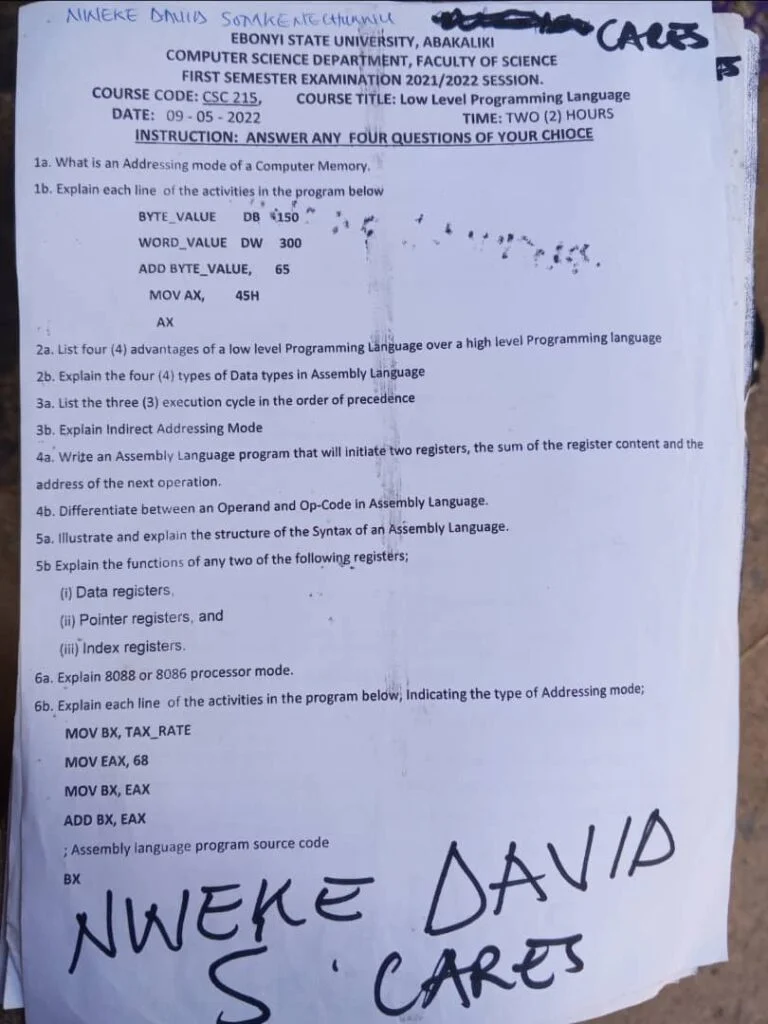
Csc 215 Past Questions and Answers
Title: Csc 215 Past Questions and Answers URL: https://studentsdash.com/csc-215-past-questions-and-answers/ -------------------------------------------------- In this Article we will be dropping the CSC 215 Past Questions and a the Answers, Access then Below. if you didn’t see the complete answers use the WhatsApp button to contact our admins CSC 215 Solutions 1 The addressing mode of a computer memory refers to the way in which the CPU accesses data stored in memory. There are several addressing modes, including direct addressing, indirect addressing, indexed addressing, relative addressing, and immediate addressing. Each of these modes involves different methods for specifying the location of the data to be accessed in memory. The choice of addressing mode can have an impact on the efficiency and speed of memory access in a computer system. 2. 2a. Four advantages of a low-level programming language over a high-level programming language are: Control: Low-level programming languages offer more control over the hardware of a computer system, allowing programmers to write code that can execute more efficiently and with greater precision. Efficiency: Low-level programming languages are often faster and more efficient than high-level programming languages because they require fewer system resources to run. Flexibility: Low-level programming languages are more flexible than high-level programming languages because they allow programmers to write code that is tailored to the specific needs of a particular application. Portability: Low-level programming languages are often more portable than high-level programming languages because they are closer to the machine language of a computer system, which means that they can be used on a wider range of hardware platforms. 2b. The four types of data types in Assembly Language are: Byte: A byte is a data type that represents a single character or number. It is typically 8 bits in size. Word: A word is a data type that represents a group of bytes. The size of a word can vary depending on the computer architecture, but it is typically 16 or 32 bits in size. Double word: A double word is a data type that represents two words. The size of a double word can vary depending on the computer architecture, but it is typically 32 or 64 bits in size. Quad word: A quad word is a data type that represents four words. The size of a quad word can vary depending on the computer architecture, but it is typically 64 or 128 bits in size. 3 3a. The three execution cycles in the order of precedence are: Fetch cycle: During the fetch cycle, the CPU retrieves the instruction from memory and prepares it for execution. Decode cycle: During the decode cycle, the CPU interprets the instruction and determines what operation it needs to perform. Execute cycle: During the execute cycle, the CPU performs the operation specified by the instruction and stores the results in memory or in a register. 3b. Indirect addressing mode is a method of addressing memory in which the address of the operand is not specified directly, but is instead stored in a register or memory location. The CPU retrieves the address from the specified location and uses it to access the operand in memory. For example, suppose we have a register called R1 that contains the memory address of a value we want to retrieve. We can use indirect addressing mode to access the value by specifying the register as the operand in the instruction. The CPU will retrieve the address from R1 and use it to access the value in memory. Indirect addressing mode is useful for situations where the address of the operand is not known in advance, or where it needs to be calculated dynamically during program execution. It can also be used to simplify the addressing of complex data structures, such as arrays or linked lists. 4 Here is an example program in Assembly Language that will initiate two registers, add their contents, and store the result in a third register, along with the address of the next operation: ORG 0x0000 ; Set the origin to 0x0000 START: MOV R1, #5 ; Initialize R1 with the value 5 MOV R2, #10 ; Initialize R2 with the value 10 ADD R3, R1, R2 ; Add the contents of R1 and R2, store the result in R3 MOV R4, PC ; Store the address of the next instruction in R4 B END ; Branch to the end of the program END: ... END ; End of the program In this program, the MOV instruction is used to initialize registers R1 and R2 with the values 5 and 10, respectively. The ADD instruction is used to add the contents of R1 and R2, and store the result in R3. Finally, the MOV instruction is used again to store the address of the next instruction in R4, and the program branches to the end of the program. 4b. In Assembly Language, an operand is a value or memory location that is operated on by an instruction. For example, in the instruction ADD R1, R2, #10 , R1 and R2 are the operands, and #10 is an immediate value that is added to the contents of R2. An op-code, on the other hand, is a code that specifies the operation to be performed by the instruction. For example, in the ADD instruction, the op-code is 0001, which specifies that the contents of the two operands should be added together. The op-code is typically the first few bits of the instruction, and it determines what operation will be performed and how the operands will be interpreted. 5 5a. The syntax of an Assembly Language program consists of a series of instructions, each of which is composed of one or more fields. The basic structure of an instruction is as follows: [label] opcode operand1, operand2, ... The label field is optional and is used to give the instruction a symbolic name. The opcode field specifies the operation to be performed, and the operand fields specify the data or memory locations to be operated on. The operands can take several forms, including register names, immediate values, memory addresses, and labels. The syntax of an Assembly Language program is typically determined by the assembler being used, which may have its own specific syntax rules and conventions. In general, Assembly Language programs are written in a text editor and saved with a .asm file extension. The program is then assembled by a separate program called an assembler, which translates the program into machine code. 5b. Data registers, pointer registers, and index registers are all types of general-purpose registers that are used to hold data and perform arithmetic and logical operations. Here are the functions of two of these registers: (i) Data registers: These registers are used to hold data values that are being operated on by the program. They are typically used for arithmetic and logical operations, such as addition, subtraction, multiplication, and division. Data registers can also be used to store intermediate results and to hold function arguments and return values. The number of data registers available in a particular processor architecture varies, but most architectures have at least a few general-purpose data registers. (ii) Pointer registers: These registers are used to hold memory addresses, which are used to access data stored in memory. Pointer registers are typically used for operations such as loading and storing data to and from memory, and for accessing data structures such as arrays, strings, and linked lists. Pointer registers are often used in conjunction with index registers to perform complex memory operations. The number of pointer registers available in a particular processor architecture varies, but most architectures have at least one or two general-purpose pointer registers. 6 6a. The 8088 and 8086 processors have two operating modes: real mode and protected mode. In real mode, the processor behaves like an 8086 processor, with a 20-bit address bus and support for up to 1 MB of memory. In protected mode, the processor can access up to 4 GB of memory and has support for features such as virtual memory, multitasking, and memory protection. Protected mode also includes support for 32-bit and 64-bit operating systems. 6b. Here is an explanation of each line of the assembly language program and the type of addressing mode used: MOV BX, TAX_RATE ; Direct addressing mode This line moves the value stored in the memory location labeled TAX_RATE into the BX register. The TAX_RATE label is assumed to be a memory address, and the value stored at that address is loaded into the BX register. This is an example of direct addressing mode, where the operand specifies the memory location directly. MOV EAX, 68 ; Immediate addressing mode This line moves the immediate value 68 into the EAX register. Immediate addressing mode is used when the operand is a constant value that is included in the instruction itself. MOV BX, EAX ; Register addressing mode This line moves the value stored in the EAX register into the BX register. Register addressing mode is used when the operand is a register. ADD BX, EAX ; Register addressing mode This line adds the value stored in the EAX register to the value stored in the BX register, and stores the result in the BX register. This is an example of register addressing mode, where the operand is a register.
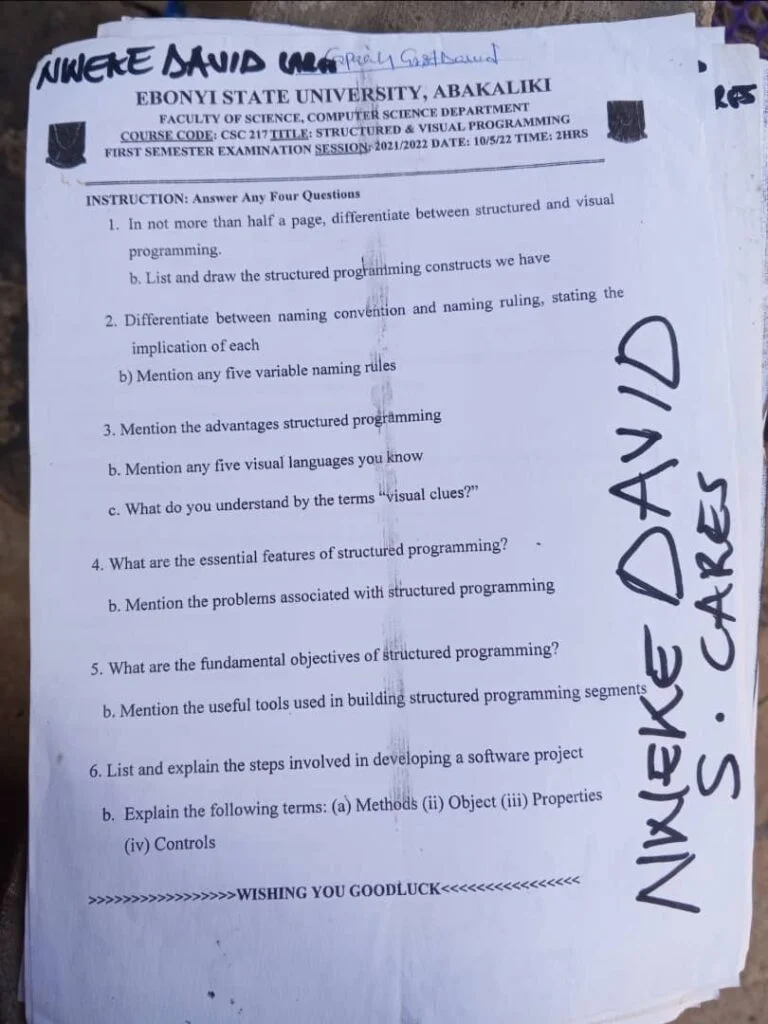
Csc 217 Past Questions and Answers
Title: Csc 217 Past Questions and Answers URL: https://studentsdash.com/csc-217-past-questions-and-answers/ -------------------------------------------------- Csc 217 Solutions 1a Structured programming and visual programming are two different approaches to software development. Structured programming is a traditional approach to programming that emphasizes the use of structured constructs, such as loops, conditionals, and subroutines, to create well-organized and maintainable code. Visual programming, on the other hand, is a more recent approach that uses visual representations, such as diagrams or flowcharts, to create software. Visual programming languages allow developers to create software by dragging and dropping pre-built components, which can make it easier to create certain types of applications. Structured programming is generally more flexible and can be used for a wide range of applications, while visual programming is often used for specific types of applications, such as games or simulations. 2 a) Naming convention and naming rules are two different concepts in programming. Naming convention refers to a set of guidelines for naming variables, functions, classes, and other elements in a program. These guidelines are typically established by a programming language or a community of developers to ensure consistency and readability of code. Naming rules, on the other hand, are specific rules that must be followed when naming variables, functions, classes, and other elements in a program. These rules are typically established by the programming language and must be followed to ensure that the program can be compiled and executed correctly. The implication of naming conventions is that it helps to make code more readable and maintainable. When everyone follows the same naming conventions, it becomes easier for developers to understand each other’s code and collaborate on projects. On the other hand, the implication of naming rules is that it ensures that the program can be compiled and executed correctly. If naming rules are not followed, the program may not compile or may produce unexpected results. b) The following are five variable naming rules: Variables must begin with a letter or an underscore. Variables can include letters, numbers, and underscores. Variable names are case-sensitive. Variable names should be descriptive and meaningful. Variable names should not be the same as keywords or reserved words in the programming language. 3 a) The advantages of structured programming include: Readability: Structured programming emphasizes the use of structured constructs, such as loops and conditionals, which make code more readable and easier to understand. Maintainability: Structured programming also makes code more maintainable by breaking it down into smaller, more manageable pieces. Reusability: Structured programming encourages the use of functions and subroutines, which can be reused in multiple parts of a program. Debugging: Structured programming can make debugging easier by isolating errors to specific parts of a program. Efficiency: Structured programming can be more efficient than unstructured programming because it eliminates unnecessary jumps and gotos. b) Five visual programming languages are: Scratch Blockly Alice LabVIEW App Inventor c) Visual clues are visual elements in a program that provide hints or feedback to the user. These clues can include icons, colors, shapes, and other visual elements that help the user understand how to interact with the program. Visual clues are important because they can make a program easier to use and more intuitive. By providing visual feedback, the user can quickly understand how the program works and how to interact with it. 4 a) The essential features of structured programming include: Top-down design: Structured programming emphasizes the use of a top-down design approach, where a problem is broken down into smaller, more manageable sub-problems. Structured constructs: Structured programming emphasizes the use of structured constructs, such as loops and conditionals, which make code more readable and easier to understand. Single entry and exit point: Structured programming requires that each function or subroutine have a single entry and exit point, which helps to eliminate unnecessary jumps and gotos. Modular design: Structured programming encourages the use of modular design, where a program is broken down into smaller, more manageable modules or functions. Data abstraction: Structured programming encourages the use of data abstraction, where data is separated from the operations that act on it. b) The problems associated with structured programming include: Limited flexibility: Structured programming can be less flexible than unstructured programming because it requires that a problem be broken down into smaller, more manageable sub-problems. Overhead: Structured programming can sometimes result in more overhead than unstructured programming because of the use of structured constructs and modular design. Complexity: Structured programming can be more complex than unstructured programming because of the use of modular design and data abstraction. Learning curve: Structured programming can have a steeper learning curve than unstructured programming because of the use of structured constructs and modular design. Limitations: Structured programming has some limitations, such as the inability to handle some types of problems that require a more flexible approach. 5 a) The fundamental objectives of structured programming include: Readability: Structured programming emphasizes the use of structured constructs, which makes code more readable and easier to understand. Maintainability: Structured programming also makes code more maintainable by breaking it down into smaller, more manageable pieces. Reusability: Structured programming encourages the use of functions and subroutines, which can be reused in multiple parts of a program. Debugging: Structured programming can make debugging easier by isolating errors to specific parts of a program. Efficiency: Structured programming can be more efficient than unstructured programming because it eliminates unnecessary jumps and gotos. b) Useful tools used in building structured programming segments include: Flowcharts: Flowcharts are useful for designing the structure of a program and visualizing the flow of control. Pseudocode: Pseudocode is useful for designing the logic of a program and describing the steps that the program should take. Modular design: Modular design is useful for breaking a program down into smaller, more manageable pieces. Structured constructs: Structured constructs, such as loops and conditionals, are useful for making code more readable and easier to understand. Functions and subroutines: Functions and subroutines are useful for reusing code in multiple parts of a program. 6 a) The steps involved in developing a software project include: Planning: This involves defining the scope of the project, identifying requirements, and setting goals and objectives. Analysis: This involves gathering and analyzing data, defining the problem, and identifying constraints and limitations. Design: This involves creating a detailed plan for the project, including the system architecture, user interface, and data structures. Implementation: This involves coding, testing, and debugging the software. Deployment: This involves installing the software on the target system and making it available to end-users. Maintenance: This involves updating and modifying the software as needed to fix bugs, add new features, or improve performance. b) The following terms are related to software development: Methods: In programming, a method is a subroutine or function that is associated with an object and can be called to perform a specific task. Object: In object-oriented programming, an object is an instance of a class that contains data and methods. Properties: In programming, properties are attributes of an object, such as its size, color, or location. Controls: In programming, controls are user interface elements, such as buttons, text boxes, and menus, that allow users to interact with the software.
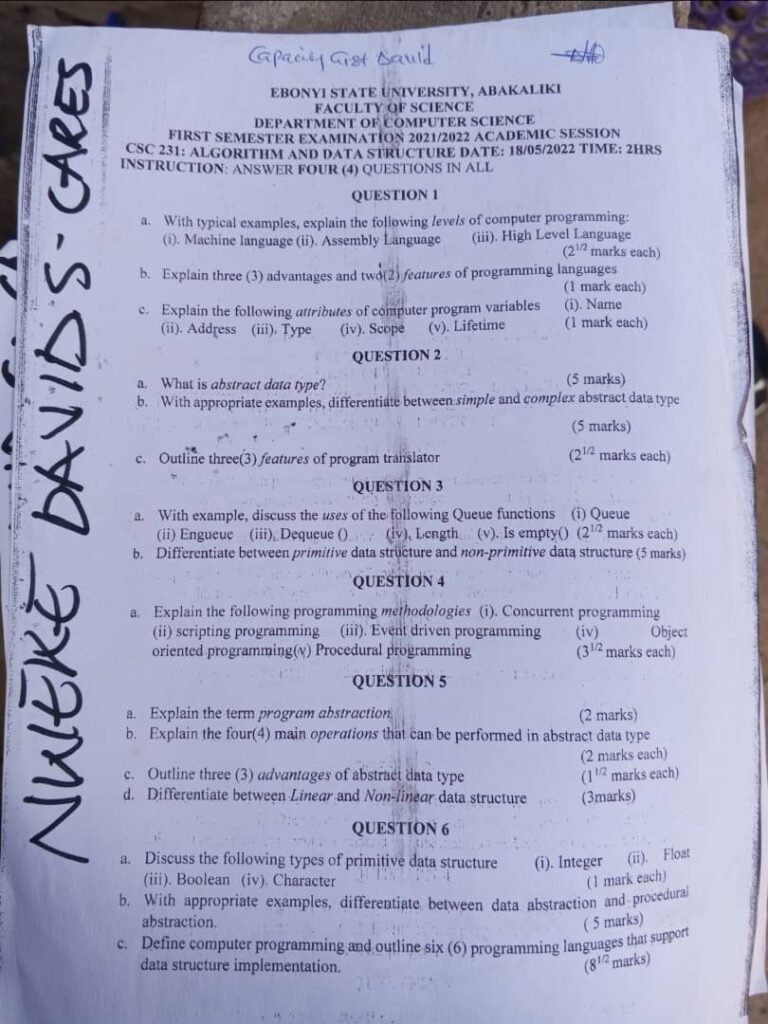
Csc 231 Past Questions and Answers
Title: Csc 231 Past Questions and Answers URL: https://studentsdash.com/csc-231-past-questions-and-answers/ -------------------------------------------------- In this Article we will be dropping the Csc 231 Past Questions and a the Answers, Access then Below. if you didn’t see the complete answers use the WhatsApp button to contact our admins. SOLUTIONs 1 (i) Machine Language: This is the lowest level of programming language. It consists of binary code, which is directly executed by the computer’s hardware. An example of machine language is 0101010101010101. (ii) Assembly Language: This is a low-level programming language that is more readable than machine language. It uses symbols to represent the instructions that are executed by the computer’s hardware. An example of assembly language is ADD AX, BX, which adds the contents of the AX and BX registers. (iii) High-Level Language: This is a programming language that is closer to human language and is easier to read and write than low-level languages. High-level languages like Python, Java, and C++ are designed to be more user-friendly and abstracted away from the hardware. An example of high-level language is “print(‘Hello, World!’)” in Python, which prints the text “Hello, World!” to the console. B Sure, here are brief explanations of the advantages and features of programming languages: Advantages: Efficiency: Programming languages allow developers to create efficient and optimized code that can perform complex tasks quickly and accurately. Portability: Programs written in high-level languages can be run on different hardware and operating systems without modification, making them highly portable. Maintainability: Programming languages allow developers to easily modify and update their code, making it easier to maintain and fix errors. Features: Syntax: Programming languages have a specific syntax that must be followed in order for the code to be executed properly. This includes the use of keywords, operators, and punctuation. Data Types: Programming languages have different data types that can be used to store and manipulate data. These include integers, floats, strings, and booleans, among others. C Sure, here are brief explanations of the attributes of computer program variables: (i) Name: This is the identifier used to represent a variable in a program. It can be any combination of letters, numbers, and special characters, but must follow certain rules depending on the programming language. (ii) Address: This is the memory location where the value of a variable is stored. Every variable has a unique address in memory that can be accessed by the program. (iii) Type: This refers to the data type of a variable, such as integer, float, or string. The type determines the size and format of the data that can be stored in the variable. (iv) Scope: This refers to the part of the program where a variable can be accessed. Variables can have global or local scope, depending on where they are declared in the program. (v) Lifetime: This refers to the duration of time that a variable exists in memory. Variables can have static or dynamic lifetime, depending on how they are declared and used in the program. 2 a) An abstract data type is a data type that is defined by its behavior rather than its implementation. It is a high-level description of a data type that specifies the operations that can be performed on it and the constraints that apply to those operations. Abstract data types are used to encapsulate data and provide a well-defined interface for working with that data. b) Simple abstract data types are those that are built into a programming language and are not composed of other data types. Examples of simple abstract data types include integers, floats, characters, and booleans. Complex abstract data types, on the other hand, are composed of other data types and are defined by their behavior rather than their implementation. Examples of complex abstract data types include arrays, lists, stacks, and queues. These data types provide a way to organize and manipulate large amounts of data in a structured and efficient manner. They are typically implemented using simple abstract data types and provide a higher-level interface for working with that data. C here are three features of program translators: Translation: The primary feature of program translators is their ability to translate code from one language to another. This includes compiling source code into object code, interpreting code on-the-fly, or translating code from one programming language to another. Optimization: Program translators often include optimization features that can improve the efficiency and performance of the code being translated. This can include techniques such as code simplification, loop unrolling, and register allocation. Error Checking: Program translators typically include error checking features that can detect and report errors in the code being translated. This can include syntax checking, type checking, and semantic checking to ensure that the code is valid and will execute correctly. 3 a. Here are the uses of the following Queue functions: (i) Queue: This function creates a new Queue data structure. For example, you can create a new Queue to store a list of tasks that need to be completed. (ii) Enqueue: This function adds an item to the end of the Queue. For instance, you can use this function to add new tasks to the list of tasks that need to be completed. (iii) Dequeue: This function removes and returns the item at the front of the Queue. For example, you can use this function to remove the first task from the list of tasks that need to be completed. (iv) Length: This function returns the number of items in the Queue. For example, you can use this function to determine how many tasks are left to be completed. (v) Is empty(): This function returns True if the Queue is empty and False otherwise. For example, you can use this function to check if there are any tasks left to be completed. b. Here is the difference between primitive data structures and non-primitive data structures: Primitive data structures are basic data types that are built into a programming language. They include integers, floats, characters, and booleans. These data types are simple and can be represented using a fixed number of bits. They are typically used to store small amounts of data and perform basic operations such as arithmetic and logical operations. Non-primitive data structures, on the other hand, are more complex data types that are composed of other data types. They include arrays, lists, stacks, and queues. These data types can store large amounts of data and provide a way to organize and manipulate that data in a structured and efficient manner. They are typically used to represent more complex data structures such as databases, trees, and graphs. 4 Here’s an explanation of the following programming methodologies: Concurrent programming: Concurrent programming is a programming methodology that deals with the execution of multiple tasks at the same time. It is commonly used in systems that require high performance and responsiveness, such as operating systems and real-time applications. Concurrent programming can be achieved through the use of threads, processes, or coroutines. Scripting programming: Scripting programming is a programming methodology that involves writing scripts to automate tasks or to add functionality to an existing program. Scripts are typically interpreted rather than compiled, and are often used to automate repetitive tasks, such as file processing, system administration, and web development. Event-driven programming: Event-driven programming is a programming methodology that responds to user actions or system events. It is commonly used in graphical user interfaces (GUIs) and web applications, where user input triggers events that cause the program to perform certain actions. Event-driven programming typically involves the use of callbacks and event handlers. Object-oriented programming: Object-oriented programming (OOP) is a programming methodology that focuses on the creation of objects, which are instances of classes that encapsulate data and behavior. OOP is based on the principles of abstraction, encapsulation, inheritance, and polymorphism, and is commonly used in a variety of applications, such as games, web applications, and enterprise systems. Procedural programming: Procedural programming is a programming methodology that focuses on the creation of procedures, which are sequences of instructions that perform a specific task. Procedural programming is typically used in applications that require a step-by-step approach to problem-solving, such as scientific computing and numerical analysis. 5 Here’s an explanation of the following programming concepts: a) Program Abstraction: Program abstraction is a programming technique that involves hiding the implementation details of a program and exposing only the necessary details to the user. It allows programmers to create complex systems by breaking them down into smaller, more manageable pieces. Abstraction is achieved through the use of interfaces, classes, and modules, which provide a high-level view of the program’s functionality without exposing the underlying details. b) Abstract Data Type (ADT): An abstract data type is a data type that is defined by its behavior, rather than its implementation. It provides a high-level view of the data and the operations that can be performed on it, without exposing the underlying details. The four main operations that can be performed on an ADT are: Creation: This operation involves creating a new instance of the ADT. The creation operation typically involves allocating memory and initializing the data. Insertion: This operation involves adding a new element to the ADT. The insertion operation typically involves checking for duplicates and maintaining the order of the data. Deletion: This operation involves removing an element from the ADT. The deletion operation typically involves searching for the element and updating the data structure. Traversal: This operation involves accessing all the elements in the ADT. The traversal operation typically involves iterating through the data structure and performing some operation on each element. c) Here are three advantages of abstract data type: Reusability: Abstract data types can be reused in multiple programs, which saves time and effort. Once an ADT is defined, it can be used in different programs without having to redefine it. Encapsulation: Abstract data types encapsulate the data and the operations that can be performed on it. This means that the implementation details are hidden from the user, which makes the program easier to use and maintain. Abstraction: Abstract data types provide a high-level view of the data and the operations that can be performed on it. This means that the user can focus on the functionality of the program, rather than the implementation details. d) Linear data structures and non-linear data structures are two types of data structures in computer science. Here’s the difference between them: Linear data structures: Linear data structures are data structures in which the elements are arranged in a linear sequence, such as a linked list or an array. The elements in a linear data structure are accessed in a sequential order, which means that each element has a unique predecessor and successor. Non-linear data structures: Non-linear data structures are data structures in which the elements are not arranged in a linear sequence, such as a tree or a graph. The elements in a non-linear data structure are accessed in a non-sequential order, which means that each element may have multiple predecessors and successors. Non-linear data structures are more complex than linear data structures, but they can represent more complex relationships between the elements. 6a Here’s a brief explanation of each of the primitive data types: (i) Integer: An integer is a whole number that can be positive, negative, or zero. In programming, integers are usually represented using a fixed number of bits, which determines the range of values that can be stored. For example, an 8-bit integer can store values from -128 to 127, while a 32-bit integer can store values from -2,147,483,648 to 2,147,483,647. (ii) Float: A float is a data type that is used to represent decimal numbers. Floats are usually represented using a fixed number of bits, which determines the precision and range of values that can be stored. For example, a 32-bit float can store values with up to 7 decimal digits of precision, while a 64-bit float can store values with up to 15 decimal digits of precision. (iii) Boolean: A boolean is a data type that can have one of two values: true or false. Booleans are often used in programming to represent logical values, such as whether a condition is true or false. (iv) Character: A character is a data type that is used to represent a single letter, digit, or symbol. Characters are usually represented using a fixed number of bits, which determines the range of values that can be stored. For example, an 8-bit character can store 256 different values, which can represent the letters, digits, and symbols used in many different languages. B Data Abstraction: Data abstraction is a technique that is used to simplify complex data structures by hiding their implementation details and exposing only the relevant information to the user. This is typically done by defining a set of operations or functions that can be used to manipulate the data, while keeping the internal representation of the data hidden from the user. For example, consider a stack data structure. The user only needs to know that they can push and pop elements from the stack, without knowing how the stack is actually implemented. Procedural Abstraction: Procedural abstraction is a technique that is used to simplify complex procedures or algorithms by hiding their implementation details and exposing only the relevant information to the user. This is typically done by defining a set of functions or procedures that can be used to execute the algorithm, while keeping the internal details of the algorithm hidden from the user. For example, consider a sorting algorithm. The user only needs to know that they can call a function to sort a list of elements, without knowing how the sorting algorithm is actually implemented. c Sure! Here’s a brief explanation of computer programming and six programming languages that support data structure implementation: Computer Programming: Computer programming is the process of designing, writing, testing, and maintaining software programs. Programming is done using a programming language, which is a set of instructions that the computer can understand and execute. Programs can be written for a variety of purposes, such as automating tasks, solving complex problems, or creating interactive applications. Six Programming Languages that Support Data Structure Implementation: C: C is a popular programming language that is widely used for system programming and embedded systems. It provides a rich set of data structures, such as arrays, linked lists, stacks, queues, and trees. C++: C++ is an object-oriented programming language that is an extension of C. It provides additional features, such as classes, templates, and operator overloading, which make it easier to implement complex data structures. Java: Java is a high-level programming language that is widely used for web development, mobile development, and enterprise applications. It provides a rich set of data structures, such as arrays, linked lists, stacks, queues, trees, and maps. Python: Python is a high-level programming language that is widely used for data analysis, machine learning, and scientific computing. It provides a rich set of data structures, such as lists, tuples, sets, dictionaries, and arrays. Ruby: Ruby is a high-level programming language that is widely used for web development and scripting. It provides a rich set of data structures, such as arrays, linked lists, stacks, queues, and trees. Swift: Swift is a programming language that is widely used for iOS and macOS development. It provides a rich set of data structures, such as arrays, linked lists, stacks, queues, and trees.

Can NELFUND Cancel Your Approved Student Loan_
Title: Can NELFUND Cancel Your Approved Student Loan? URL: https://studentsdash.com/can-nelfund-cancel-your-approved-student-loan/ -------------------------------------------------- Many students become anxious after seeing their NELFUND application approved. A common question is: Can NELFUND cancel my approved student loan? If you’ve been wondering whether an approved application can still be withdrawn or cancelled, here’s what you need to know. What Does “Approved” Mean? When your NELFUND application is marked as Approved , it means your application has successfully passed the required review stages and has been accepted under the scheme. This is an important milestone because it indicates that your application has met the necessary requirements for approval. However, approval doesn’t always mean the payment will reflect in your account immediately. If you’re still waiting for your upkeep payment after approval, read: Why Is My NELFUND Upkeep Payment Taking Longer Than Other Students? Why Is My NELFUND Upkeep Payment Taking Longer Than Other Students? Can an Approved Application Be Cancelled? An approved application is generally expected to proceed to payment, but students should continue ensuring that the information provided during the application process remains accurate. If serious issues such as incorrect information, verification problems, or other administrative concerns are discovered, additional reviews may be necessary. For most students with a valid application, there is no reason to panic after approval. Why Hasn’t My Payment Arrived After Approval? Approval and payment are two different stages. Even after your application has been approved, your payment may still be waiting for: Batch processing. Payment scheduling. Bank processing. Institutional procedures. This is why some approved students receive their payments earlier than others. If you’re worried about your bank, you should also read: Does Your Bank Affect How Fast You Receive NELFUND Payment? Does Your Bank Affect How Fast You Receive NELFUND Payment? What Should You Do After Approval? Once your application has been approved: Continue checking your dashboard for updates. Ensure your registered bank account is active. Avoid submitting another application. Follow only verified updates from NELFUND. Patience is important because payment timelines can differ for different students. Should You Contact NELFUND? If your application has been approved for a long period without any payment or further update, you may consider contacting NELFUND through its official support channels for clarification. Before doing so, make sure you’ve confirmed that your application details and bank information are correct. Frequently Asked Questions Can NELFUND withdraw an approved application? Approved applications generally move toward payment processing, although additional reviews may occur if issues requiring clarification are identified. Does approval mean I’ll receive payment today? No. Approval does not always mean payment will be made immediately. Can my approval status change? Application statuses may change if additional processing or updates are required, so it’s important to keep monitoring your dashboard. Should I apply again after being approved? No. Once your application has been approved, there is no need to submit another application. Final Thoughts Receiving an Approved status is a positive step in the NELFUND application process. While students naturally worry about possible delays or changes, most approved applications simply continue through the remaining payment process. Keep checking your dashboard, ensure your details remain accurate, and rely on official updates instead of rumors or misinformation. Stay Updated with Studentsdash Download the Studentsdash app today: www.studentsdash.com.ng/app Studentsdash also provides verified updates on JAMB, Post-UTME, admissions, scholarships, campus news, and educational opportunities across Nigeria. Download Studentsdash now: www.studentsdash.com.ng/app Thousands of Nigerian students trust Studentsdash for fast and reliable education updates. Stay informed with Studentsdash: www.studentsdash.com.ng/app Join our Telegram community: https://t.me/studentsdash Need help? Contact Studentsdash: 07075012541 Download the Studentsdash app: www.studentsdash.com.ng/app Never miss another NELFUND update: www.studentsdash.com.ng/app Stay one step ahead: www.studentsdash.com.ng/app Get verified student news every day: www.studentsdash.com.ng/app

E-PHY 221 Past Questions and Answers
Title: E-PHY 221 Past Questions and Answers URL: https://studentsdash.com/e-phy-221-past-questions-and-answers/ -------------------------------------------------- EBSU-PHY 221 – Introduction to Geophysics – Past Questions and Answers