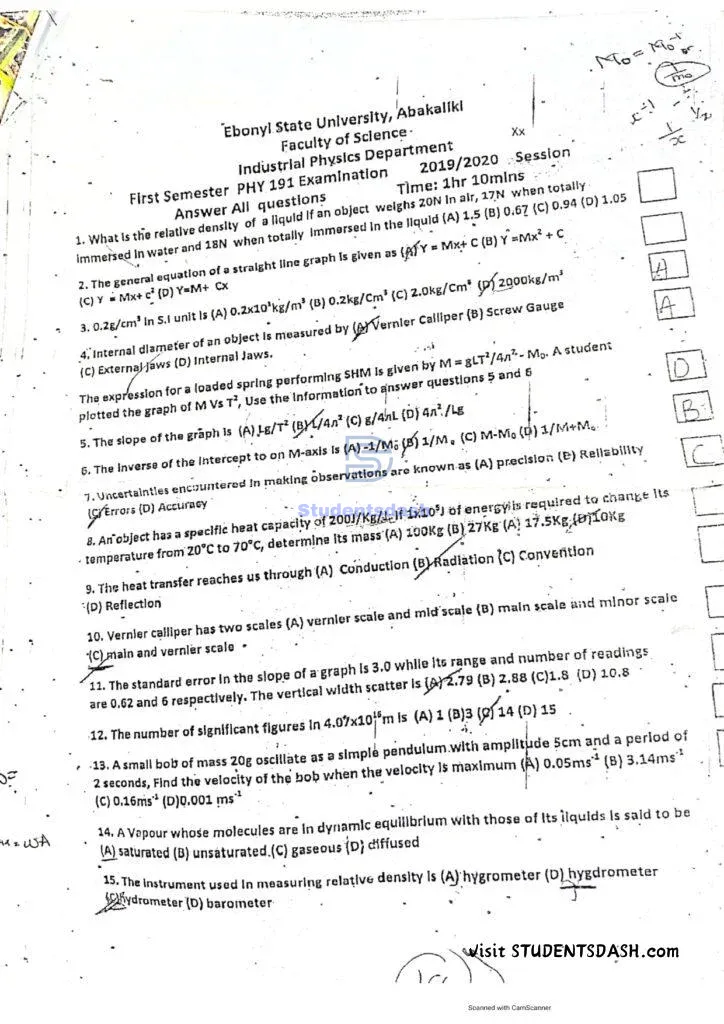
PHY 191 — 2019/2020 Session
1. What is the relative density of a liquid if an object weighs 20N in air, 17N when totally immersed in water and 18N when totally immersed in the liquid?
A. 1.5
B. 0.67
C. 0.94
D. 1.05
Answer: C
2. The general equation of a straight line graph is given as:
A. Y = Mx + C
B. Y = Mx² + C
C. Y = Mx + c²
D. Y = M + Cx
Answer: A
3. 0.2g/cm³ in S.I unit is:
A. 0.2x10¹ kg/m³
B. 0.2kg/Cm³
C. 2.0kg/Cm³
D. 2000kg/m³
Answer: D
4. Internal diameter of an object is measured by:
A. Vernier Calliper
B. Screw Gauge
C. External Jaws
D. Internal Jaws
Answer: A
5. The expression for a loaded spring performing SHM is given by M = 8LT²/4π² - M₀. A student plotted the graph of M Vs T². The slope of the graph is:
A. Lg/T²
B. 1/4π²
C. g/4πL
D. 4π²/Lg
Answer: B
6. The inverse of the intercept on M-axis is:
A. -1/M₀
B. 1/M₀
C. M-M₀
D. 1/M+M₀
Answer: B
7. Uncertainties encountered in making observations are known as:
A. Precision
B. Reliability
C. Errors
D. Accuracy
Answer: C
8. An object has a specific heat capacity of 200J/Kg/°C. If 1x10⁵J of energy is required to change its temperature from 20°C to 70°C, determine its mass:
A. 100Kg
B. 27Kg
C. 17.5Kg
D. 10Kg
Answer: D
9. The heat transfer reaches us through:
A. Conduction
B. Radiation
C. Convention
D. Reflection
Answer: B
10. Vernier calliper has two scales:
A. Vernier scale and mid scale
B. Main scale and minor scale
C. Main and vernier scale
D. None of the above
Answer: C
11. The standard error in the slope of a graph is 3.0 while its range and number of readings are 0.62 and 6 respectively. The vertical width scatter is:
A. 2.79
B. 2.88
C. 1.8
D. 10.8
Answer: B
12. The number of significant figures in 4.07x10¹⁵m is:
A. 1
B. 3
C. 14
D. 15
Answer: B
13. A small bob of mass 20g oscillate as a simple pendulum with amplitude 5cm and a period of 2 seconds. Find the velocity of the bob when the velocity is maximum:
A. 0.05ms⁻¹
B. 3.14ms⁻¹
C. 0.16ms⁻¹
D. 0.001ms⁻¹
Answer: C
14. A Vapour whose molecules are in dynamic equilibrium with those of its liquids is said to be:
A. Saturated
B. Unsaturated
C. Gaseous
D. Diffused
Answer: A
15. The instrument used in measuring relative density is:
A. Hygrometer
B. Hydrometer
C. Hydrometer
D. Barometer
Answer: B
16. If a simple pendulum performing SHM swings to maximum amplitude, its kinetic energy is:
A. Zero
B. Maximum
C. Twice its potential
D. Equal to its potential
Answer: A
17. In an experiment, the vernier calliper was used to measure the breadth to be 2.40cm and the thickness to be 0.45cm of the metre rule. Find the volume of the metre rule:
A. 123.0cm
B. 105.0cm
C. 108.0cm
D. 109.0cm
Answer: C
18. Given that L = 20.00±0.05 and w = 15.00±0.05cm, What is the maximum error in the sum:
A. 0.1cm
B. 0.01cm
C. 0.05cm
D. 0.001cm
Answer: A
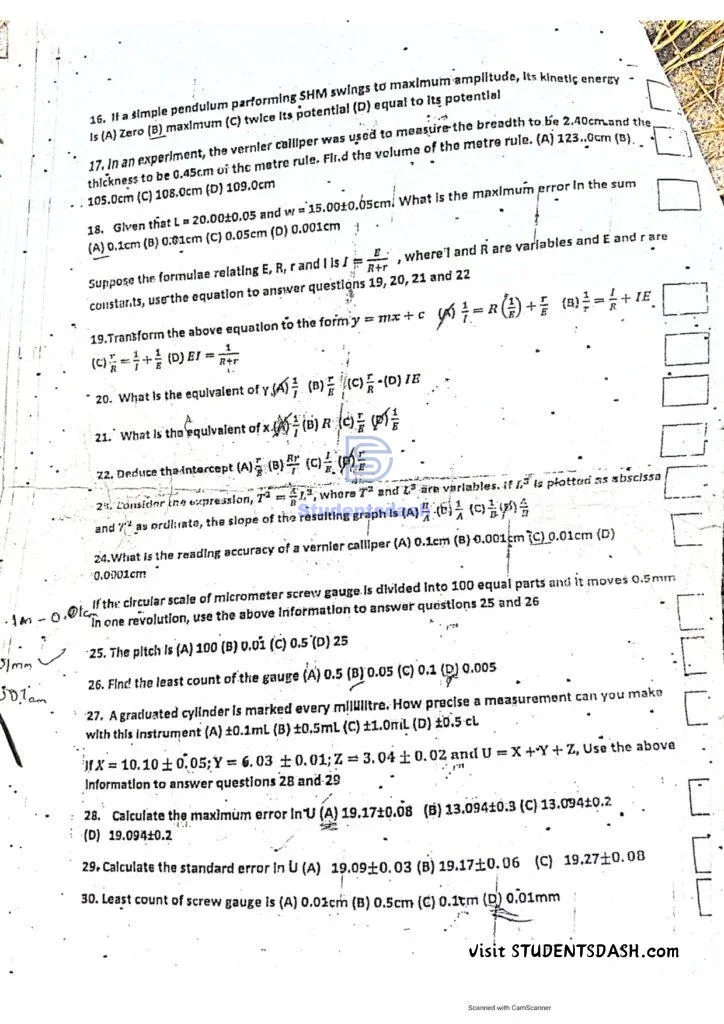
*Suppose the formulae relating E, R, r and I is I = E/(R+r), where I and R are variables and E and r are constants. Use the equation to answer questions 19, 20, 21 and 22*
19. Transform the above equation to the form y = mx + c:
A. 1/I = R(1/E) + r/E
B. 1/I = 1/R + IE
C. r/I = 1/I + 1/E
D. EI = 1/(R+r)
Answer: A
20. What is the equivalent of y:
A. 1/I
B. r/E
C. r/R
D. IE
Answer: A
21. What is the equivalent of x:
A. 1/I
B. R
C. r/E
D. 1/E
Answer: B
22. Deduce the intercept:
A. r/B
B. Rr/I
C. 1/E
D. r/E
Answer: D
23. Consider the expression, T² = (π/g)L², where T² and L² are variables. If L² is plotted as abscissa and T² as ordinate, the slope of the resulting graph is:
A. π/g
B. 1/g
C. 1/g
D. π/g
Answer: A
24. What is the reading accuracy of a vernier calliper:
A. 0.1cm
B. 0.001cm
C. 0.01cm
D. 0.0001cm
Answer: C
*If the circular scale of micrometer screw gauge is divided into 100 equal parts and it moves 0.5mm in one revolution, use the above information to answer questions 25 and 26*
25. The pitch is:
A. 100
B. 0.01
C. 0.5
D. 25
Answer: C
26. Find the least count of the gauge:
A. 0.5
B. 0.05
C. 0.1
D. 0.005
Answer: D
27. A graduated cylinder is marked every millilitre. How precise a measurement can you make with this instrument:
A. ±1mL
B. ±0.5mL
C. ±1.0mL
D. ±0.5cL
Answer: B
*If X = 10.10 ± 0.05; Y = 6.03 ± 0.01; Z = 3.04 ± 0.02 and U = X + Y + Z, Use the above information to answer questions 28 and 29*
28. Calculate the maximum error in U:
A. 19.17±0.08
B. 13.094±0.3
C. 13.094±0.2
D. 19.094±0.2
Answer: A
29. Calculate the standard error in U:
A. 19.09±0.03
B. 19.17±0.06
C. 19.27±0.08
D. None of the above
Answer: B
30. Least count of screw gauge is:
A. 0.01cm
B. 0.5cm
C. 0.1cm
D. 0.01mm
Answer: D
---
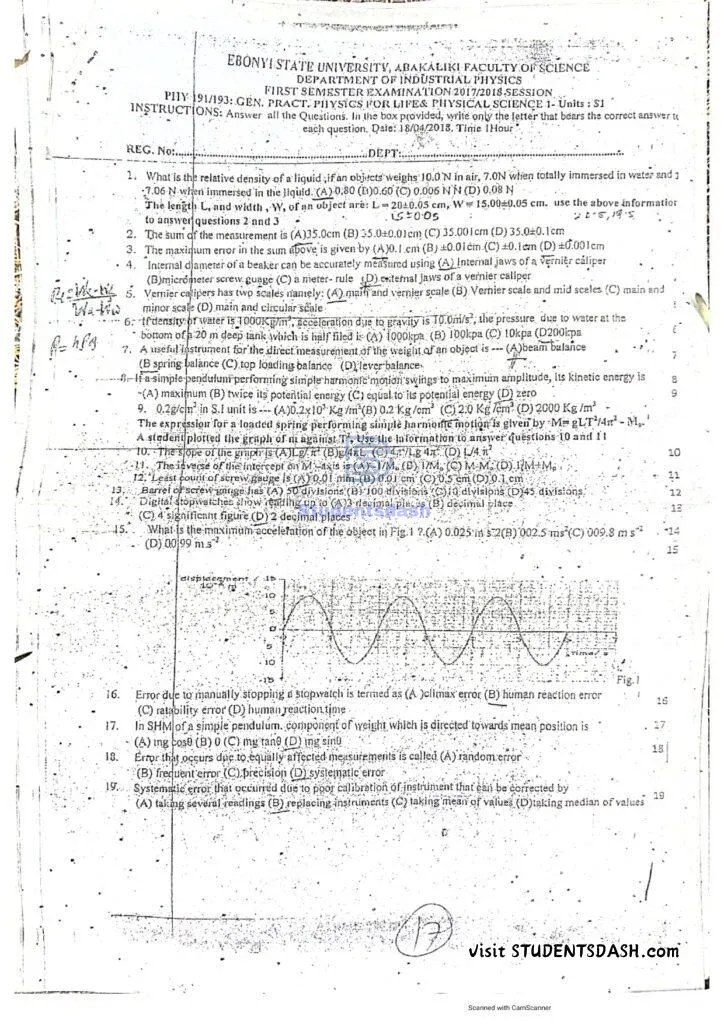
PHY 191/193 — 2017/2018 Session
1. What is the relative density of a liquid if an object weighs 10.0N in air, 7.0N when totally immersed in water and 7.06N when immersed in the liquid:
A. 0.80
B. 0.60
C. 0.006 N
D. 0.08 N
Answer: A
*The length L, and width W of an object are: L = 20±0.05 cm, W = 15.00±0.05 cm. Use the above information to answer questions 2 and 3*
2. The sum of the measurement is:
A. 35.0cm
B. 35.0±0.01cm
C. 35.001cm
D. 35.0±0.1cm
Answer: D
3. The maximum error in the sum above is given by:
A. 0.1cm
B. ±0.01cm
C. ±0.1cm
D. ±0.001cm
Answer: C
4. Internal diameter of a beaker can be accurately measured using:
A. Internal jaws of a Vernier caliper
B. Micrometer screw gauge
C. A meter-rule
D. External jaws of a vernier caliper
Answer: A
5. Vernier callipers has two scales namely:
A. Main and vernier scale
B. Vernier scale and mid scales
C. Main and minor scale
D. Main and circular scale
Answer: A
6. If density of water is 1000Kg/m³, acceleration due to gravity is 10.0m/s², the pressure due to water at the bottom of a 20m deep tank which is half filled is:
A. 1000kpa
B. 100kpa
C. 10kpa
D. 200kpa
Answer: C
7. A useful instrument for the direct measurement of the weight of an object is:
A. Beam balance
B. Spring balance
C. Top loading balance
D. Lever balance
Answer: B
8. If a simple pendulum performing simple harmonic motion swings to maximum amplitude, its kinetic energy is:
A. Maximum
B. Twice its potential energy
C. Equal to its potential energy
D. Zero
Answer: D
9. 0.2g/cm³ in S.I unit is:
A. 0.2x10³ Kg/m³
B. 0.2 Kg/cm³
C. 2.0 Kg/cm³
D. 2000 Kg/m³
Answer: D
*A student plotted the graph of m against T². Use the information to answer questions 10 and 11*
10. The slope of the graph is:
A. Lg/π²
B. g/4πL
C. 4π/Lg 4π²
D. L/4π²
Answer: D
11. The inverse of the intercept on M-axis is:
A. -1/M₀
B. 1/M₀
C. M-M₀
D. 1/M+M₀
Answer: B
12. Least count of screw gauge is:
A. 0.01mm
B. 0.01cm
C. 0.5cm
D. 0.1cm
Answer: A
13. Barrel of screw gauge has:
A. 50 divisions
B. 100 divisions
C. 10 divisions
D. 45 divisions
Answer: B
14. Digital stopwatches show reading up to:
A. 3 decimal places
B. Decimal place
C. 4 significant figure
D. 2 decimal places
Answer: D
15. What is the maximum acceleration of the object in Fig. 1?
A. 0.025 ms⁻²
B. 002.5 ms⁻²
C. 009.8 ms⁻²
D. 00.99 ms⁻²
Answer: B
16. Error due to manually stopping a stopwatch is termed as:
A. Climax error
B. Human reaction error
C. Rateability error
D. Human reaction time
Answer: B
17. In SHM of a simple pendulum, component of weight which is directed towards mean position is:
A. mg cosθ
B. 0
C. mg tanθ
D. mg sinθ
Answer: D
18. Error that occurs due to equally affected measurements is called:
A. Random error
B. Frequent error
C. Precision
D. Systematic error
Answer: D
19. Systematic error that occurred due to poor calibration of instrument that can be corrected by:
A. Taking several readings
B. Replacing instruments
C. Taking mean of values
D. Taking median of values
Answer: B
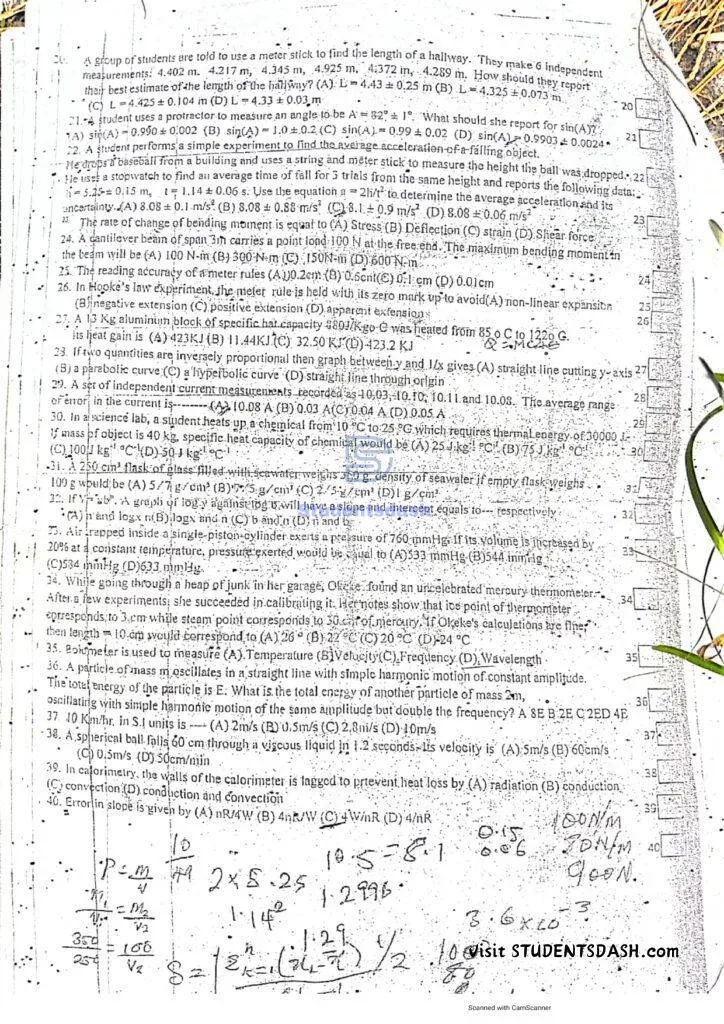
20. A group of students are told to use a meter stick to find the length of a hallway. They make 6 independent measurements: 4.402 m, 4.217 m, 4.345 m, 4.925 m, 4.372 m, 4.289 m. How should they report their best estimate of the length of the hallway?
A. L = 4.43 ± 0.25 m
B. L = 4.325 ± 0.073 m
C. L = 4.425 ± 0.104 m
D. L = 4.33 ± 0.03 m
Answer: C
21. A student uses a protractor to measure an angle to be A = 82° ± 1°. What should she report for sin(A)?
A. sin(A) = 0.990 ± 0.002
B. sin(A) = 1.0 ± 0.2
C. sin(A) = 0.99 ± 0.02
D. sin(A) = 0.9903 ± 0.0024
Answer: D
22. A student performs a simple experiment to find the average acceleration of a falling object. He drops a baseball from a building and uses a string and meter stick to measure the height the ball was dropped. He used a stopwatch to find an average time of fall for 3 trials from the same height: t = 5.25 ± 0.15 m, t = 1.14 ± 0.06 s. Use the equation a = 2h/t² to determine the average acceleration and its uncertainty:
A. 8.08 ± 0.1 m/s²
B. 8.08 ± 0.88 m/s²
C. 8.1 ± 0.9 m/s²
D. 8.08 ± 0.06 m/s²
Answer: B
23. The rate of change of bending moment is equal to:
A. Stress
B. Deflection
C. Strain
D. Shear force
Answer: D
24. A cantilever beam of span 3m carries a point load 100N at the free end. The maximum bending moment in the beam will be:
A. 100 N-m
B. 300 N-m
C. 150 N-m
D. 600 N-m
Answer: B
25. The reading accuracy of a meter rule is:
A. 0.2cm
B. 0.5cm
C. 0.1cm
D. 0.01cm
Answer: D
26. In Hooke's law experiment, the meter rule is held with its zero mark up to avoid:
A. Non-linear expansion
B. Negative extension
C. Positive extension
D. Apparent extension
Answer: A
27. A 13 Kg aluminium block of specific heat capacity 480J/Kg°C was heated from 85°C to 122°C. Its heat gain is:
A. 423KJ
B. 11.44KJ
C. 32.50KJ
D. 423.2KJ
Answer: A
28. If two quantities are inversely proportional then graph between y and 1/x gives:
A. Straight line cutting y-axis
B. A parabolic curve
C. A hyperbolic curve
D. Straight line through origin
Answer: D
29. A set of independent current measurements recorded as 10.03, 10.10, 10.11 and 10.08. The average range of error in the current is:
A. 10.08 A
B. 0.03 A
C. 0.04 A
D. 0.05 A
Answer: C
30. In a science lab, a student heats up a chemical from 10°C to 25°C which requires thermal energy of 30000J. If mass of object is 40kg, specific heat capacity of chemical would be:
A. 25 J·kg⁻¹·°C⁻¹
B. 75 J·kg⁻¹·°C⁻¹
C. 100 J·kg⁻¹·°C⁻¹
D. 50 J·kg⁻¹·°C⁻¹
Answer: D
31. A 250cm³ flask of glass filled with seawater weighs 350g. Density of seawater if empty flask weighs 100g would be:
A. 5/7 g/cm³
B. 5/3 g/cm³
C. 5/g cm³
D. 1 g/cm³
Answer: A
32. If Y = log b, A graph of log y against log b will have a slope and intercept equals to respectively:
A. n and logx n
B. logx n and n
C. b and n
D. n and b
Answer: A
33. Air trapped inside a single-piston-cylinder exerts a pressure of 760 mmHg. If its volume is increased by 20% at constant temperature, pressure exerted would be equal to:
A. 533 mmHg
B. 544 mmHg
C. 534 mmHg
D. 633 mmHg
Answer: A
34. A mercury thermometer was calibrated: ice point corresponds to 3cm while steam point corresponds to 30cm of mercury. If length = 10cm, the temperature corresponds to:
A. 26°C
B. 22°C
C. 20°C
D. 24°C
Answer: D
35. Bolometer is used to measure:
A. Temperature
B. Velocity
C. Frequency
D. Wavelength
Answer: D
36. A particle of mass m oscillates in a straight line with SHM of constant amplitude. The total energy of the particle is E. What is the total energy of another particle of mass 2m, oscillating with SHM of the same amplitude but double the frequency?
A. 8E
B. 2E
C. 2ED
D. 4E
Answer: A
37. 10 Km/hr in S.I units is:
A. 2m/s
B. 0.5m/s
C. 2.8m/s
D. 10m/s
Answer: C
38. A spherical ball falls 60cm through a viscous liquid in 1.2 seconds. Its velocity is:
A. 5m/s
B. 60cm/s
C. 0.5m/s
D. 50cm/min
Answer: C
39. In calorimetry, the walls of the calorimeter is lagged to prevent heat loss by:
A. Radiation
B. Conduction
C. Convection
D. Conduction and convection
Answer: A
40. Error in slope is given by:
A. nR/4W
B. 4nR/W
C. 4W/nR
D. 4/nR
Answer: C
MORE QUESTIONS
1. Which of the following is a fundamental unit in the SI system?
A. Newton
B. Joule
C. Kilogram
D. Watt
Answer: C
2. The dimensional formula for pressure is:
A. MLT⁻²
B. ML⁻¹T⁻²
C. ML²T⁻²
D. MLT⁻¹
Answer: B
3. Which instrument has the least count of 0.001cm?
A. Metre rule
B. Vernier calliper
C. Micrometer screw gauge
D. Measuring tape
Answer: C
4. The number of significant figures in 0.00340 is:
A. 5
B. 2
C. 3
D. 6
Answer: C
5. Convert 72 km/h to m/s:
A. 10 m/s
B. 20 m/s
C. 25 m/s
D. 30 m/s
Answer: B
6. The SI unit of luminous intensity is:
A. Lumen
B. Candela
C. Lux
D. Watt
Answer: B
7. Which of the following has the dimension of energy?
A. Force × velocity
B. Force × distance
C. Force × acceleration
D. Force × time
Answer: B
8. 1 nanometre is equal to:
A. 10⁻⁶ m
B. 10⁻⁹ m
C. 10⁻¹² m
D. 10⁻³ m
Answer: B
9. The uncertainty in a measurement of 25.6 ± 0.5 cm expressed as a percentage is approximately:
A. 1.56%
B. 1.95%
C. 2.50%
D. 0.50%
Answer: B
10. Which of the following is a derived unit?
A. Ampere
B. Kelvin
C. Pascal
D. Mole
Answer: C
11. The difference between the measured value and the true value of a quantity is called:
A. Relative error
B. Absolute error
C. Percentage error
D. Standard deviation
Answer: B
12. When two quantities X and Y are multiplied, the percentage error in the product is:
A. The product of individual percentage errors
B. The difference of individual percentage errors
C. The sum of individual percentage errors
D. The ratio of individual percentage errors
Answer: C
13. A student records the following values: 2.5, 2.7, 2.4, 2.6 cm. The mean value is:
A. 2.4 cm
B. 2.5 cm
C. 2.6 cm
D. 2.55 cm
Answer: D
14. Random errors can be reduced by:
A. Using a better instrument
B. Taking repeated readings and averaging
C. Replacing the instrument
D. Calibrating the instrument
Answer: B
15. The error that results from an instrument not being zeroed properly is:
A. Random error
B. Human error
C. Systematic error
D. Gross error
Answer: C
16. If A = 5.0 ± 0.1 cm and B = 3.0 ± 0.1 cm, the value of A − B with error is:
A. 2.0 ± 0.0 cm
B. 2.0 ± 0.2 cm
C. 2.0 ± 0.1 cm
D. 2.0 ± 0.01 cm
Answer: B
17. The precision of an instrument refers to:
A. How close a measurement is to the true value
B. How reproducible repeated measurements are
C. The smallest reading the instrument can measure
D. The range of the instrument
Answer: B
18. A micrometer reads 2.35mm when measuring a wire three times. This suggests the readings are:
A. Accurate but not precise
B. Precise but not necessarily accurate
C. Neither accurate nor precise
D. Both accurate and precise
Answer: B
19. If Z = X/Y, the fractional error in Z is:
A. ΔX/X − ΔY/Y
B. ΔX/X × ΔY/Y
C. ΔX/X + ΔY/Y
D. ΔX × ΔY
Answer: C
20. The reading error of a metre rule is typically:
A. ± 0.5 mm
B. ± 0.01 mm
C. ± 0.001 mm
D. ± 5 mm
Answer: A
21. The slope of a graph of velocity against time represents:
A. Displacement
B. Speed
C. Acceleration
D. Distance
Answer: C
22. A straight line graph passes through the origin. This means:
A. The two variables are inversely proportional
B. The two variables are directly proportional
C. The intercept is maximum
D. The slope is zero
Answer: B
23. On a graph of y = 3x + 5, the y-intercept is:
A. 3
B. 0
C. 5
D. −5
Answer: C
24. The area under a velocity-time graph represents:
A. Acceleration
B. Displacement
C. Force
D. Power
Answer: B
25. If a graph of 1/v against 1/u gives a straight line, the relationship between u and v is:
A. Linear
B. Quadratic
C. Reciprocal/linear
D. Exponential
Answer: C
26. In a linear graph y = mx + c, if c = 0 and m is negative, the graph:
A. Passes through origin with positive slope
B. Passes through origin with negative slope
C. Has a positive intercept
D. Has a negative slope and positive intercept
Answer: B
27. Which of the following best describes a graph with a hyperbolic shape?
A. y is directly proportional to x
B. y is directly proportional to x²
C. y is inversely proportional to x
D. y is independent of x
Answer: C
28. A graph of T² against L for a simple pendulum gives a straight line whose slope equals:
A. g/4π²
B. 4π²/g
C. 2π/g
D. g/2π
Answer: B
29. The intercept on the y-axis of the graph y = 5x − 3 is:
A. 5
B. 3
C. −3
D. −5
Answer: C
30. In error analysis, the best-fit line on a graph is drawn to:
A. Connect all data points
B. Pass through the origin always
C. Minimize overall deviation from data points
D. Maximize the slope
Answer: C
31. The period of a simple pendulum depends on:
A. Mass of the bob
B. Amplitude of oscillation
C. Length of the pendulum
D. Material of the bob
Answer: C
32. The acceleration of a body undergoing SHM is:
A. Proportional to displacement and in same direction
B. Proportional to displacement and in opposite direction
C. Constant throughout the motion
D. Zero at maximum displacement
Answer: B
33. At the equilibrium position of a body in SHM, the:
A. Potential energy is maximum
B. Kinetic energy is zero
C. Velocity is maximum
D. Acceleration is maximum
Answer: C
34. The period of a mass-spring system is given by:
A. T = 2π√(k/m)
B. T = 2π√(m/k)
C. T = 2π√(g/L)
D. T = 2π√(L/g)
Answer: B
35. For a simple pendulum of length 1m, taking g = 10m/s², the period is approximately:
A. 3.14 s
B. 6.28 s
C. 1.99 s
D. 0.50 s
Answer: C
36. The total mechanical energy of a body in SHM is:
A. Zero
B. Constant
C. Maximum at equilibrium
D. Minimum at equilibrium
Answer: B
37. At maximum displacement in SHM:
A. Kinetic energy is maximum
B. Potential energy is zero
C. Potential energy is maximum
D. Velocity is maximum
Answer: C
38. The frequency of SHM is defined as:
A. Number of oscillations per minute
B. Time for one complete oscillation
C. Number of complete oscillations per second
D. Distance covered per second
Answer: C
39. A spring of force constant 200 N/m has a 0.5 kg mass attached. Its angular frequency is:
A. 10 rad/s
B. 20 rad/s
C. 40 rad/s
D. 400 rad/s
Answer: B
40. The restoring force in SHM is:
A. F = ma
B. F = −kx
C. F = kx²
D. F = mg
Answer: B
41. The specific latent heat of vaporization is the heat required to:
A. Raise the temperature of 1kg of substance by 1°C
B. Change 1kg of liquid to gas at constant temperature
C. Change 1kg of solid to liquid at constant temperature
D. Lower the temperature of 1kg of substance by 1°C
Answer: B
42. Which law of thermodynamics states that heat cannot spontaneously flow from a cold body to a hot body?
A. Zeroth law
B. First law
C. Second law
D. Third law
Answer: C
43. The amount of heat required to raise the temperature of 2kg of water by 5°C (specific heat capacity of water = 4200 J/kg°C) is:
A. 42000 J
B. 21000 J
C. 8400 J
D. 4200 J
Answer: A
44. Which mode of heat transfer does not require a medium?
A. Conduction
B. Convection
C. Radiation
D. Advection
Answer: C
45. A good absorber of heat radiation is also:
A. A poor emitter
B. A good emitter
C. A poor reflector only
D. Neither emitter nor reflector
Answer: B
46. The relationship between Celsius and Kelvin temperature scale is:
A. K = °C − 273
B. K = °C × 273
C. K = °C + 273
D. K = °C / 273
Answer: C
47. In an ideal gas, when temperature is constant, pressure is:
A. Directly proportional to volume
B. Inversely proportional to volume
C. Independent of volume
D. Equal to volume
Answer: B
48. The process in which a gas expands without exchanging heat with the surroundings is called:
A. Isothermal
B. Isobaric
C. Isochoric
D. Adiabatic
Answer: D
49. Which thermometric property is used in a mercury-in-glass thermometer?
A. Change in resistance
B. Change in volume
C. Change in pressure
D. Change in EMF
Answer: B
50. The temperature at which all molecular motion ceases is:
A. 0°C
B. −100°C
C. −273°C
D. 100°C
Answer: C
51. The relative density of a substance is defined as:
A. Mass of substance / Mass of equal volume of water
B. Weight of substance / Weight of equal volume of water
C. Density of substance / Density of water
D. All of the above
Answer: D
52. An object weighs 80N in air and 60N when fully immersed in water. Its relative density is:
A. 2
B. 3
C. 4
D. 6
Answer: C
53. A hydrometer measures:
A. Temperature of a liquid
B. Relative density of a liquid
C. Pressure of a liquid
D. Volume of a liquid
Answer: B
54. If an object sinks in water, its density is:
A. Less than water
B. Equal to water
C. Greater than water
D. Zero
Answer: C
55. The SI unit of density is:
A. g/cm³
B. kg/m²
C. kg/m³
D. g/m³
Answer: C
56. An object has a mass of 500g and volume of 250cm³. Its density is:
A. 0.5 g/cm³
B. 1.0 g/cm³
C. 2.0 g/cm³
D. 4.0 g/cm³
Answer: C
57. The upthrust on an object immersed in a fluid is equal to:
A. Weight of the object
B. Mass of fluid displaced
C. Weight of fluid displaced
D. Volume of the object
Answer: C
58. An object floats when:
A. Its density equals that of the fluid
B. Its weight equals the upthrust
C. Both A and B
D. Its volume is large
Answer: C
59. The relative density of iron is 7.8. Its density in kg/m³ is:
A. 780 kg/m³
B. 7800 kg/m³
C. 78 kg/m³
D. 78000 kg/m³
Answer: B
60. A liquid has a density of 800 kg/m³. Its relative density is:
A. 0.08
B. 0.8
C. 8.0
D. 80
Answer: B
61. Pressure is defined as:
A. Force multiplied by area
B. Force divided by area
C. Area divided by force
D. Mass divided by volume
Answer: B
62. The SI unit of pressure is:
A. Newton
B. Pascal
C. Joule
D. Bar
Answer: B
63. The pressure at the bottom of a liquid column is given by:
A. P = ρg
B. P = ρgh
C. P = mgh
D. P = mg/h
Answer: B
64. Standard atmospheric pressure in Pascals is approximately:
A. 1.01 × 10³ Pa
B. 1.01 × 10⁵ Pa
C. 1.01 × 10⁴ Pa
D. 1.01 × 10⁶ Pa
Answer: B
65. A barometer is used to measure:
A. Liquid pressure
B. Atmospheric pressure
C. Gas pressure in a container
D. Blood pressure
Answer: B
66. According to Pascal's principle, pressure applied to an enclosed fluid:
A. Decreases throughout the fluid
B. Is transmitted unequally
C. Is transmitted equally in all directions
D. Acts only downward
Answer: C
67. A hydraulic press has pistons of area 2cm² and 100cm². If a force of 10N is applied to the smaller piston, the force on the larger piston is:
A. 50 N
B. 200 N
C. 500 N
D. 1000 N
Answer: C
68. The instrument used to measure gas pressure in a container is:
A. Barometer
B. Hydrometer
C. Manometer
D. Thermometer
Answer: C
69. Atmospheric pressure can support a column of water of height approximately:
A. 0.76 m
B. 7.6 m
C. 10.3 m
D. 76 m
Answer: C
70. Which of the following increases pressure in a liquid?
A. Decreasing depth
B. Decreasing density of liquid
C. Increasing depth
D. Decreasing gravity
Answer: C
71. The distance between two successive crests of a wave is called:
A. Amplitude
B. Frequency
C. Wavelength
D. Period
Answer: C
72. The speed of a wave is related to frequency and wavelength by:
A. v = f/λ
B. v = λ/f
C. v = fλ
D. v = f + λ
Answer: C
73. Transverse waves can be:
A. Polarized
B. Refracted only
C. Diffracted only
D. Reflected only
Answer: A
74. Sound waves are:
A. Transverse waves
B. Electromagnetic waves
C. Longitudinal waves
D. Surface waves
Answer: C
75. The phenomenon by which waves bend around obstacles is called:
A. Reflection
B. Refraction
C. Diffraction
D. Interference
Answer: C
76. When a wave moves from a less dense to a more dense medium, it:
A. Speeds up
B. Slows down
C. Maintains the same speed
D. Disappears
Answer: B
77. The refractive index of a medium is defined as:
A. Speed of light in medium / Speed of light in vacuum
B. Speed of light in vacuum / Speed of light in medium
C. Wavelength in vacuum / Wavelength in medium
D. Both B and C
Answer: D
78. The critical angle is the angle of incidence at which the angle of refraction is:
A. 0°
B. 45°
C. 90°
D. 180°
Answer: C
79. Which of the following colours has the highest frequency?
A. Red
B. Yellow
C. Green
D. Violet
Answer: D
80. The speed of light in vacuum is approximately:
A. 3 × 10⁶ m/s
B. 3 × 10⁸ m/s
C. 3 × 10¹⁰ m/s
D. 3 × 10⁴ m/s
Answer: B
81. Ohm's law states that:
A. V = IR²
B. V = I/R
C. V = IR
D. R = VI
Answer: C
82. The SI unit of electrical resistance is:
A. Volt
B. Ampere
C. Ohm
D. Watt
Answer: C
83. Three resistors of 2Ω, 3Ω and 6Ω are connected in parallel. The equivalent resistance is:
A. 11 Ω
B. 1 Ω
C. 6 Ω
D. 3 Ω
Answer: B
84. The power dissipated in a resistor is given by:
A. P = V²R
B. P = I²R
C. P = IR²
D. P = V/IR
Answer: B
85. The instrument used to measure electric current is:
A. Voltmeter
B. Galvanometer
C. Ammeter
D. Ohmmeter
Answer: C
86. A voltmeter is connected in a circuit:
A. In series
B. In parallel
C. In series-parallel
D. At right angles
Answer: B
87. Kirchhoff's current law states that:
A. The sum of EMFs in a loop equals zero
B. The algebraic sum of currents at a junction is zero
C. Current is proportional to voltage
D. Resistance increases with temperature
Answer: B
88. The unit of capacitance is:
A. Henry
B. Farad
C. Ohm
D. Coulomb
Answer: B
89. Which of the following materials is a good conductor of electricity?
A. Glass
B. Rubber
C. Copper
D. Plastic
Answer: C
90. The electromotive force (EMF) of a source is the energy supplied per:
A. Unit time
B. Unit charge
C. Unit resistance
D. Unit current
Answer: B
91. Newton's first law of motion is also known as the law of:
A. Acceleration
B. Action and reaction
C. Inertia
D. Gravitation
Answer: C
92. The impulse of a force is equal to:
A. Change in kinetic energy
B. Change in momentum
C. Force × distance
D. Mass × acceleration
Answer: B
93. A body of mass 5kg is accelerated at 4m/s². The net force acting on it is:
A. 1.25 N
B. 9 N
C. 20 N
D. 40 N
Answer: C
94. The law of conservation of momentum states that:
A. Momentum is always zero
B. Total momentum of a system remains constant in the absence of external forces
C. Momentum equals kinetic energy
D. Momentum increases with velocity
Answer: B
95. A car of mass 1000kg moving at 20m/s has a kinetic energy of:
A. 10,000 J
B. 100,000 J
C. 200,000 J
D. 400,000 J
Answer: C
96. The work done by a force of 50N acting over a distance of 10m at an angle of 60° to the direction of motion is:
A. 500 J
B. 433 J
C. 250 J
D. 866 J
Answer: C
97. The gravitational potential energy of a body of mass m at height h is:
A. mgh²
B. mh
C. mgh
D. mg/h
Answer: C
98. When a body is thrown vertically upward, at maximum height its velocity is:
A. Maximum
B. Equal to initial velocity
C. Zero
D. Equal to g
Answer: C
99. The escape velocity from the Earth's surface is approximately:
A. 7.9 km/s
B. 11.2 km/s
C. 3.0 km/s
D. 9.8 km/s
Answer: B
100. A projectile is launched horizontally. The horizontal component of its velocity:
A. Increases with time
B. Decreases with time
C. Remains constant
D. Becomes zero at maximum height
Answer: C



Discussion
No comments yet. Be the first to start the conversation!