
Studentsdash
Past Questions

BIO 107 (BIO 191) Past Questions and Answers

BIO 107 (BIO 191) Past Questions and Answers
By Studentsdash •Sep 2, 2026
Title: BIO 107 (BIO 191) Past Questions and Answers
URL: https://studentsdash.com/bio-107-past-questions-and-answers/
--------------------------------------------------

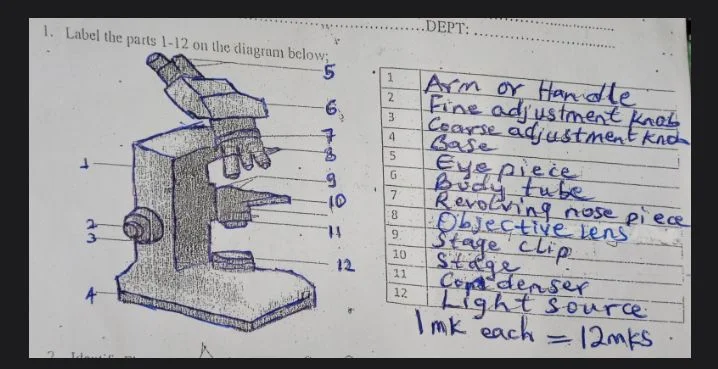
Identify the part labeled “A” in the microscope diagram.
a) Objective lens
b) Eyepiece
c) Stage
d) Base
Answer:
a) Objective lens
What is the function of the diaphragm in a microscope?
a) To magnify the specimen
b) To control the amount of light reaching the specimen
c) To hold the slide in place
d) To focus the image
Answer:
b) To control the amount of light reaching the specimen
In a drawing of a plant cell, which structure is responsible for photosynthesis?
a) Cell wall
b) Chloroplast
c) Mitochondria
d) Nucleus
Answer:
b) Chloroplast
Which part of the ant is primarily responsible for sensing the environment?
a) Antennae
b) Mandibles
c) Abdomen
d) Thorax
Answer:
a) Antennae
When preparing a slide for microscopic examination, what is the purpose of adding a coverslip?
a) To enhance color
b) To protect the objective lens
c) To flatten the specimen and reduce air bubbles
d) To increase magnification
Answer:
c) To flatten the specimen and reduce air bubbles
Identify the structure labeled “B” in the ant anatomy diagram.
a) Head
b) Abdomen
c) Thorax
d) Legs
Answer:
c) Thorax
Which of the following is a key characteristic of eukaryotic cells when observed under a microscope?
a) Lack of nucleus
b) Presence of membrane-bound organelles
c) Smaller size than prokaryotic cells
d) Unicellular only
Answer:
b) Presence of membrane-bound organelles
What staining technique is often used to visualize cell structures under a microscope?
a) Heat fixing
b) Gram staining
c) Iodine staining
d) Simple staining
Answer:
c) Iodine staining
Identify the type of symmetry exhibited by an ant.
a) Radial symmetry
b) Bilateral symmetry
c) Asymmetry
d) Spherical symmetry
Answer:
b) Bilateral symmetry
What is the role of the ocular lens in a microscope?
a) To focus the image
b) To magnify the image for viewing
c) To illuminate the specimen
d) To adjust light intensity
Answer:
b) To magnify the image for viewing
When observing a slide under a microscope, what is the correct procedure for focusing?
a) Start with the lowest power objective lens
b) Use coarse focus on high power
c) Adjust the diaphragm before focusing
d) Only use fine focus at all times
Answer:
a) Start with the lowest power objective lens
Identify the main function of the mandibles in an ant.
a) Sensory perception
b) Locomotion
c) Feeding
d) Reproduction
Answer:
c) Feeding
What feature distinguishes a compound microscope from a simple microscope?
a) Number of lenses
b) Size of the specimen
c) Source of illumination
d) Type of specimen
Answer:
a) Number of lenses
In the drawing of a cell, what does the cell membrane do?
a) Provides energy
b) Protects the cell and regulates transport
c) Synthesizes proteins
d) Stores genetic material
Answer:
b) Protects the cell and regulates transport
What is the magnification if you are using a 10x eyepiece and a 40x objective lens?
a) 100x
b) 400x
c) 50x
d) 10x
Answer:
b) 400x
Which part of a microscope should be adjusted to bring the specimen into sharp focus?
a) Coarse focus knob
b) Fine focus knob
c) Diaphragm
d) Revolving nosepiece
Answer:
b) Fine focus knob
What is the primary purpose of a wet mount slide?
a) To observe dry specimens
b) To provide a clear view of living organisms
c) To stain specimens
d) To enhance colors
Answer:
b) To provide a clear view of living organisms
Identify the organelle that is responsible for ATP production.
a) Nucleus
b) Mitochondria
c) Ribosome
d) Golgi apparatus
Answer:
b) Mitochondria
What type of organism is an ant classified as?
a) Vertebrate
b) Invertebrate
c) Fungi
d) Plant
Answer:
b) Invertebrate
In a microscope setup, what does the term “field of view” refer to?
a) The size of the specimen
b) The area visible through the eyepiece
c) The total magnification
d) The type of objective used
Answer:
b) The area visible through the eyepiece
Which part of the microscope is used to adjust the light intensity?
a) Stage
b) Diaphragm
c) Objective lens
d) Ocular lens
Answer:
b) Diaphragm
What structure in the plant cell is responsible for providing support?
a) Chloroplast
b) Cell membrane
c) Cell wall
d) Cytoplasm
Answer:
c) Cell wall
Which type of cell division occurs in the formation of gametes?
a) Mitosis
b) Meiosis
c) Binary fission
d) Budding
Answer:
b) Meiosis
What is the function of the flagella in some microorganisms?
a) To capture food
b) To help in movement
c) To perform photosynthesis
d) To store nutrients
Answer:
b) To help in movement
Identify the primary component of the ant’s exoskeleton.
a) Chitin
b) Keratin
c) Cellulose
d) Collagen
Answer:
a) Chitin
What is the main purpose of the nucleus in a cell?
a) Energy production
b) Genetic information storage
c) Protein synthesis
d) Photosynthesis
Answer:
b) Genetic information storage
When observing a slide, what should you do if the specimen is out of focus?
a) Adjust the light
b) Change the slide
c) Use the coarse focus knob first, then fine focus
d) Move the stage up
Answer:
c) Use the coarse focus knob first, then fine focus
What is the primary function of ribosomes?
a) Energy production
b) Protein synthesis
c) DNA replication
d) Lipid synthesis
Answer:
b) Protein synthesis
Which of the following is NOT a characteristic of life?
a) Growth
b) Reproduction
c) Ability to move
d) Metabolism
Answer:
c) Ability to move
Identify the process by which cells take in large particles.
a) Endocytosis
b) Exocytosis
c) Osmosis
d) Diffusion
Answer:
a) Endocytosis
What is the purpose of using a cover slip in microscopy?
a) To enhance color
b) To protect the lens
c) To flatten the specimen
d) To absorb excess light
Answer:
c) To flatten the specimen
Which part of the microscope allows you to switch between different magnifications?
a) Stage
b) Revolving nosepiece
c) Diaphragm
d) Coarse focus knob
Answer:
b) Revolving nosepiece
Identify the type of tissue represented by a drawing of a simple squamous epithelium.
a) Muscle tissue
b) Connective tissue
c) Epithelial tissue
d) Nervous tissue
Answer:
c) Epithelial tissue
What structure in the ant helps with locomotion?
a) Antennae
b) Legs
c) Mandibles
d) Abdomen
Answer:
b) Legs
**What is the role of chloroplasts in plant cells?**
a) Respiration
b) Photosynthesis
c) Protein synthesis
d) Cell division
Answer:
b) Photosynthesis
Which of the following structures is found in both prokaryotic and eukaryotic cells?
a) Nucleus
b) Mitochondria
c) Ribosomes
d) Chloroplasts
Answer:
c) Ribosomes
What is the function of the Golgi apparatus in a cell?
a) Energy production
b) Protein modification and packaging
c) DNA replication
d) Photosynthesis
Answer:
b) Protein modification and packaging
Which part of the microscope is used to place the slide?
a) Base
b) Arm
c) Stage
d) Ocular lens
Answer:
c) Stage
In a typical biology lab, what is the purpose of the pipette?
a) To hold slides
b) To mix chemicals
c) To measure and transfer liquids
d) To observe specimens
Answer:
c) To measure and transfer liquids
Identify the main function of the endoplasmic reticulum.
a) Energy production
b) Protein and lipid synthesis
c) Photosynthesis
d) Cell division
Answer:
b) Protein and lipid synthesis
What type of tissue connects and supports other tissues?
a) Epithelial
b) Muscle
c) Nervous
d) Connective
Answer:
d) Connective
What is the purpose of fixing a specimen before staining?
a) To make it more colorful
b) To preserve the structure
c) To increase transparency
d) To prepare it for viewing
Answer:
b) To preserve the structure
Identify the structure that regulates what enters and leaves the cell.
a) Cell wall
b) Cytoplasm
c) Cell membrane
d) Nucleus
Answer:
c) Cell membrane
In an experiment, what does a control group do?
a) Receives the treatment
b) Provides a standard for comparison
c) Is varied to test the hypothesis
d) Is the main focus of the study
Answer:
b) Provides a standard for comparison
What type of microscope uses beams of electrons to magnify specimens?
a) Light microscope
b) Compound microscope
c) Scanning electron microscope
d) Dissecting microscope
Answer:
c) Scanning electron microscope
Identify the structure responsible for detoxifying harmful substances in cells.
a) Ribosome
b) Smooth endoplasmic reticulum
c) Golgi apparatus
d) Lysosome
Answer:
b) Smooth endoplasmic reticulum
What is the primary function of the cell wall in plant cells?
a) Protection and support
b) Energy production
c) Photosynthesis
d) Nutrient storage
Answer:
a) Protection and support
Which of the following is used to identify different types of cells through color changes?
a) Light microscope
b) Staining
c) Electron microscopy
d) Centrifugation
Answer:
b) Staining
Identify the part of the microscope that holds the objective lenses.
a) Stage
b) Revolving nosepiece
c) Base
d) Arm
Answer:
b) Revolving nosepiece
What is the primary role of lysosomes in a cell?
a) Energy production
b) Digestion of waste materials
c) Protein synthesis
d) Photosynthesis
Answer:
b) Digestion of waste materials
Chat Studentsdash: 07075012541
🏛️ Ebonyi State University

More in Past Questions

Past Questions

EBSU-GST 105 Past Questions and Answers

Are you preparing for your GST 105 exam at Ebonyi State University? We’ve got you covered.This PDF contains 266 objective questions from past exams (2022, 2023 & 2024) complete with all options (A–D) and correct answers clearly marked for every single question.Download the PDF below.Join thousands of students already using StudentsDash to study smarter and pass with confidence.Join our WhatsApp channel:WhatsApp us directly: 07075012541

Free
595 PDF
Past Questions

COS 101 Past Questions PDF Download (EBSU) – Updated for 100 Level Students

Get access to verified COS 101 past questions for Ebonyi State University (EBSU) 100 level students. This PDF contains likely exam questions, repeated topics, and CBT-style practice to help you prepare effectively and pass your exams with confidence. Perfect for last-minute revision and deep understanding of key COS 101 topics like computer basics, hardware, software, binary system, and more.

Free
714 PDF

Discussion

No comments yet. Be the first to start the conversation!